Topic 5: Perfect Competition, Imperfectly Competitive Markets and Monopoly
 Call Kai
 Learn
Learn Practice Test
 Spaced Repetition
 Match
Match Flashcards
 Knowt Play
1/37

There's no tags or description
Looks like no tags are added yet.
Name | Mastery | Learn | Test | Matching | Spaced | Call with Kai |
|---|
No analytics yet
Send a link to your students to track their progress
38 Terms
characteristics of perfect competition
many buyers and sellers, price takers (many small firms) - price driven by the market, no barriers to entry and exit , perfect knowledge (buyers and sellers have complete knoweldge on the prices, quality, and available products. So, there's no information gap, and that helps make the market super efficient.), homogeneous products (identical), FRP is actually short for free resource portability perfectly mobile (labor or capital—can move freely between firms or industries. dynamically effeicient) , firms are short run profit maximisers (they just keep producing up to the point where every extra unit is only just covering its cost. Beyond that, they'd lose money, so that's where their profit maxes out)
perfect competition diagram analysis in short run
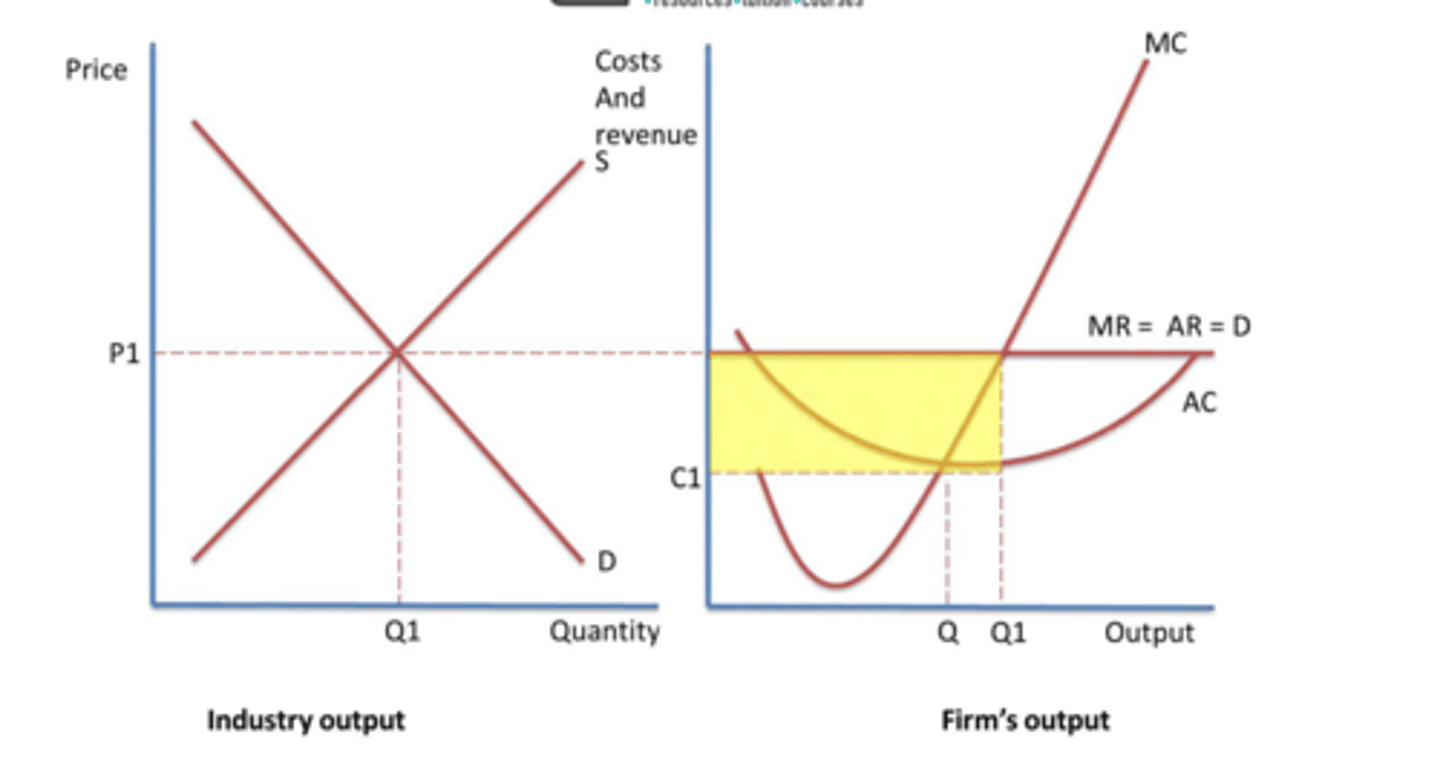
The firm is a price taker, and it accepts the industry price of P1. In the short run, the firm produces an output of Q1. The yellow shaded rectangle shows the area of supernormal profits earned in the short run. It is assumed that firms are short run profit maximisers.
AC - average cost - variable costs are costs that change with the level of output—things like materials or labor per unit. Fixed costs, on the other hand, are constant no matter how much you produce—like rent or equipment.
when you're producing more, those fixed costs spread out, so average cost falls. But after a certain point, you run into diminishing returns—your variable costs rise faster. So, after that low point, average cost starts going back up, creating that U-shape. so diminishing returns basically means that after a certain point, each extra unit of input—like labor or capital—gives you a smaller increase in output. So, at some point, adding more just gets less and less efficient, and that’s why your costs start to rise again
perfect competition diagram analysis long run
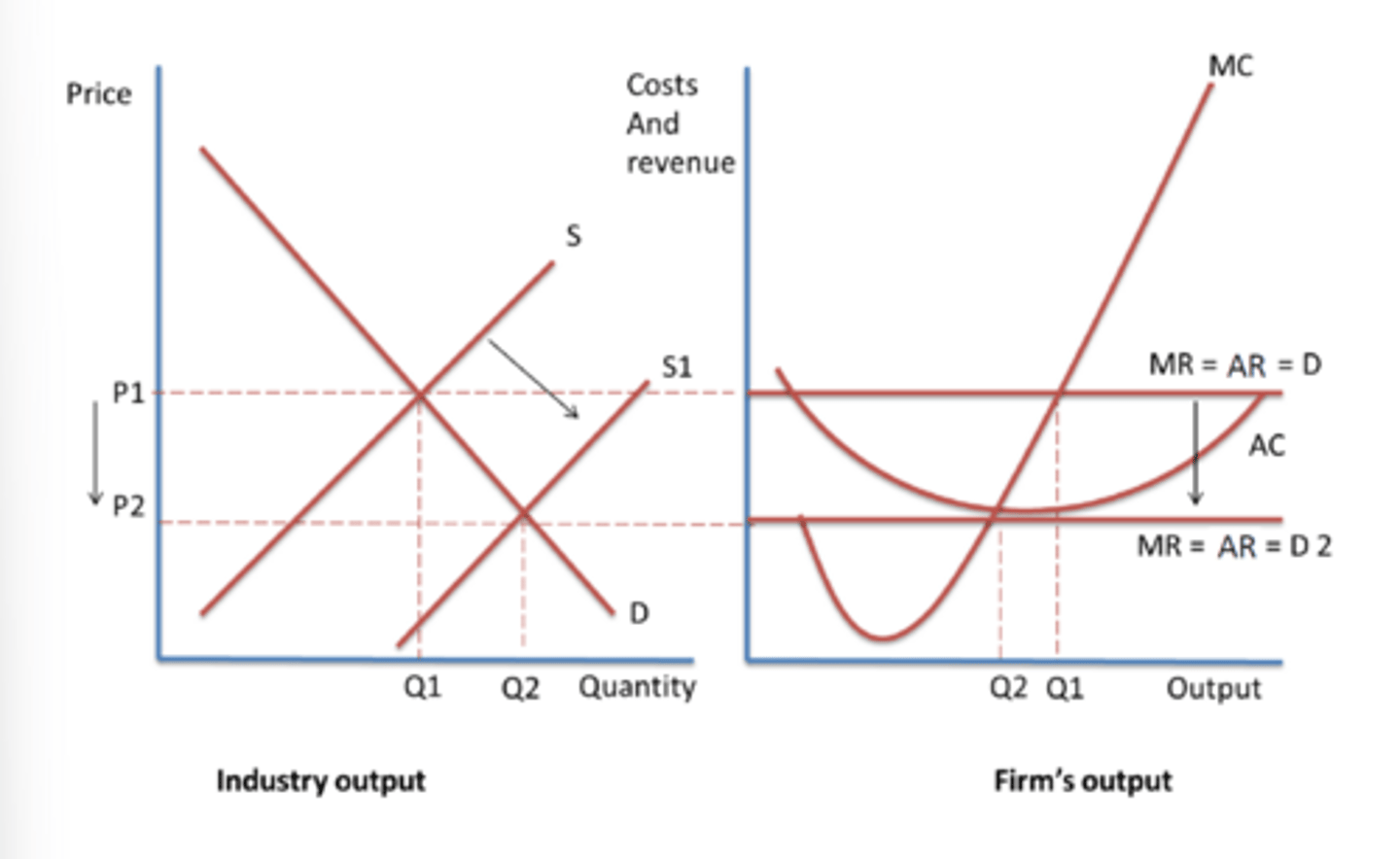
abnormal profits means now firms have higher incentive to join the market. This causes the supply in the market to increase, as shown by the shift in the supply curve from S to S1. The price level in the market falls as a consequence. Since firms are price takers, they must accept this new, lower price. comp pressure in LR so firms only make normal profits (Normal profit in economics is the minimum level of earnings required to keep a firm operating in its current industry, occurring when total revenue equals total costs (\(TR = TC\))
supernormal profit is any profit above a normal level—basically, it’s extra. Normal profit is just the minimum needed to keep a firm in business
Long run - more firms enter due to low barriers to entry - increasing supply - decreasing the price equilibrium till firms make normal profit where MR=MC - firms earn just enough to cover their opportunity cost - firms have not incentive to stay in the LR - so supply decreases - therefore stabalizing the prices.
Opportunity cost - what you give by choosing another product or use of resources, once firms only make normal profit, that means they aren’t missing out on anything better, it’s earning just enough to keep them in the market. But if another market offers a higher return, then they would leave
advantages of perfect competitive market
lower price in LR - minimum possible price, productive efficiency - firms try to produce at the lowest possible cost, therefore using their resources efficiently, dynamic efficiency in SR - supernormal profit give firms the boost to invest in R and D that drive for profit pushes them to innovate, boosting consumer welfare are efficiency.
disadvantages of perfect competition
Economies of Scale are cost advantages that firms experience when they increase production, resulting in a lower average cost per unit as fixed costs are spread across more output.
limited dynamic efficiency in LR, few economies of scale since firms are small, advertising + externalities + product differentiation means not applicable in real life.
firms might not have any incentive to improve product quality since everything’s completely identical.
1. Limited dynamic efficiency in the long run
Firms in Perfect Competition make only normal profit in the long run, so they may have less incentive to invest in research and development. This can reduce innovation and technological progress, leading to weaker dynamic efficiency.
2. Few economies of scale
Because firms are very small, they cannot fully benefit from large-scale production. This means they may miss out on economies of scale, so costs could be higher than in larger firms in other market structures.
3. Lack of product differentiation
Products are identical (homogeneous) in Perfect Competition. This limits consumer choice and brand variety, as firms cannot differentiate their products.
4. Unrealistic assumptions
The model assumes perfect information, no advertising, and no barriers to entry, which rarely exist in real markets. Because of this, Perfect Competition is often considered theoretical and not very applicable to real-world industries.
5. Externalities are ignored
The model does not account for external costs or benefits, meaning socially optimal outcomes may not occur if externalities exist.
characteristics of monopolistic competition
monoposict copotetion is where there is many firms within the market. all with similare but diifrentiated products from there competitiors, so they are not equal substitutes. Therefore they are able to have limited price setting power. There product differentiate with branding, adverticement, atmosphere. There are low barreres to entry. e.g restaurants.
imperfect competition, differentiated products, low barriers to entry and exit, imperfect information, some degree of price setting power
Imperfect competition
There are many firms in the market, but they do not sell identical products, so competition is not perfect.
Product differentiation
Firms sell similar but differentiated products (e.g., branding, quality, packaging). This gives firms some control over price.
Low barriers to entry and exit
It is relatively easy for new firms to enter or leave the market, meaning firms can earn normal profit in the long run.
Imperfect information
Consumers and producers do not have full information, which allows firms to use branding and advertising to influence demand.
Some price-setting power
Because products are differentiated, firms are price makers to a limited extent and face a downward-sloping demand curve.
monopolistic competition analysis short run
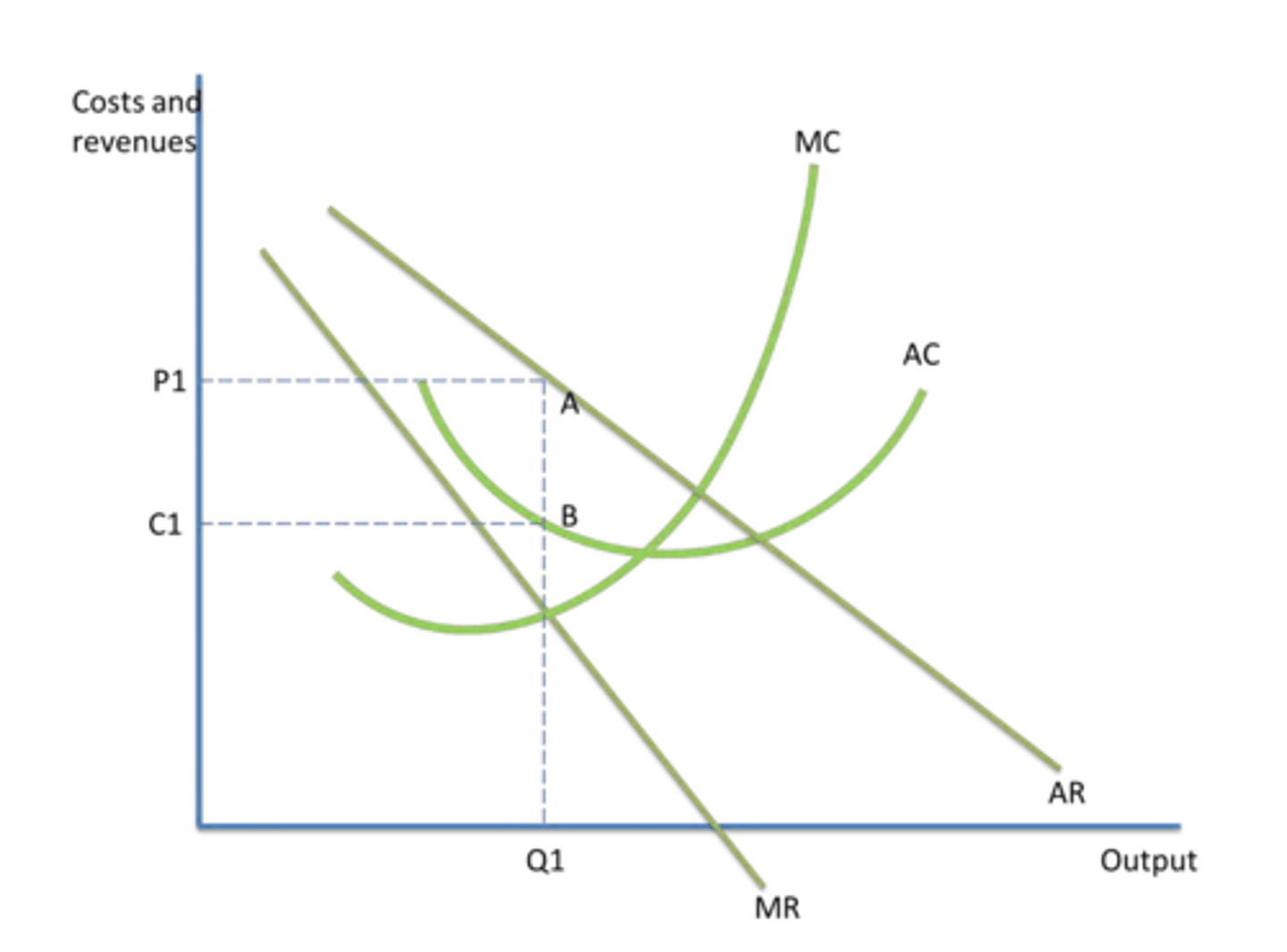
firms profit maximise at MC=MR and they earn abnormal profts
Firms have price setting power, they are price maker till a certain extent, due to their differentiated products, causeing them to have a downwardsloping demand curve. Firms proift maximise untic MC = MR, therefore able to make abnormal (supernormal) profit as long as average revenue is greater than average costs.
monopolistic competition analysis long run
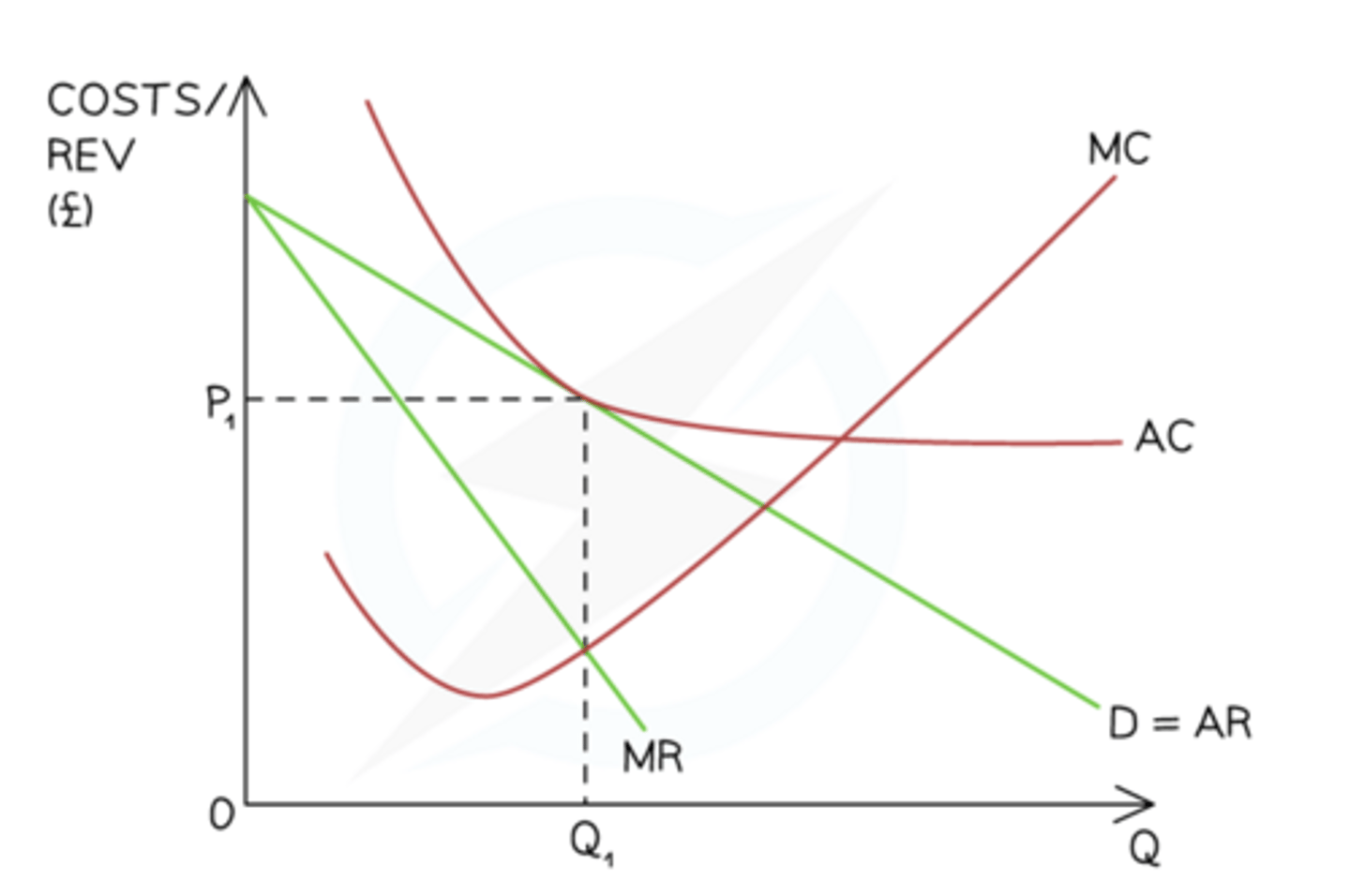
new firms enter the market and are attracted by the profits being made by the existing firms. this makes the demand for the existing firms' products more price elastic which shifts the AR curve to the left. consequently, only normal profits are made in the long run.
due to the low barriers to entry, new firms are attracted by the profit made from existing firms. As more firms try to join, the demand for existinf firms products will become more price elastic and therefor causing AR to the left. cause firms to only make normal profit in the LR where TR=TC
advantages of monopolistic competition
consumers get a wide variety of choice, the model is more realistic than perfect competition, abnormal profits in SR may promote dynamic efficiency
1. Greater consumer choice
Because firms sell differentiated products, consumers benefit from a wide variety of goods and services. Differences in quality, branding, packaging, and design allow consumers to choose products that best suit their preferences.
2. More realistic model than Perfect Competition
Perfect Competition assumes no advertising, perfect information, and homogeneous products, which rarely occur in real markets. Monopolistic Competition is more realistic because firms differentiate products and compete through advertising and branding, which reflects many real-world markets.
3. Potential for innovation and dynamic efficiency in the short run
Firms may earn abnormal (supernormal) profit in the short run. These profits can be reinvested into research and development, innovation, improved technology, branding, and product quality, increasing Dynamic Efficiency and potentially improving consumer welfare.
disadvantages of monopolistic competition
firms make normal profit - lack on dynamic efficiency in LR,
firms may have x-inefficiency since they have little incentive to minimise their costs - as firms face less intense competion compared to perf comp as they have differtiated products allowing them to have price setting power. - reducing the pressure to minimise costs - so they are less productivly efficitnt. - organisational slack and inefficient management.
, allocatively inefficient in SR and LR - Consumers are charged more than the cost of extra output. Some consumers who value the good more than its cost but less than the price are excluded from buying This creates a loss of potential trades, called deadweight loss - Definition: Resources allocated to maximize total welfare
Condition: Price (P) = Marginal Cost (MC) - In Monopolistic Competition, firms have some price-setting power due to product differentiation. As a result, price is greater than marginal cost, meaning Allocative Efficiency is not achieved in both the short run and long run.
productively inefficient since firms do not fully exploit their factors so there is excess capacity - Productively efficient - which goods and services are produced at the lowest possible cost, using all available resources fully and efficiently. Excess capacity = the firm could produce more using the same resources, without increasing average cost. Firms are not producing at the minimum AC point
They stop at MC = MR, which is not the lowest-cost output
characteristics of an oligopoly
high barriers to entry and exit, high concentration ratio, interdependence of firms, product differentiation
Oligoply - Is where there is a small number of large dominant firms in the market that control most of the markets sales, e.g. cars, supermarkets. - high concentration ratio
High barriers to to entry - high start up costs - brand loyalty - economies of scale - makes it hard for new firms to enter.
Interdependance of firms - Firms are likely to consider the reaction of competitors before a change in price or output
Product differentioation - The products are similar but not identical therefore firms rather than competing for just price. they parrticipate in non price competion llike branding, advertisment, quality
overt collusion
when firms explicitly agree to limit competition or raise prices e.g. a cartel. they do this using price fixing, setting output quotas which limit supply, agreements to block new firms from entering the market.
they will explicitly agree to limit competition or raise prices. - PRICE FIXING - firms agree on setting the same or higher prices to avoid price competion.
- output qotas - firms will agree on limiting the supply of the product to keep prices high.
- high barriers to entry - firms will agree to discourage or block new firms from enetering the market.
Cartel - Informsal or forma agreement between firms to COLLUDE
consequences of overt collusion
higher prices for consumers, less output in the market, poor quality products, less investment in innovation
tacit collusion
when firms avoid formal agreements but closely monitor each other's behaviour e.g. use of price leadership. firms monitor the price of the price leaders product and then adjust theirs to match
distinction between non-collusive and collusive oligopolies
collusive behaviour occurs when firms cooperate to fix prices and restrict output, the incentive to collude in oligopolies in high. non-collusive behaviour occurs when firms actively compete to maintain/increase market share e.g. price wars.
the kinked demand curve analysis
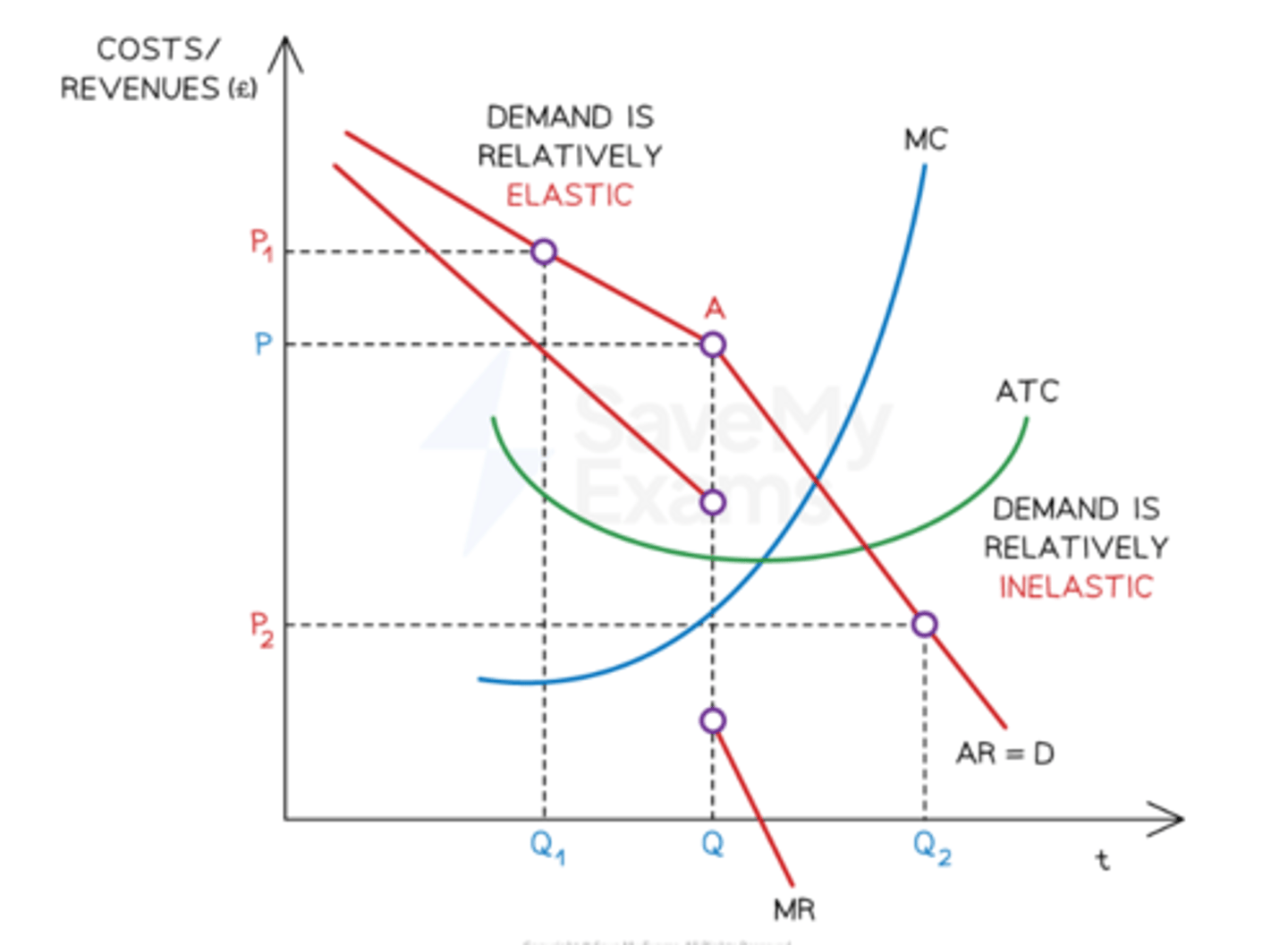
if a firm increases its price above p it is unlikely that rival firms will follow the price increase so the demand curve above p is price elastic.if a firm decreases its price below p it is likely that rival firms will follow so the demand curve below p is price inelastic, meaning total revenue and profit declines for all firms. the change in elasticities created price rigidity at the price level p as firms tend not to change price due to anticipated behaviour of competitors (mutual interdependence), so firms focus on non-price competition.
Kinked demand curve (clear explanation)
The kinked demand curve is a model used to explain why prices in an Oligopoly tend to be stable (rigid).
It is based on the idea of interdependence — firms react to what rivals do.
1. If a firm raises price above P
Rival firms do NOT follow the price increase
So customers switch to cheaper competitors
This means demand for the firm’s product is very responsive (price elastic) above P
Result: the firm loses a lot of sales, so raising price is not profitable
2. If a firm lowers price below P
Rival firms match the price cut
So the firm does NOT gain many extra customers
This means demand is less responsive (price inelastic) below P
Result: firms lose revenue and profit because all firms earn less per unit
3. Why this creates price rigidity
Because:
raising price → lose customers
lowering price → rivals follow → no gain
Firms have no incentive to change price, so price tends to stay at P.
This creates price rigidity in the market.
4. Key outcome: non-price competition
Since firms avoid changing price, they compete using:
advertising
branding
product quality
customer service
This is called non-price competition.
a cartel
a group of two or more firms which have agreed to control prices, limit output or prevent the entrance of new firms into the market e.g. OPEC which fixed their output of oil
informal or formal agreement between firms to collude within the market
price leadership
when one firm changes their prices and other firms follow. this firm is usually the dominant firm in the market. this explains why there is price stability in oligopolies, other firms risk losing their market share if they don't follow the price change.
price wars
a type of price competition, which involves firms constantly cutting their prices below that of its competitors, their competitors then lower their prices to match this e.g. the UK supermarket industry.
non-price competition
aims to increase the loyalty to a brand, which makes demand for a good more price inelastic
game theory
Game theory is a method used in Oligopoly to analyse how firms make decisions when outcomes depend on the actions of rival firms and there is incomplete information..
Game theory is a way of analysing strategic behaviour between firms, where each firm’s decision depends on what it expects its rivals to do.
advantages of an oligopoly
significant abnormal profits can yield positive externalities and promote dynamic efficiency, higher profits could be a source of government revenue, industry standards could improve because firms can collaborate on technology and improve it, firms can exploit economies of scale.
1. Dynamic efficiency and innovation
Firms in an oligopoly can earn significant abnormal (supernormal) profits. These profits can be reinvested into research and development, new technology, and innovation, increasing Dynamic Efficiency and improving products over time.
2. Economies of scale
Large firms can produce at a high level of output and benefit from Economies of Scale, reducing average costs. This can make production more efficient and potentially lower prices for consumers.
3. Higher government revenue
Because oligopolies often generate high profits, governments may collect more corporation tax, which can be used to fund public services.
4. Potential technological collaboration
Large firms may collaborate on industry standards, technology, or research, improving efficiency and technological progress across the industry.
disadvantages of an oligopoly
Productive Efficiency occurs when a firm produces goods or services at the lowest possible cost using its resources.
misallocation of resources compared to the outcome in a competitive market, if firms collude there is a loss of consumer welfare, collusion could reinforce monopoly power and the absence of competition could restrict efficiency.
Disadvantages of Oligopoly
1. Misallocation of resources
Compared with more competitive markets such as Perfect Competition, oligopolies may produce less output at higher prices. This means resources are not allocated efficiently, reducing overall welfare.
2. Loss of consumer welfare from collusion
If firms collude (for example through a cartel), they may fix prices or restrict output. This leads to higher prices and lower output, reducing consumer surplus and creating deadweight welfare loss.
3. Reinforcement of monopoly power
Collusion between firms can make the industry behave like a Monopoly, concentrating market power among a few firms and reducing competitive pressure.
4. Reduced efficiency due to weak competition
When competition is limited, firms may have less incentive to minimise costs or improve productivity, leading to X-inefficiency and lower efficiency.
charactistics of a monopoly
high barriers to entry, price makers, profit maximisers
A Monopoly is a market with a single dominant firm that has significant market power and faces high barriers to entry.
monopoly diagram analysis
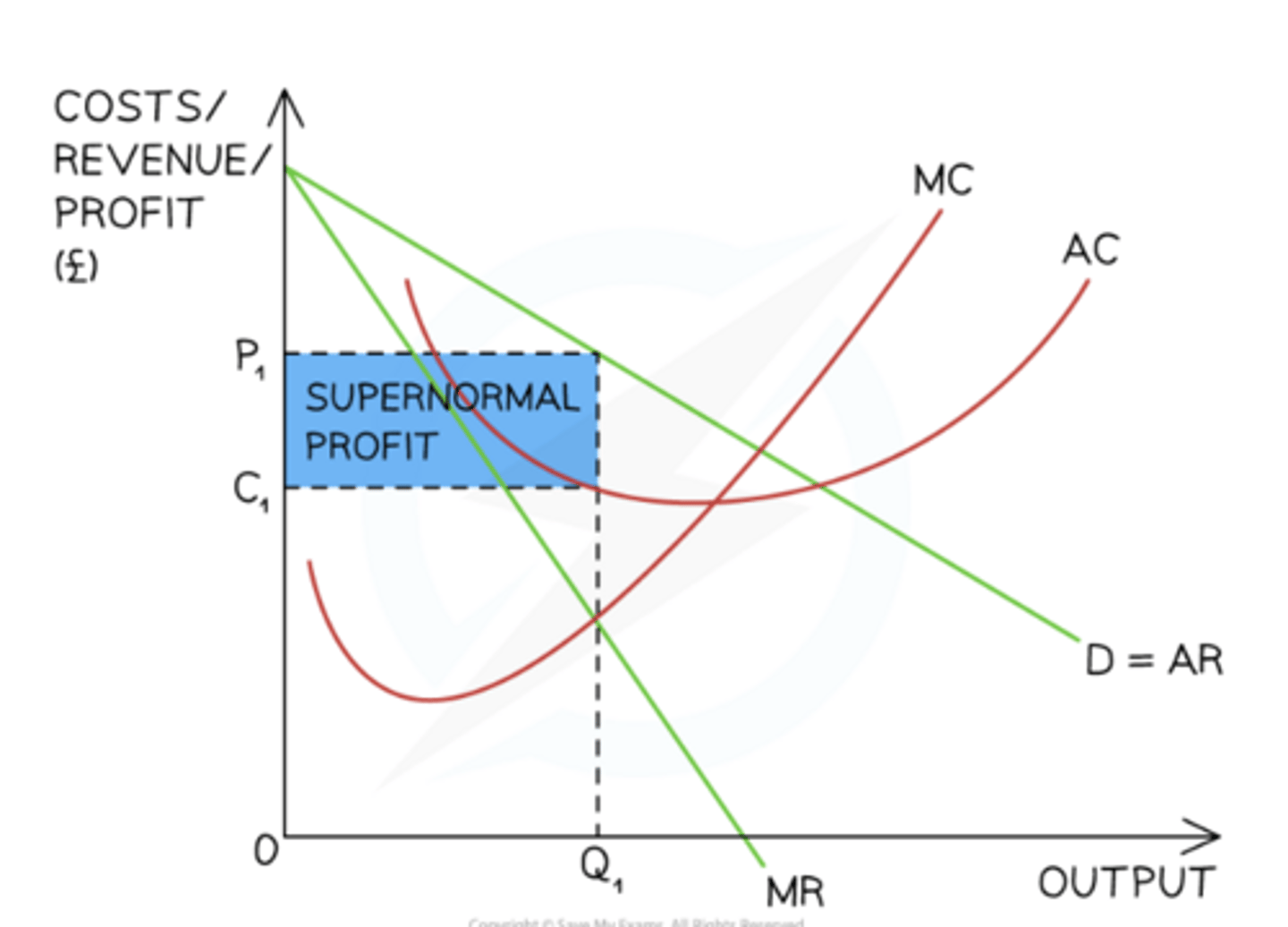
the firm is a price maker so the revenue curves are downward sloping and there is no differentiation between the firm and the industry. firms produce at the profit maximising level where MC=MR, the firm is making supernormal profits at this level
advantages of a monopoly
abnormal profits could promote dynamic efficiency, market power enables the firm to increase global competitiveness, increase in producer surplus, price discrimination could allow cross subsidation, economies of scale, abnormal profits could allow higher wages fro employees.
1. Economies of scale
Large monopoly firms can produce at a high level of output and benefit from Economies of Scale, lowering average costs. This can increase efficiency and potentially reduce prices in the long run.
2. Dynamic efficiency and innovation
Monopolies can earn abnormal (supernormal) profits, which may be reinvested into research, development, and new technology. This can increase Dynamic Efficiency and improve products or production processes.
3. Global competitiveness
Large monopoly firms may have the financial resources and scale to compete internationally, making them more competitive in global markets.
4. Price discrimination and cross-subsidisation
A monopoly may use Price Discrimination to charge different prices to different groups. This can allow cross-subsidisation, where higher prices from one group help fund lower prices or services for another group.
5. Higher wages and investment in employees
Because monopolies may earn high profits, they may be able to pay higher wages, provide training, or improve working conditions for employees.
disadvantages of a monopoly
due to lack of competition there is reduced incentive to be efficient - firm doesn't allocate resources in a way that maximizes overall welfare, misallocation of resources because P > MC - allocatively inefficient
, innovation sometimes lacks effectiveness due to lack of competition,
higher prices because there are no substitute goods,
no incentive to innovate, consumer surplus decreases, abnormal profits could go to shareholders
third degree price discrimination
when a firm charges a different price for the same good/service in order to maximise its revenue.
This occurs when a firm charges different prices to different groups of consumers based on their price elasticity of demand.
e.g. student discount where students pay less due to there denmand is elastic and adults pay more due their deman is inelastic
first degree price discrimination
when a firm separates consumers based on their ability to pay e.g. blind auction. this is known as 'perfect discrimination' but is unlikely to occur because it requires perfect information in the market
First-Degree Price Discrimination occurs when a firm charges each consumer the maximum price they are willing to pay for every unit of a product.
Key idea
The firm captures all the consumer surplus, turning it into producer surplus.
Example
A simple example is negotiated pricing, such as:
car dealerships negotiating different prices with each customer
auctions where each buyer bids their maximum willingness to pay
second degree price discrimination
when a firm gives discounts for bulk buying. often used to get rid of spare capacity to allow firms to pay fixed costs.
Second-Degree Price Discrimination occurs when the price per unit changes depending on how much a consumer buys.
Instead of charging different groups different prices, the firm offers different pricing options, and consumers self-select based on how much they purchase.
Key idea
The more units a consumer buys, the lower the price per unit.
Examples
Bulk discounts (buy 10 items → cheaper per unit)
conditions required for price discrimination
price making power, varying consumer price elasticity of demand, ability to prevent resale of tickets.
1. Price-making power
The firm must have some control over price, meaning it is usually a Monopoly or part of an Oligopoly. Firms in perfectly competitive markets cannot price discriminate because they are price takers.
2. Different price elasticities of demand
The firm must be able to identify groups of consumers with different Price Elasticity of Demand.
Consumers with inelastic demand → charged higher prices
Consumers with elastic demand → charged lower prices
3. Ability to prevent resale (no arbitrage)
Consumers who buy the product at a lower price must not be able to resell it to those facing higher prices. If resale were possible, the price discrimination strategy would fail.
Example:
Cinema or train tickets are linked to a specific person or time, preventing resale.
third degree price discrimination diagram analysis
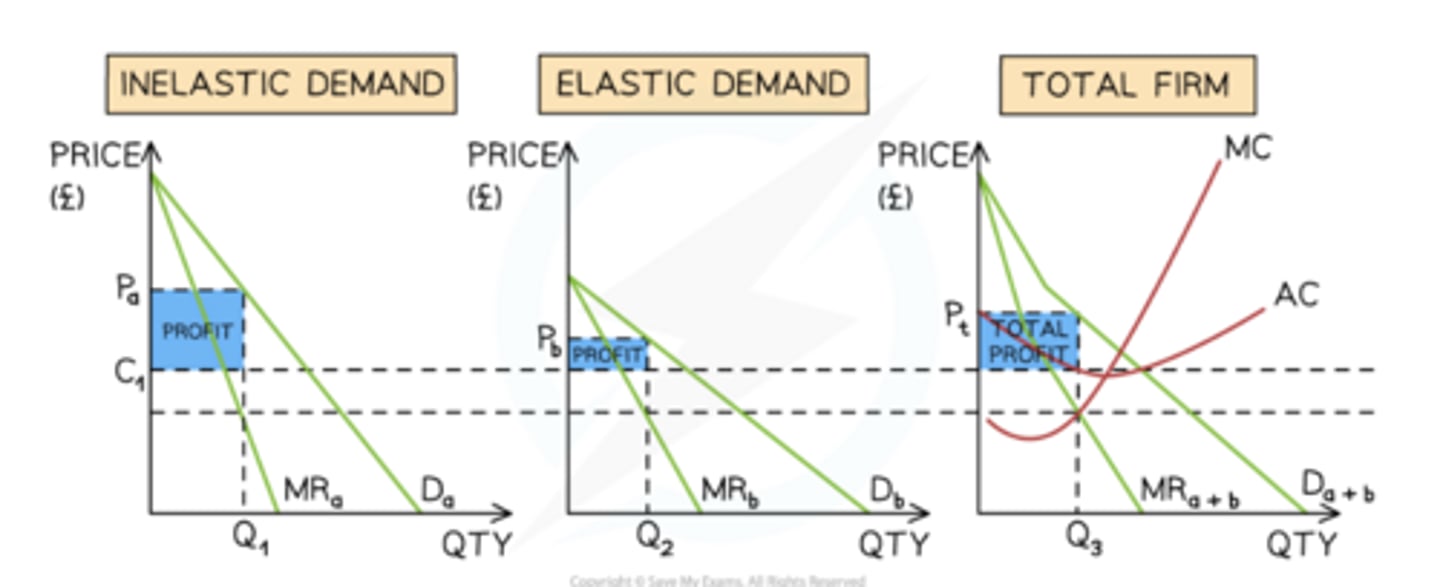
the overall firm is producing at the profit maximising level where MC=MR. the firm charges a higher price where demand is inelastic and a lower price where demand is elastic, so the total revenue has increased in each sub-market and the firm's total profits are higher than if they had charged a single price for all consumers.
The firm still produces where MC = MR (profit maximisation). By separating markets with different price elasticity of demand, it can charge higher prices in inelastic markets and lower prices in elastic markets. This increases total revenue and therefore profit compared to charging one single price.
advantages of price discrimination
consumers could benefit from a net welfare gain as a result of cross-subsidation if they recieve a lower price, producers make better use of spare capacity, the higher abnormal profits could stimulate investment and promote dynamic efficiency
Spare capacity is when a firm has resources (labour, machines, factories) that are not fully being used, so it could increase output without needing extra inputs.
Spare capacity is when a firm has resources (labour, machines, factories) that are not fully being used, so it could increase output without needing extra inputs.
disadvantages of price discrimination
loss of consumer surplus, since P >MC there is a loss of allocative efficiency, strengthens the monopoly power of firms which could lead to higher prices in the LR, if used as a predatory pricing method then firms could face investigation by the CMA, may cost firms to divide the market which limits the benefits they could gain
the process of creative destruction
If firms have monopoly power and they are making large profits, new firms have an incentive to enter the market and innovate, to overcome barriers to entry. This process of creative destruction is a fundamental feature of the way competition operates in a market economy. The process of creative destruction is linked to technological change and could lead to more innovation.
Firms may initially have market power and earn high profits. These profits create an incentive for new firms to enter the market and innovate, especially by developing new technologies or more efficient production methods.
As a result, new firms replace less efficient existing firms, forcing them out of the market. This ongoing process is known as Creative Destruction.
It is a key feature of a market economy and is closely linked to technological change and innovation, which can increase long-run productivity and Dynamic Efficiency.
characteristics of contestable markets
no barriers to entry or exit, no competitive disadvantages on entry, perfect information, hit-and-run competition exists
A Contestable Market is a market with low barriers to entry and exit, where the threat of new firms entering keeps existing firms competitive.
Low sunk costs (easy to exit without big losses)
No competitive disadvantage on entry - New firms can enter the market and compete on equal terms with existing firms, without being disadvantaged by branding, technology, or scale.
3. Perfect information - Consumers and firms have full knowledge of prices and costs, allowing them to react quickly to better offers.
4. Hit-and-run competition - Firms can enter the market quickly, make short-term profits, and then leave if conditions become less profitable. This threatens existing firms and keeps prices competitive.
hit-and-run competition
firms are attracted by the SR abnormal profits and once they have acquired these profits, they exit the market just as quickly
sunk costs
sunk cost is an investment that has been made that cannot be recovered. the lower the sunk costs, the more contestable the market