Equalization transfers
0.0(0)
Studied by 3 people Call Kai
 Learn
Learn Practice Test
 Spaced Repetition
 Match
Match Flashcards
 Knowt Play
Card Sorting
1/3

Earn XP
Description and Tags
Last updated 8:01 PM on 1/23/23
Name | Mastery | Learn | Test | Matching | Spaced | Call with Kai | Chat |
|---|
No analytics yet
Send a link to your students to track their progress
4 Terms
1
New cards
AB referendum on equalization
October 2021: Should section 36(2) of Constitution Act be removed? 62% Yes for a 40% turnout→ J.KennydemandsofJ.Trudeautonegociateafairdealw/AB
BUT J. Kenny was part of gov when current formula decided + noobligationofthefedtonegociate(notlegallybinding)
BC AB incomes are high, paymorefedtaxesbutgetlessredistribution
BUT J. Kenny was part of gov when current formula decided + noobligationofthefedtonegociate(notlegallybinding)
BC AB incomes are high, paymorefedtaxesbutgetlessredistribution
2
New cards
Constitution Act (1982) Part III: Equalization and regional disparities
Commitment to promote equal opportunities, making sure allows to provide ==reasonably comparable public services== at comparable tax levels ==between provinces==
3
New cards
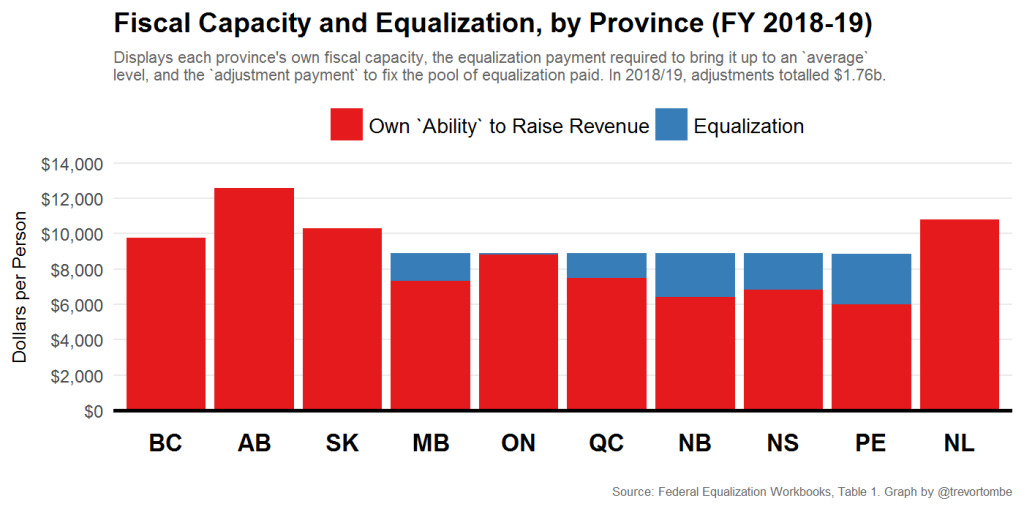
Constitutional principle of regional equity
started in 1957, %%horizontal fiscal imbalance addressed%% by %%unconditional transfers%% → province can do anything they want with that money (use it for education, to repay debts, to pay vacations…)
Have vs %%Have nots provinces%%, latter get check bc need it
Have vs %%Have nots provinces%%, latter get check bc need it
4
New cards
Key issues
^^Not need based but fiscal capacity based^^ (if same tax level, how much $ per Povince?)
PB of ^^estimating fiscal capacity^^ (count all potential sources of revenue, only non renewable/renewable…)
If calculating per capita threshold → ^^fed = incentive to lower threshold^^ (if high, more $ to have nots bc need more $ to reach it)→ to manage cost = ^^N-province formula^^ (basically excluding AB
Does it work + creates perverse incentives + dependency ?
observation: ^^QC fiscal capacity is weakening^^, from 44% of total transfers in 2004 to 66% in 2020.
PB of ^^estimating fiscal capacity^^ (count all potential sources of revenue, only non renewable/renewable…)
If calculating per capita threshold → ^^fed = incentive to lower threshold^^ (if high, more $ to have nots bc need more $ to reach it)→ to manage cost = ^^N-province formula^^ (basically excluding AB
Does it work + creates perverse incentives + dependency ?
observation: ^^QC fiscal capacity is weakening^^, from 44% of total transfers in 2004 to 66% in 2020.