5. Bio explanations for shizophrenia
 Call Kai
 Learn
Learn Practice Test
 Spaced Repetition
 Match
Match Flashcards
 Knowt Play
1/54

There's no tags or description
Looks like no tags are added yet.
Name | Mastery | Learn | Test | Matching | Spaced | Call with Kai |
|---|
No analytics yet
Send a link to your students to track their progress
55 Terms
What biological explanations are there for the development of schizophrenia?
Neurotransmitter hypothesis - dopamine and glutamate hypothesis
Genetics
What is the neurotransmitter explanation as a whole?
One bio explanation for schizophrenia focuses on the abnormal levels of neurotransmitters in the brain.
It is suggested that the imbalance of specific neurotransmitters can lead to the development of psychosis, positive and negative symptoms, which characterise the schizophrenia disorder.
2 theories involving neurotransmitters have been suggested - the dopamine hypothesis (hyperdopaminergia) and the glutamate hypothesis (hypoglutamatergia).
What does the dopamine hypothesis focus on?
This theory focuses on how schizophrenia may be a result of an imbalance of neurotransmitters in the brain - specifically dopamine.
What did early research find regarding amphetamines/dopamine?
Early research found that patients who abused amphetamines (speed, LSD)/psychoactive drugs, in large quantities showed positive psychotic symptoms e.g. hallucinations and delusions.
Amphetamines result in a huge surge of dopamine being released in the brain
So this research led people to believe that psychosis and schizophrenia may be a result of excess dopamine receptors releasing too much dopamine.
What did Carlsson suggest? - dopamine hypothesis
Carlsson et al 1999, 2000 suggests that one neurotransmitter that is directly involved in the development of schizophrenia is dopamine.
This neurotransmitter is linked to pleasure, mood and emotion, however in excess amounts (Hyperdopaminergia) - seems to lead to the development of psychosis and schizophrenia.
This suggestion is that there are an excess number of dopamine receptors at the synapses in the dopamine pathways and this leads to an oversensitivity to dopamine and excessive levels which leads to schizophrenia.
What else does Carlsson suggest in terms of the dopamine pathways?
Carlsson also suggests that excess dopamine in two dopamine pathways in the brain are linked to different symptoms of schizophrenia.
It is suggested that the mesolimbic pathway is associated with the positive symptoms.
And the mesocortical pathway is associated with the negative symptoms.
What has research identified in terms of genes and dopamine?
What is the key receptor to do with oversensitivity?
More specifically, research has identified specific genes linked to the production of dopamine which seem to be higher in schizophrenia patients.
In addition there are a number of dopamine receptors that are present in excess in specific areas of the brain and show an oversensitivity to dopamine - e.g. the D2 receptor.
How do Parkinson disease sufferers contribute to the dopamine hypothesis?
Parkinson disease sufferers also contribute to the dopamine hypothesis.
It is suggested that they have insufficient levels of the neurotransmitter and drugs given to them to increase dopamine seem to lead to side effects similar to psychotic symptoms.
What is support for the dopamine hypothesis in terms of the research studies used? - A03
Support for the suggestion that neurotransmitters are involved come from a range of research studies.
To investigate the effects of neurotransmitters on the development of schizophrenia PET scans, animal studies and research involving drug users and sufferers of Parkinson have been used.
Adds to credibility of neurotransmitter theory.
What is a weakness of the dopamine hypothesis in terms of reductionism? - A03
However, it must be remembered that the biological approach is also considered reductionist as it does not consider social or cognitive factors such as how we process information or dysfunctional beliefs in the development of schizophrenia.
And there are also issues with research, which will be discussed later.
What is support for the dopamine hypothesis due to research focusing on the effect of amphetamines? - A03
(Randrup and Mukvad 1966)
This suggestion is supported by research focusing on the effect of amphetamines.
It has been shown that the use of amphetamines seems to produce excess dopamine and symptoms of psychosis similar to the positive symptoms of schizophrenia i.e. hallucinations and delusions.
Research by Randrup and Munkvad (1966) using rats showed that injecting them with amphetamines produced increased levels of dopamine and changes in behaviour to more aggressive, isolated and stereotyped.
This seems to show a direct link between levels of dopamine and psychosis.
What is support for the dopamine hypothesis due to research focusing on the effect on amphetamines? - A03
(Carlsson et al 1999,2000)
Research by Carlsson 1999, 2000 also shows that if people with schizophrenia are given amphetamines, they have an even greater release of dopamine compared to people who use the drug without schizophrenia.
This is further support for the role of dopamine in the development of schizophrenia.
However, what is a weakness of the dopamine hypothesis in terms amphetamines? - A03
However, it must be noted that amphetamines only produce the positive symptoms of schizophrenia.
Therefore, the increase in dopamine as a result of amphetamine use cannot be the only explanation for schizophrenia due to an absence of negative symptoms.
In addition it is difficult to generalise the effect of amphetamines on rats to humans as the complex nature of human neural pathways is different.
What is a strength in terms of research supporting the overall dopamine hypothesis and different pathways - A03
Research also supports the overall dopamine hypothesis and different pathways.
PET scans show that using antagonist antipsychotic drugs that block dopamine receptors, such as phenothiazine reduces the levels of dopamine in both pathways of the brain.
This then reduces the positive and negative symptoms of schizophrenia.
However what limitation of the dopamine hypothesis is highlighted by research? - A03
However research also highlights a limitation of the dopamine hypothesis.
PET scans of schizophrenia patients show that not all patients experience a reduction in symptoms when treated with antipsychotic drugs.
If patients are treated early the antipsychotic drugs seems to be effective, however if they have been a sufferer for over 10 years the antipsychotic drugs do not reduce the positive or negative symptoms of the disorder.
Furthermore, not all people who take amphetamines experience psychosis.
Therefore the individual differences must affect the reaction to excess dopamine.
What is support for the genetic link and dopamine - A03
Owen et al 1978 - this suggestion is supported by post mortem examination of schizophrenic patients who show higher numbers of dopamine receptors and supports the role of both dopamine and genetics in the development of schizophrenia.
However, what must be noted about research showing different dopamine receptors in different areas of the brain? - A03
However, it must be noted that research also shows that different dopamine receptors in different areas of the brain show different results in terms of the symptoms of schizophrenia.
For example, research shows fewer dopamine receptors in the prefrontal cortex (mesocortical pathway) of schizophrenics and has been linked to the negative symptoms.
This further supports the involvement of dopamine, but also highlights the complex differences in the different receptors in different parts of the brain, which makes isolation and direct causation difficult.
Where does support for the link between Parkinson’s sufferers and psychotic symptoms come from? - A03
Support for the link between Parkinson’s sufferers and psychotic symptoms comes from patients who are given Levodopa (L-Dopa).
This drug is an agonist, which stimulates the receptors sites and increases dopamine at the synapse.
However, it also seems to produce symptoms similar to schizophrenia, which supports the dopamine hypothesis.
What are the strengths of natural experiments here? - A03
Natural experiments such as this are a strength as patients already have Parkinson’s and are undergoing treatment with L-Dopa.
This link between the effects of the drug and dopamine can seem to inform our understanding of schizophrenia in an ethical way.
That being said, natural experiments are difficult to control, therefore lowering the validity of the results.
What is a weakness in terms of reductionism - synoptics A03
However it must be remembered that the biological approach is also considered reductionist as it does not consider social or cognitive factors such as how we process information or dysfunctional beliefs in the development of schizophrenia.
And there are also issues with research, which will be discussed later.
What is another weakness in terms of the neurotransmitter approach being reductionist? - Synoptics A03
Neurotransmitter approach is reductionist.
reducing complex behaviours down to simple chemical processes/dysfunction.
Brown et al (1968) - people who relapsed experienced social triggers.
Drug abuse can lead to the development of schizophrenia.
What is a weakness in terms of struggling to get fully informed consent but also psychology overtime - Synoptic A03
Drugs to treat schizophrenia have been well developed since the 1970’s, but this is only possible through trials that have investigated the effects of different forms of medication.
Many people have raised concerns about the ability of patients with psychotic illnesses such as schizophrenia to give informed consent regarding their participation in research.
Someone who has lost touch with reality may not be able to consider all of the implications involved in their taking part in drug trials and this can cause problems with the ethics of such research.
Cannot really gain FIC from someone who is delusional of hallucinating.
However it is justified as it is the only way to find out if drugs work and are able to give people better quality lives if they do work.
How does the dopamine hypothesis foster psychological knowledge in society - synoptic A03
The dopamine hypothesis emphasises to society that schizophrenia is an illness with a physical cause and therefore encouraged a change in opinions about treating those with mental health problems.
The change in attitude towards medical treatment for disorders like schizophrenia has led to improvements in the understandings of how drugs can be used to alter brain chemistry and Antipsychotic medications are now a well established treatment for schizophrenia.
This medication has enabled many individuals suffering from schizophrenia to regain a good quality of life and has prevented many from having to be hospitalised.
What did Carlsson suggest about Glutamate in relation to schizophrenia?
What is Glutamate?
Carlsson et al 1999, 2000 suggests that another neurotransmitter that is directly involved in the development of schizophrenia is Glutamate.
This neurotransmitter is responsible for sending signals between nerve cells in all areas of the brain and is linked to a wide range of behaviours.
What does insufficient amounts of Glutamate lead to?
However, insufficient amounts (hypoglutamatergia) seems to lead to the development of schizophrenia.
The suggestion is that insufficient glutamate or blocking the production of it leads to symptoms of schizophrenia, not just excess dopamine.
What is suggested about Glutamate in relation to dopamine?
Due to the investigation of glutamate in schizophrenia it has been suggested that glutamate has a regulatory effect over dopamine.
Carlsson suggests that glutamate can either increase or decrease the production of dopamine in the brain.
This means when levels of glutamate are reduced, levels of dopamine increase, maybe to compensate.
Where does research support for the glutamate hypothesis come from? - A03
Research support comes from animal studies, as rats treated with NMDA receptor antagonists (Normally stimulated by glutamate) showed reduced glutamate and changes in behaviour that resembled psychosis.
However there was not always an increase in dopamine.
Therefore suggesting that dopamine cannot be the only cause for schizophrenia, glutamate is also involved.
How has the role of glutamate been supported by research into the effects of recreational drugs?
In addition, like the dopamine hypothesis, the role of glutamate has been supported by research into the effects of recreational drugs.
Drugs like PCP/angel dust and ketamine are NMDA receptor antagonists (and increase dopamine).
This means they block the normal activation of the receptor by the glutamate.
This block reduces the amount of glutamate and produces psychosis like symptoms.
This further supports the role of both glutamate and dopamine in schizophrenia.
What does research from PCP studied show i relation to the link between dopamine and glutamate? - A03
Research from the PCP studies can again support this link between dopamine and glutamate.
This is due to PCP as an NMDA receptor antagonist leading to reduced levels of glutamate but also increasing dopamine levels.
This supports a relationship between glutamate in low levels and dopamine in excess.
How does the glutamate hypothesis work with the dopamine hypothesis in terms of psychological understanding over time - synoptic A03
The glutamate hypothesis works with the dopamine hypothesis and expands on the understanding of the neurotransmitters involved.
This is a strength as it means the strong evidence for the dopamine hypothesis can be incorporated into the glutamate hypothesis - adding to the original hypothesis.
This demonstrates the development of psychological understanding over time due to building a body of knowledge based on scientific research, which increases the credibility at the same time.
What is the explanation for schizophrenia to do with genetics - where does the evidence come from?
There is evidence for a genetic link for schizophrenia from research using MZ and DZ twins.
The prevalence of schizophrenia in the general population is less than 1%.
If there is a genetic link for schizophrenia, then families, and in particular twins should have a higher concordance rate due to the genetic similarities.
If there is a genetic link as suggested, then the highest concordance rate should be between MZ twins as they share genetic information, - that means if one twin has schizophrenia, the other identical twin should also have the disorder.
Who aimed to investigate if schizophrenia had a genetic basis?
Gottesman & Shields
What is another way to explore a genetic link with schizophrenia?
Another way to explore a genetic link with schizophrenia is to use adoption studies.
This allows researchers to investigate the extent of a genetic influence on the development of schizophrenia, as the environment they are raised in is different.
What can be argued about twin studies, how do adoption studies overcome this?
With twin studies it can be argued that they share the same environment, especially MZ twins, therefore making it difficult to separate any environmental influences.
In adoption studies the environment of each twin is different, therefore any higher concordance rate must be due to the genetic information they share.
What did Gottesman and Shields (1966) aim to investigate? - A03
Research conducted by Gottesman and shields (1966) using secondary data, aimed to investigate the extent of a genetic link with schizophrenia using MZ and DZ twins.
How do the results support a genetic link? - A03
The results strongly support a genetic link as they found a concordance rate of around 42% for MZ twins.
This means that 42% of the time if one twin had schizophrenia so does the other.
Although there is a lower concordance rate for DZ twins it also shows a concordance rate that supports a genetic link of 9%.
Why is using MZ and DZ twins a strength of research? - A03
Using MZ and DZ twins to study whether there is a genetic link for schizophrenia is a significant strength of research.
This is because MZ twins share the exact same genetic information, and a higher concordance rate compared to DZ twins, families and the general population means it is clear that there must be a genetic influence on the development of the disorder.
What did Gottesman and Shields conclude about the link? - A03
As twins in the MZ twin pairs did not have 100% concordance rates, the implication is that schizophrenia is not caused entirely by genes.
Instead, the results led Gottesman and Shields to believe that genetic factors do predispose someone to schizophrenia, by lowering their threshold for coping with stress, but environmental triggers may also be needed to actually start the development of the disorder.
Genes appear to play an important role in schizophrenia because the concordance rate is higher in MZ twins than DZ twins.
There is some evidence to suggest that there is a set of genes responsible but not one in particular.
Why may concordance rates in MZ twins be higher? - A03
Higher concordance rates in MZ twins may be due to the fact they tend to be treated more similarly than DZ twins, the environment may play a role.
What was Gottesman’s 1991 research? - A03
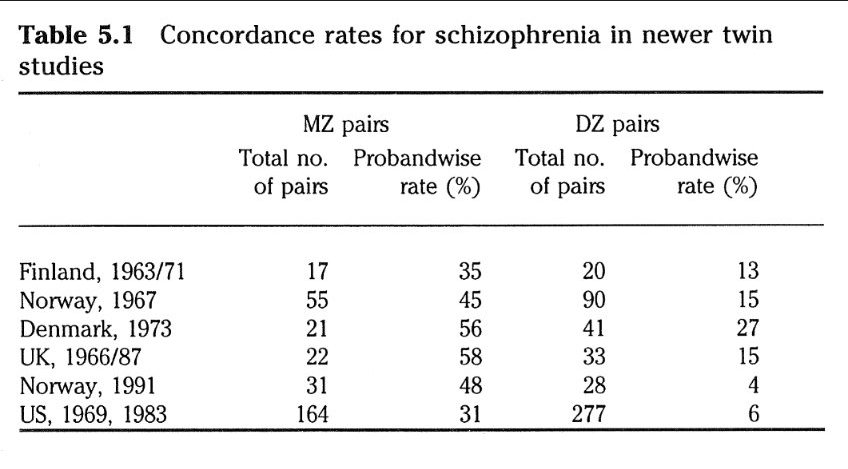
Gottesman (1991) - conducted a meta-analysis in 1991 using approximately 40 family studies spanning several decades of research in Western Europe.
Further support for a genetic link to schizophrenia was reflected in these results.
The largest ample for MZ and DZ twins (US) show a higher concordance rate for MZ pairs than DZ pairs.
31% - MZ
6% - DZ
How does Kety’s adoption study support a genetic link for schziophrenia? - A03
Support for a genetic link for schizophrenia using adoption studies comes from Kety et al (1968) who found more signs of schizophrenic spectrum disorders in the index Pp’s biological family than their adoptive family.
They also found more spectrum disorders in the index Pp’s biological families than in the control’s biological families.
This supports the fact that the development of schizophrenia is influenced by genetics as the incidence of schizophrenia was greater within the biological family compared to the adoptive family or the control group.
What is a strength of Kety’s research? - A03
A strength of Kety’s research is the sample used.
Denmark keeps a complete record of adoptions in the Danish Adoption Register which includes children born as far back as 1924.
It includes full details of both the biological and adoptive families, making large scale family research much easier in Denmark than in many other countries.
Moreover, Denmark makes this information public along with information from the mental health register, enabling researchers to link people from the adoption register to the people on the mental health register, which is access to a large amount of secondary data.
What is a weakness of the genetic explanation - synoptic/AO3
We are suggesting that disorders are predetermined and that if someone has parents who are schizophrenic, they are determined to be, which is not always the case.
Not even with twin studies, as the highest concordance rate was 48%.
It is ethically wrong to do this as it creates a label for people which can cause psychological ham.
There is a stigma attached to mental health which can cause problems for people i.e. employment.
How does developmental psychology link to schizophrenia? - Overall synoptics A03
Schizophrenia is a disorder that can be explained though the process of development.
The two biological explanations dealt with here (neurotransmitters and genetics) could be used to discuss issues in developmental psychology.
The neurotransmitter balance in the brain is something that could be affected by many things including the genes you have from conception, prenatal factors such as maternal illness, and chemical exposure such as drugs used throughout life.
Other risk factors that have been linked with schizophrenia are prenatal exposure to infection or lack of nutrition (Opler and Susser 2005).
Schizophrenia develops late in adolescence and early adulthood, so it is of importance that developmental psychologists establish what biological, social or emotional changes occur during this period of life that could account for this onset.
What factors can impact on biological factors right from conception to adolescence? (developmental psychology) - Overall synoptics A03
Onset is usually early 20’s and there can be a lot of factors that impact on biological factors right from conception to adolescence.
For example, the mothers behaviour whilst the child is in the womb (drugs, infection), early childhood experiences (abuse, trauma) and hormonal changes on adolescence.
Many factors that could account for onset.
What is a strength of the bio explanation to do with psychology as a science? - overall synoptic A03
There is a great deal of objective data to support biological explanations of schizophrenia.
Evidence comes from studies using brain scans, blood tests, genetic testing etc, all conducted using reliable equipment, meaning that the actual data is highly credible.
Many of the studies are conducted in labs where it is possible to isolate and measure specific factors.
There is also a great deal of evidence to demonstrate reliability by replicating the findings from previous research and building on evidence gathered as techniques develop further.
For example, early research such as that by Gottesman & Shields (1996) found basic evidence of genetic causes for schizophrenia but more contemporary research such as Egan et al (2001) has developed from this to isolate specific genes associated with developing the illness.
Why are bio explanations a strength to do with psychology as a science - Overall synoptic A03
Biological approaches give us objective ways to measure things (blood samples, brain samples, scientific equipment, brain scans).
Lab studies are often used to isolate specific factors so that we can establish cause and effect.
Higher replicability by replication of studies which have stood the test of time and same/similar findings have been found over time.
Implications are drug treatments to benefit people.
How is the bio explanation a weakness in terms of individual differences - Overall synoptic A03
Symptoms of schizophrenia are very diverse and not the same for everyone.
Some might argue that the biological view of schizophrenia is unlikely to be a complete one as there are likely to be different factors associated with developing the disorder that may account for the various subtypes and presentation of symptoms.
How is the bio explanation reductionist making it a weakness? - Synoptic A03
However, it must be remembered that the biological approach is also considered reductionist as it does not consider social or cognitive factors such as how we process information or dysfunctional beliefs in the development of schizophrenia.
And there are also issues with research.
How is the bio explanation reductionist making it a strength? - overall synoptic A03
Behaviour is reduced to a simple explanation - genetics or chemical processes
It can be advantageous because then we may be able to create specific treatments for people who show these biological problems.
What is a weakness of the bio explanation to do with determinism? - overall synoptic A03
We are suggesting that disorders are predetermined and that if someone has parents who are schizophrenic, they are determined to be which is not always the case.
Not even with twin studies, as the highest concordance rate was 48%.
It is ethically wrong to do this as it creates a label for people which can cause psychological harm.
There is a stigma attached to mental health which can cause problems for people i.e. employment.
What is a weakness of the bio explanation in terms of nature vs nurture - overall synoptic A03
Biological explanations of schizophrenia ignore any role of external influences on the development of the disorder.
Social factors have been implicated in explanations for schizophrenia, which could account for some biological factors that have been uncovered.
For example, research has found higher rates of schizophrenia in deprived areas, and in these areas here may have also been increased levels of drug use due to exposure to such behaviour.
Drugs have been implicated in changes in brain chemistry that may be associated with developing the disorder - and so the social context the patient lives in could be the ultimate cause of the illness.
Both nature and nurture aspects should be considered and how they interlink.
What it a better explanation for schizophrenia (nature vs nurture)? - overall synoptic A03
Diathesis stress is a better way as it considers a biological predisposition but also a social trigger.
This theory suggests that there is no single explanation for mental illness, but rather the cause is actually a combination of factors - which therefore refutes the biological view.
Less ethically problematic in terms of labelling people/determinism - more holistic view.
Both nature and nurture aspects should be considered and how they interlink.
What is a weakness of the bio explanation in terms of ethics, but how can it be justified? - overall synoptic A03
Drugs to treat schizophrenia have been well developed since the 1970’s, but this is only possible through trials that have investigated the effects of different forms of medication.
Many people have raised concerns about the ability of patients with psychotic illnesses such as schizophrenia to give informed consent regarding participation in research.
Someone who has lost touch with reality may not be able to consider all of the implications involved in their taking part in drug trials and this can cause problems with the ethics of such research.
Cannot really gain FIC from someone who is delusional or hallucinating.
However it is justified as it is the only way to find out if drugs work and are able to give people better quality lives if they do work.
What is a weakness of the bio explanation in terms of socially sensitive research - overall synoptic A03
Labelling - the way that society perceives people with schizophrenia is dangerous and in a very negative way.
We have to be careful how we research and present findings to not exaggerate these labels.
Due to the nature of symptoms, researches could feed into hallucinations/delusions or justify behaviours by saying that they are biological based - removes responsibility from the patient for behaviour.