PSYC3202 - Industrial Psychology
 Call Kai
 Learn
Learn Practice Test
 Spaced Repetition
 Match
Match Flashcards
 Knowt Play
1/291

Earn XP
Description and Tags
kms
Name | Mastery | Learn | Test | Matching | Spaced | Call with Kai |
|---|
No analytics yet
Send a link to your students to track their progress
292 Terms
Building blocks of organisational design
Formalisation, centralisation, departmentalistion, span of control
Centralisation definition
degree to which deicison making is concentrated at a single point within an organiation
Centralisation advantages
clear chain of command, allows for oversight and control
Centralisation disadvantages
slow, less adaptable
Departmentalisation definition
basis by which jobs are grouped together
Departmentalisation groupings based on…
Function
Product
Process/Customer
Geography
Departmentalisation advantages
increased operational efficiency, clear accountability, and structured support for business growth
Departmentalization disadvantages
frequently creates communication barriers, operational "silos," and resource duplication
Formalisation
degree to which jobs within orgnization are standardized
Formalization advantages
easier training and onboarding, consistency in customer experience, role clarity
Formalization disadvatanges
rigidities that stifle creativity, slow down decision-making with bureaucratic red tape, and reduce overall employee autonomy
Span of Control definition
number of subordinates a manager can effectivelry oversee
Wide Span - Span of Control
cost-effecftive and encourages autonomy, but less individualized mentorship
Narrow Span - Span of Control
Closer supervision, individual considerations; but slow, increased costs, and risk of micromanagement
Two extreme models of organisational design
Mechanistic models and organic model
Mechanistic model
High specialisation
Rigid departmentalisation
Clear chain of command
Narrow spans of control
Centralisation
High formalisation
Organic model
cross-functional teams
cross-hierarchical teams
free flow of information
wide spans of control
decentralisation
low formalisation
Contextual factors in org design
stategy, organisational size, technology, environmental factors
Strategy — contextual factor in org design
innovation (organic) vs cost-monimization (mechanistic) vs imitaation (mixed)
Organisational size - contextual factors in org design
shift away from organic to mechanistic with growth
Technology - contextual factors in org design
organic often better when technology rapidly evolving
Environmental factors - contextual factors in org design
mechanistic often more common when external landscape more complex
Organisational Culture
‘vibe’ or ethos of an organization
assumptions that members of an org may have which affect their thinking, act, and perception of environment
collective knowledgge reflecting how organization has learned to exist
Org Culture Importance
shapes employee behaviours + company direction
certain cultures associated with better formance
other cultures associated with higher employee satisfaction
Functions of culture
defines boundarues - differentiates one org from another
provides identity - fosters sense of belonging within org
enhances commitment - dvlps loyalty to org
clarifies behaviour - sets workplace behaviour standards
shapes atttitude - influences employee mindsets and actions in workplace
Schein’s Iceberg model (1985)
Artifacts - observable symbols and behaviours
Values - shared beliefs and objectives
Assumptions - deep-seated, often unconscious beliefs
How is culture formed and maintained?
leadership
selection
socialisation/onboarding
reward systems
Attraction-Selection-Attrition Model (Scheider et al, 1995)
companies attract and retain people aligned with their values, while those misaligned tend to depart
Hatch’s Model of Cultural Dynamics (1993)
Symbols → Assumptions → Values → Artifacts → Symbols (REPEAT! CYCLE!)
ex: customer service culture [Hatch’s Model of Cultural Dynamics]
prioritise customer service in training (symbols) → internalised belief in importance of customer service (assumptions) → customer-centric vision and policies (values) → less formalised structure, autonomous decision making (artifacts)
ex: creating an ethical culture [Hatch’s Model of Cultural Dynamics]
Role modelling + communication from leadership + reward [symbol] → employee believe ethical conduct valued [assumptions] → value transparency + accountability [values] → code of confuct, confidential reporting [artifacts]
Culture as a liabilty
Impediment to change
Obstacle to mergers + acquisitions
Barrier to diversity
Organisational Climate
How employees perceive policies, practices, and procedures within an organization
Individual’s perception of climate
psychological climate
Culture vs Climate
Culture
ethnological/anthropological research tradition
target organisations
focus on underlying assumptions
qualitative methodology
long-term time span
perspective that organisations have one
Climate
psychological research tradition
targets individuals
focus on observable manifestations
quantitative methodology
short-term time span
perspective that organisations have many
Hatch’s Model Extended
Added artifacts → climate → behaviour → artifacts alongside basic cycle
Recruitment
Process of attracting potential employees to the organisation
Selection
Process of evaluating potential employees and deciding who gets offered employment
Beyond just securing talent, need to also…
Serve public relations function
Form psychological contract
Start socialisation process
Consequence of Poor Practices
Lower employee motivation and performance
Higher turnover
Reduced company profits
Higher recruitment and training expenses
Legal ramifications
Role of I/O psychologists
workforce planning
fairness evaluation
job analysis
process improvement
test battery creation
data utilisation
research
Selection Steps
Job Analysis
Develop Strategy
Execute Process
Evaluate Process
Predicting success
Predictors: knowledge, skills, abilities, other attributes, background, interests
Criteria (Outcomes): job performance, longevity, attendance, development potential
Reliability
Degree of dependabilty, consistency, or stability of scores on a measure
Alt forms:
Internal consistency
Test-retest reliability
Inter-rater reliability
Validity
The accuracy and appriopriateness of a tool or method in measuring what it intends to measure
ex: construct, face, cotent, convergent, divergent, criterion-related
Selection Steps: In Detail
Job Analysis
Advertising the position
Primary screening
Secondary screening
Job offers
Post-hire evaluation
Primary screening tools
Resume or CV
Reference check
Application forms
Weighted application bank
Biographical Data Questionnaire or Biographical Information Blank (BIB)
Covers variety of topics such as educational experriences, hobbies, family relations, leisure time, personal health, and early work experiences
Drakeley (1989)
Classification of biodata, background data, commitment data, and achievement data
Abilities Testing pros vs cons
Advantages:
High predictive validity
Defendable
Impression-proof
Cost-effective
Disadvantages:
Possibility of bias
Examples: abstract reasoning, numerical abilities, verbal comprehension
Assessing verbal reasoning
Assesses the candidate’s demonstrated understanding of vocabulary, analogies, synonyms, and antonyms
Numerical Reasoning
Assesses candidate’s demonstrated understanding of numerical sequences, arithmeitical reasoning, and number matrices
Abstract reasoning
Measures a candidate’s ability to make sense of complex situations, create meaning out of ambiguity or confusion, and perceive and think clearly
Personality testing
General tests: 16PF, Eysenck, NEO-PIR Hogan’s Personality Inventory, Minnesota Multi-phasic
Workplace Specific tests: occupational personality questionnaire
Challenges: profile matching, impression management, candidate reactions
The Five-Factor Model
Openness
Conscientiousness
Extroversion
Agreeableness
Neuroticism
Other assessments
Mental health assessments (DASS21)
Emotional Intelligence (MSCEIT)
Interests (ex: Myer briggs)
Integrity testing (HEXACO model)
Interviews
Unstructured: informal meeting/chat
Structured: follows protocol with set questions + rating scales
Advantages of structures
Higher validity
based on job analysis
ensures consistency + job revelance
may yield more genuine responses
Assessment Centres
Series of tailored exercises and tests designed to evaluaste candidates against specific selection criteria
Activities:
leaderless group acitivites
In-basket techniques
Work sample or simulation
Case analyses or business games
Gamification of Selection Tools (Baumert, Schlosser, and Schmitt [2014])
Using economic games that involve decision making regarding compensation, rejection, and punishment
results reveal individual differences in altruism and fairness
strong correlations between altruism and fairness scores, self-report scores on these dispositions
results support psychometric properties of using economic games
features of optimal employee selection
realiability
validity
legality defensible
cost-effective
issues of optimal employee selection
who should administer tests?
privvacy issues
changing demographics
applicant reactions
changing ideas of job performance
technology
performance appraisal
review of employee’s performance to assess effectiveness and identify dvlp areas
features of:
360-degree feedback
clear performance indicators and objectives
proactive performance management
elements of effective performance appraisal
360 degree feedback
clear performance indicators and objectives
proactive performance management
robust assessment of performance indicators
training for the appraisers
multiple evaluations
appraiser accountability
frequent appraisals
used for feedback + HR decisions
continious review and revision
Training definition
A planned effort by an organisation to facilitate employees learning, retention, and transfer of job-related behaviours (e.g., formal qualifications, induction)
Development definition
An effort to equip employees with skills and experiences valuable
beyond their current role to throughout their career (e.g., mentoring, secondment, workshops, acting up)
Relationship between Job Analysis and Performance Appraisal
Job Analysis → Performance Appraisal, Selection and Training
• Performance Appraisal and Selection can also inform Training and Development
• Training and Development can be used in many areas (e.g.
communication, teamwork, leadership, task specific skills/knowledgeetc.)
• To be effective training must be a continuous process
Areas of application for training
New employee
orientation/onboarding
Retraining and continuing
education programs
Retirement planning and
preparation
Employee career development
Training workers for
international assignments
Training in diversity issues,
harassment, and ethical
behaviour
Team training
Bell et al (2017) - Science of Training
Increasing cumulative number of training articles over the years
Classic Training Process
Assess training needs → establish training objectives → design & test training programs → implement training program → evaluate training program
consider conditions of training
consider modes of delivery
consider transfer of training
to be successful, training process should follow a rational design that’s clearly linked to job analysis and incorporate theories and principles of adult learning
Steps of training & development
1. Training Needs Analysis
2. Establish Objectives
3. Design & Test Program
4. Implement Program
5. Evaluate Training Program
Organisational analysis strategies
Align training with organizational goals,
assess management support, and consider logistics
Job/Task analysis
understand nature of various jobs, list necessary skills and identify gaps
Person analysis
identify who needs training, assess current skill levels and understand attitudes toward training
Steps for training needs analysis
1. Organisational Analysis
• Determining whether training is a viable solution to organisational problems
and where in the organisation training should be directed
2. Task Analysis
• Identifying the duties and tasks of the job and the KSATI’s needed to perform
them
• Also involves identifying which components of the job should be targeted for
training
3. Person Analysis
• Identifying which individuals within an organisation should receive training
• Demographic analyses
• Tailoring training to the trainees
Needs Assessment Steps
What training need to accomplish
in terms of org’s goals?
in terms of specific work tasks?
in terms of people involved?
essentially, organisation + task/job + individual
Type of data for needs assessment
training outcomes
competency assessment
gap analysis
incident reports
customer feedback
surveys
interviews
Factors to consider in Pre-Training environment
Individual Differences: What do learners bring to the training
environment?
Environmental Support: Is training valued?
Framing of the Training: Is it basic or advanced?
Objectives should be….
• Concrete
• Precise
• Measurable
• Specific
Factors that influence success of training
• Encoding – optimal cognitive load
• Memory – learning schema formation
• Constructive processes – interactivity
• Feedback – provide guidance
Declarative Knowledge Definition
• Knowledge about facts and things
• Involves memorising and reasoning processes
• Attention devoted to understanding the task
• Performance is slow and error prone
Procedural Knowledge Definitoon
• Knowledge about how to perform the task
• The skill has become automated
• Can perform the task efficiently with little attention
• Can use information to solve problems
Types of feedback
• Critic function – what was ‘wrong’
• Instructive function – ‘constructive’ feedback
• Combined – both
Praxis defition
action with reflection or learning by doing
Needs assessment Definition
participation of the learners in naming what is to be learned.
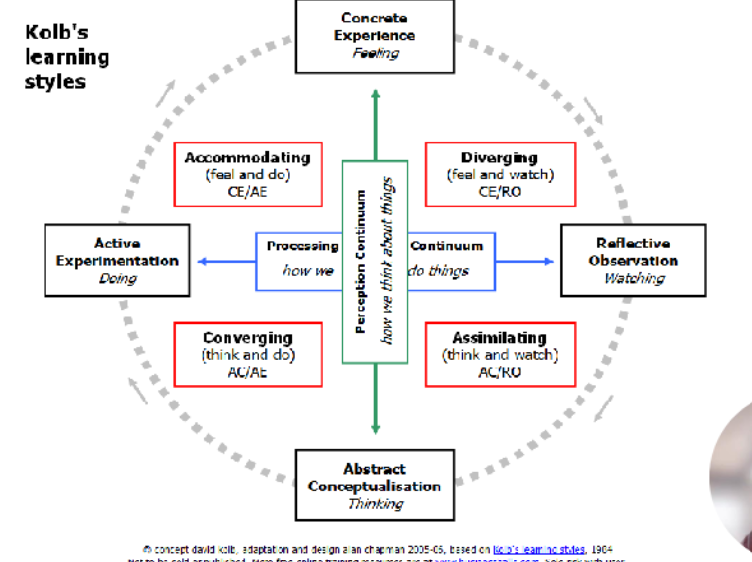
Kolb’s learning styles
posits that knowledge is created through the transformation of experience. His model features a continuous 4-stage learning cycle: Concrete Experience (feeling/doing), Reflective Observation (watching), Abstract Conceptualization (thinking), and Active Experimentation (trying/applying)
Types of training methods
On-Site Training
• On-the-job training
• Job rotation
• Vestibule training
• Apprentice training
Off-Site Methods
• Lectures, conferences,
seminars/workshops
• Debriefing
• Simulations
• Web-based
training/programmed
instruction
• Behaviour modelling training
Managerial Training Methods definition
• Developmental assessment centres
• Problem-solving case study
• Management/business games
• Role playing
• Conference/group discussion
• Mentoring/coaching
• Cross-cultural training
Strategies for onboarding new hires
• communicating information about the job and the organization
• acquiring essential job and safety skills
• typical norms and attitudes that fit into the organization’s culture
• understanding how things get done within the organizational
structure
• making clear who does what within the organization
Possible issues for implementing program
• Motivation and readiness
• Familiarity among participants
• Trust in the trainer
• Tuckman’s model
• Pre- and post-training context
Trainee Motivation definition
degree learner is motivated to gain KSAs or to succeed in the training
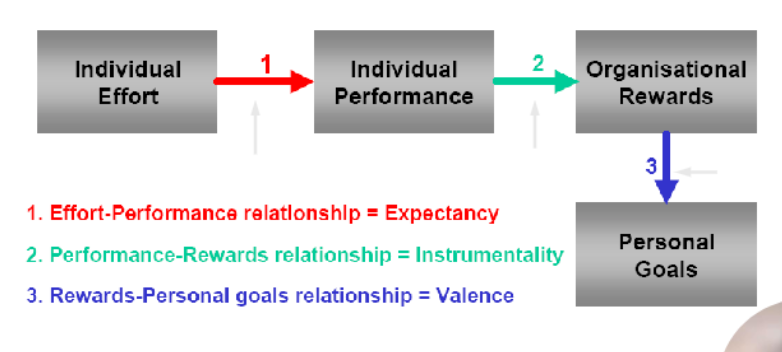
Expectancy theory definition
Aim to increase trainee expectancy, instrumentality
and valence.
Valence definition [expectancy theory]
attractiveness of an outcome
Instrumentality definiton [expectancy theory]
perceived relationship between performance and the outcome
Expectancy definition [expectancy theory]
perceived relationship between effort and performance
Self-Efficacy definiton
• Personal expectations of competence
• Types of expectations
outcome expectations (VIE – Instrumentality)
Efficacy expectations (VIE – Expectancy)
Contextual factors definition and influences
Learning climate and post-training
environment
• Contextual Influences
• Pre-training environment
• E.g., Learning climate (climate for transfer)
• E.g., Perceptions of training
• Post-training environment
• E.g., Supervisor support
Colquitt et al (2000) - Training Motivation
Age → Valence → Motivation to Learn → Learning Outcomes → Transfer → Job Performance
Kirkpatrick-Katzell 1994 Training Evaluation
1. Reaction - The feeling of the trainees toward the course
2. Learning - The expression of the KSAs at the end of the training
3. Behaviour - The transfer of the KSAs to the work environment
4. Results - The impact of the training on wider organisational objectives / ROI
Training Evaluation Reaction Criteria
• Internal to the training program
• Feelings of employees
• Short-term criteria
• Assessment methods include
surveys
Training evaluation Learning criteria
• Internal to the training program
• What has been learned
• Short-term criteria
• Assessment methods include tests
of knowledge and skill
demonstration