Hypothermia (and everything else)
 Call Kai
 Learn
Learn Practice Test
 Spaced Repetition
 Match
Match Flashcards
 Knowt Play
1/82

There's no tags or description
Looks like no tags are added yet.
Name | Mastery | Learn | Test | Matching | Spaced | Call with Kai |
|---|
No analytics yet
Send a link to your students to track their progress
83 Terms
What is hypothermia?
Why is hypothermia problematic for the body?
slows and alters chemical reactions in the body
heart becomes irritable
How is hypothermia prevented?
stop external bleeding ASAP
reduce heat loss
burrito method
keep ambulance warm
ensure IV fluids are warm (if providing)
warm packs
axilla
groin
neck
head
How can we reduce heat loss?
foil blankets over the skin with insulated coverings (passive rewarming)
remove wet clothes
burrito method
vapour barrier between patient and backboard
tarp
plastic
blanket
What is the “burrito method”?
wrapping the patient like a burrito
prevents ongoing convective heat loss
How can warm IV fluids be administered in the truck?
What is the trauma triad of death?
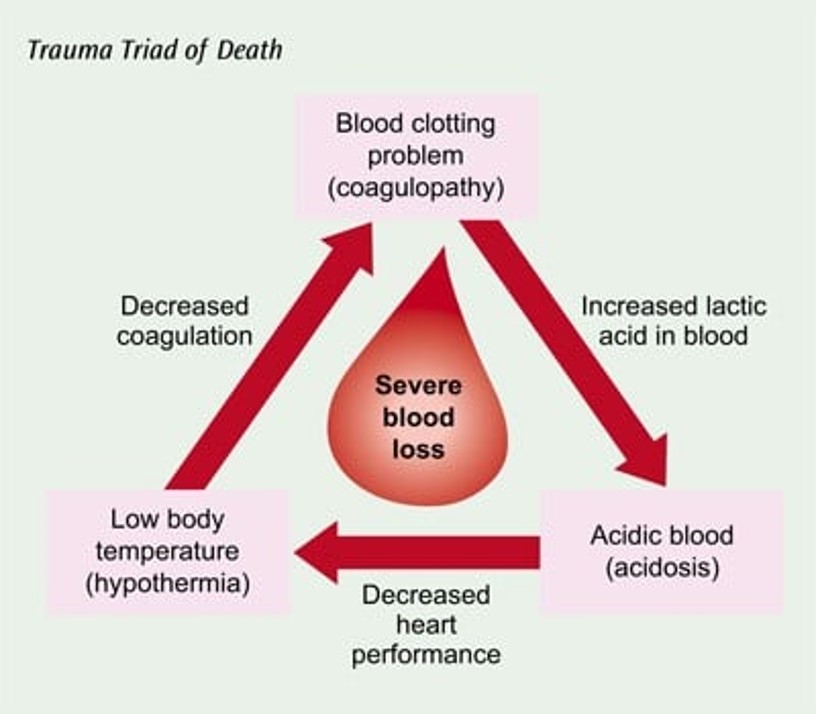
Why can coagulopathy result in acidosis?
coagulopathy → increased lactic acid in blood → acidosis (acidic blood)
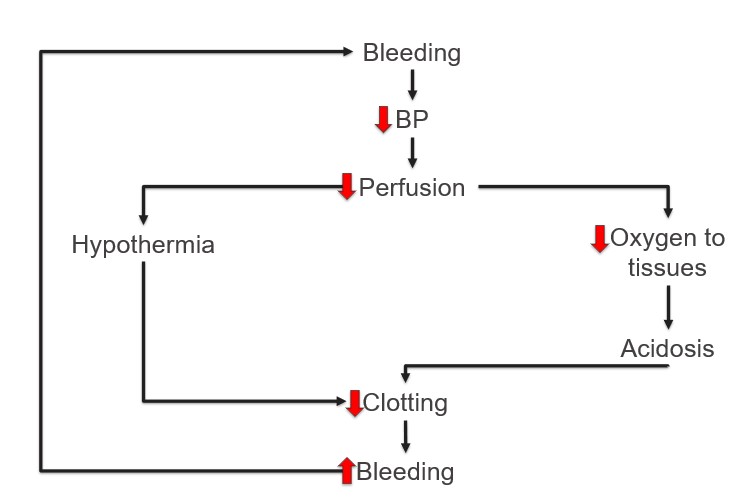
How can acidosis result in hypothermia?
acidosis → decreased heart performance → hypothermia (low body temperature)
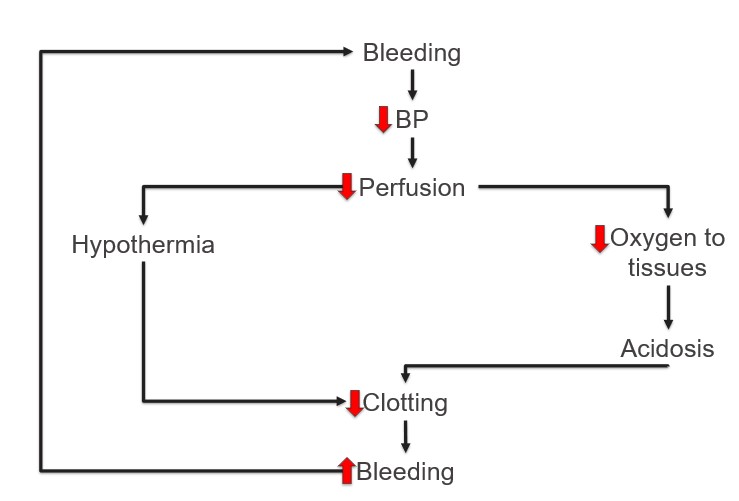
How can hypothermia result in coagulopathy?
hypothermia → decreased coagulation → coagulopathy
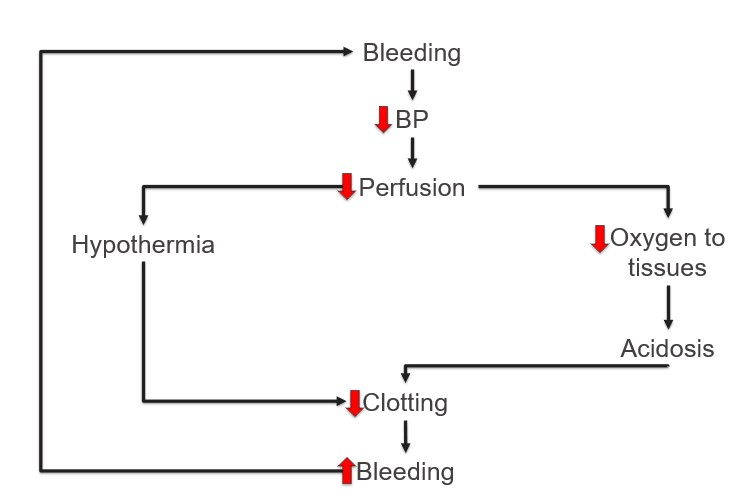
What is coagulopathy?
blood losses the ability to clot
What can cause coagulopathy?
trauma consumes clotting factors
hypothermia + acidosis → shuts down clotting pathways
dilution of clotting factors (too much saline)
liver cannot produce clotting factors fast enough → hypoperfusion
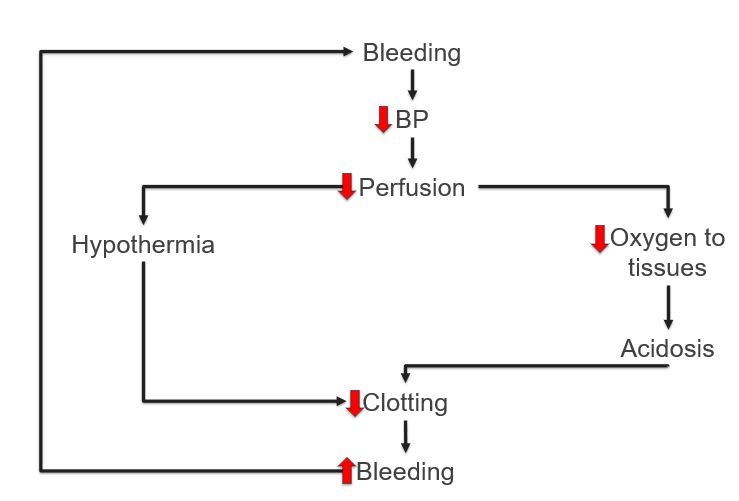
True or false: hypothermia and acidosis shut down clotting pathways.
true
What can happen if too much saline is given?
What is hypoperfusion?
What are the dangers of coagulopathy?
How can coagulopathy be prevented?
What is acidosis?
What can cause acidosis?
severe bleeding → decreased blood volume → decreased perfusion → less oxygen to cells
switch to anaerobic metabolism → production of lactic acid → metabolic acidosis
note: remember the trauma triad of death
What are the dangers of acidosis?
acidic environment in the blood inactivates enzymes responsible for clotting
causes heart and brain function to decrease
eventually = multi-organ failure
How can acidosis be prevented?
stop external bleeding ASAP
administer oxygen
ensure ventilation is adequate
maintain perfusion (blood pressure)
What is an abrasion?
What is a penetrating wound?
What is a puncture wound?
What is a laceration
What is evisceration
What is avulsion
What is tenting
What is shortening
What is rotation
What is ecchymosis
What is a hematoma
What is an contusion
What are deadly bleed indicators
steady or pulsatile bleeding
may not appear heavy
location/depth of wound involves danger areas
patient appears “sick”
vital signs indicate shock
multiple injuries
high energy/dangerous MOI
What are wound care indicators
wound should be well visualized
no more than a small amount of oozing collects within the wound
location/depth involves low risk areas
dorsal aspects of limbs
areas distal to the wrists
patient appears well perfused + alert
vital signs WNL (within normal limits)
no direct pressure applied prior to arrival
bleeding has stopped on its own (with all of the above findings also present)
What should be done with any impaled objects
stablilization of object
What should be used to clean surface injuries in (stable) patients
saline (sterlle water)
What should be done with embedded objects
they should be left in place
True or false: large surface contaminants should NOT be removed if possible
false
What should be considered during soft tissue injury management
underlying injuries to deep structures (nerves, vessels, bones, etc.)
What should protruding tissues/organs be covered with
non-adherent materials such as moist, sterile dressings, or plastic wrap
What should be done prior to splint application
dress and bandage open wounds
How can neurovascular status be restored
loosening of bandages
Should digits be wrapped individually or together
individually
Should the tips of fingers/toes be left uncovered or covered
uncovered (unless otherwise indicated by the Standards)
Why do we leave the tips of fingers/toes uncovered
allow for observations of neurovascular status
What are pulse motor sensation (PMS) assessments
check distal neurovascular function in limbs after injury
pulse = ensures blood flow
motor = checks nerve/muscle function
sensation = detects nerve integrity/sensory changes
When should PMS assessments be done
When is just a pulse check acceptable
What are the 6 P’s (and an A) of the PMS check
What are the steps of an amputation/avulsion assessment
How are amputation/avulsion injuries treated
What happens if a body part(s) cannot be found before transport
do NOT delay transport
attempt to engage others at the scene (allied agencies) to look for parts
if found, parts can be transported to the receiving facility
What are some important considerations regarding amputation/avulsion injuries
What can be assessed to determine visual disturbances after an eye injury
What should be assumed with all eye injuries
threats to vision
What else is assessed for (besides visual disturbances) in eye injuries
head injury
What should be done if eyelids are swollen shut
nothing (leave them alone)
How should eye injury bleeds be controlled
absolute minimum pressure required
What should be done if injury/pain is severe and injury is unilateral
cover both eyes (affected + non-affected)
When should any kind of manipulation/palpation/irrigation/direct pressure be avoided
if obvious (or suspected) rupture of the globe
What should be done if the eye is extruding (avulsed)
do NOT replace inside the socket
cover eye with a moist, sterile dressing
protect/stabilize as if it is an impaled object
advise patient to keep eye movements to a minimum
transport supine with head elevated 30 degrees
How can avulsed eyes be protected and stabilized
What are chemotactic factors
chemicals released by white blood cells that attract more white blood cells to an area of inflammation
What is erythema
Why might ecchymosis not be evident during pre-hospital care
develops over time
What is a crush injury
What is crush syndrome
Dark red hemorrhage can indicate which type of injury
venous injury
Red hemorrhage can indicate which type of injury
capillary injury
Bright red hemorrhage can indicate which type of injury
arterial
Why is it that clean lacerations and amputations may not bleed profusely
What is hyperemia
Why is hyperemia important after an injury
brings oxygen and phagocytes to the injured area
draws away the by-product of cell destruction and repair
What are the first cells to arrive to the site of injury during the inflammatory process
granulocytes
What is compartment syndrome
How is compartment syndrome managed
What is necrosis
What is rhabdomyolysis
What are the different compartments of the leg
What are the splinting priorities (according to BLS PCS)
spine (neck; thoraco-lumbar; head)
pelvis
femur
lower legs
upper limbs