ECG C1: Anatomy of the Heart
 Call Kai
 Learn
Learn Practice Test
 Spaced Repetition
 Match
Match Flashcards
 Knowt Play
1/48

There's no tags or description
Looks like no tags are added yet.
Name | Mastery | Learn | Test | Matching | Spaced | Call with Kai |
|---|
No analytics yet
Send a link to your students to track their progress
49 Terms
Pericardial fluid acts a _________ to the heart during contractions.
Lubricant
The _________ view of the heart is also called the frontal view, whereas the posterior view is also called the _________ view.
Anterior; dorsal
The purpose of the _________ side of the heart is to pump blood throughout the body.
Left
The 12-lead ECG views from the heart from the _________ wall, _________ wall, _______ wall, and the ________ wall.
Lateral; anterior; apical; septal
The heart is located in the ________ cavity between the two _________.
Thoracic; lungs
True or False: Oxygen-poor blood is pumped from the right ventricle into the pulmonary vein to the lungs.
False: Blood goes to the pulmonary artery to the lungs. Oxygen-rich blood returns to the heart through the pulmonary veins.
True or False: The left atrium pumps blood through the tricuspid valve into the left ventricle.
False: Blood is pumped through the mitral valve into the left ventricle
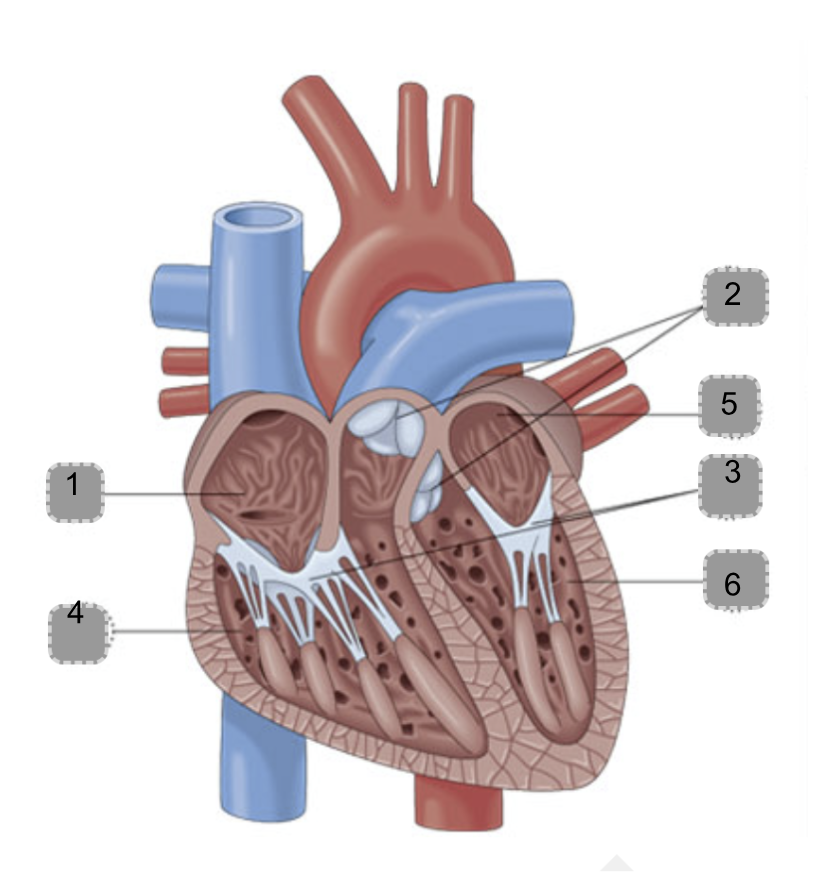
Label the following:
Right Atrium
Semilunar Valves
Atrioventricular Valves
Right Ventricle
Left Atrium
Left Ventricle
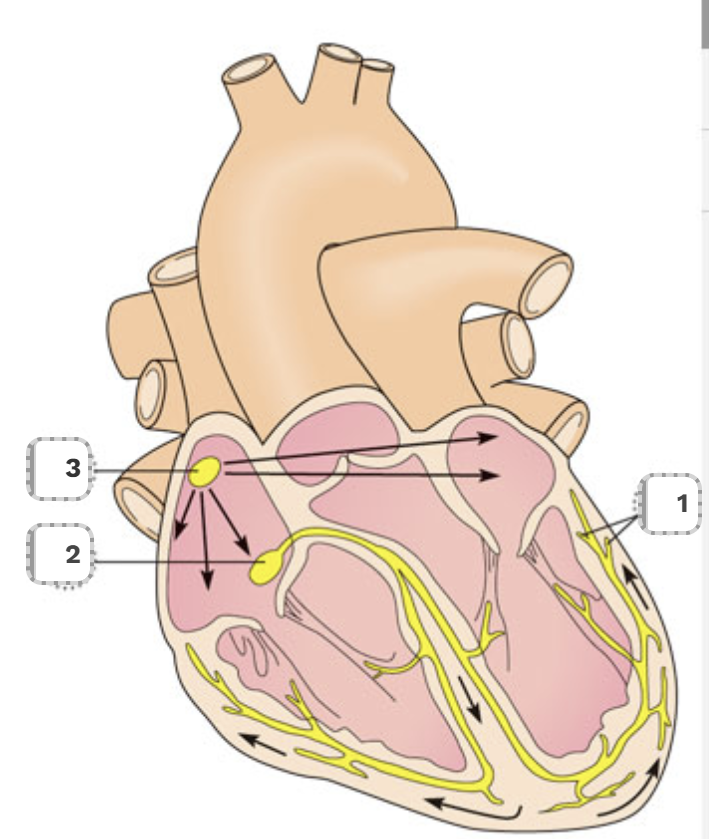
Label the following:
Purkinje’s Fibers
Atrioventricular Node
Sinoatrial Node (Pacemaker)
The heart consists of two upper chambers, called the right and left ________, and two lower chambers, called the right and left _______
Atrium; Ventricles
The _____________ (AV) valves separate the ________ from the __________.
Atrioventricular; atria; ventricles
The _________ valve has two cusps, whereas the other three valves have three cusps each.
Mitral or bicuspid
In a state of relaxation, the ________ valves are closed to allow the right and left _______ to fill with blood.
Atrioventricular; atrium
As the ventricles contract, the ________ valve opens to allow blood to enter the ________.
Pulmonic; lungs
The __________ cell layer is located next to the blood flow in blood vessels, whereas the ________ is the exterior cell layer.
Endothelial; epithelial
________ muscle cells provide for the movement of fluids through blood vessels.
Smooth
Smooth muscle cells are responsible for the ________ and _______ of the diameter of blood vessels.
Constriction; dilation
________ have the ability to produce an electrical current, causing the heart muscle to _________
Cardiomyocytes; contract
Cardiomyocytes are classified as _________, _________, and ________ muscles
Striated; branched; involuntary
The atrioventricular valves are held in place by _________ muscles.
Papillary
Ventricular walls are separated by a muscular wall called the _________.
Intraventricular Septum
The heart wall is composed of three types of tissue. The innermost layer is composed of _______ tissue, the middle layer is composed of ________ tissue, and the outermost layer is composed of ________ tissue.
Endocardium; Myocardium; Epicardium
The thickest layer of heart wall is the ________ layer.
Myocardium
Normal heart conduction begins in the ___________, then travels to the ___________, which is located near the lower right side of the ____________, and finally travels into the _________ system.
Sinoatrial (SA) Node; Atrioventricular (AV) Node; Right Atrium; His-Purkinje System
__________ circulation is blood flow between the heart and the lungs, whereas _______ circulation is blood flow to the body (except the lungs).
Pulmonary; Systemic
The volume of blood that is pumped in one minute by either ________ determines cardiac ________
Ventricle; Output
_________ occurs when arterial pressure is forced to increase.
Vasoconstriction
The change in blood pressure as the blood moves through the vessels of the body is known as ________.
Total Peripheral Resistance (TPR)
Blood pressure decreases when the _________ and the vascular resistance decreases.
Body temperature
In a(n) ______ position, the tricuspid valve releases blood from the right atrium to the right ventricle.
Open
In a closed position, the ______ valve holds blood in the right atrium.
Tricuspid
In an open position, the ______ valve releases blood from the left atrium into the left ventricle.
Mitral
In a closed position, the mitral valve _________________.
holds blood in the left atrium
In a(n) ______ position, the pulmonic valve releases blood from the right ventricle into the lungs.
open
In a closed position, the _______ valve holds blood in the right ventricle.
Pulmonic
In a(n) _______ position, the aortic valve releases blood from the left ventricle into the body.
open
In a(n) _______ position, the aortic valve holds blood in the left ventricle.
closed
Arterioles control ________ blood flow and determine ________________ resistance.
systemic; total peripheral
Oxygenated blood flows _____ from the heart, except for the pulmonary artery, which carries deoxygenated blood from the right ventricle to the _______.
away; lungs
The largest blood vessel in the body is called the ______.
Aorta
The _____________ is a vein that drains blood from the upper body into the ______ atrium.
Superior Vena Cava; right
The atrioventricular groove surrounds the _______ surface of the heart.
external
The ______________ is a vein that drains blood from the lower body into the _______ atrium.
Inferior Vena Cava; right
Typical weight of adult female heart:
8-10 ounces
Typical weight of male adult heart:
10-12 ounces
Dimensions of heart:
2.5-3.5 in (6-9 cm) wide; 5 in (12-13 cm) long
The base of the heart refers to the:
Top of the heart. It is level with the third rib.
The apex of the heart refers to the:
Bottom of the heart. It projects downward to the left, right above the diaphragm.
Starting in the Right Atrium, list the flow of blood through the heart:
Right Atrium → tricuspid valve → Right Ventricle → Pulmonic Valve → Pulmonary Artery → Lungs → Pulmonary Veins → Left Atrium → bicuspid valve → Left Ventricle → aortic valve → aorta → body