Four primary tissue types
 Call Kai
 Learn
Learn Practice Test
 Spaced Repetition
 Match
Match Flashcards
 Knowt Play
1/87

There's no tags or description
Looks like no tags are added yet.
Name | Mastery | Learn | Test | Matching | Spaced | Call with Kai |
|---|
No analytics yet
Send a link to your students to track their progress
88 Terms
What forms the four primary tissue types
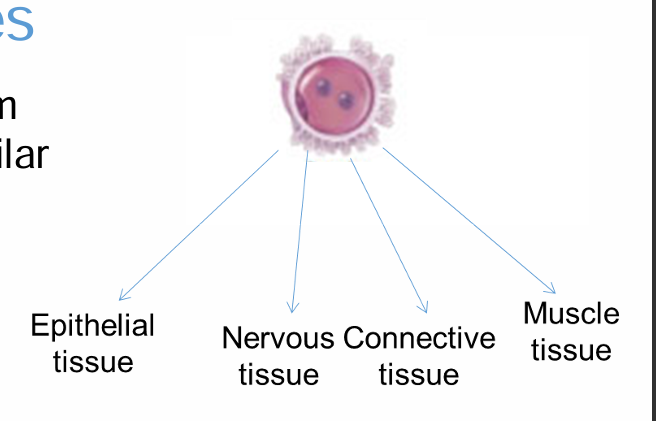
Cell differentiation from stem cells
Creates collections of similar specialised cells
Stem cells → specialised cells → four tissue types → tissues combine to form organs.
What are the four primary tissue types
Epithelial tissue
Connective tissue
Muscle tissue
Nervous tissue
What do organs consist of
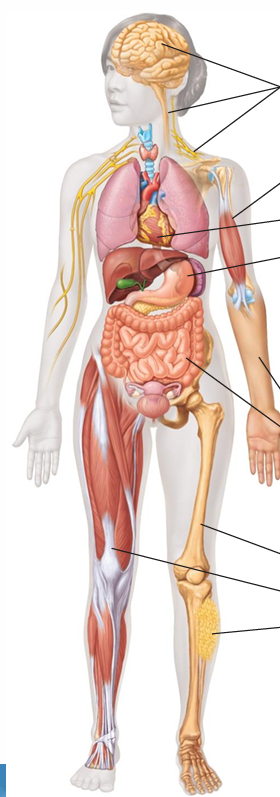
Combinations of all four tissue types
Nervous tissue main function
Internal communication
Nervous tissue locations
Brain
Spinal cord
Nerves
Muscle tissue main function
Contracts to cause movement
Muscle tissue locations
Skeletal muscles (attached to bones)
Cardiac muscle (heart)
Smooth muscle (walls of hollow organs)
Epithelial tissue main function
Forms boundaries
Protects
Secretes
Absorbs
Filters
Epithelial tissue locations
Skin surface (epidermis)
Lining of GI tract and other hollow organs
Connective tissue main function
Supports
Protects
Binds other tissues together
Connective tissue locations
Bones
Tendons
Fat and soft padding tissues
What is nervous tissue the main component of
Brain
Spinal cord
Nerves
What is nervous tissue composed of
Neurons
Supporting cells
What is the function of nervous tissue
Communication
Transmits electrical signals
Regulates and controls body functions
What is muscle tissue composed of
Muscle cells containing contractile microfilament
What is muscle tissue specialised for
Contraction to allow movement
Three types of muscle tissue
Skeletal muscle
Cardiac muscle
Smooth muscle
Skeletal muscle - describe
Voluntary
Produces skeletal movement
Cardiac muscle - describe
Involuntary
Found in the heart
Smooth muscle - describe
Involuntary
Found in blood vessels, gut, bladder, uterus
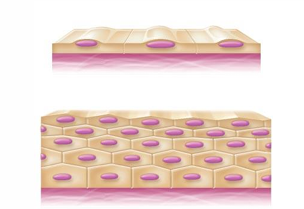
What is epithelium
A sheet of cells that covers the body, lines cavities and organs, and forms glands
What is epithelial tissue composed of
Epithelial cells forming continuous sheets
Does epithelial tissue have blood vessels
No — it is avascular
Oxygen and nutrients diffuse from underlying connective tissue
Does epithelial tissue contain nerves
Yes — it is innervated
Epithelial Tissue Functions
Protection
Absorption
Excretion
Filtration
Secretion
Transport of mucus
Sensory function
Epithelial Tissue Functions - Protection
Forms a barrier to protect underlying tissues from injury, pathogens, and dehydration
Epithelial Tissue Functions - Absorption
Takes in substances such as nutrients (e.g., in the intestines)
Epithelial Tissue Functions - Excretion
Removes waste products from the body or from cells (e.g., sweat, urine components)
Epithelial Tissue Functions - Filtration
Allows selective movement of substances, especially in structures like the kidneys
Epithelial Tissue Functions - Secretion
Produces and releases substances such as mucus, enzymes, and hormones
Epithelial Tissue Functions - Transport of mucus
Ciliated epithelial cells move mucus along surfaces (e.g., respiratory tract)
Epithelial Tissue Functions - Sensory function
Contains sensory receptors that detect stimuli (e.g., touch, pressure)
What is connective tissue
The connecting tissue of the body
Most abundant and widely distributed tissue type
What are the three basic components of connective tissue
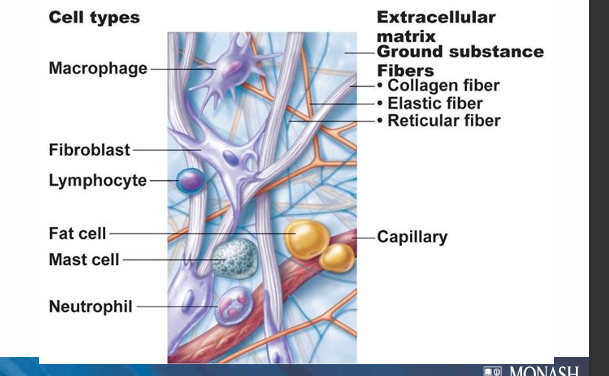
Specialised cells
Ground substance
Protein fibres
What is the extracellular matrix (ECM) in connective tissue
A combination of ground substance + fibres
Makes up most of the tissue
Cells are few and widely separated
Connective Tissue — Cell Types
Fibroblasts
Produce fibres and ground substance
Macrophages
Engulf and digest pathogens and debris
Lymphocytes
Immune defence cells
Mast cells
Release histamine during inflammation
Neutrophils
Short‑lived immune cells that attack bacteria
Fat cells (adipocytes)
Store energy as fat
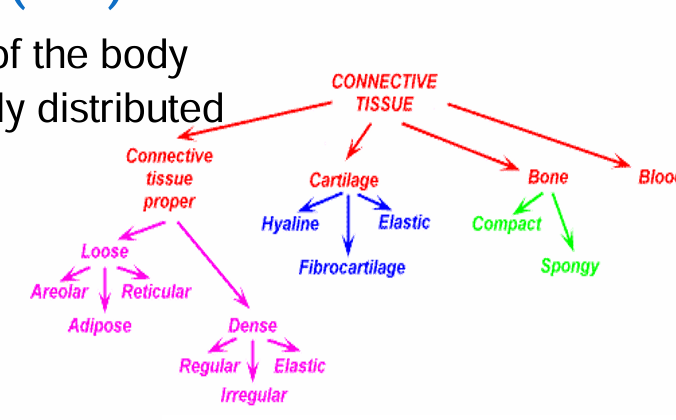
Connective Tissue — Classifications (branch one)
Connective tissue proper → loose/dense
Cartilage
Blood
Bone
Connective Tissue Proper — Loose CT
Areolar
Reticular
Adipose
Connective Tissue Proper — Dense CT
Dense regular
Dense irregular
Elastic
Cartilage Types
Hyaline
Elastic
Fibrocartilage
Bone Types
Compact bone
Spongy bone
Blood
A fluid connective tissue
Which tissue type is the most diverse
Connective tissue
Why is connective tissue the most diverse
It includes many different subtypes with very different structures and functions
e.g., areolar, adipose, dense CT, cartilage, bone, blood
Why is epithelial tissue more susceptible to damage
It is exposed to the external environment, so it experiences friction, pathogens, chemicals, and physical stress.
How does epithelial tissue cope with this
It has a high rate of cell division and regeneration, allowing rapid repair and replacement of damaged cells.
What is the ECM
A non‑living substance surrounding the cells
Composed of ground substance and protein fibre
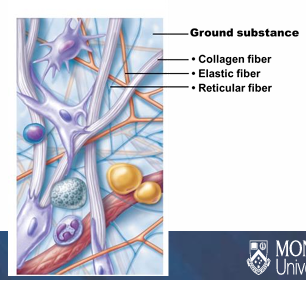
What is ground substance
Unstructured material filling the space between cells
Contains protein fibre
What does ground substance do
Holds a large volume of water (interstitial fluid)
Can range from liquid → gel → solid
Types of protein fibres
Collagen fibres
Elastic fibres
Reticular fibres
Collagen fibres - describe
Tough
High tensile strength
Resist twisting and pulling forces
Elastic fibres - describe
Long, thin fibres
Allow stretch and recoil
Reticular fibres - describe
Short fibres
Continuous with collagen fibres
Form delicate supporting networks
Why can connective tissue bear weight and withstand tension
Because of its ECM, especially strong collagen fibres and water‑rich ground substanc
What do all classes of CT have
A resident cell type in both immature and mature forms
What suffix do immature CT cells have
“‑blast”
What do “blast” cells do
Secrete ground substance and fibres
Build the extracellular matrix
Example: fibroblasts
What suffix do mature CT cells have
“‑cyte”
What do “cyte” cells do
Maintain the matrix
Example: fibrocytes
What do Adipocytes do
Store fat
What do Macrophages do
Engulf pathogens and debris
What do Mast cells do
Release histamine during inflammatio
Connective Tissue Proper - immature, mature
Fibroblasts (immature)
Fibrocytes (mature)
Cartilage - immature, mature
Chondroblasts
Chondrocytes
Bone - immature, mature
Osteoblasts
Osteocytes
Blood - immature, mature
Haematopoietic stem cells (“blast” form)
Erythrocytes (RBCs)
Leukocytes (WBCs)
What is connective tissue proper
A major category of CT with 6 subclasses (loose + dense) — you do not need to know the 6
What specialised cells does CT proper contain
Fibroblasts (immature)
Fibrocytes (mature)
What other tissue does CT proper include
Adipose tissue, which contains adipocytes
Functions of CT proper
Support
Binding
Storage
Insulation
What are the 3 types of cartilage
Hyaline
Elastic
Fibrocartilage
What is cartilage structurally like
Has qualities between dense CT and bone
What is the ECM of cartilage like
Up to 80% water
Contains collagen and some elastic fibres
Allows cartilage to withstand tension and compression
What specialised cells does cartilage contain
Chondroblasts (immature)
Chondrocytes (mature)
Does cartilage have nerves or blood vessels
No — it is avascular and lacks nerve fibre
Functions of cartilage
Support
Absorb compression
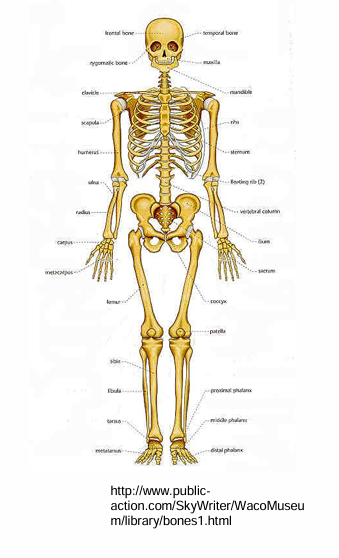
What is bone made of
Abundant collagen fibres
A hard matrix due to calcium phosphate crystals
Which cells does bone contain
Osteoblasts — produce the organic portion of the matrix
Osteocytes — resorb bone when needed
Does bone have blood vessels and nerves
Yes, bone contains both
Functions of bone
Support
Protection
Storage
What is blood
A fluid within blood vessels
Blood cells surrounded by a liquid matrix called plasma
What cells does blood contain
Erythrocytes (RBCs)
Leukocytes (WBCs)
Platelets
Function of blood
Transport substances throughout the body
Where does all connective tissue come from
Mesenchyme (an embryonic tissue)
What is loose connective tissue
CT with a loose arrangement of fibres
Contains lots of ground substance
What does this structure allow
Flexibility
Space for diffusion, nutrients, and immune cell
What is dense connective tissue
CT with closely packed bundles of fibres
Contains very little ground substance
What does this structure allow
High tensile strength
Ability to resist pulling forces