Optics
 Call Kai
 Learn
Learn Practice Test
 Spaced Repetition
 Match
Match Flashcards
 Knowt Play
1/66

There's no tags or description
Looks like no tags are added yet.
Name | Mastery | Learn | Test | Matching | Spaced | Call with Kai |
|---|
No analytics yet
Send a link to your students to track their progress
67 Terms
Light
Electromagnetic radiation. Light is both a particle and a wave. When it is a particle, it is known as a photon, a massless packet of energy. When it is a wave, it is known as a stream of photons travelling in a wave-like pattern.
Visible Light
Electromagnetic radiation that can be seen by humans. Everything else cannot be seen without the use of special equipment.
Natural Sources of Light
Light created without human involvement:
- Sun
- Stars
- Fire
- Lava
- Bioluminescence
Artificial Sources of Light
Light created with human involvement:
- Flashlight
- Lightbulbs
- Device screens
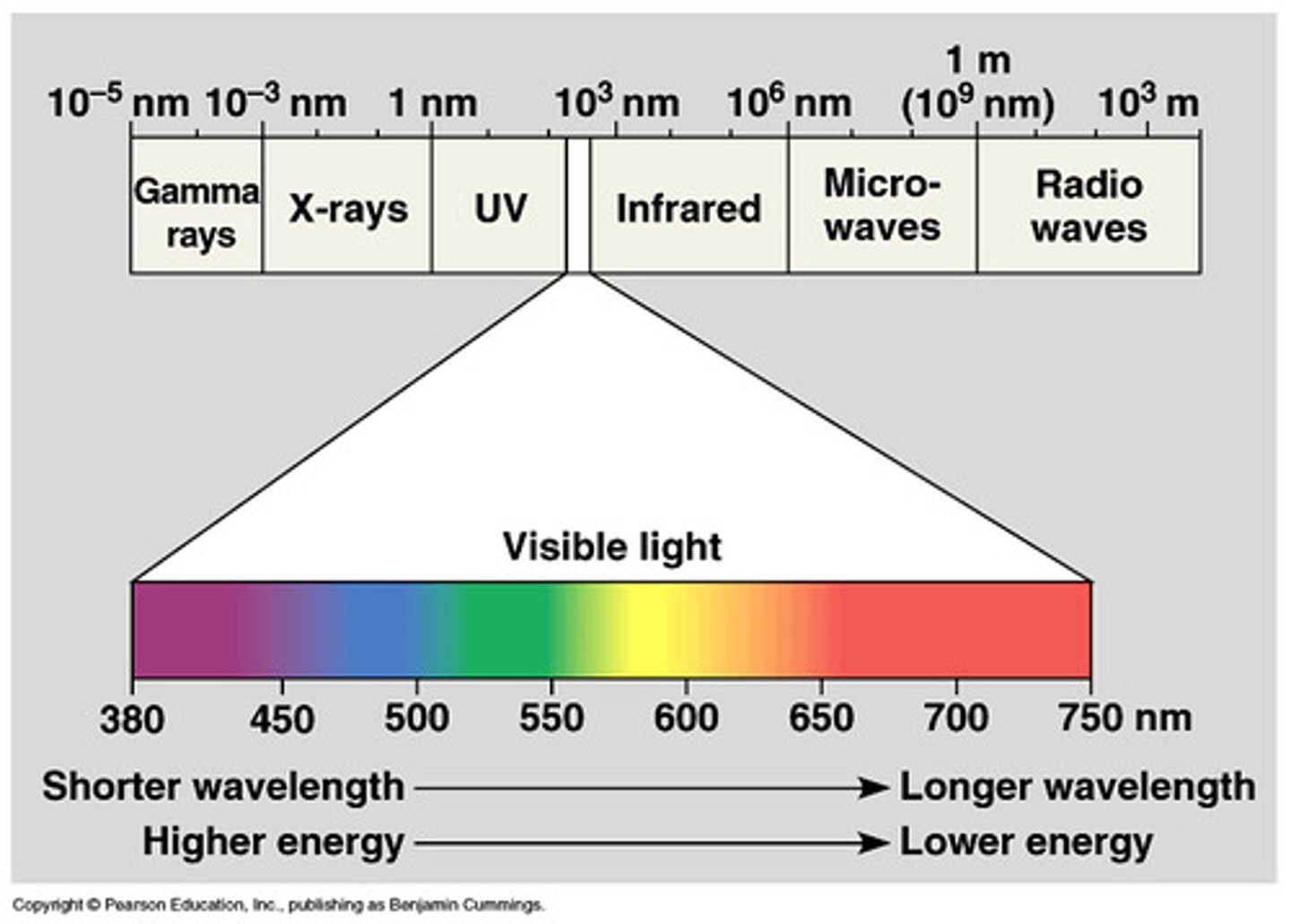
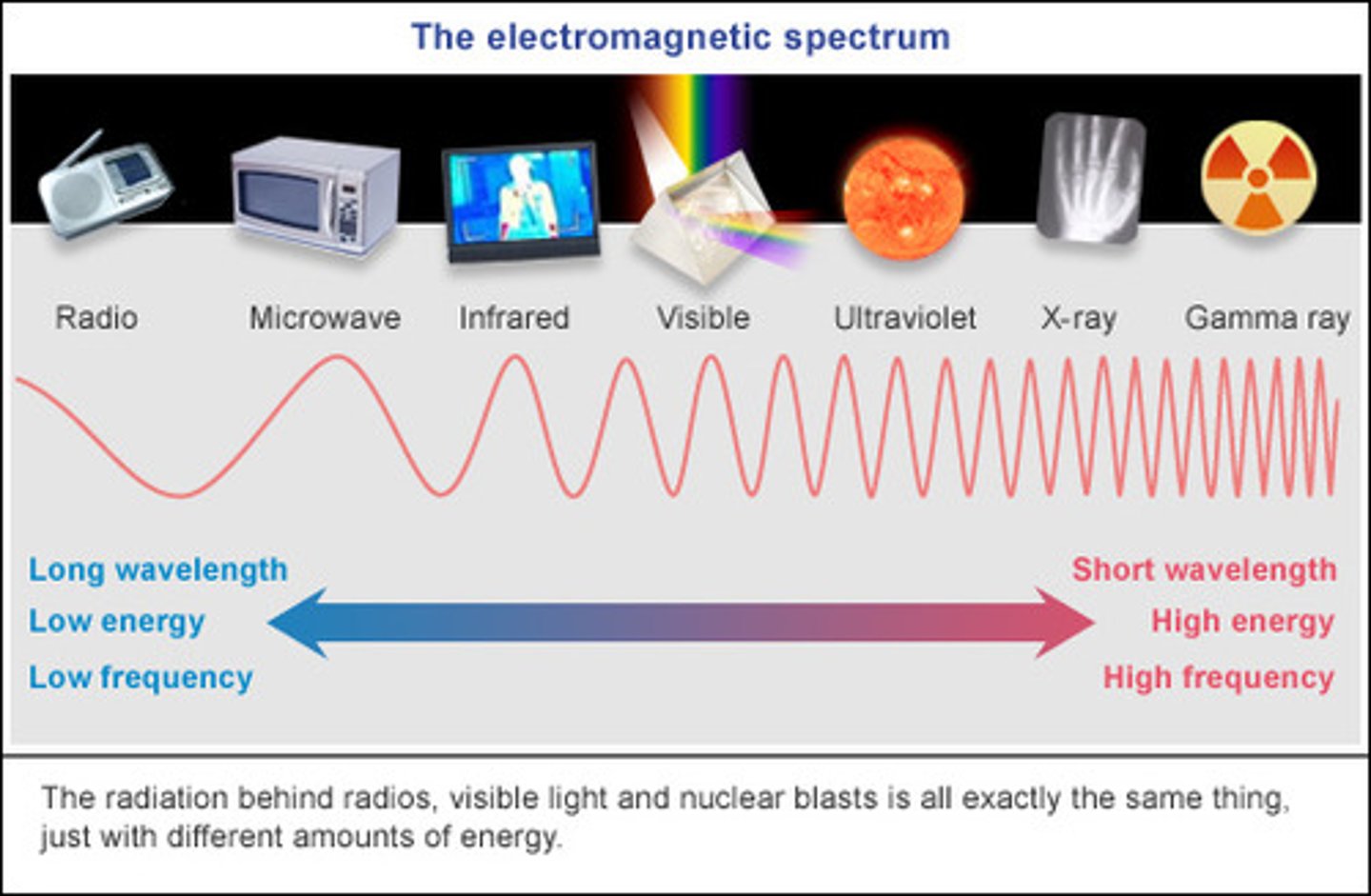
Electromagnetic Spectrum (EM)
The range of all types of electromagnetic (EM) radiation or wavelengths.
Long wavelengths have low energy and low frequency (easy to remember as all the terms start with "L")
Short wavelengths have high energy and high frequency. (Think of me or Martin when you read one of these terms. We're short, but we have loads of energy and therefore frequency)
Wave Model of Light
A way of explaining the behavior of light; involves picturing it travelling as a wave.
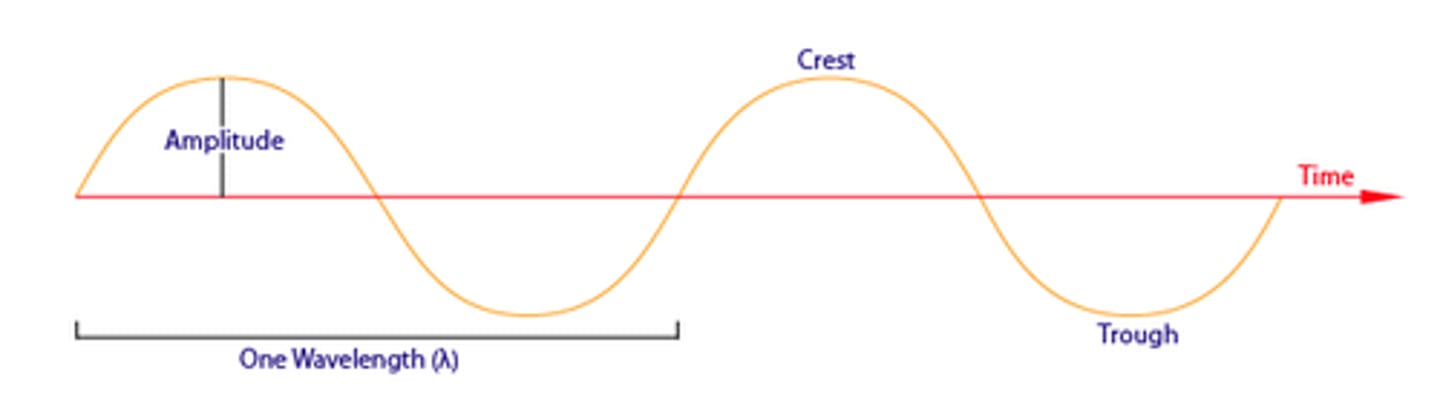
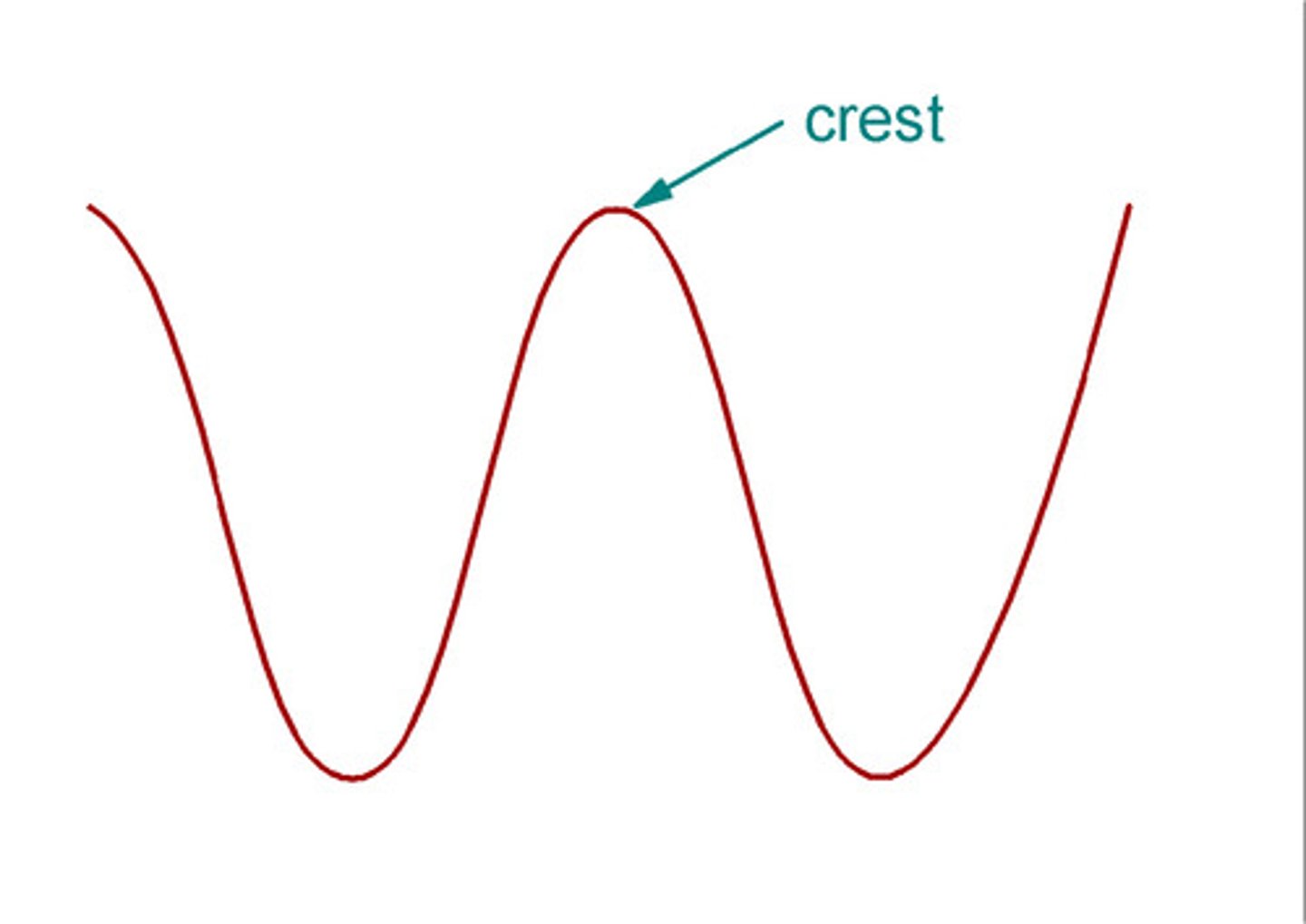
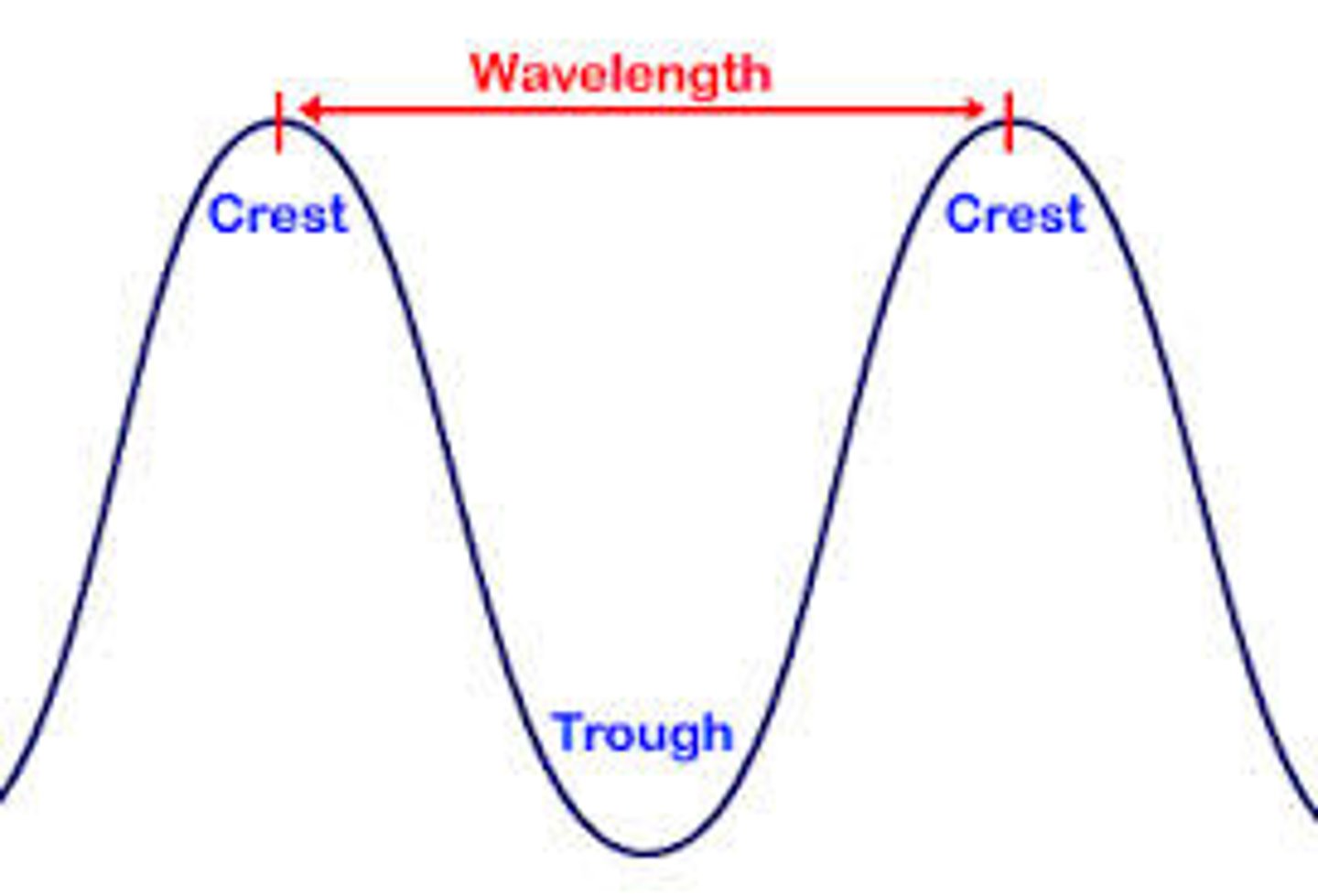
Crest
The highest point of a wave.
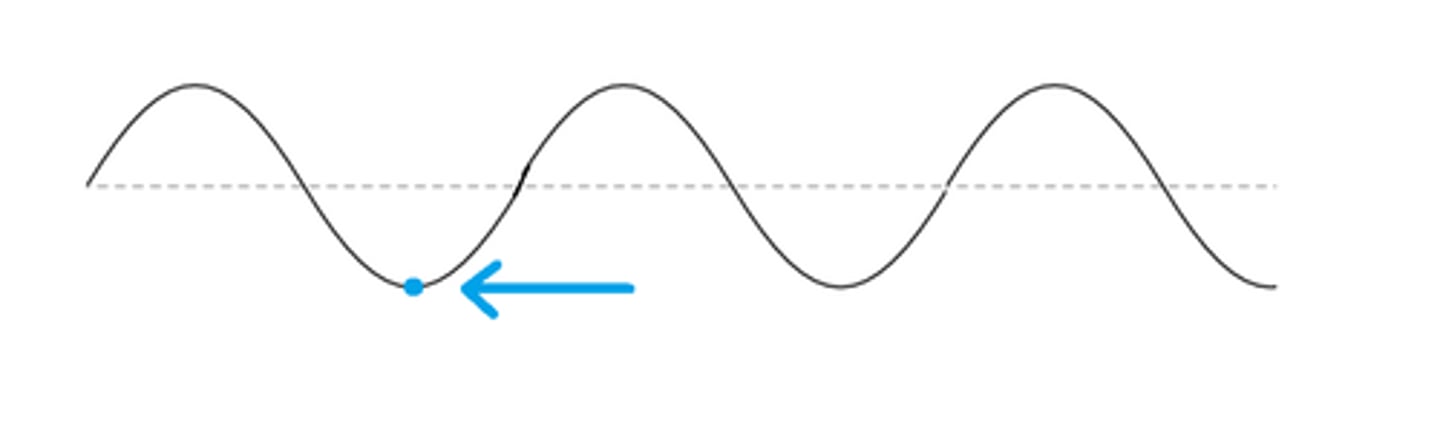
Trough
The lowest point of a wave.
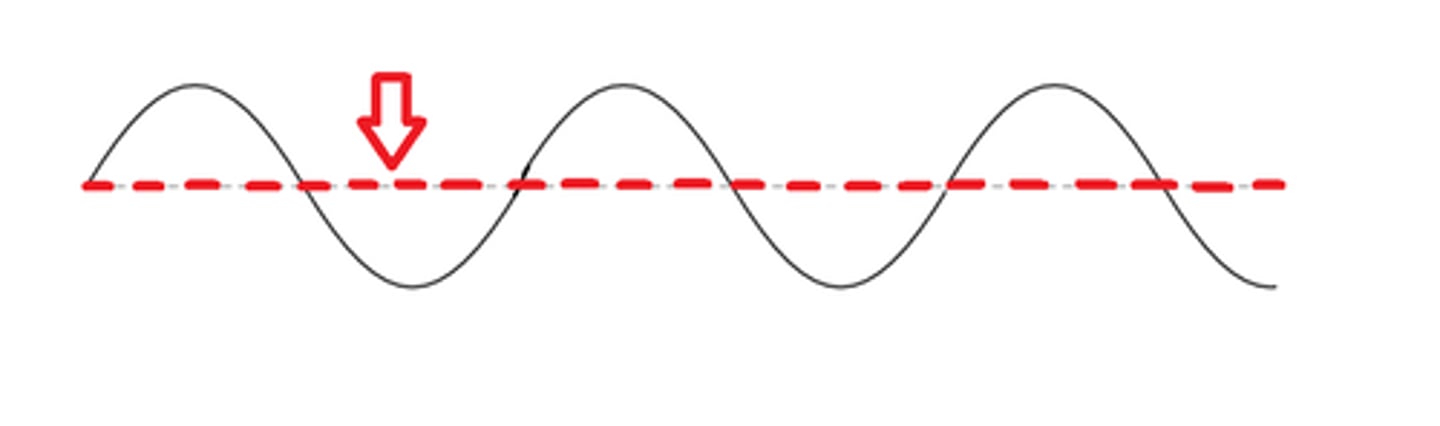
Rest Position
The position where the wave is at rest, halfway between the crest and trough.
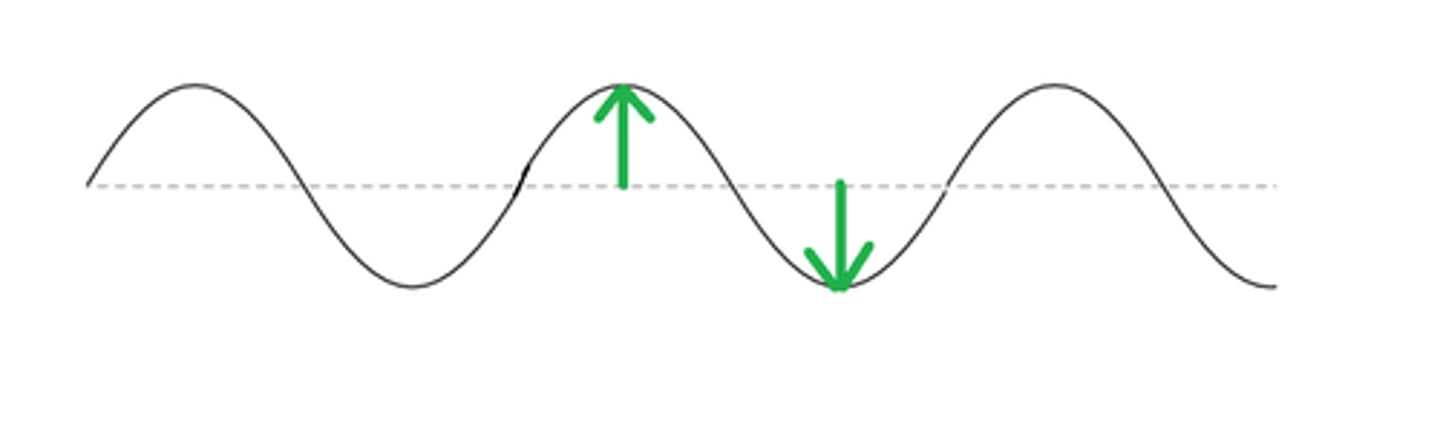
Amplitude
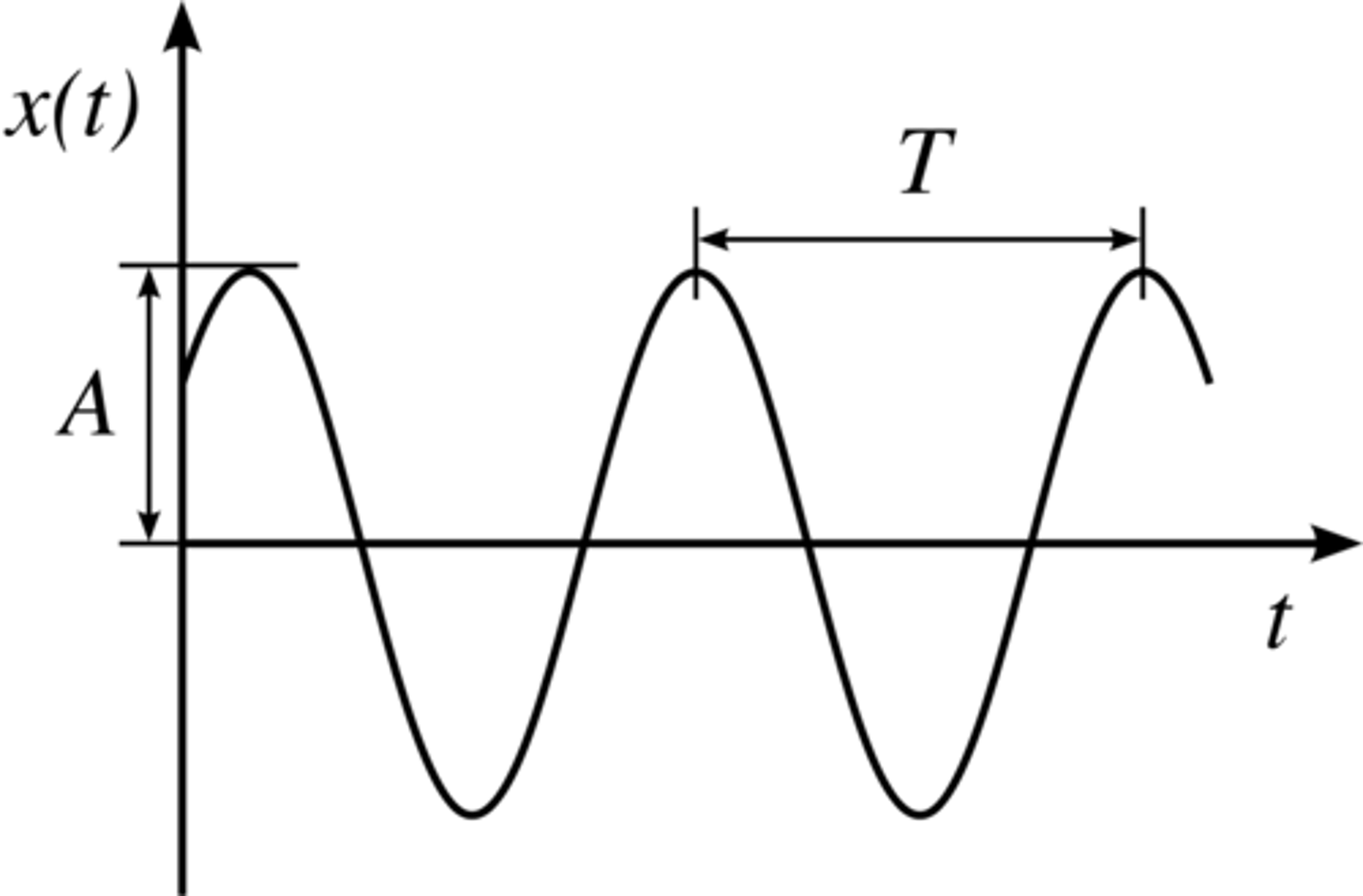
Height of a wave (distance from the equilibrium to a crest or trough.)
Wavelength
Distance between two crests or two troughs.
Labelled as the greek symbol lambda: λ
Formula: λ = c / f
c or v is speed (note: c is used to refer to the speed of light in a vacuum, while v is for all other mediums)
f is frequency
Oscillation
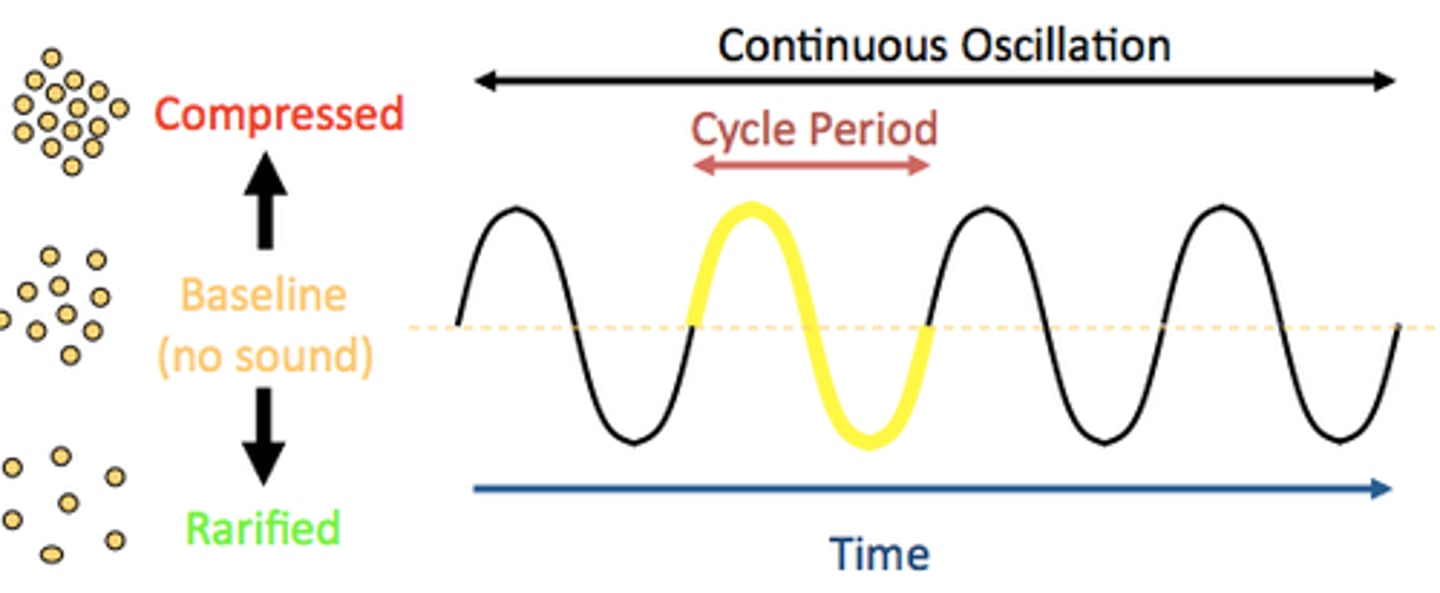
The act of a wave moving up and down / cycle between up and down.
Period
How long it takes for a wave to return to the same state, e.g. the time between two crests or troughs.
Do not confuse with frequency, which is # of cycles per 1 second, whereas period is # of seconds per 1 cycle.
Labelled as capital "T"
Formula: T = 1/f (f is frequency)
Measured in seconds.
Frequency
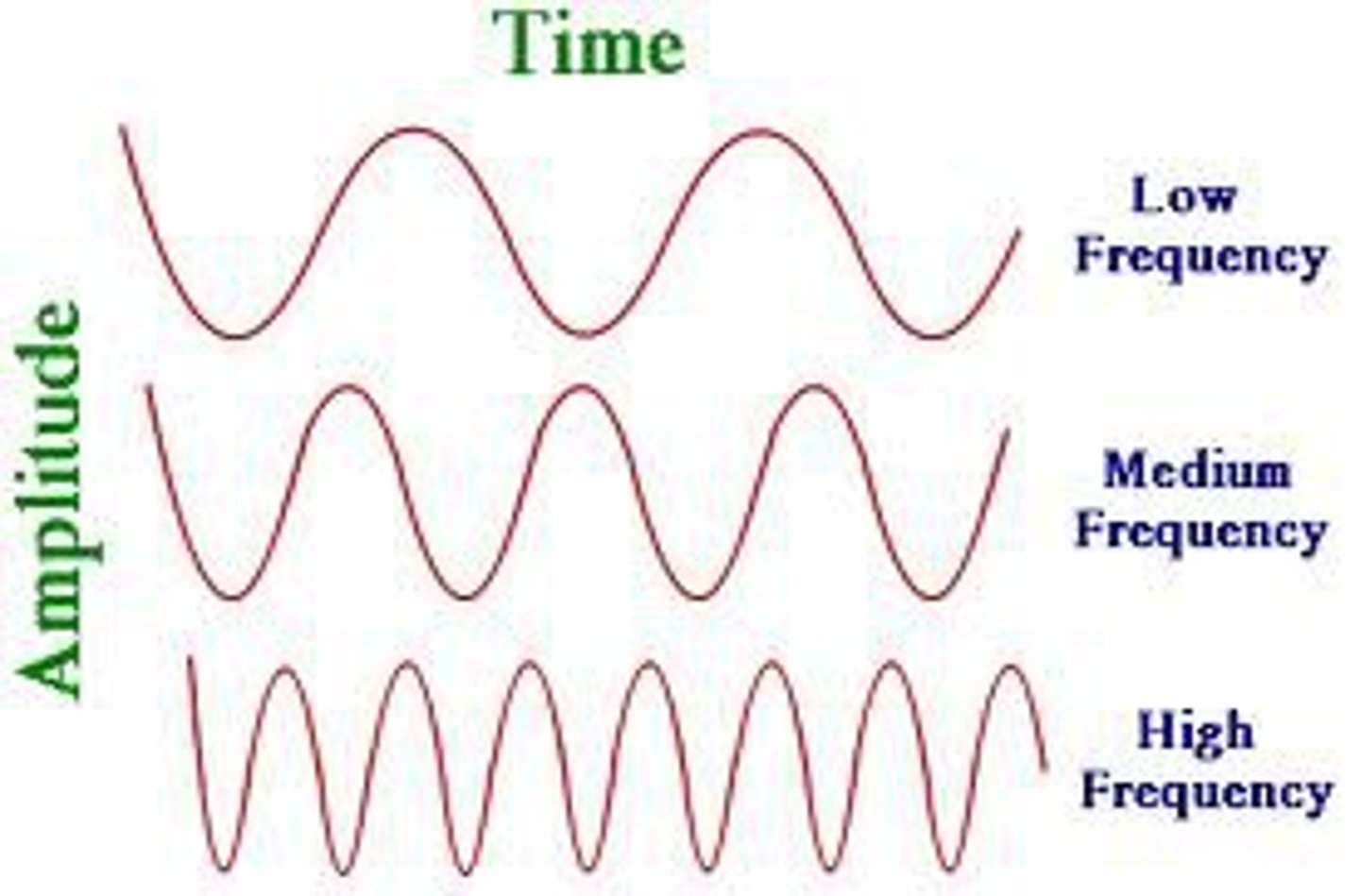
The number of complete wavelengths that pass a point in a given time. Wavelength and Frequency are inversely proportional to each other.
Shorter/Skinny Wavelengths = Higher Frequency
Longer/Wider Wavelengths = Low Frequency
Think of it as short wavelengths being skinny, which allows more of them to fit inside a given time. Long wavelengths are wide, which means less can fit inside a given time.
Measured in hertz (Hz)
Labelled as lowercase "f"
Formulas:
f = 1/T
f = c/λ
Energy
Directly proportional to frequency.
High Frequency = High Energy
Low Frequency = Low Energy
Speed
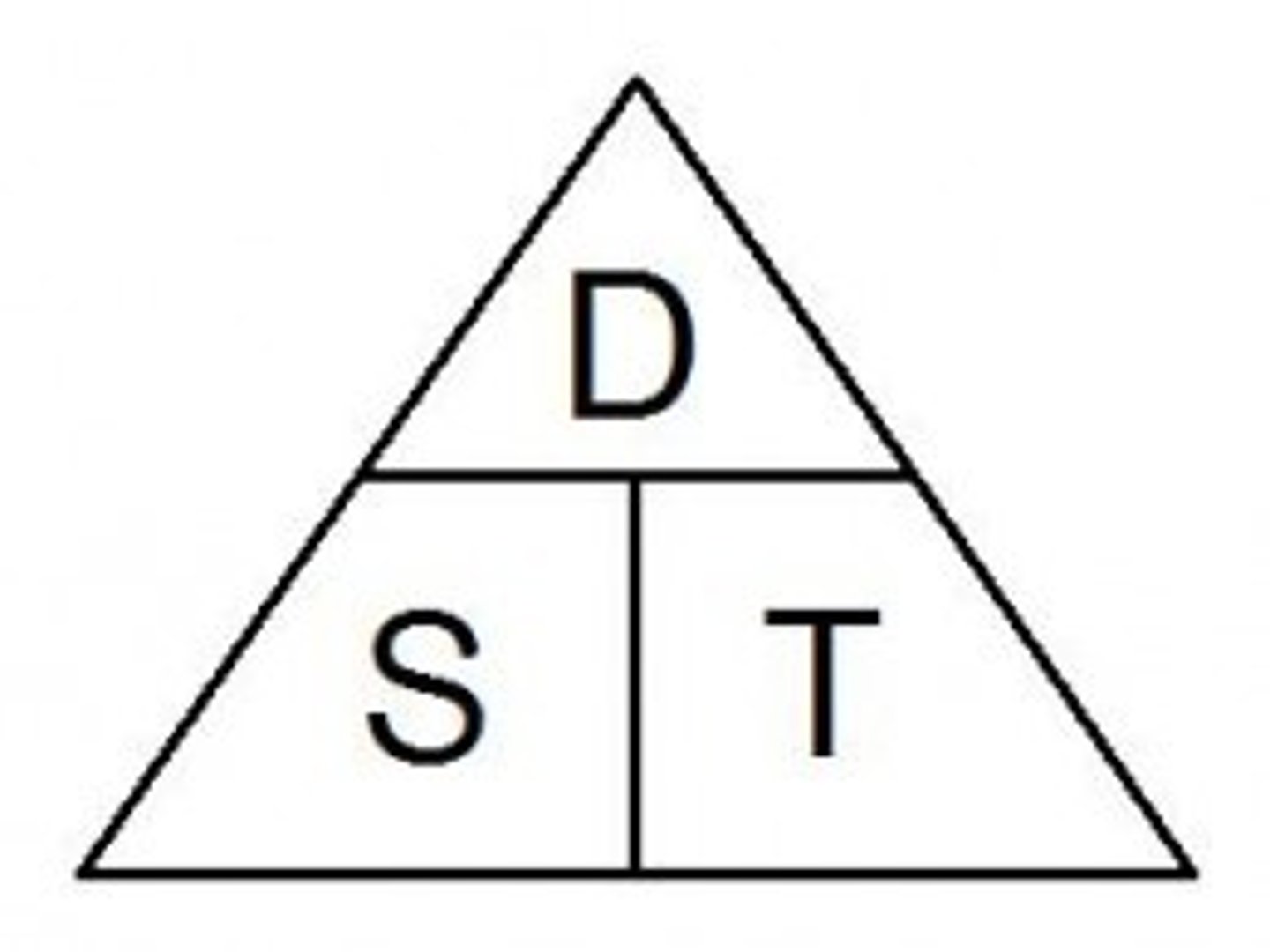
The distance a wave travels over time. Labelled as "c" when referring to the speed of light in a vacuum, and "v" when referring to the speed of light in other mediums (forms of matter, water, diamond, etc.) There are two formulas to calculate it:
c = f (frequency) * λ (wavelength)
c = distance / time
If given T (period), it can be used as time in the second formula or be converted into f (frequency) in the first formula.
Speed of Light
How fast light travels in a vacuum: 3.00 x 10^8 m/s
Light will move slower in water and other mediums.
Important Formulas
Speed (c):
c = f * λ
c = distance / time
Frequency (f):
f = 1/T
f = c / λ
Period (T):
T = 1/f
Wavelength (λ):
λ = c / f
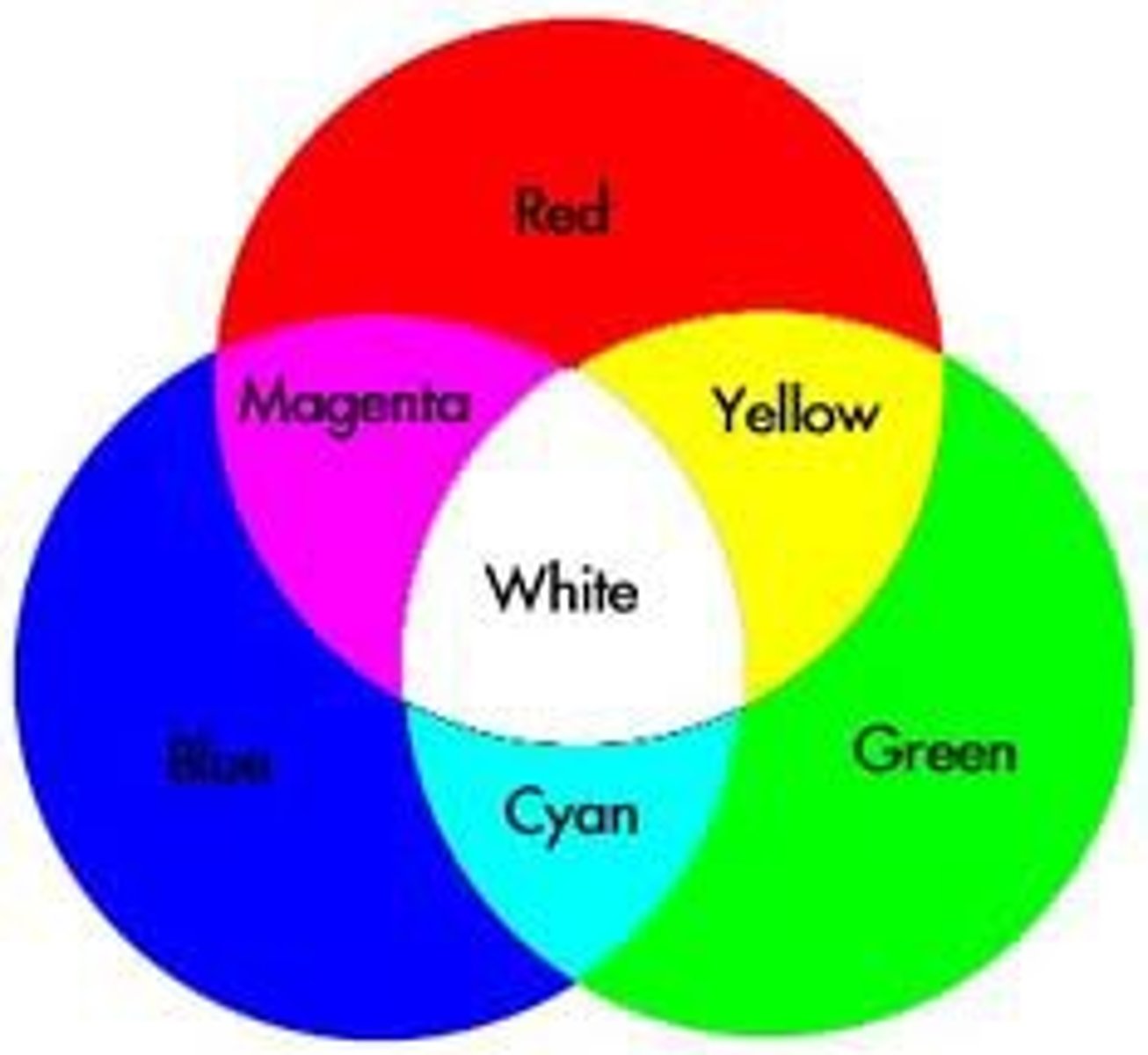
Additive Colour Theory
Theory of light stating all visible colours are made by combining three primary colours, red, blue, and green. This is because the cones in our retina can only detect these 3 colours.
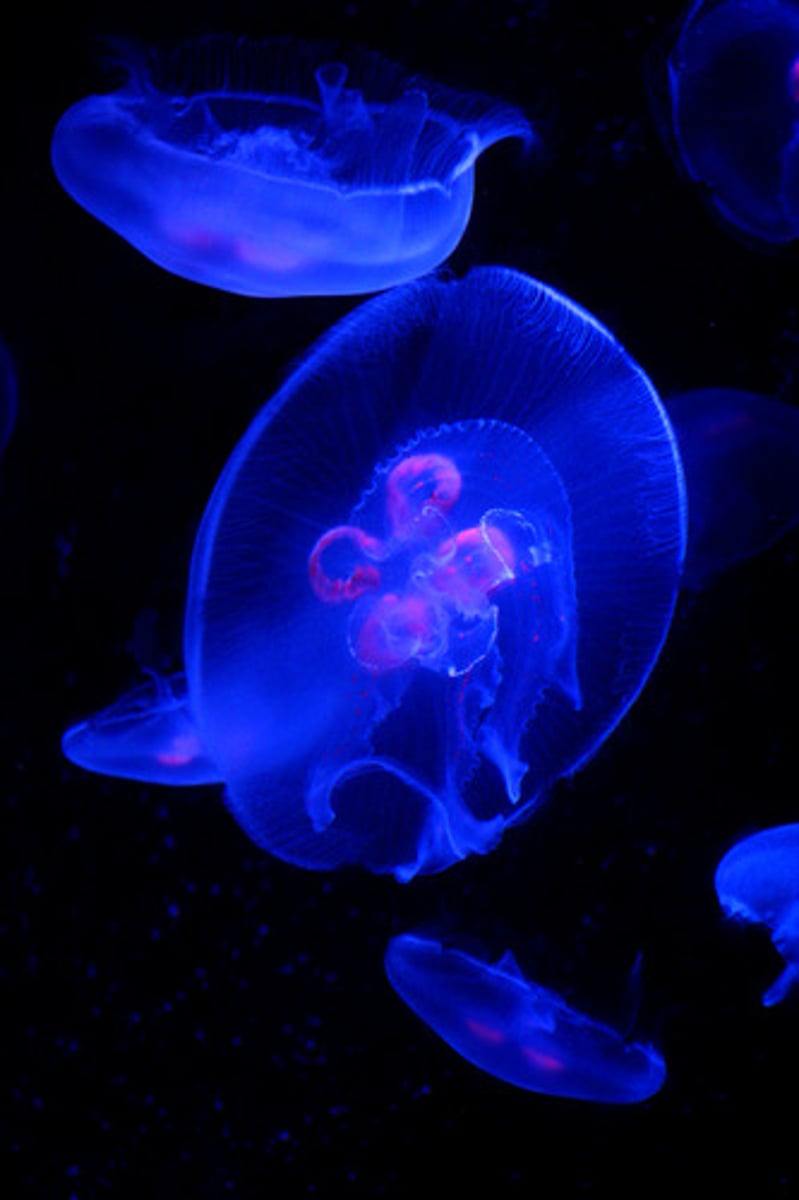
Bioluminescence
The production of light by means of a chemical reaction in an organism.
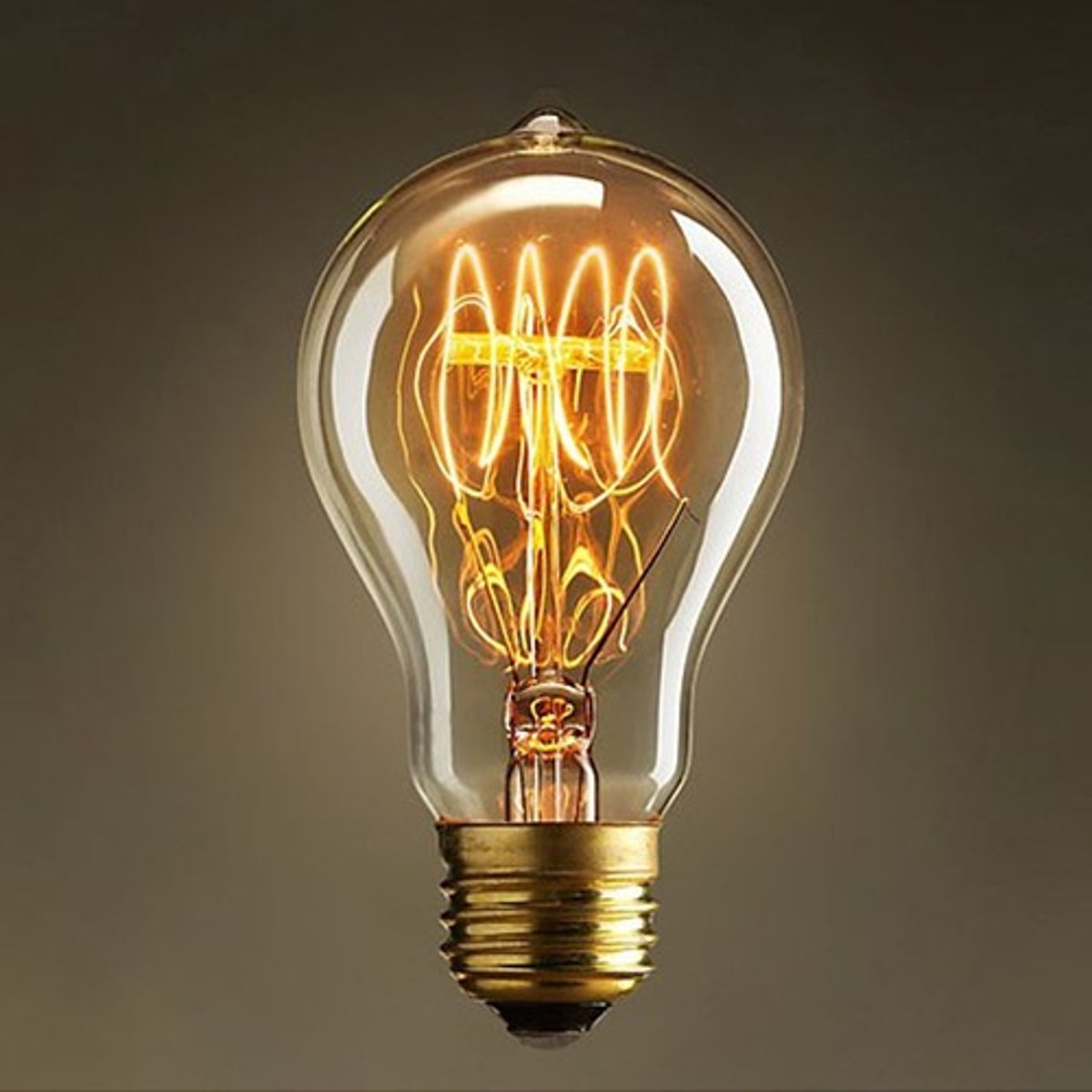
Incandescent Light
Light generated by heating a piece of metal until it glows.
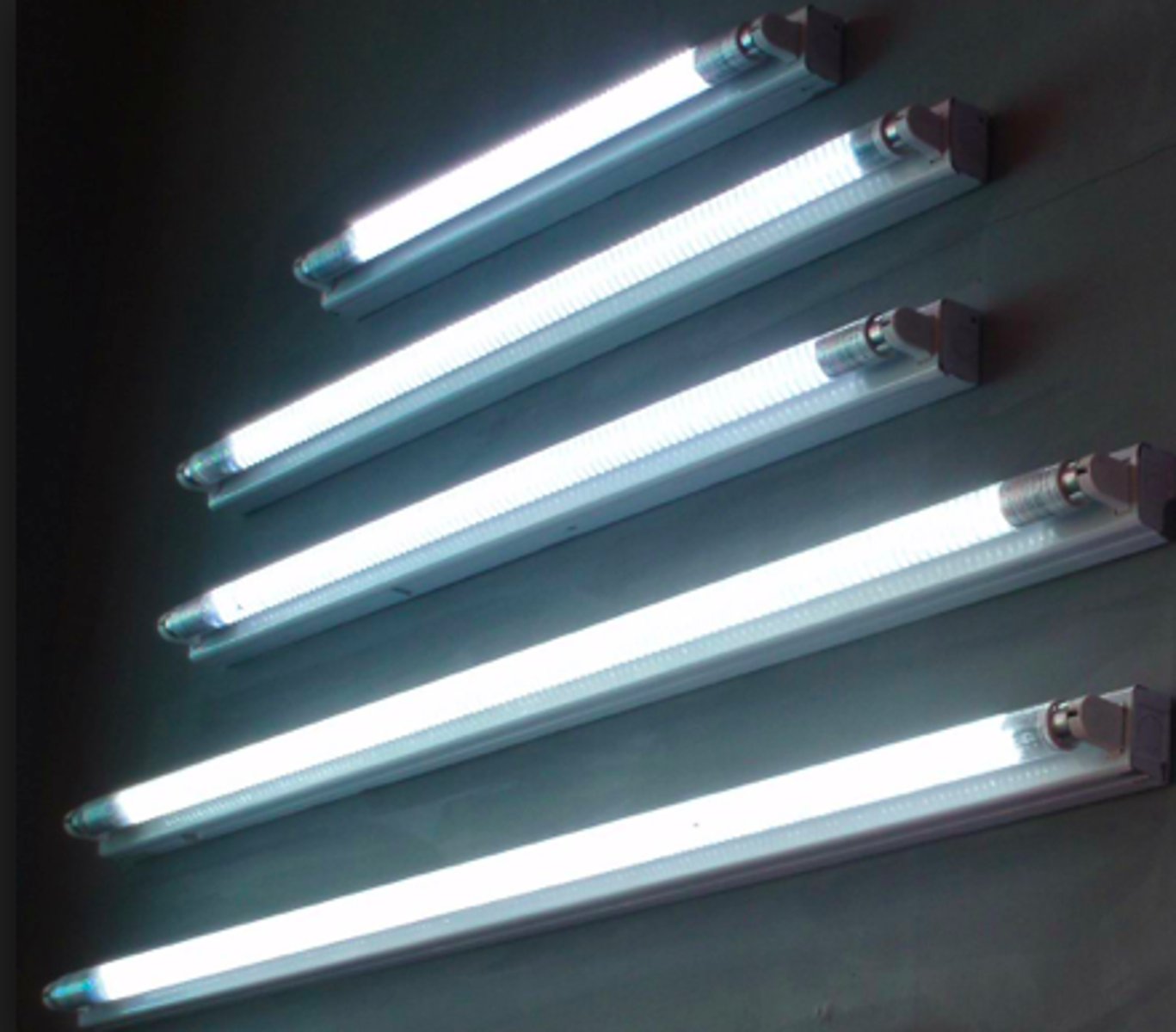
Fluorescent Light
Light generated by exciting mercury vapour via an electric current, which creates UV light. This UV light causes a phosphor coating inside the light bulb to produce visible light.
Phosphor
A solid material that can emit light by fluorescence.
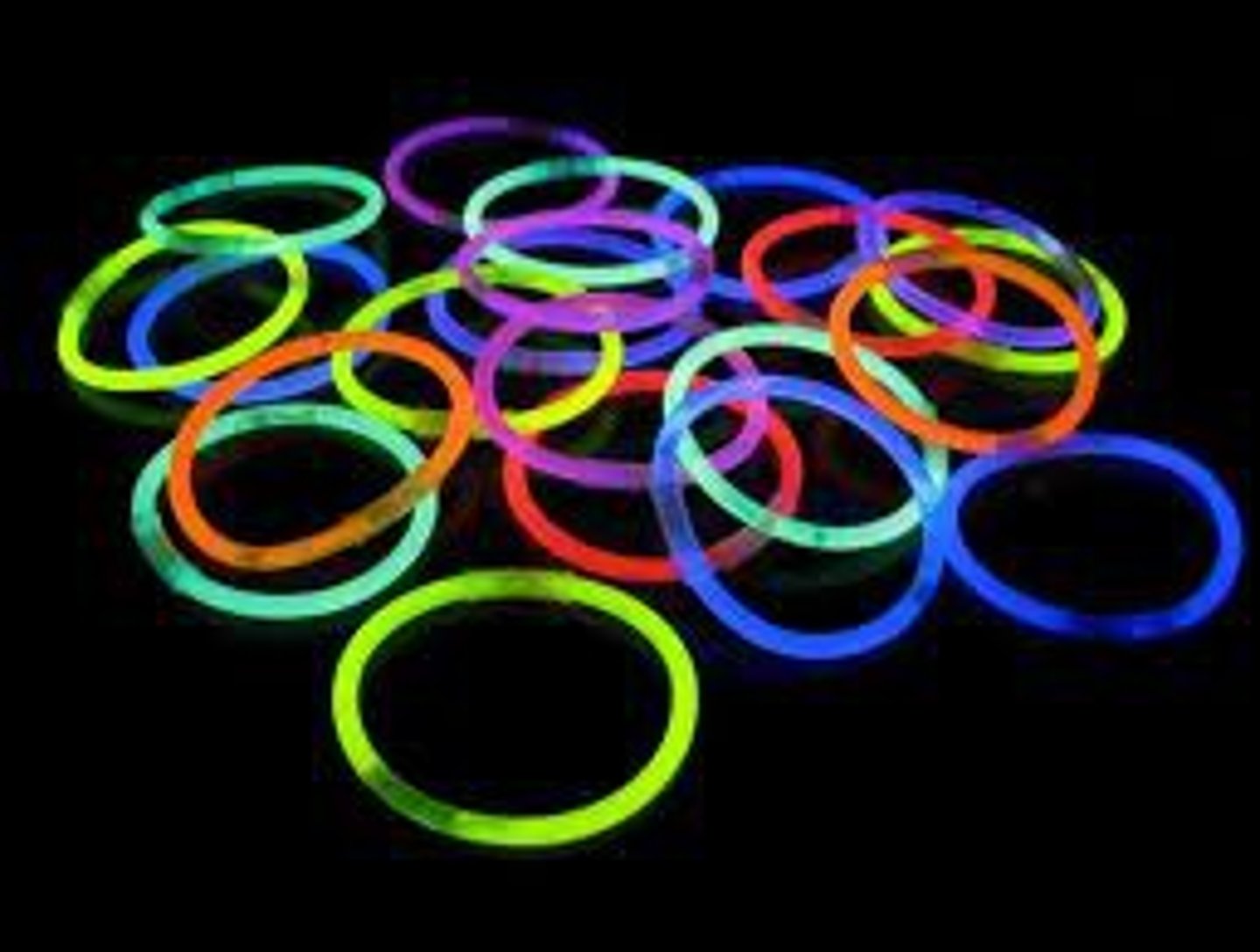
Phosphorescence
Light emitted by storing energy from a light source and then slowly remitting it over a long period of time. Commonly seen in glow-in-the-dark objects.
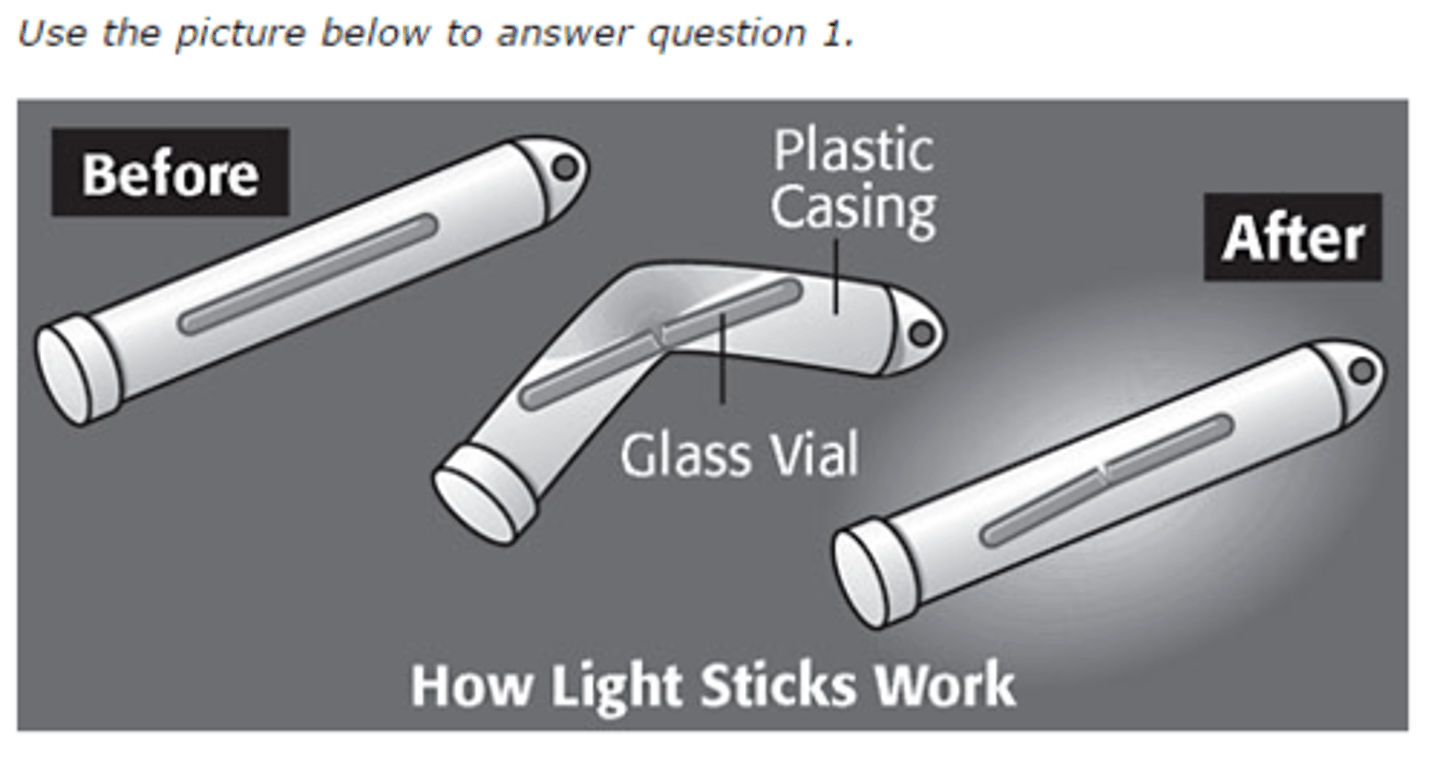
Chemiluminescence
The direct production of light as the result of a chemical reaction with little or no heat produced. All forms of bioluminescence are special kinds of chemiluminescence.
Light Emitting Diode (LED)
Light produced as a result of an electric current flowing through semiconductors. Semiconductors are materials that can change how well they conduct electricity.
The process of converting electrical energy into light energy is called electroluminescence.
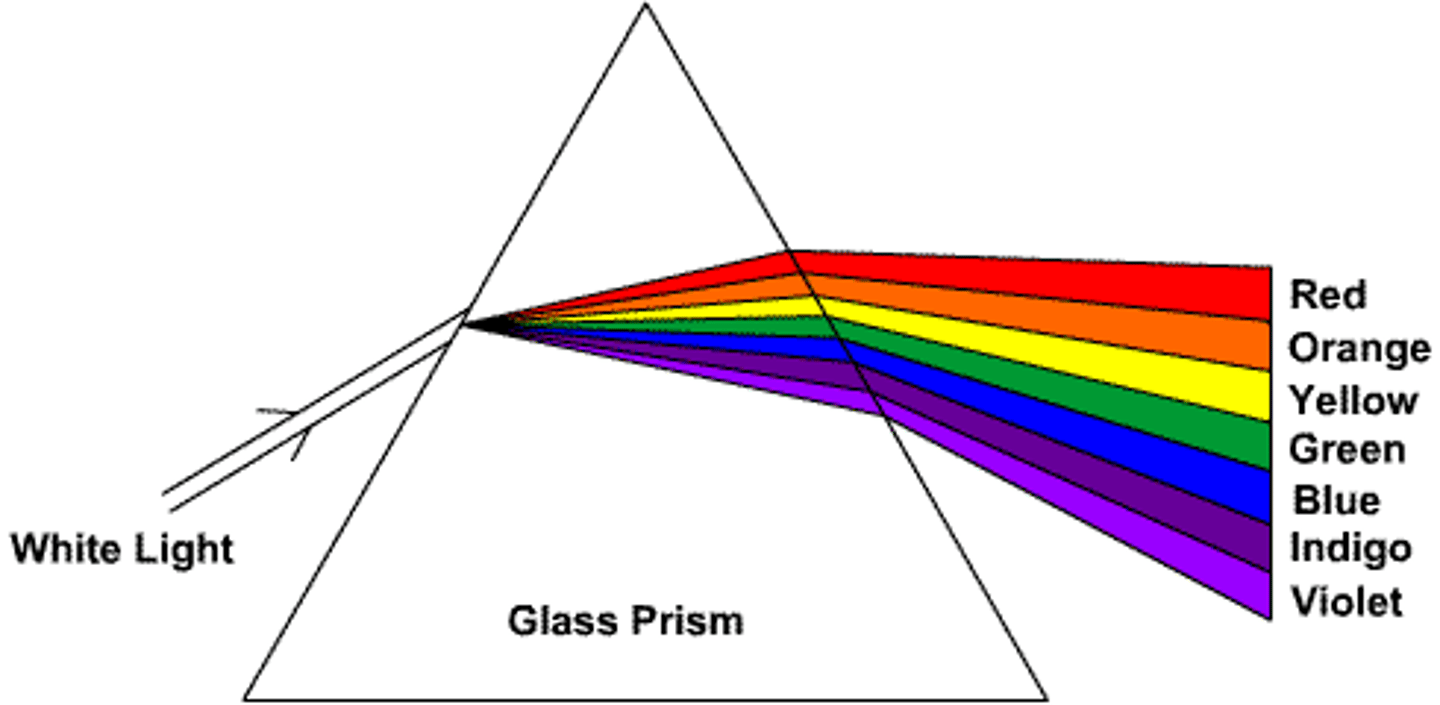
White Light
Mixture of all the colors in the visible spectrum.
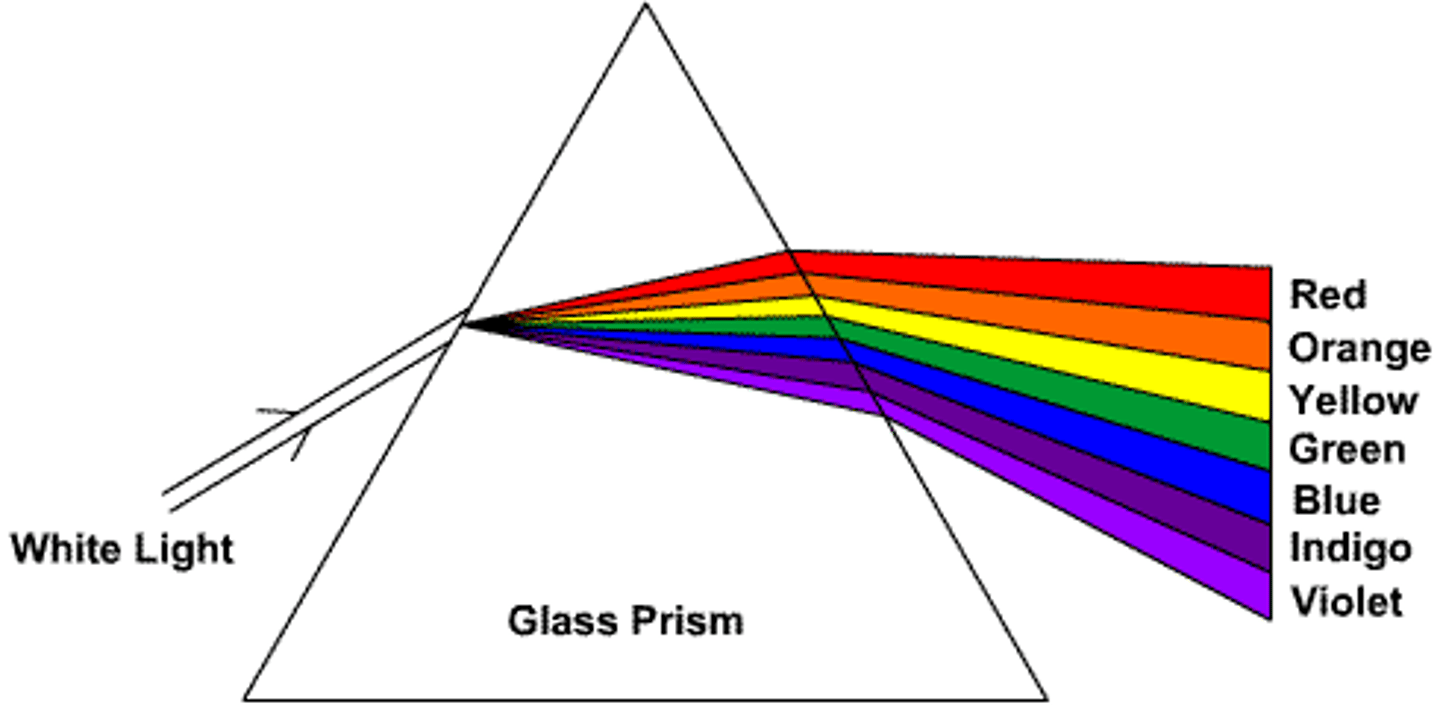
Prism
A piece of glass that separates white light into colours of the spectrum.
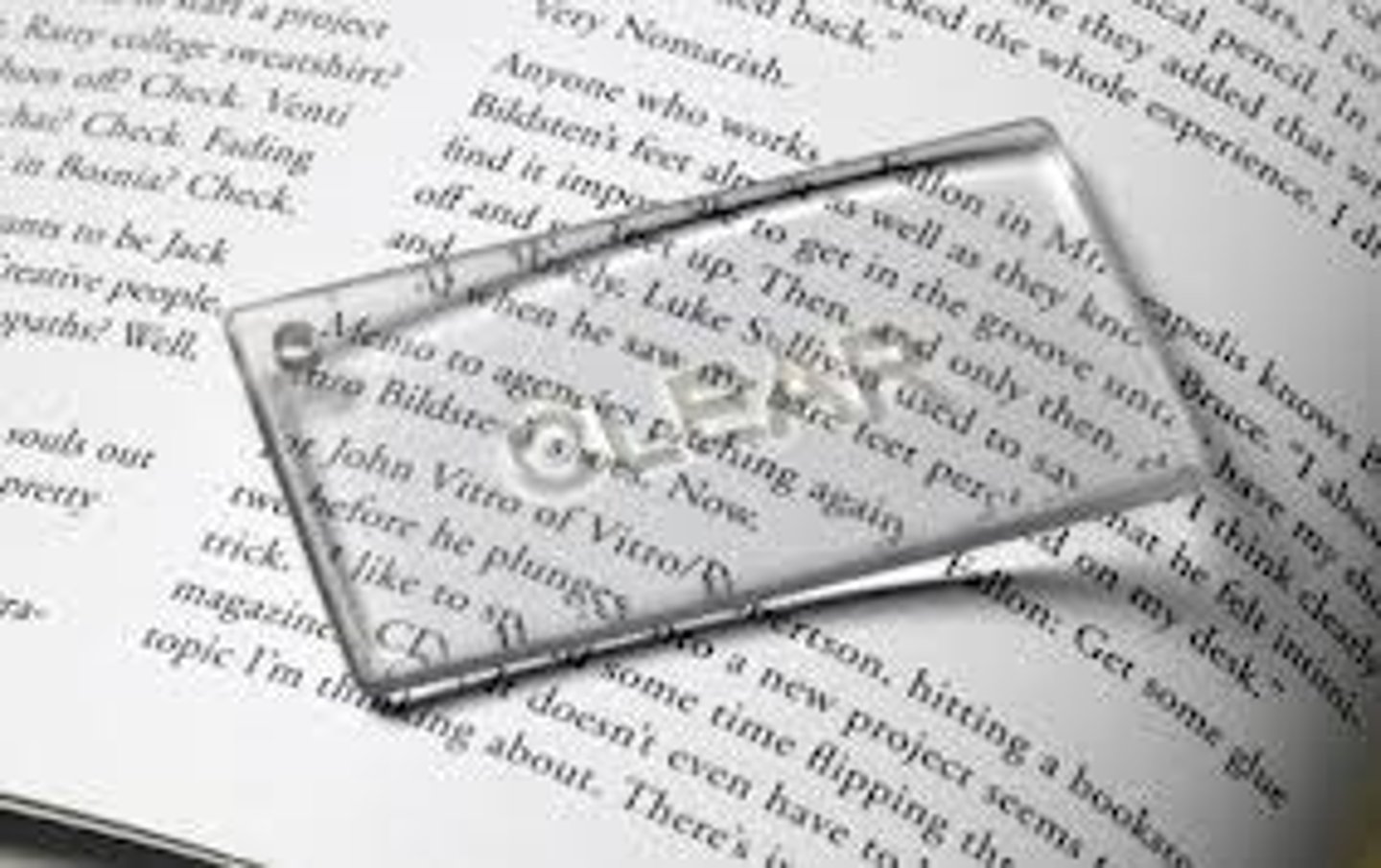
Transparent
A material or substance that allows light to pass through.
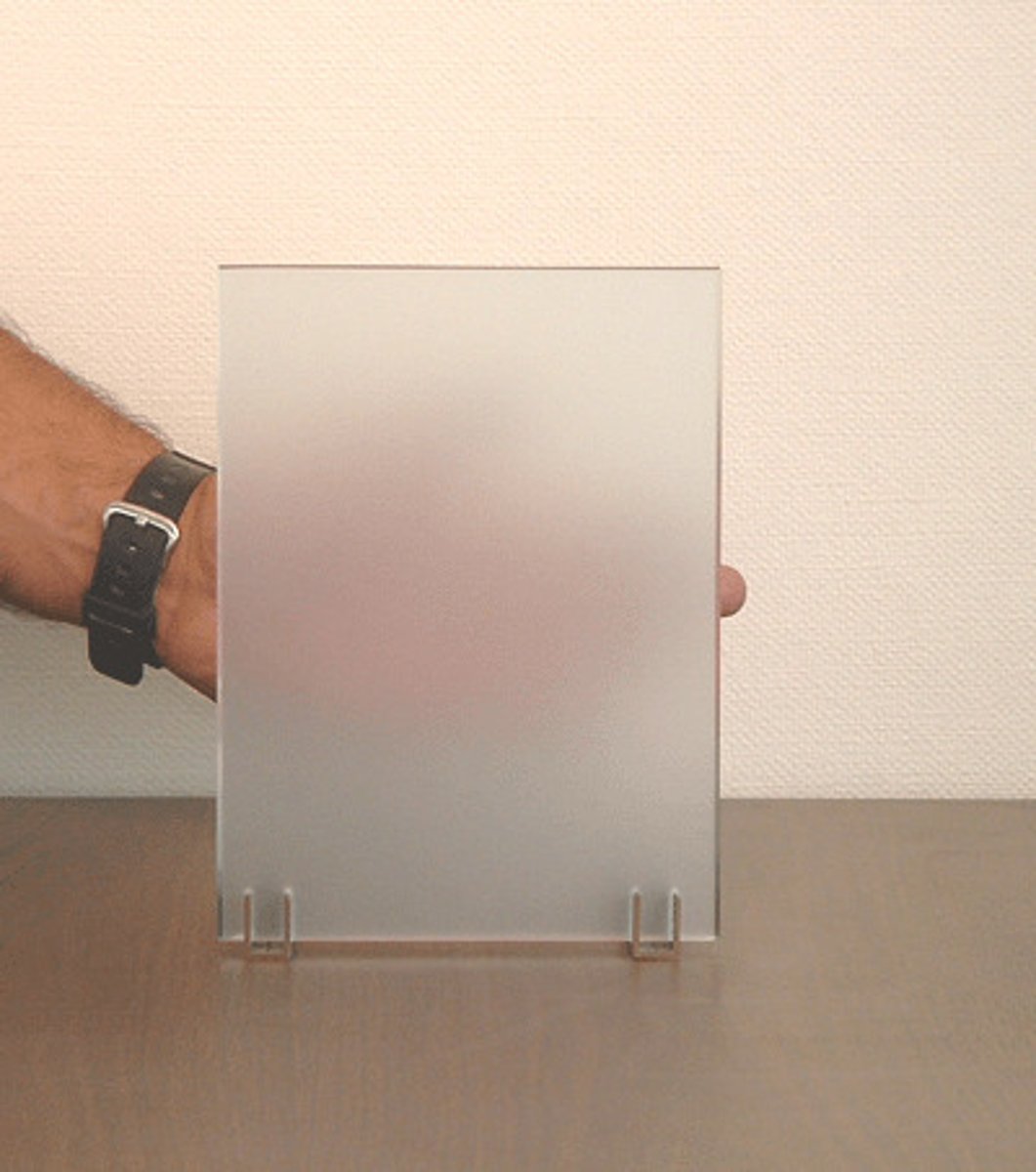
Translucent
A material or substance that allows some light to pass through.
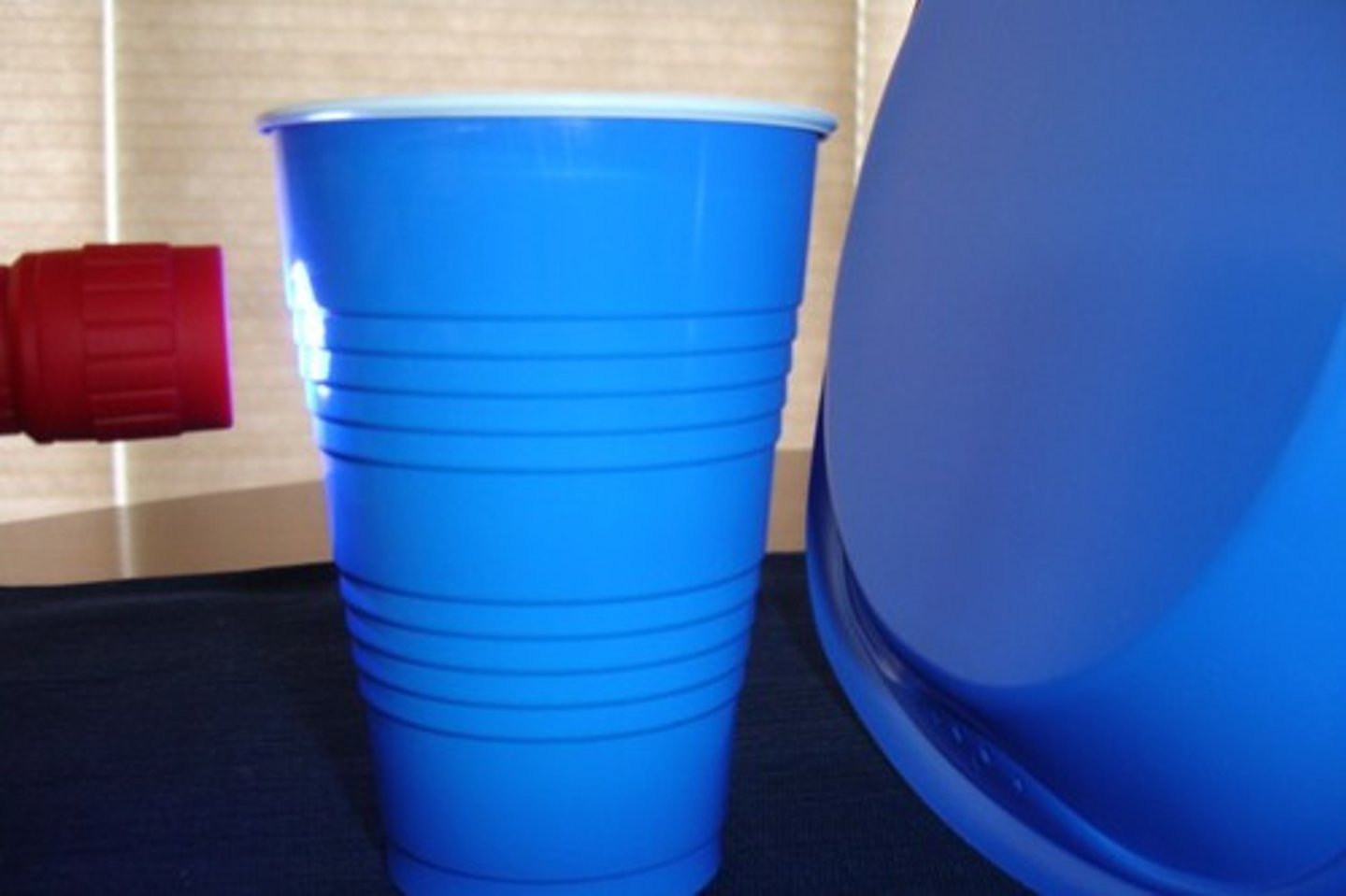
Opaque
A material or substance that allows no light to pass through.
Reflection
The bouncing back of a wave when it hits a surface through which it cannot pass.
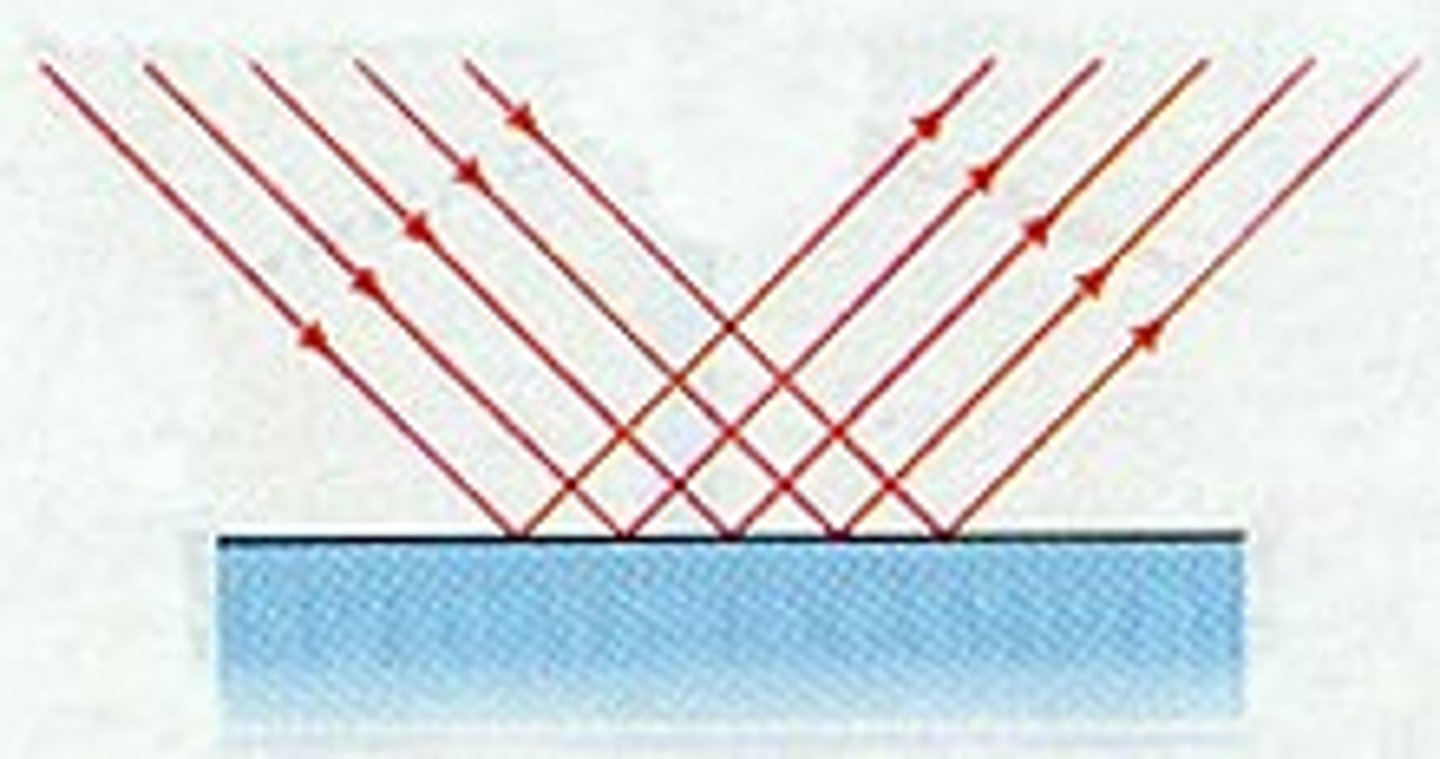
Regular Reflection
Reflection that occurs when parallel rays of light hit a smooth surface and all reflect at the same angle.
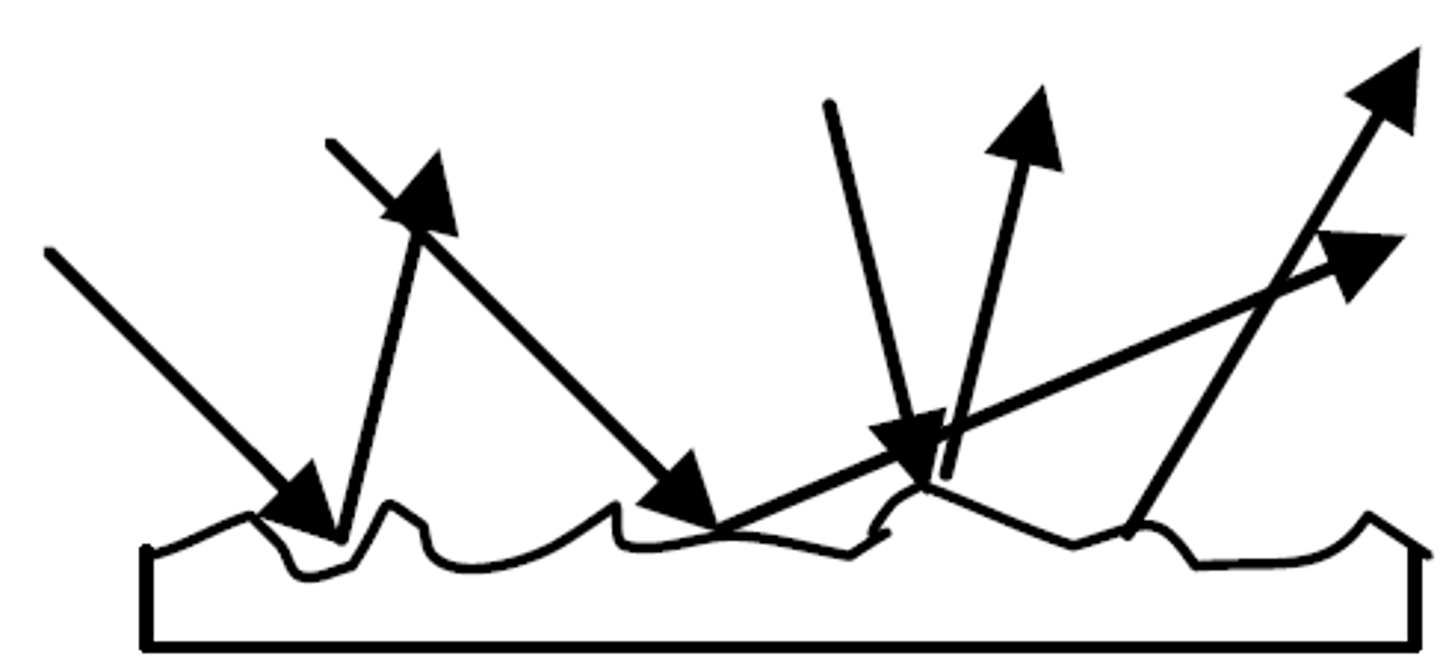
Diffuse Reflection
Reflection that occurs when parallel rays of light hit a rough surface and all reflect at different angles.
Plane Mirror
A mirror with a flat surface. Labelled as M.
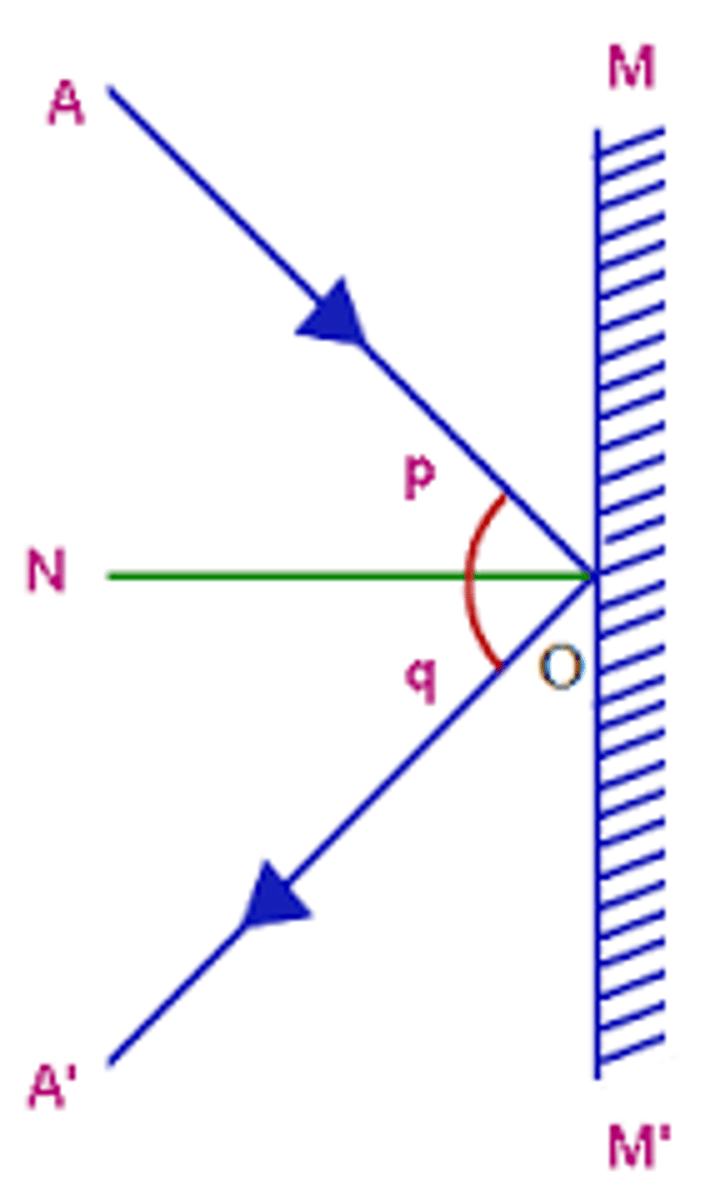
Normal
The line at a right angle to the mirrors surface. Labelled as N.
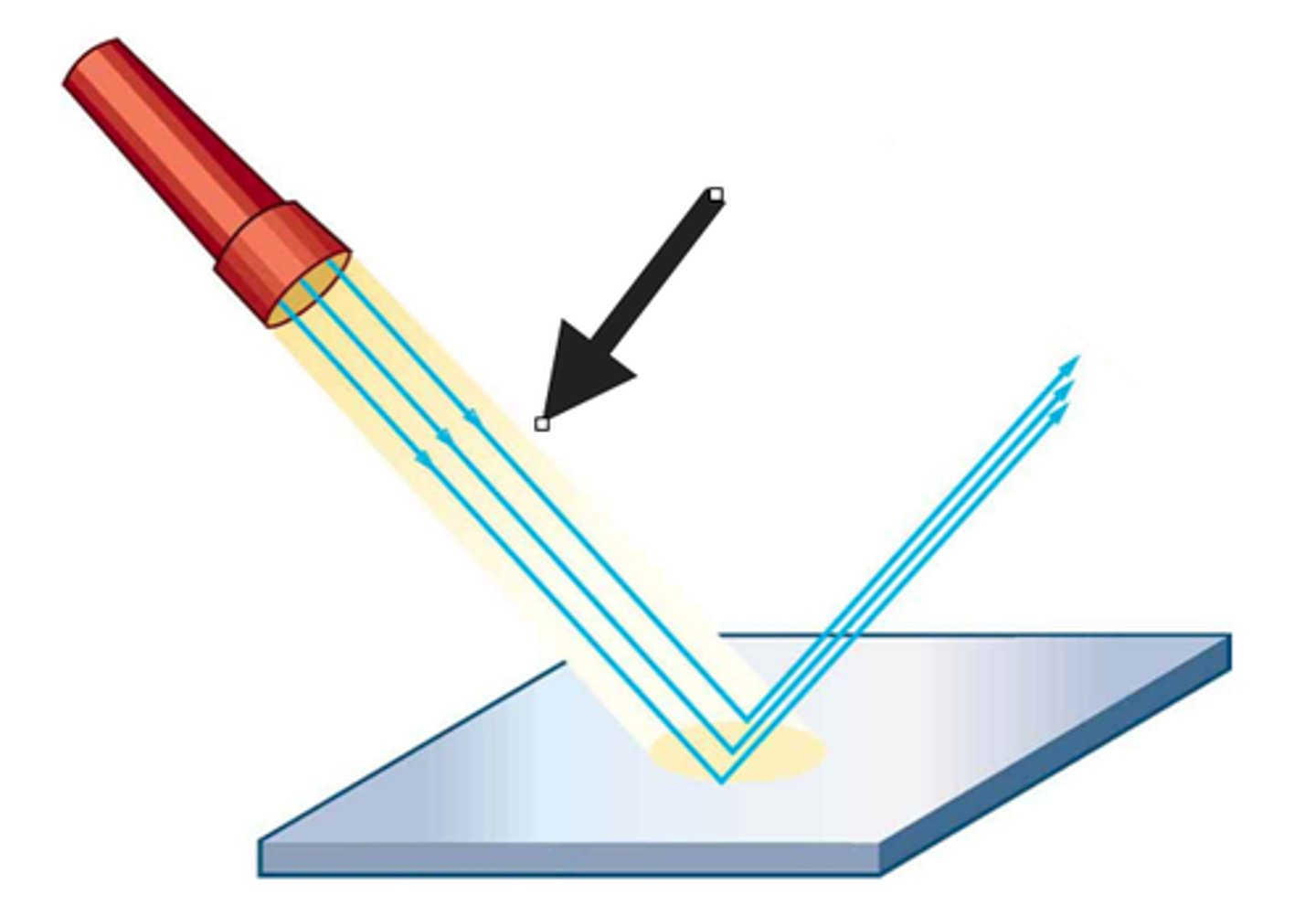
Incident Ray
The ray that comes from an object and strikes a surface.
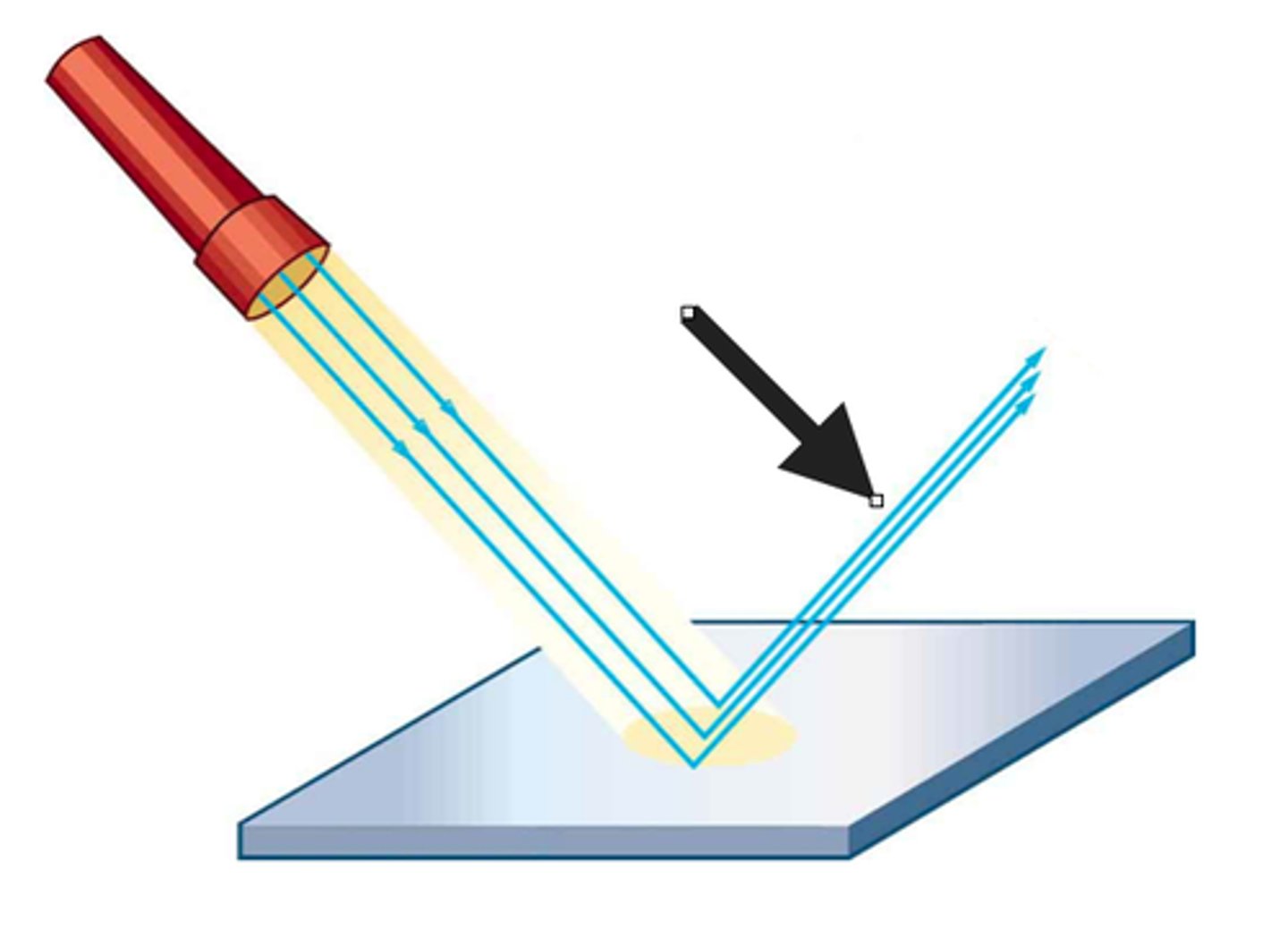
Reflected Ray
The ray that reflects off of the mirror.
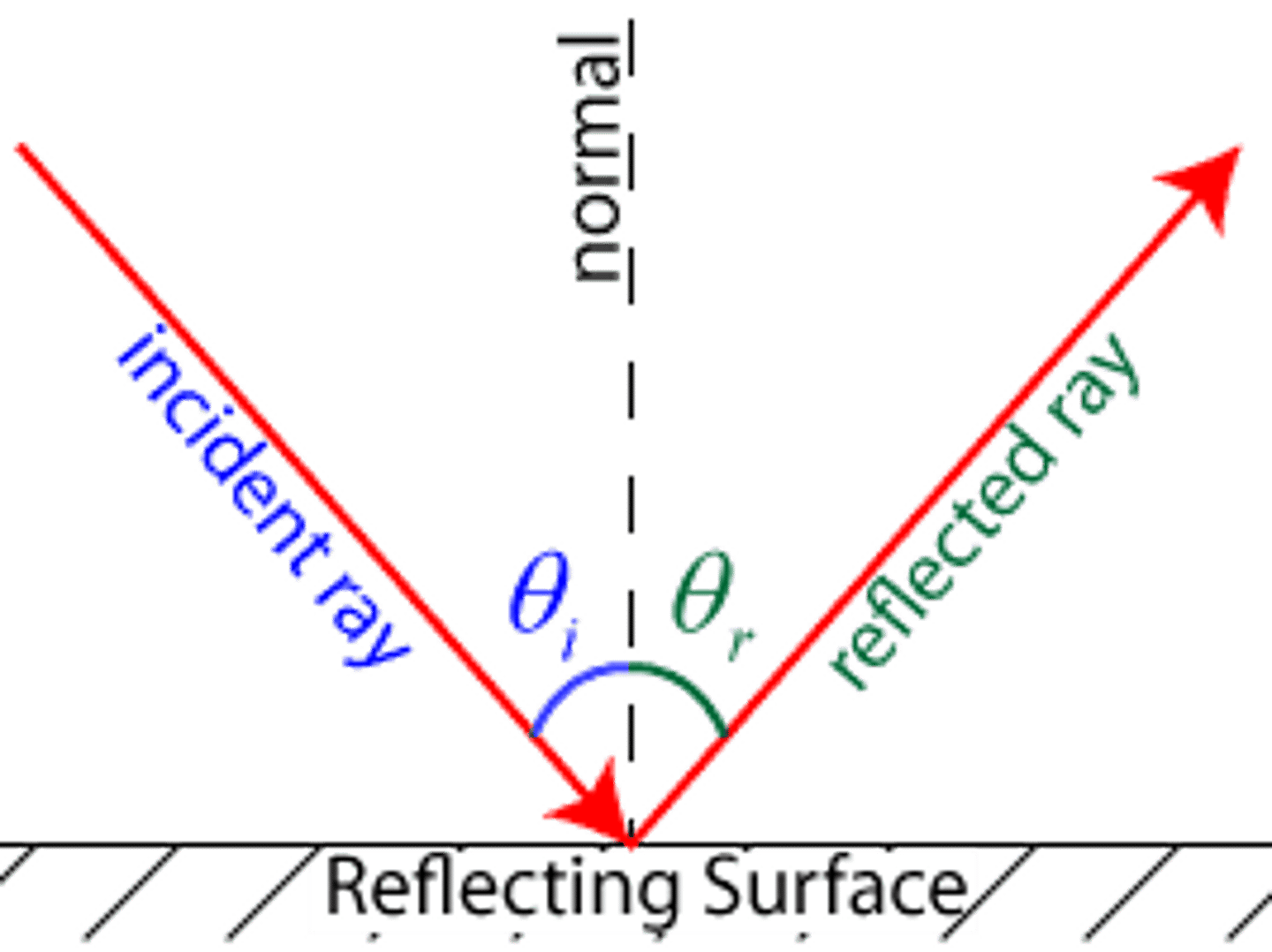
Angle of Incidence
The angle between the incident ray and the normal. Labelled as θt. "θ" is the Greek letter Theta.
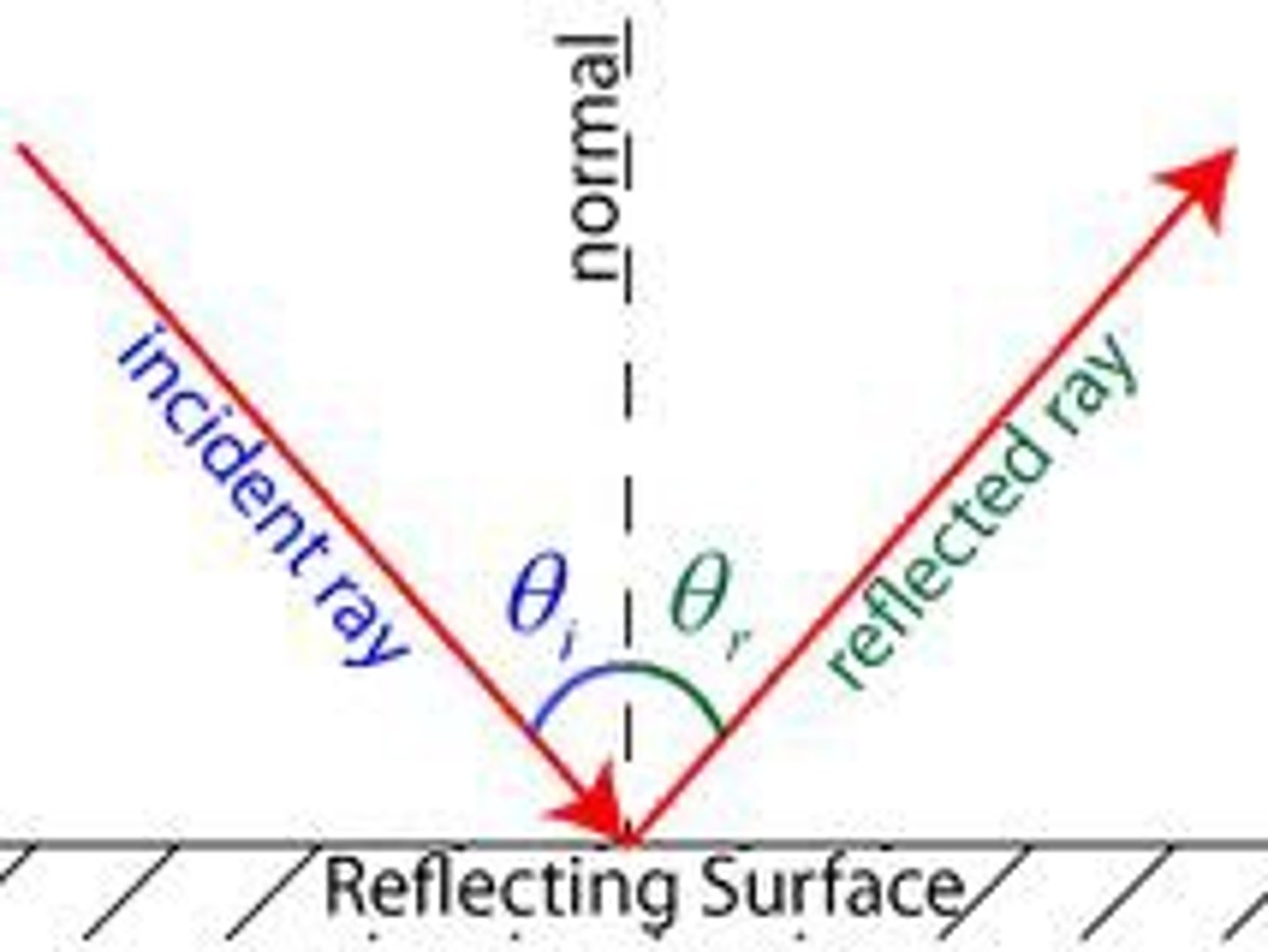
Angle of Reflection
The angle between the reflected ray and the normal. Labelled as θr. "θ" is the Greek letter Theta.
Law of Reflection
The angle of incidence is equal to the angle of reflection.
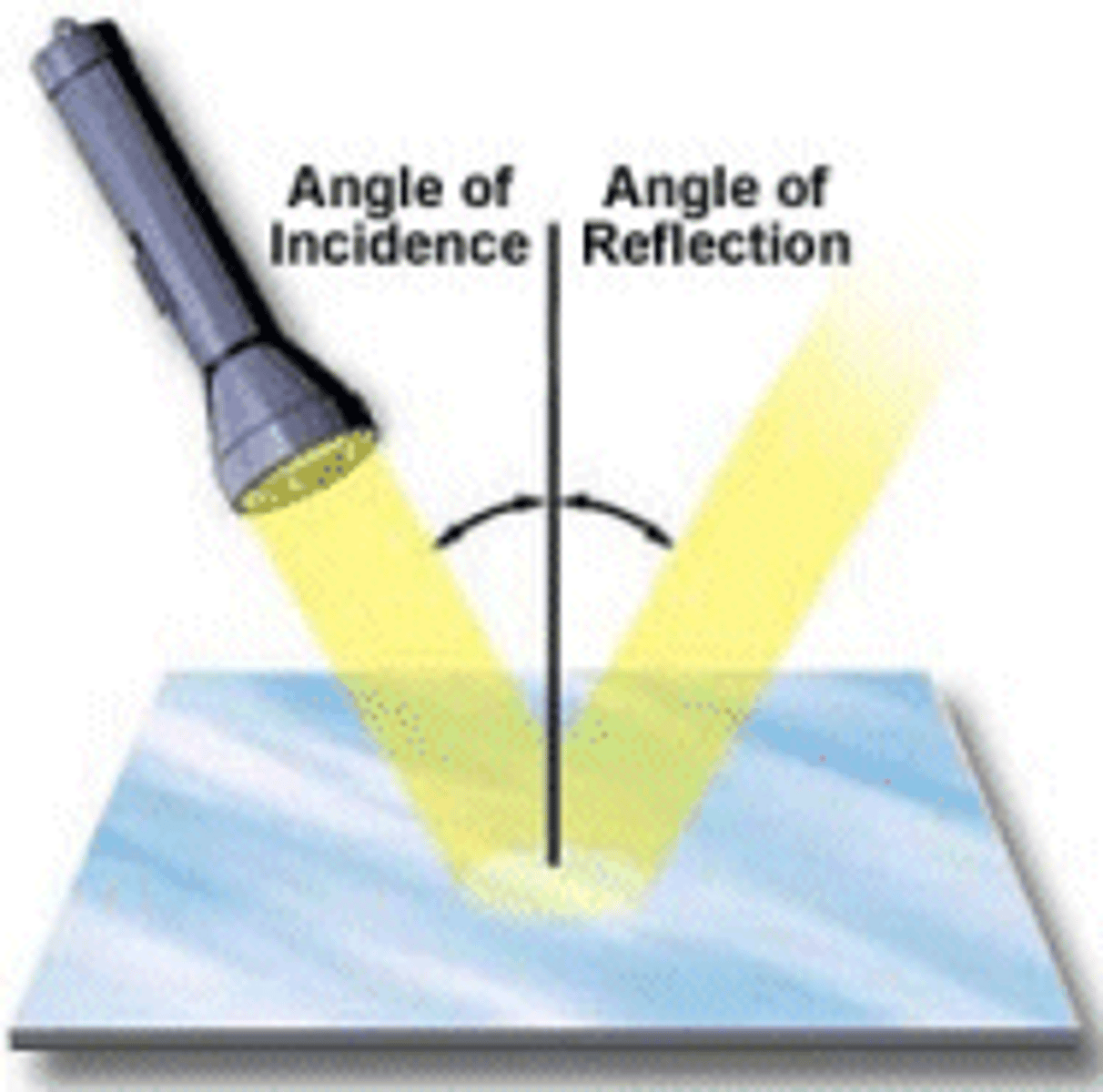
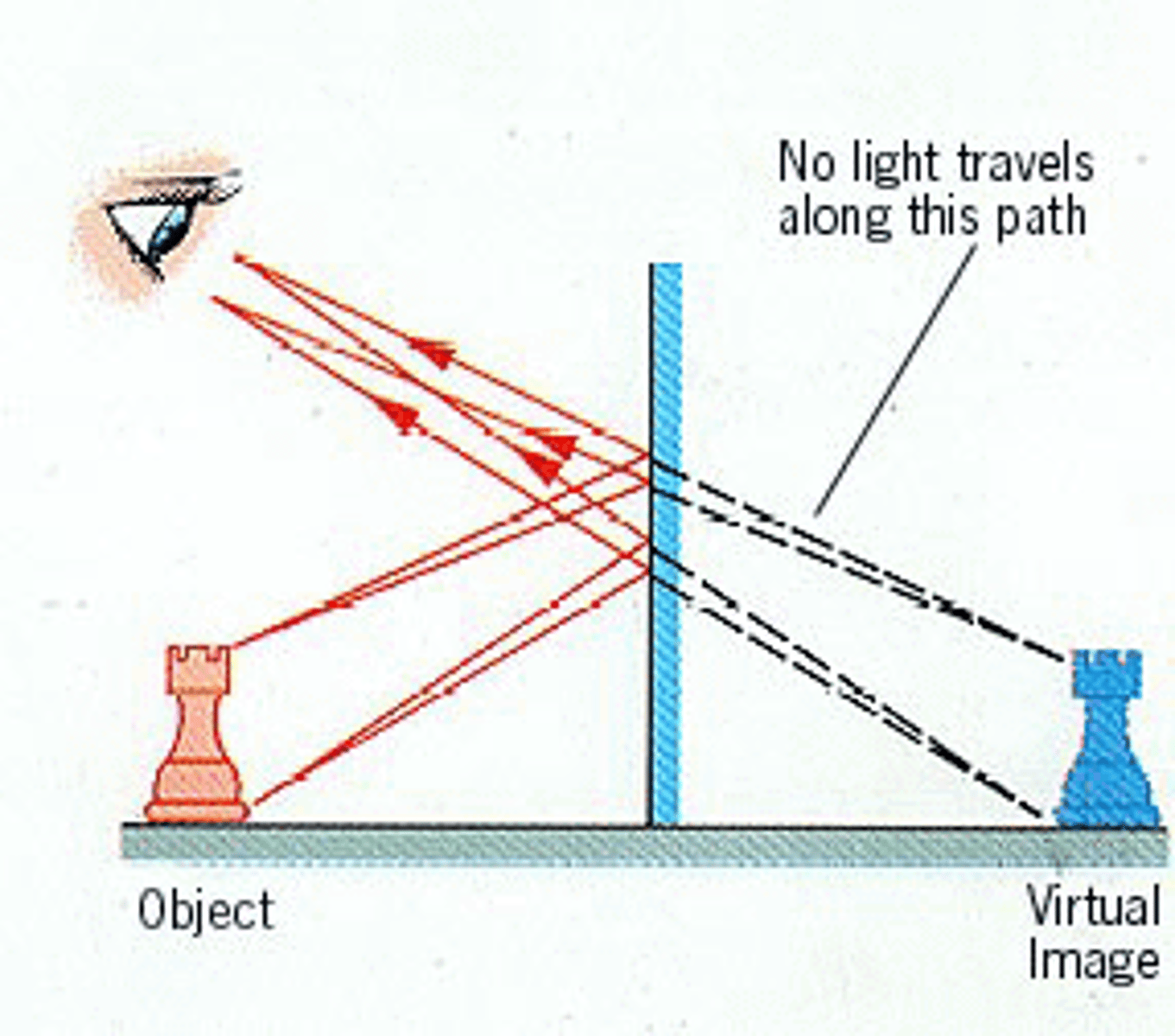
Image in Plane Mirrors
When an object is placed in front of a plane mirror, a virtual image (or just image) appears behind the plane mirror. This image is what our eyes see.
SALT
An acronym used to describe the four steps of classifying an image.
S: Size of the image. Can be smaller, bigger, or same size as the object. Size, or height, is determined starting from the principal axis and going up or down to the point where all reflected rays converge (meet.)
A: Attitude or orientation of the image. Can be upright or inverted/upside down. It will be upright when the image is behind the mirror and inverted when in front of the mirror.
L: Location of the image. Can be behind C, on C, between C and F, on F, in front of F, or behind mirror.
T: Type of the image. Can be real or virtual.
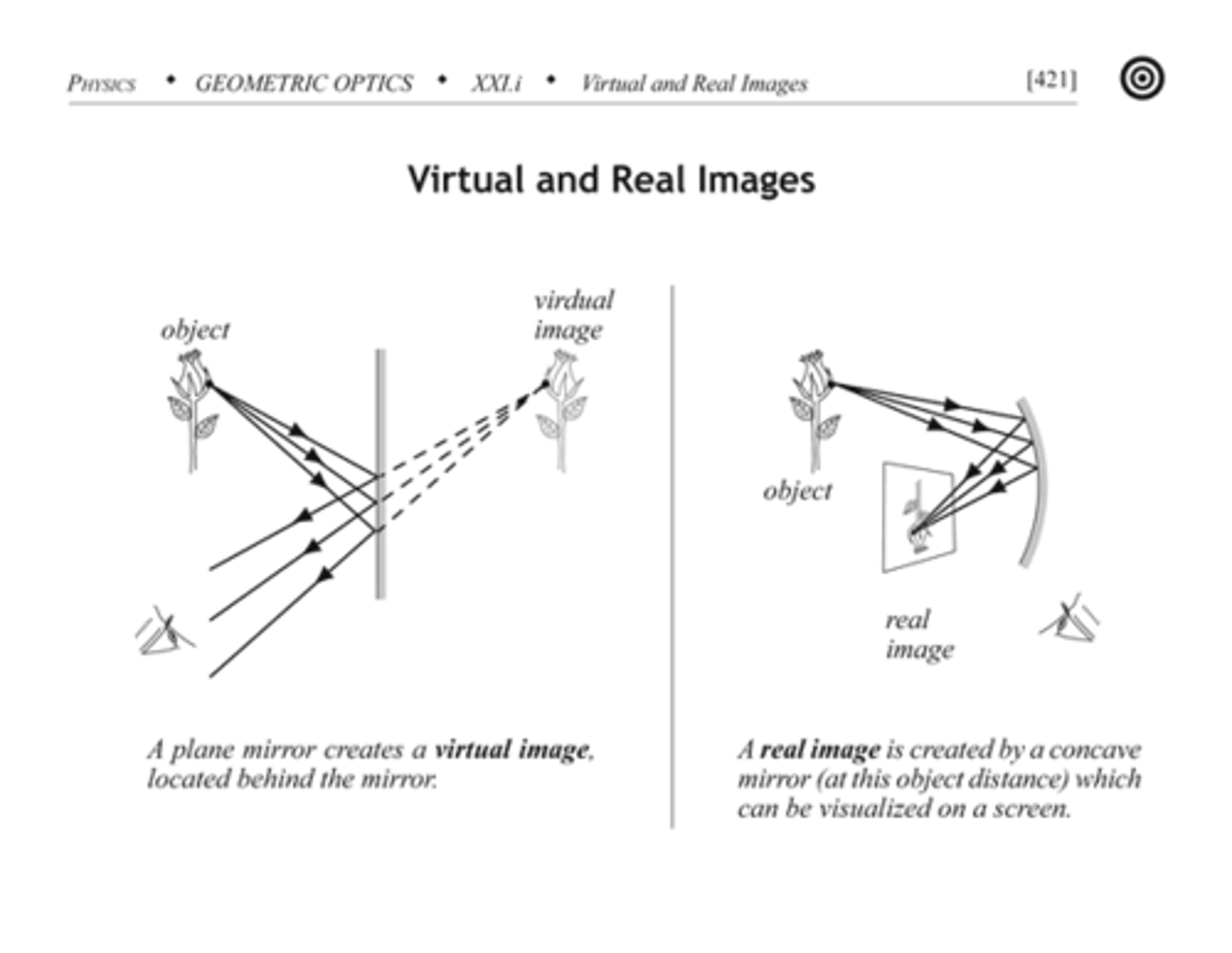
Images
Virtual images are created when using plane mirrors when the light rays do not meet each other (image appears behind the mirror.) Real images are when the light waves converge at one point (image appears in front of the mirror.)
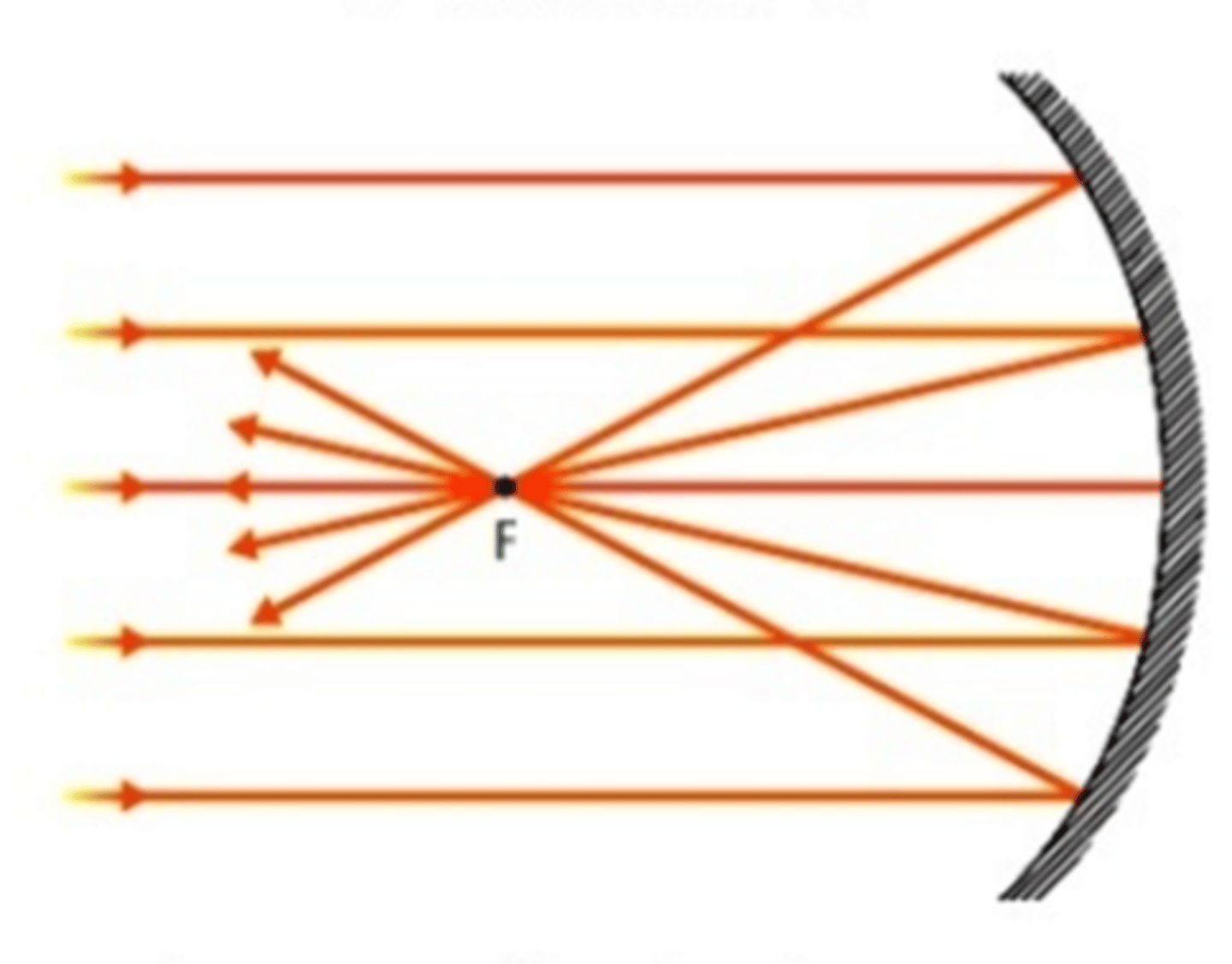
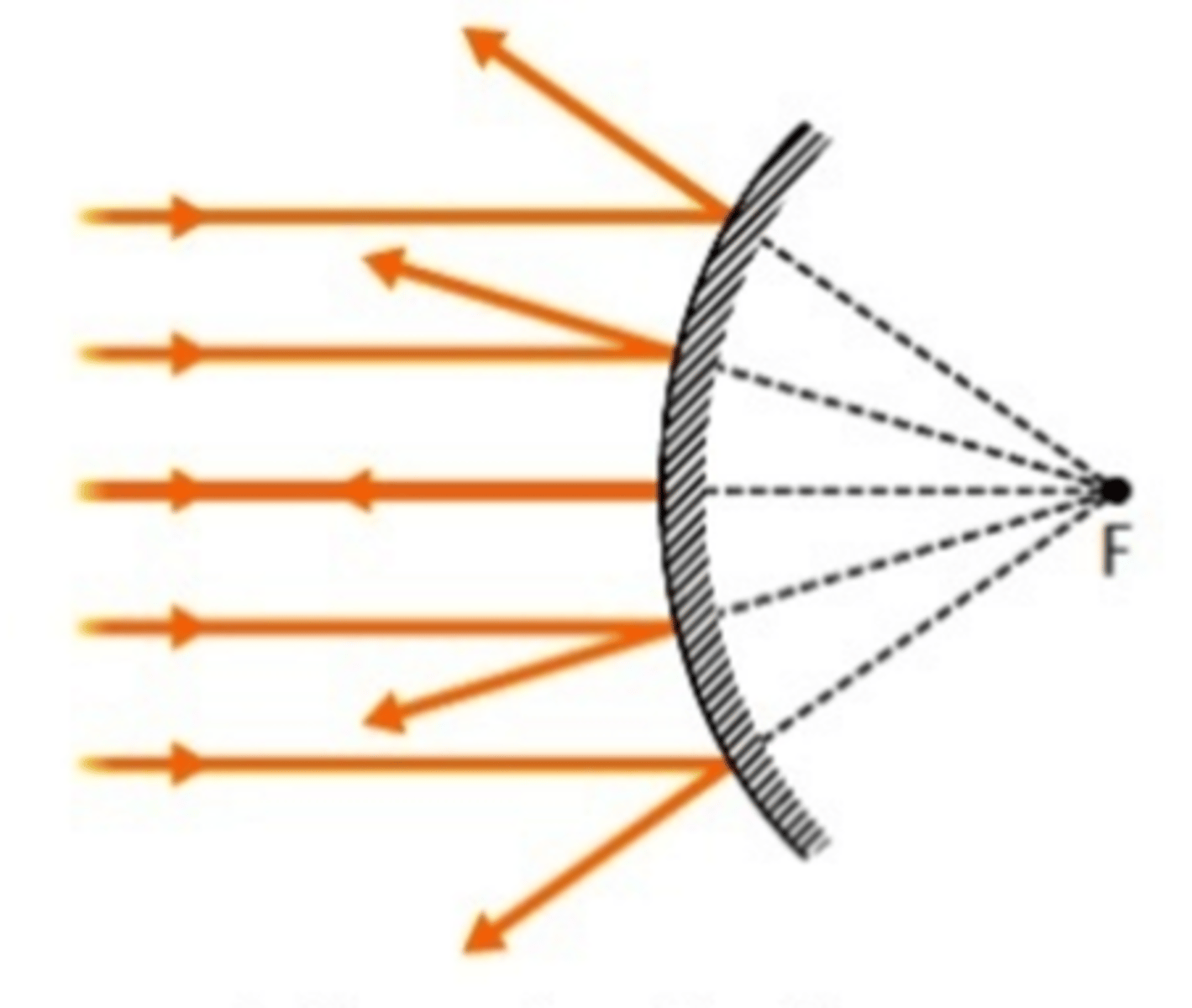
Concave Mirror
A mirror with a surface that curves inward like the inside of a bowl.
Convex Mirror
A mirror that is curved outward like the back of a spoon.
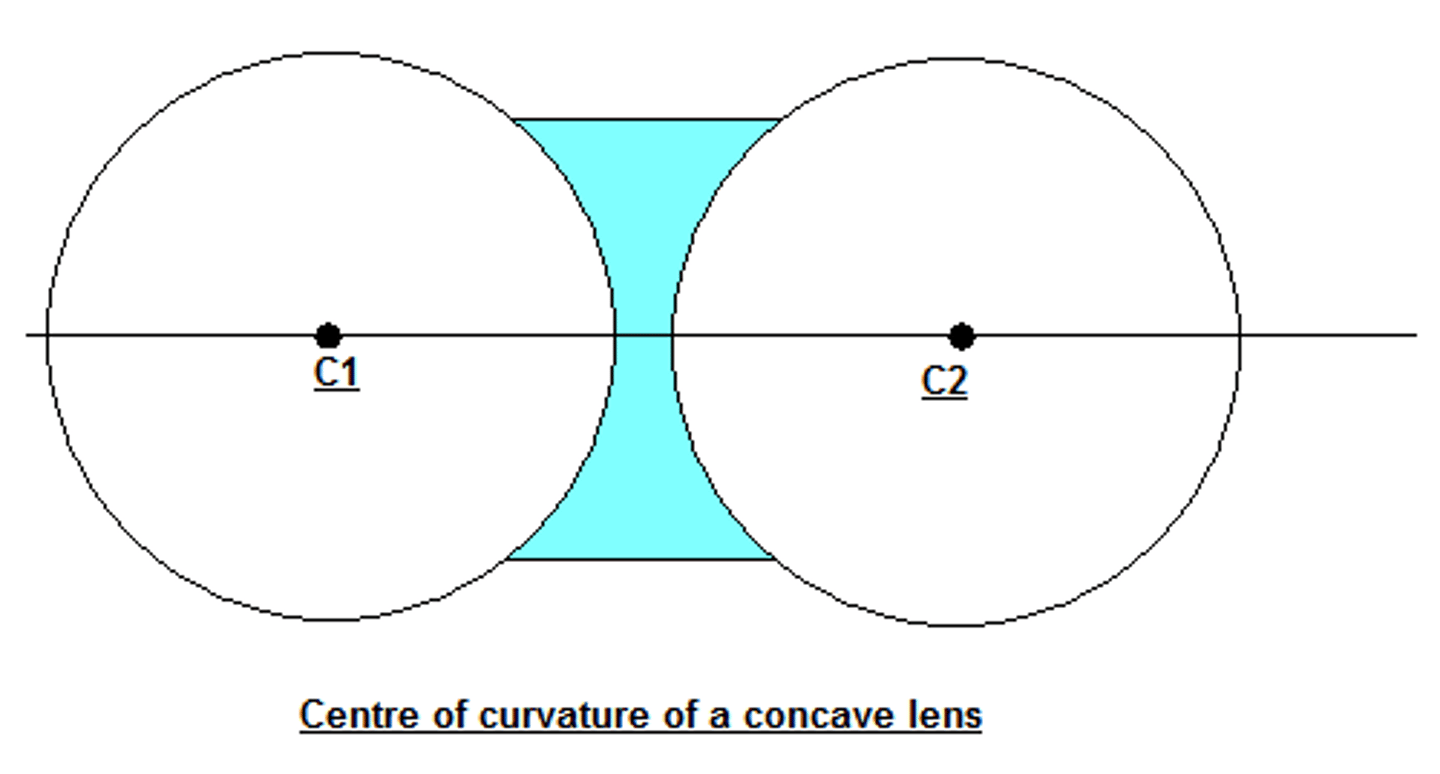
Centre of Curvature
Labelled as "C." The centre of a sphere from which a curved mirror is formed.
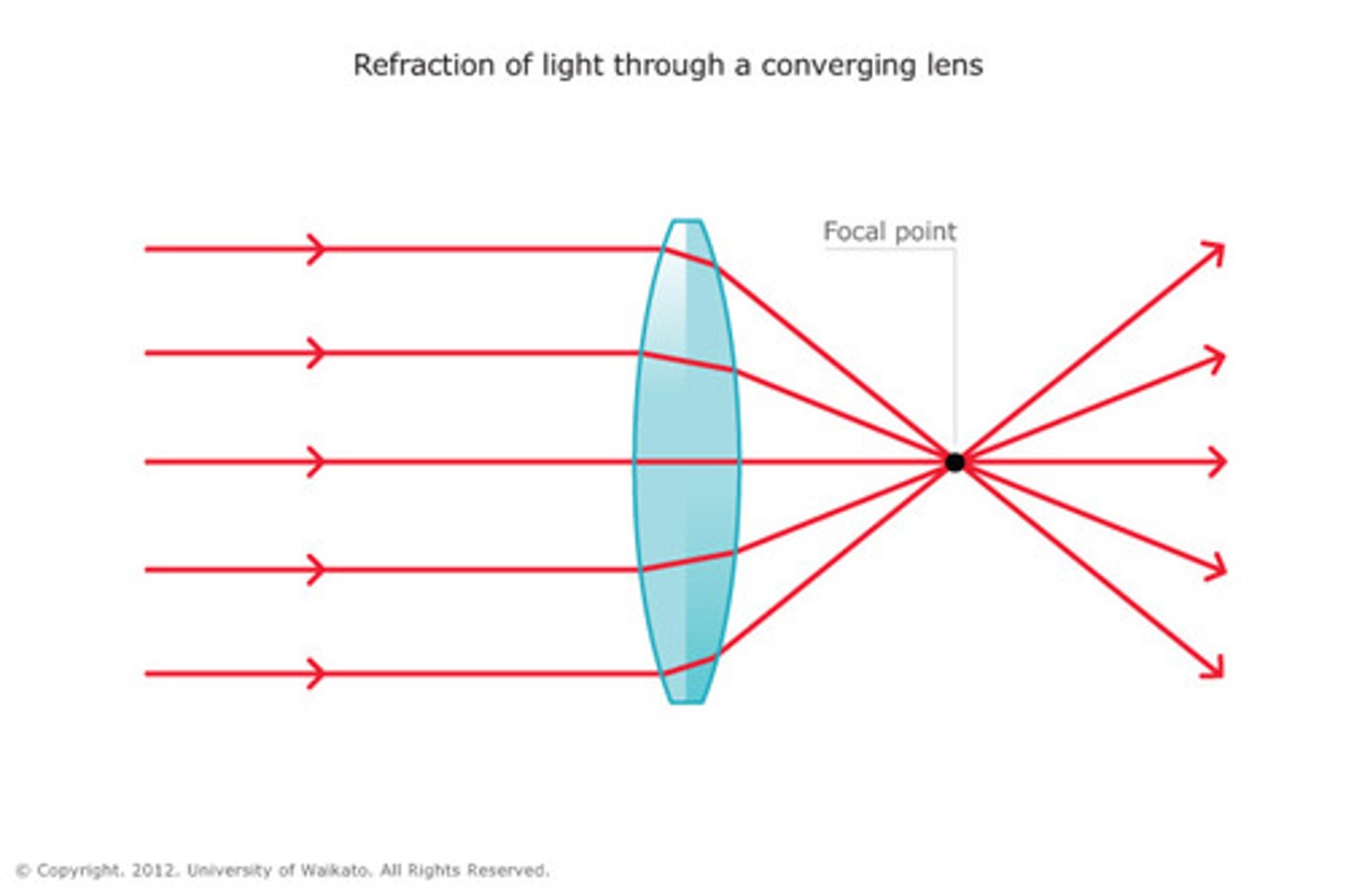
Focal Point
Also known as the Focus. Labelled as "F." It is the point at which all light rays converge (meet).
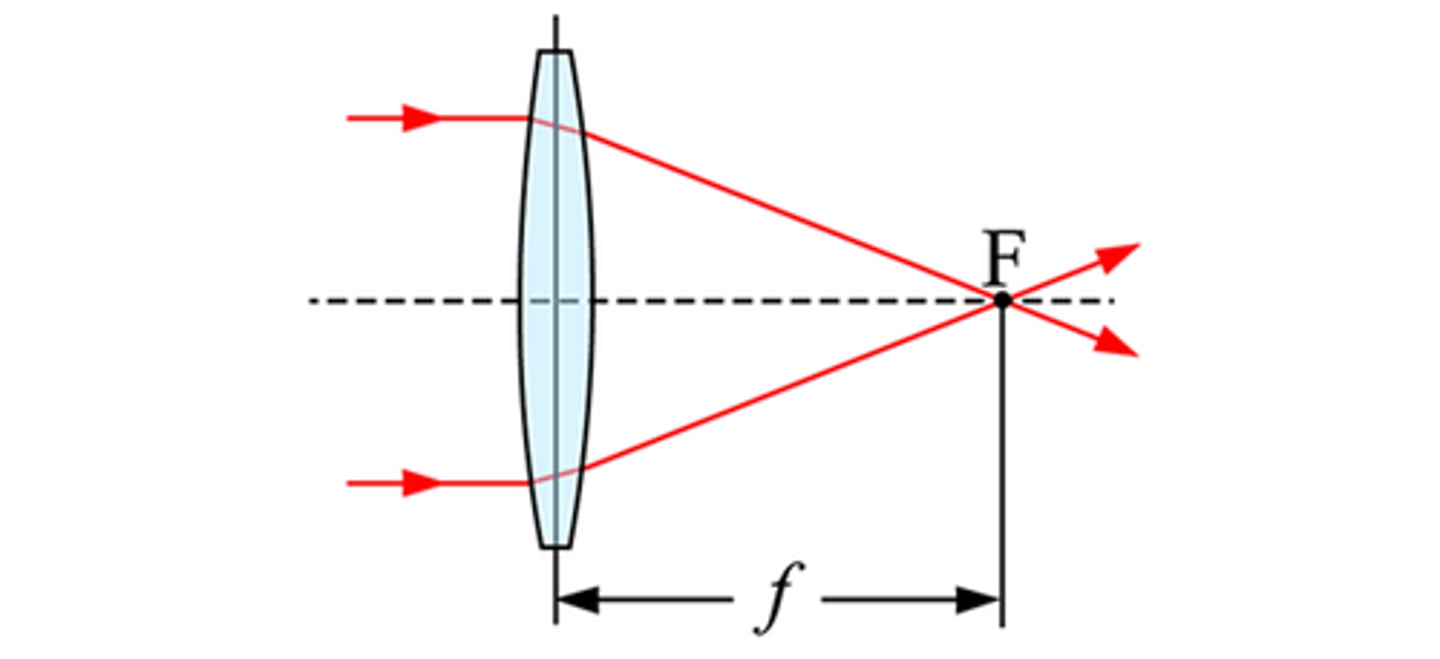
Focal Length
Labelled as "f." It is the distance from the focal point to the mirror.
Vertex
Labelled as "V." It is the center of a mirror. It is also where the principal axis meets the mirror.
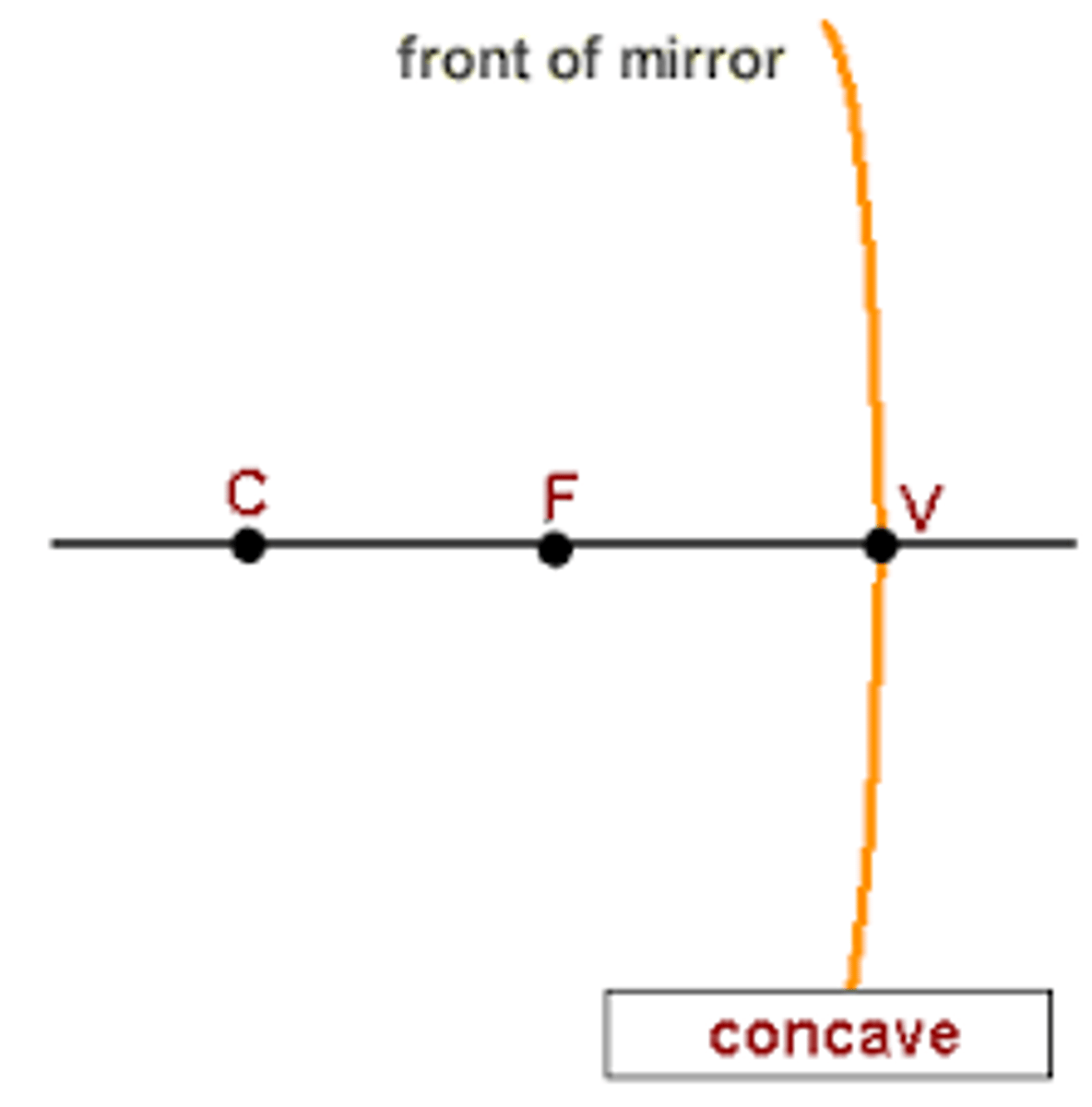
Principal Axis
Labelled as "PA." A straight line perpendicular to the surface of a mirror.
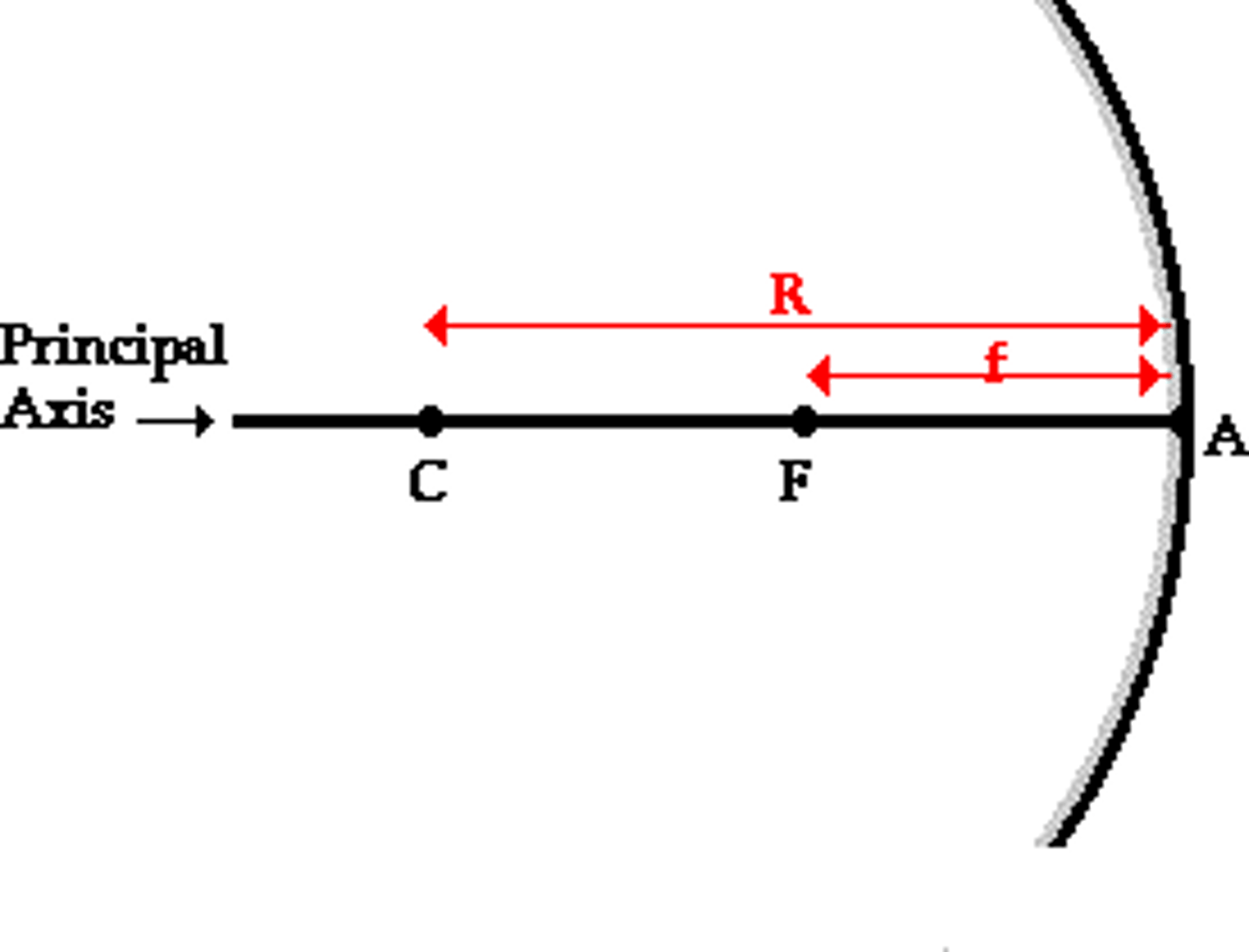
Magnification
Concave mirrors are able to magnify objects, meaning that the image can appear bigger or smaller than the object. It can be expressed as a ratio of either height or distance.
M = image height / object height or M = hi / ho
OR
M = image distance / object distance or M = di / do or M = -di / do (distance means distance from the mirror) di is positive if the image is real, while di is negative when the image is virtual.
Aqueous Humor
A transparent liquid that helps the Cornea keep its round shape.
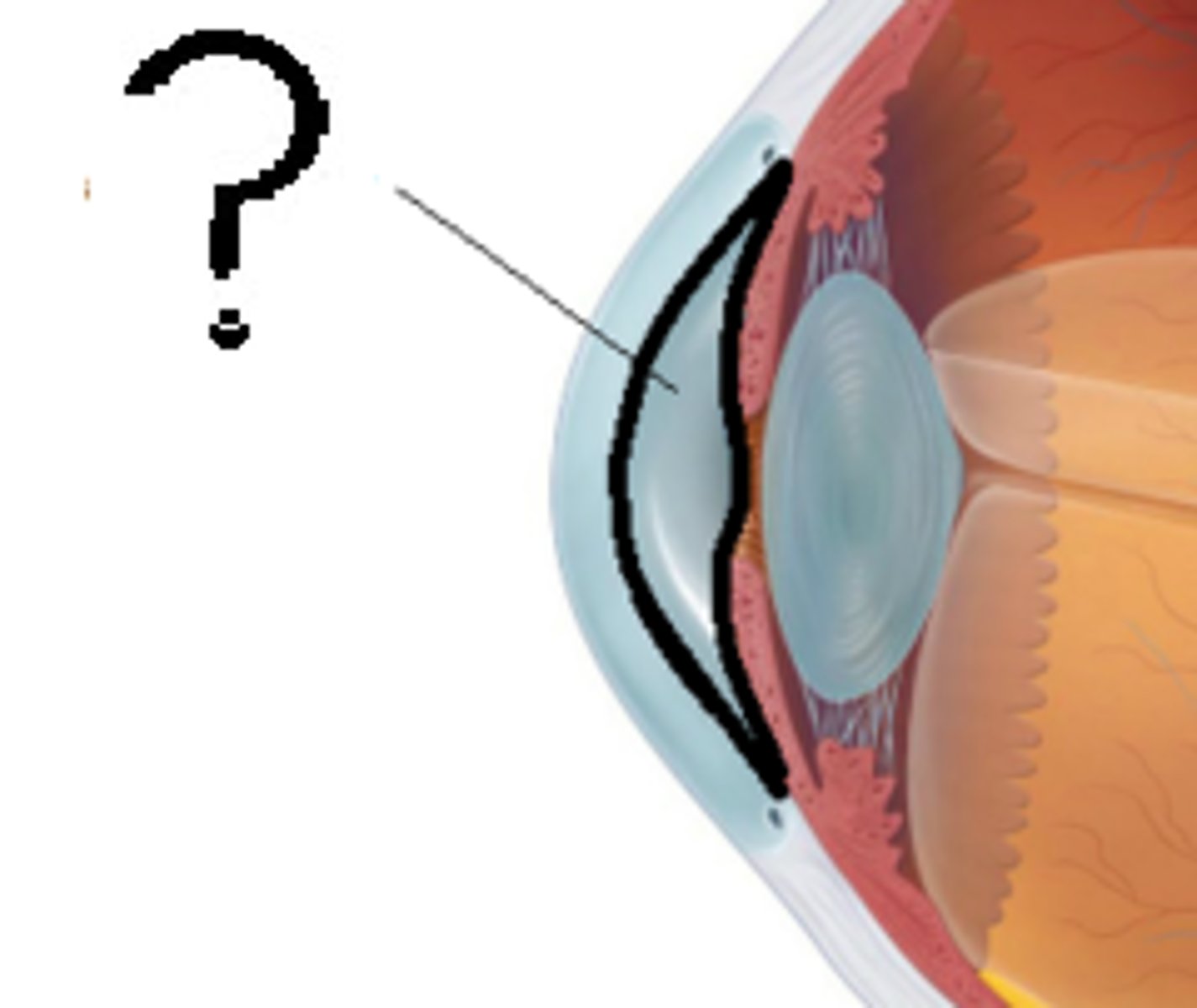
Cornea
A clear covering of the iris and pupil (front of the eye.) It bends (refracts) light.
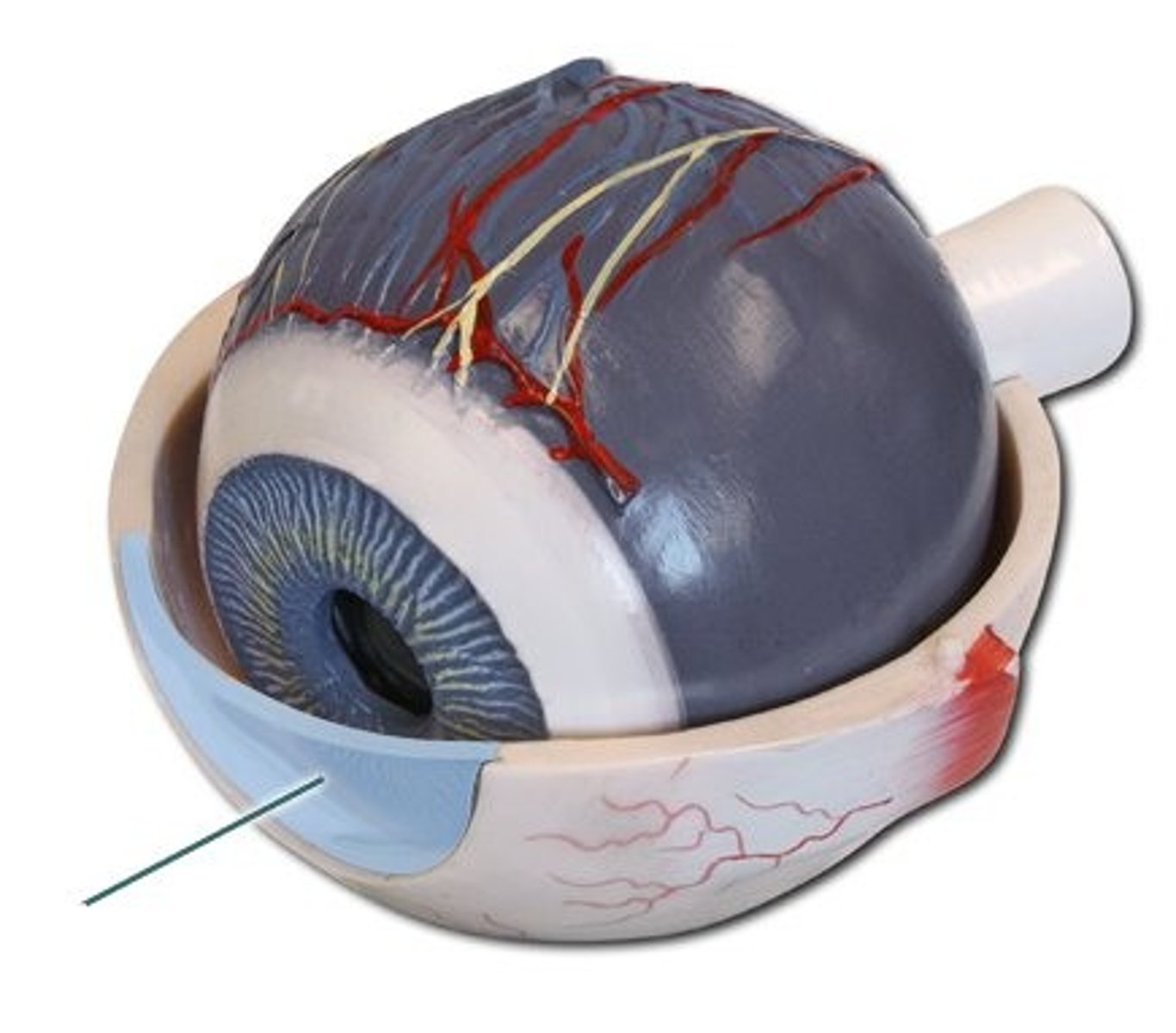
Iris
Muscle tissue that controls how much light enters the eye. Contains the colour of the eye.
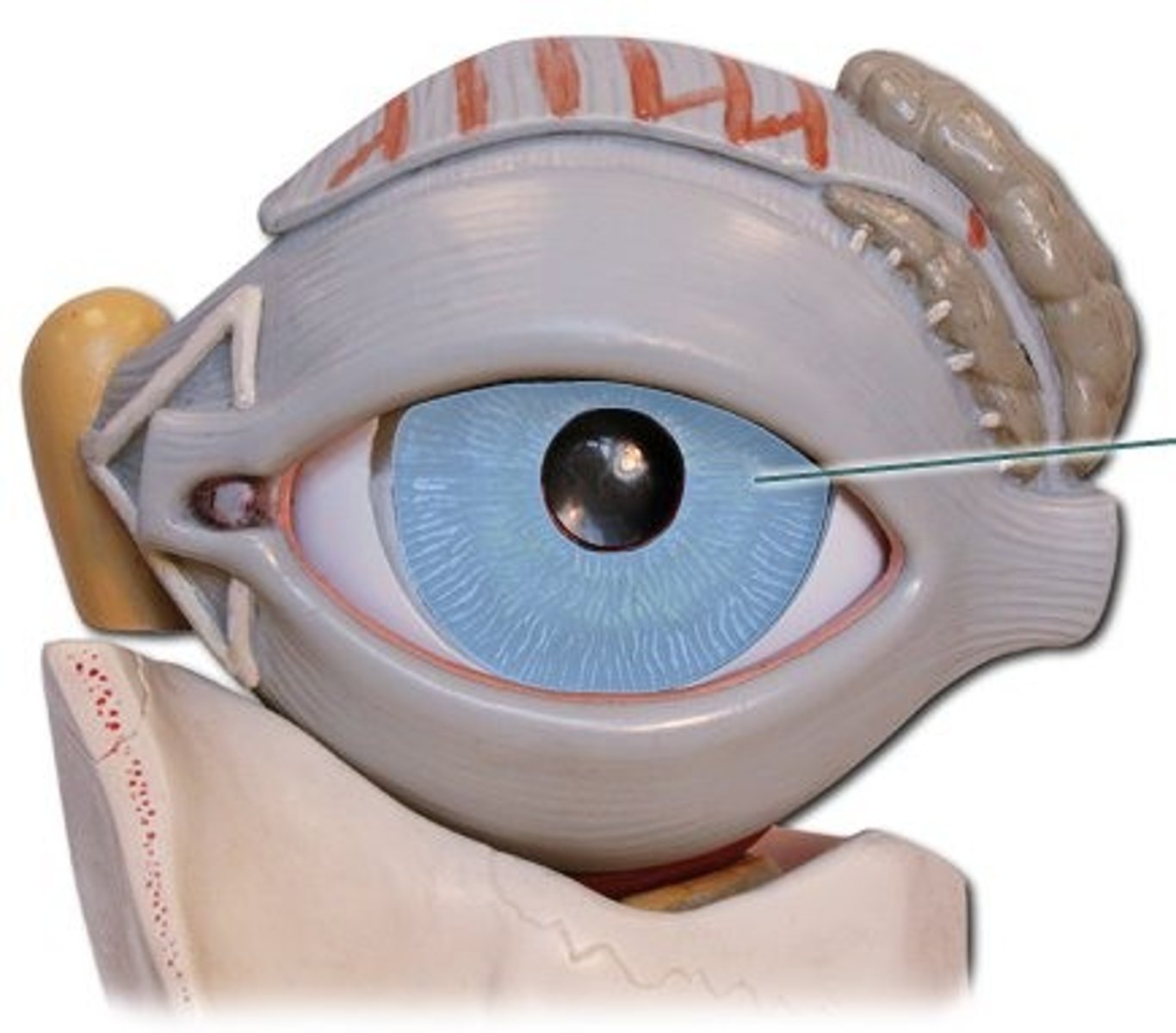
Optic Nerve
Bundle of nerves that carries information from the retina to the brain.
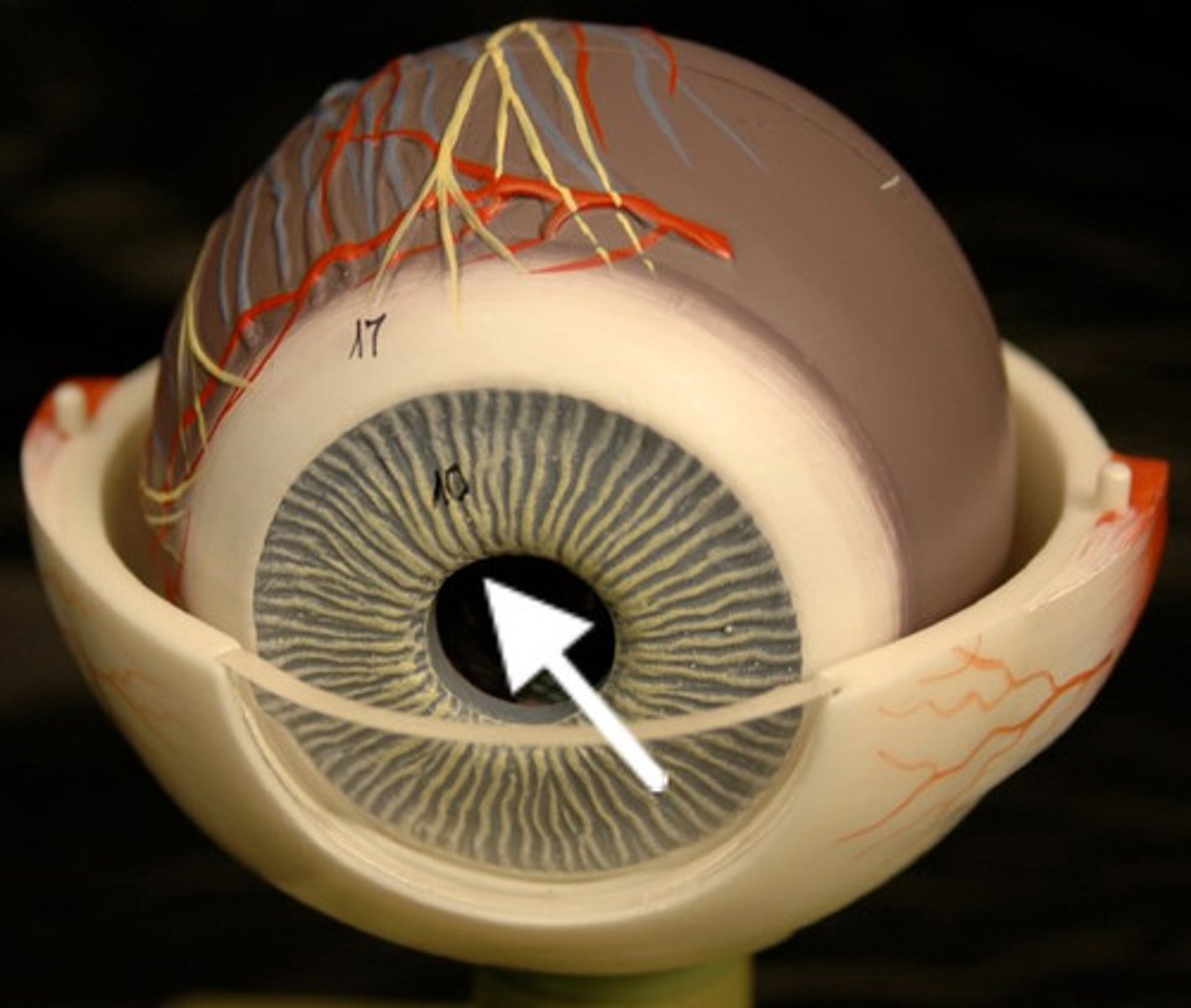
Pupil
The "black" circle in the centre of the iris. Lets light into the inner eye.
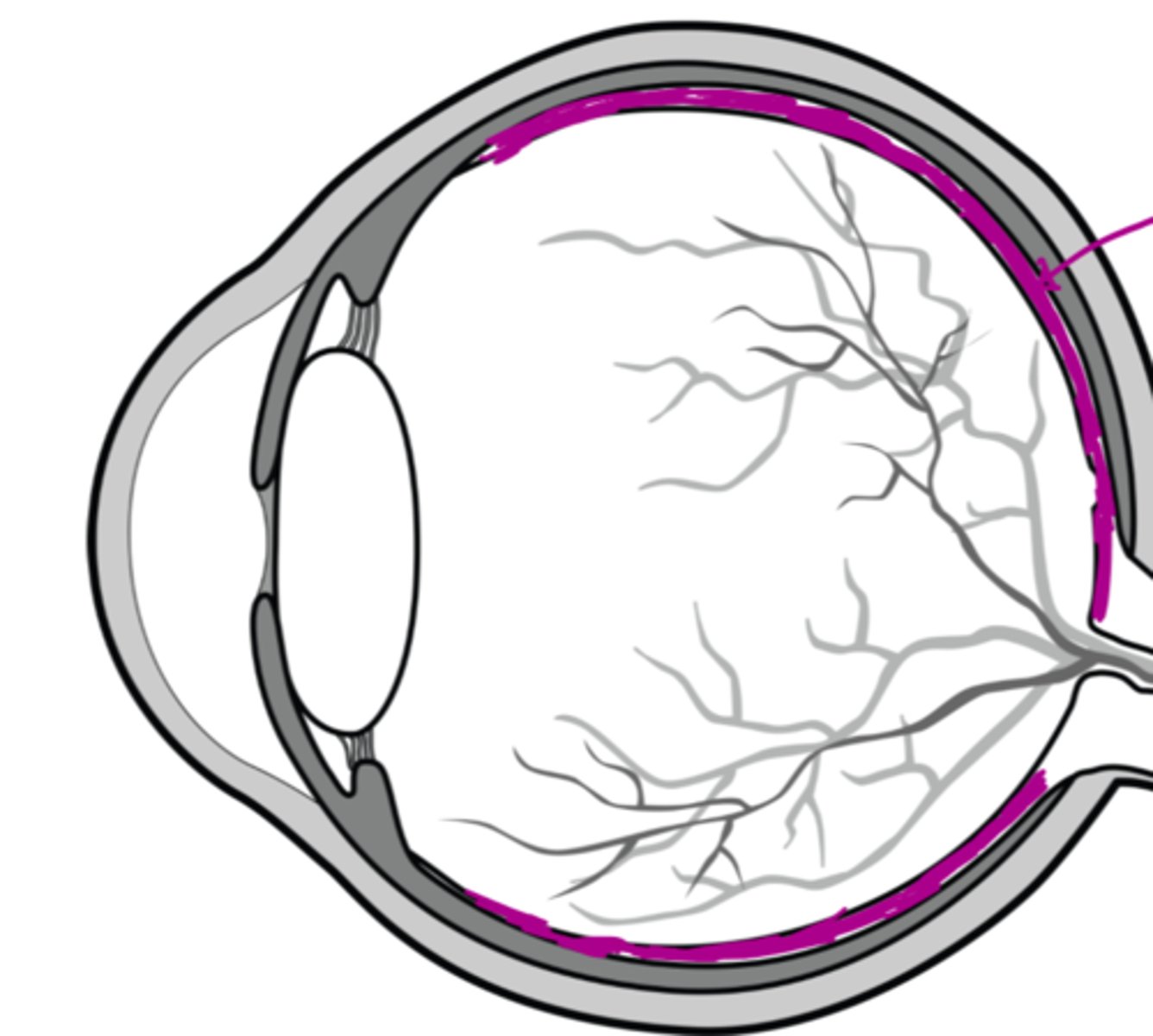
Retina
Detects images focused by the cornea. Converts wavelengths of light into neuronal signals that become perceived visual images. Connected to the brain via the optic nerve.
Blind Spot
Area where all nerves from the retina join together. There are no light sensitive cells at this part in the eye.
Rods
A kind of light-sensitive cells in the retina. Detects dim lights.
Cones
A kind of light-sensitive cells in the retina. Responsible for colour vision/brighter lights.
Importance of Two Eyes
- Better depth perception, as each eye creates an image. These two images create a clear 3D image.
- Wider field of view.
20/20 Vision
If you are standing 20 ft (20/20) away, you see what an "average" person sees when they are standing 20 ft (20/20) away.
Three Layers of the Eye
1. Located on the outside of the eye, and made up of two parts: Clear cornea (right at the front of the eye) and White Sclera (gives the eyeball its shape).
2. Middle of the eye, the iris (controls how much light enters the eye).
3. Back of the eye, which is everything past and including the lens.
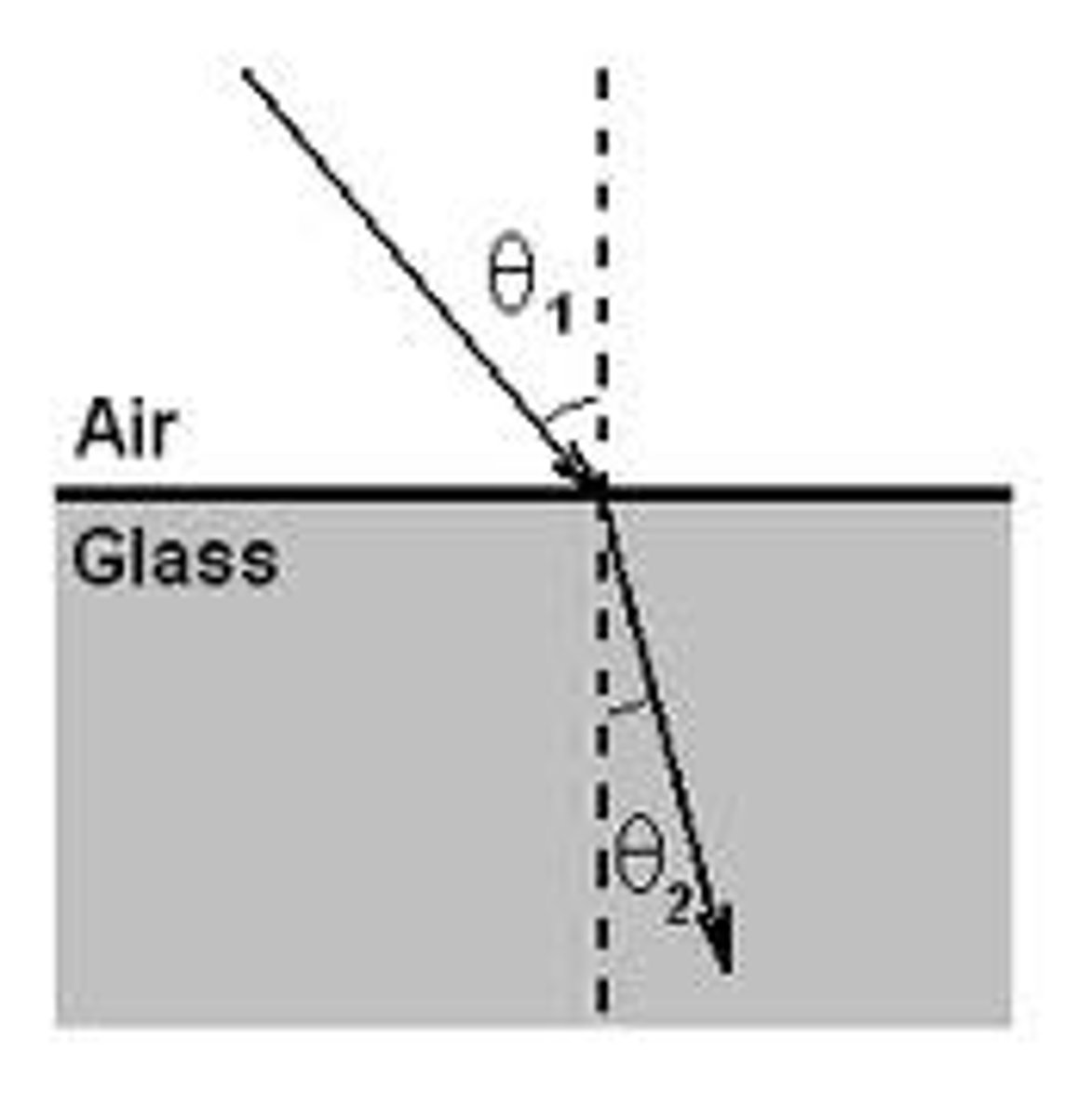
Refraction
The bending of a wave as it passes at an angle from one medium to another.
Converging Lens
A lens that is thicker in the middle than at the edges and that refracts parallel rays to a focal point.
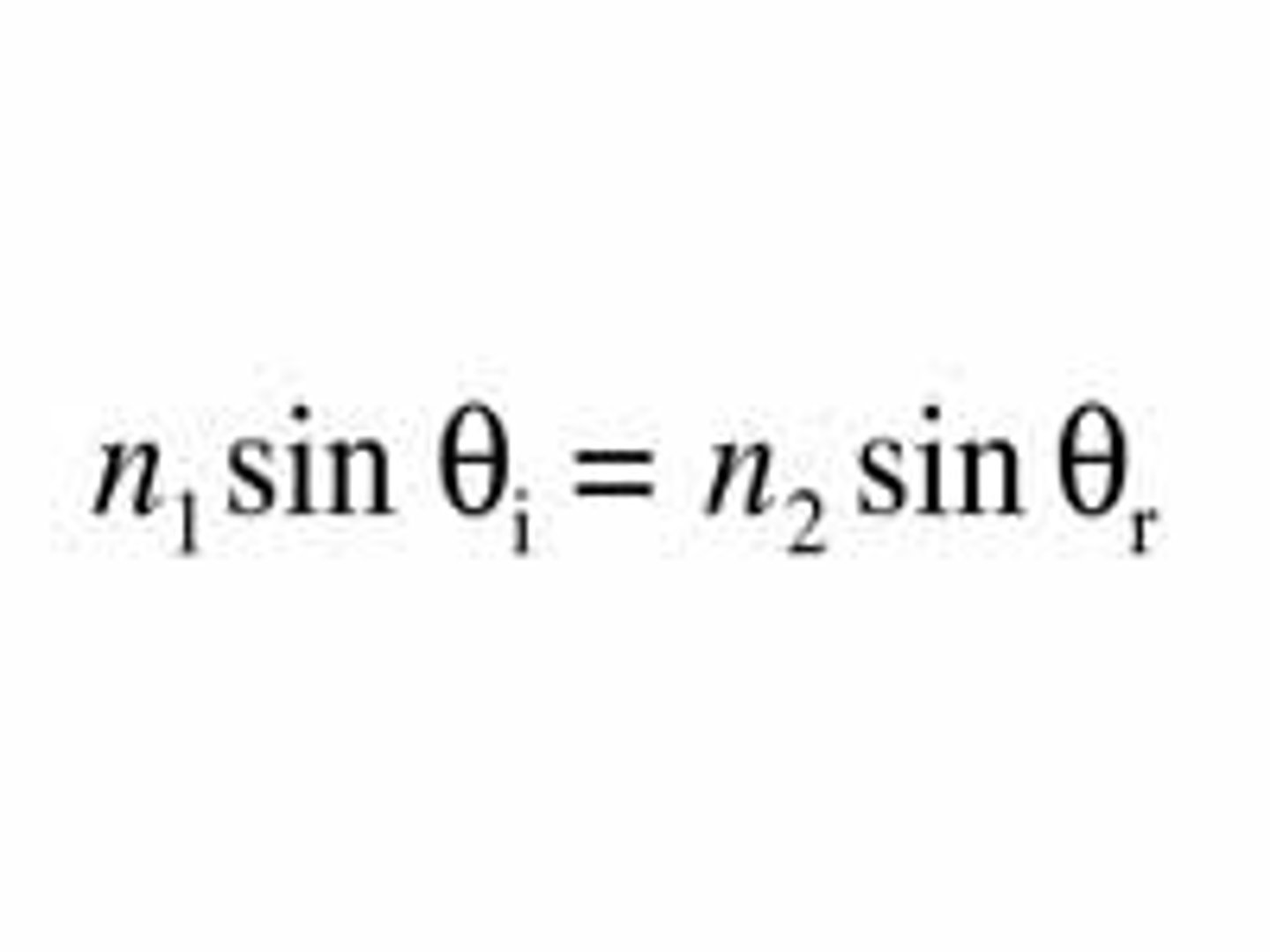
Snell's Law
The ratio of the sine of the angle of incidence to the sine of the angle of refraction is a constant. Often given three variables to find the fourth one.
n1 represents index of refraction of the incident medium.
n2 represents index of refraction of the refractive medium.
θ1 or θi represents angle of incidence.
θ2 or θr represents angle of refraction.