Universal Wave Equation, Transverse and Longitudinal Waves
 Call Kai
 Learn
Learn Practice Test
 Spaced Repetition
 Match
Match Flashcards
 Knowt Play
1/23

There's no tags or description
Looks like no tags are added yet.
Name | Mastery | Learn | Test | Matching | Spaced | Call with Kai | Chat |
|---|
No analytics yet
Send a link to your students to track their progress
24 Terms
What is a vibration?
A vibration is a cyclical motion about an equilibrium point. (ex. windshield wipers and clock pendulum)
What is a wave? (3)
Waves are disturbances that transfer energy over a distance without permanently transporting matter along with it.
What is a transverse wave?
A wave that oscillates matter in a perpendicular direction to the wave’s motion (or propagation)
ex.
string in musical instruments
wave dance move
moving slinky in up and down motion
water
EM waves/ light
What is a longitudinal wave?
A wave that oscillates matter in a parallel direction to the wave’s motion (or propagation)
ex.
sound oscillation of air molecules
pushing sling back and forth
earthquake motion
What is a mechanical wave?
A wave that requires a medium to move through or else it cannot exist.
Can be transverse or longitudinal
ex.
waves in the ocean (need water, the medium, to occur)
What is a medium?
The material (solid, liquid, or gas) through which a wave travels
The more rigid it it is the more efficient it is at transferring a vibration (solids > liquids > gases)
However other factors such as temperature, density, and tension play a role in the medium’s ability to transmit vibrations
What are electromagnetic (EM) waves? (3)
A wave that moves through a vacuum (which is just empty space).
Created as a result of vibrations between electric and magnetic fields.
ALL EM waves are photons and move at the same speed (3 ×10⁸ ms-1)
Bightness/ intensity of light is proportional to wave amplitude
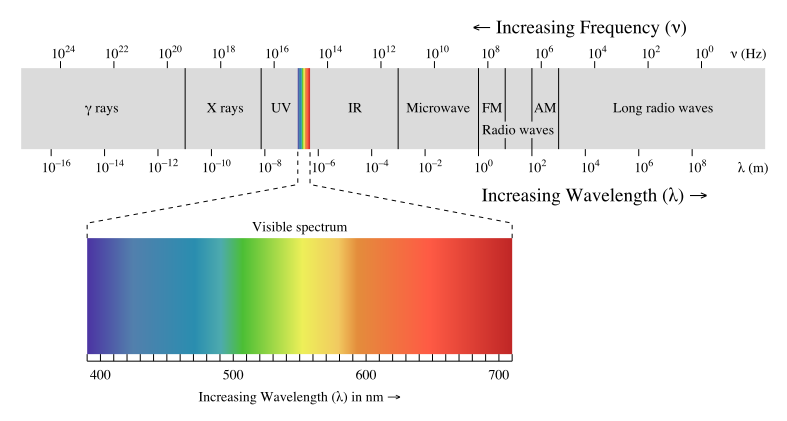
What is the electromagnetic spectrum?
A classification of the types of electromagnetic waves arranged by wavelength and frequency.
Gamma rays, X rays, Ultraviolet, visible spectrum, Infrared, Microwave, Radio waves
What are the 8 components of a wave?
cycle
period (T)
frequency (f)
amplitude (A)
wavelength (λ)
crest
through
equilibrium position
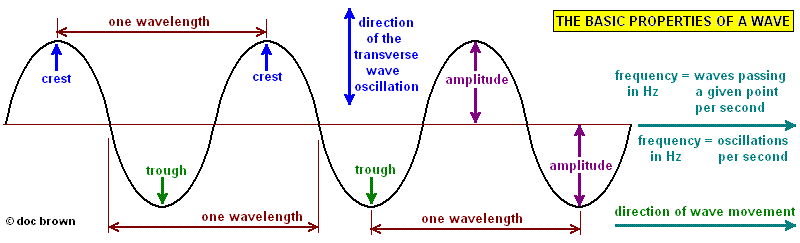
What is a cycle?
One complete shape that starts and end at the same position (e.g. crest to crest)
What is is the period (T)?
The amount of time it takes for the cycle to occur.
measured in seconds (s)
What is the frequency (f)?
The number of cycles that occur per second.
measured in Hertz (Hz)
1 Hz = 1 cycle/ second
Note: Frequency is affected by the source; it is not affected by changes to the speed or wavelength
What is the relationship between period and frequency?
T = t/N or time/ cycle
f = N/t or cycle/ second
T = 1/f and f = 1/T (reciprocal relationship)
where N is the number of cycles and t is the total time for N cycles
What is the amplitude (A)?
The maximum distance a particle moves from the the equilibrium position.
What is a wavelength (λ)?
The distance a cycle travels.
measured in meter (m)
What are crest, troughs, and equilibrium position?
Crest - highest point
Through - lowest point
Equilibrium position - central rest point when not disturbed by wave
What is the universal wave equation?
v = fλ or v = λ/T
Note: the velocity is dependent on the medium, and the frequency is dependent on the source
What is phase?
The phase is the particles state at one moment in time
The state can be completely described by its position and velocity
Particles can be described to be in phase, out of phase, and opposite phase (anti-phase) - misaligned by exactly 180 degrees
What are 3 factors that affect wave speed?
Temperature
Molecular forces
Tension (strings)
How does temperature affect wave speed?
Waves travel faster in warmer gases
Waves travel more slowly in colder gases
Since molecules in hotter gases travel faster and transfer energy a lot more efficiently through collisions
Temperature plays a role in the equation for the velocity of a sound wave:
v = 331.4 ms-1 + 0.606 ms-1°c-1 (T)
where T is the object’s temperature in celcius
How does molecular forces affect wave speed?
strong molecular forces = faster energy transfer = higher wave speed
(solid > liquid > gas)
What are the 2 properties that affect the speed of a string?
Linear density (µ) determines how much force it takes to make the string vibrate
Mass per unit length determines how much force is needed to vibrate a string
µ = m / L
Tension in a string determines how well it transmits energy (a loose string quickly absorbs energy, whereas a tight string transmits energy very effectively)
v = square root (FT / µ)
What does a displacement-distance graph tell you?
Shows the displacement of all particles in the medium at one single, frozen moment in time (snapshot).
Can find the wavelength
What does a displacement-time graph tell you?
Shows how a single particle's displacement changes as time passes.
Can find the period