Introduction and research methods + Neuroscience and Biological Foundations
 Call Kai
 Learn
Learn Practice Test
 Spaced Repetition
 Match
Match Flashcards
 Knowt Play
1/64

There's no tags or description
Looks like no tags are added yet.
Name | Mastery | Learn | Test | Matching | Spaced | Call with Kai |
|---|
No analytics yet
Send a link to your students to track their progress
65 Terms
What is psychology?
The scientific study of mental activity and behavior, which are based on brain processes.
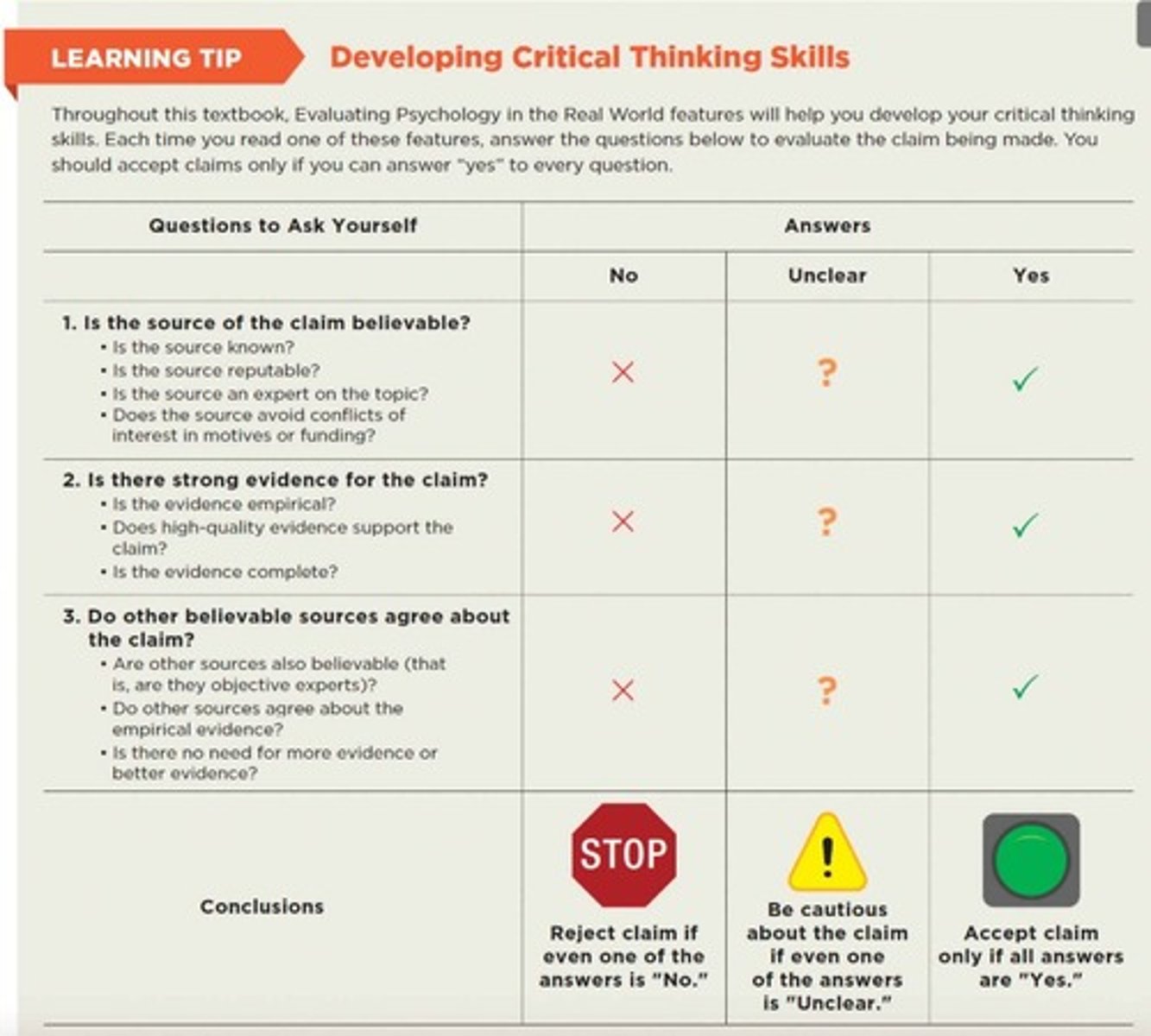
What is critical thinking?
Systematically evaluating information to reach conclusions based on the evidence that is presented.
what does critical thinking entail? (more details page 11)
Step 1 in Critical Thinking: Is the Source of the Claim Believable?
Step 2 in Critical Thinking: Is There Strong Evidence for the Claim?
Step 3 in Critical Thinking: Do Other Believable Sources Agree About the Claim?
psychoanalytic/psychodynamic theory
Personality is based on unconscious wishes that create conflict between the id, ego, and superego
Unconscious forces—such as wishes, desires, and hidden memories—determine behavior and influence personality.
According to Freud, unique interactions among the id, superego, and ego produce individual differences in personality.
behaviorism
A school of thought that emphasizes the role of environmental forces in producing behavior.
In 1913, the psychologist John B. Watson proposed that for psychology to be a true science, it had to stop studying mental events that could not be observed directly. For this reason, Watson developed the school of behaviorism, which investigates how observable stimuli in the environment affect behavior (Watson, 1924). He believed that all animals—including humans—learn all their behaviors from their environment.
gestalt
A series of laws to explain how our brains group the perceived features of a visual scene into an organized whole.
Gestalt psychology holds that our brains use a number of built-in principles to organize sensory information.
.These principles explain why we perceive, say, "a car" as opposed to metal, tires, glass, hubcaps, fenders, and so on. For us, an object exists as a unit, not as a collection of separate features. Let's consider these principles of object perception.
In terms of Gestalt principles, an object is a figure that is distinct from the background, which is called the ground. In identifying any figure, the brain assigns the rest of the scene to the ground
humanistic psychology (page 345)
views people as striving toward personal fulfillment.
From this perspective, human beings are unique among animals because people continually try to improve themselves. In considering motivation, humanists focus on the person.
A state of self-actualization occurs when people achieve their personal dreams and aspirations. A self-actualized person is living up to his or her unique potential and therefore is truly happy.
Maslow writes, "A musician must make music, an artist must paint, a poet must write, if he is ultimately to be at peace with himself. What a man can be, he must be"
Cognitive Psychology
This school emerged from the "cognitive revolution" in the 1950s, focusing on internal mental processes such as thinking, memory, problem-solving, and language. It views the mind similarly to a computer, analyzing how individuals encode, process, and retrieve information.
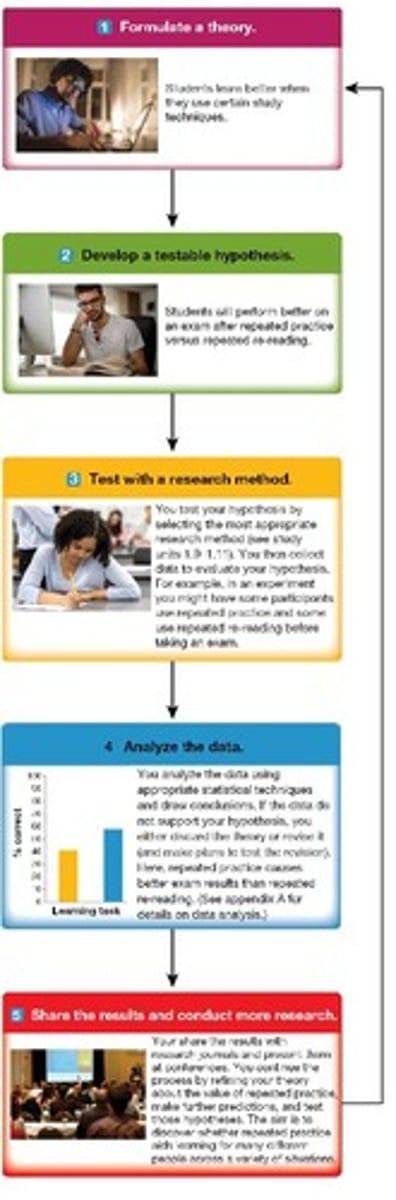
hypothesis (page 25)
A specific, testable prediction of what should be observed in a study if a theory is correct
operational definition (page 37)
Operational definitions qualify (describe) and quantify (measure) variables so they can be understood objectively.
experimental methods
Research methods that can reveal causality by manipulating independent variables and measuring the effects on dependent variables.
independent variable
In an experiment, the variable that the experimenter manipulates to examine its impact on the dependent variable.
dependent variable
In an experiment, the variable that is measured to determine how it was affected by the manipulation of the independent variable.
experimental group
In an experiment, one or more groups of participants that experience the treatment of interest based on manipulation of the independent variable.
control group
In an experiment, a group of participants that receives either no treatment or a baseline manipulation that is expected to have little or no impact; this group serves as a comparison to the experimental group.
random assignment
Placing research participants into the conditions of an experiment in such a way that each participant has an equal chance of being assigned to any level of the independent variable.
Correlation (methods)
Research methods that examine how variables are naturally related in the real world without altering the variables and without revealing whether one factor causes changes in another.
directionality problem
a problem encountered in correlational studies; the researchers find a relationship between two variables, but they cannot determine which variable may have caused changes in the other variable
Cannot show the direction of the cause and effect relationship between variables
third variable problem
the concept that a correlation between two variables may stem from both being influenced by some third variable
An unidentified variable may be involved
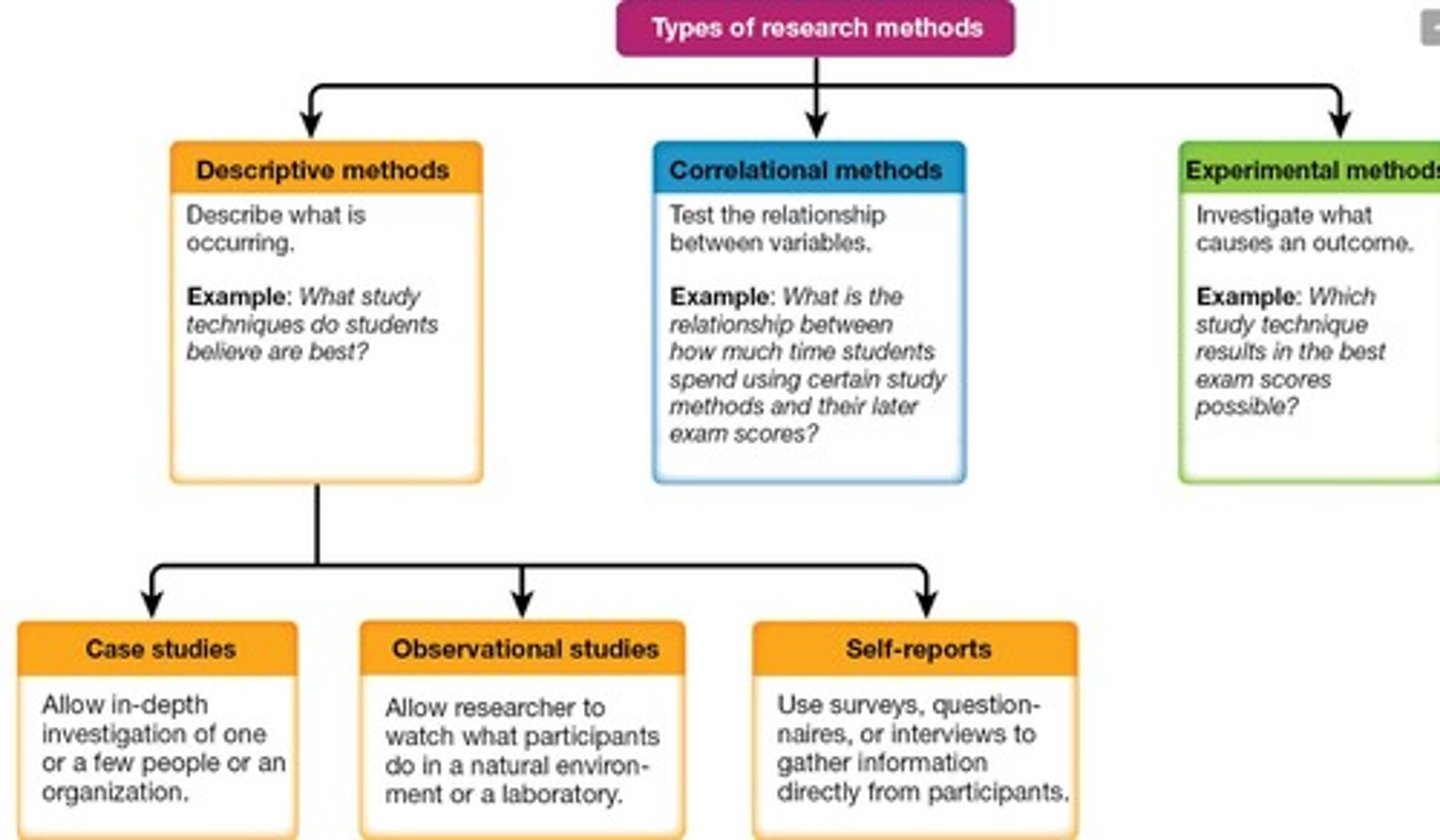
What is the main difference between a correlational study and an experiment? (page 27)
Correlational methods: Test the relationship between variables
(Example: What is the relationship between how much time students spend using certain study methods and their later exam scores?)
Experimental methods: Investigate what causes an outcome (Example: Which study technique results in the best exam scores possible?).
Surveys
Questionnaires and surveys are two common types of self-reports that researchers use to gather data from a large number of people in a short time. They gather information directly from participants.
In these two types of self-reports, participants write answers to questions they are given. These research tools are easy to administer and cost-efficient.
Observational Studies
Observational studies involve systematically assessing and coding observable behavior across specific time intervals
allow the researcher to watch what participants do in a natural environment or a laboratory
case studies
Case studies involve intensive examination of just one person (or organization) or a few atypical people (or organizations). Because of this intense focus, case studies can yield a lot of data
Allow in-depth investigation of one or a few people or an organization
How does a sample differ from a population?
The general group you want to know about is your population
For instance, you might want your results to generalize to college students, to people of certain age ranges or from certain cultural backgrounds, and so on.
To learn about the whole population of interest, you study a subset, or a small number, of people from that population.
Sampling is the process you use to select people from the population to participate in the study, and the subset of people chosen to participate in the research is called the sample.
Dendrites
The dendrites are short, branchlike extensions of the cell body. They receive signals from neighboring neurons.
cell body (soma)
In the cell body, the information received from thousands of other neurons is collected and integrated (combined).
Axon
Once the incoming information has been integrated in the cell body, electrical impulses are transmitted along the axon. Axons vary tremendously in length
For example, the longest axons stretch all the way from the spinal cord to each of the big toes. In everyday language, we commonly refer to neurons as nerves, as in the phrase "pinched nerve."
In this context, a nerve is a bundle of axons that carry information between the brain and other specific locations in the body.
myelin sheath
A fatty material that covers and insulates some axons to allow for faster movement of electrical impulses along the axon.
Terminal buds (terminal buttons, synaptic knobs, axon buds)
Parts of the neuron at the end of axons that release chemical signals from the neuron into the synapse.
synapse
The gap between the terminal buttons of a sending neuron and the dendrites of a receiving neuron.
Parts of a neuron
dendrites, cell body (soma), axon, myelin sheath, terminal buds, and synapse.
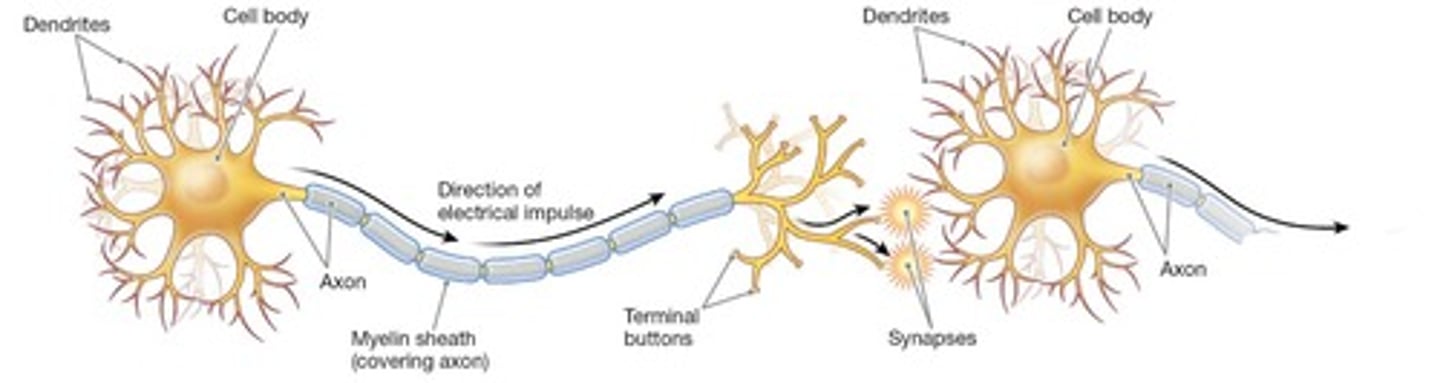
How do neurons communicate?
Communication occurs between neurons at the synapse. The neurons do not actually touch each other in the synapse.
Instead, they communicate by releasing chemicals at the terminal buttons. These chemicals, called neurotransmitters, cross the tiny gap between the sending neuron and the dendrites of the receiving neurons.
Neurotransmitters
Chemicals that carry signals from one neuron to another.
action potential
The neural impulse that travels along the axon and then causes the release of neurotransmitters into the synapse.
Think of receiving texts from your friends to go out and be social. When you receive enough texts, you finally spring into action and go to meet them.
nervous system
A network of billions of cells in the brain and the body, responsible for all aspects of what you think, feel, and do.
Central Nervous System (CNS)
The part of the nervous system that consists of the nerve cells in the brain and the spinal cord.
For example, when you bite into an ice cream sandwich, the PNS registers those sensory signals and transmits the information to the CNS. The CNS organizes and evaluates that information, then directs the PNS to perform specific behaviors, such as taking another bite of the sandwich
Peripheral Nervous System (PNS)
consists of the nerve cells outside of the brain and spinal cord.
For example, when you bite into an ice cream sandwich, the PNS registers those sensory signals and transmits the information to the CNS. The CNS organizes and evaluates that information, then directs the PNS to perform specific behaviors, such as taking another bite of the sandwich.
Somatic Nervous System (SNS)
The somatic nervous system is made up of skin, muscles, and joints that send signals to the spinal cord and brain.
The brain and spinal cord then send signals to the muscles, joints, and skin.
autonomic nervous system
The autonomic nervous system is made up of glands and internal organs that send signals to the spinal cord and brain.
The brain and spinal cord then send signals to the glands and internal organs.
The autonomic nervous system is made up of the sympathetic nervous system and the parasympathetic nervous system.
sympathetic nervous system
The sympathetic division prepares the body for action
This preparation for action is prompted by the sympathetic nervous system.
he sympathetic nervous system arouses the body and prepares it for action.
parasympathetic nervous system
the parasympathetic division returns the body to a resting state.
the parasympathetic division of the autonomic nervous system returns the body to a resting state.
The parasympathetic nervous system calms the body, letting it relax.
sympathetic and parasympathetic nervous systems
these are part of the autonomic nervous system. Sympathetic is fight or flight response. Parasympathetic is calming and conserves energy.
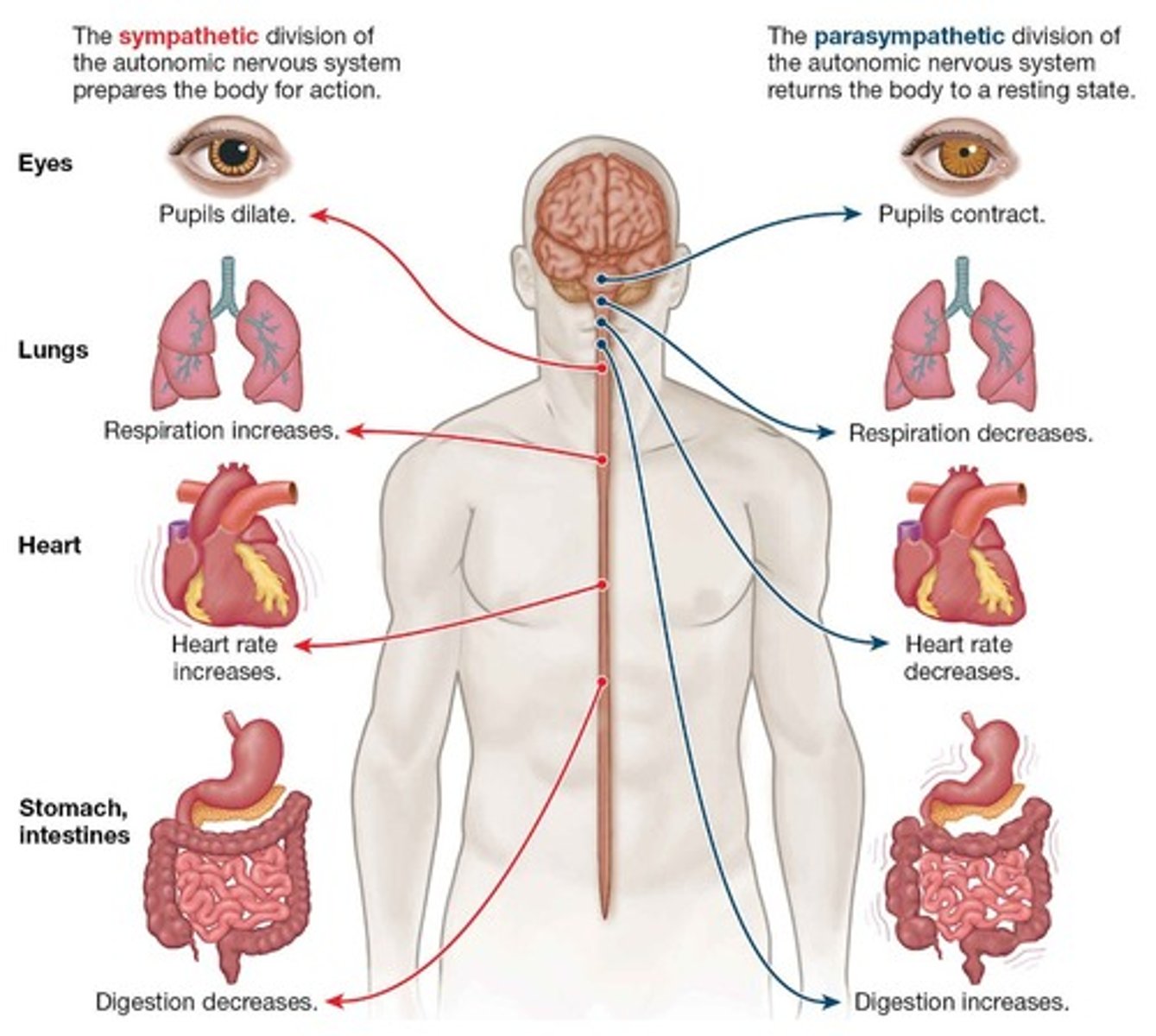
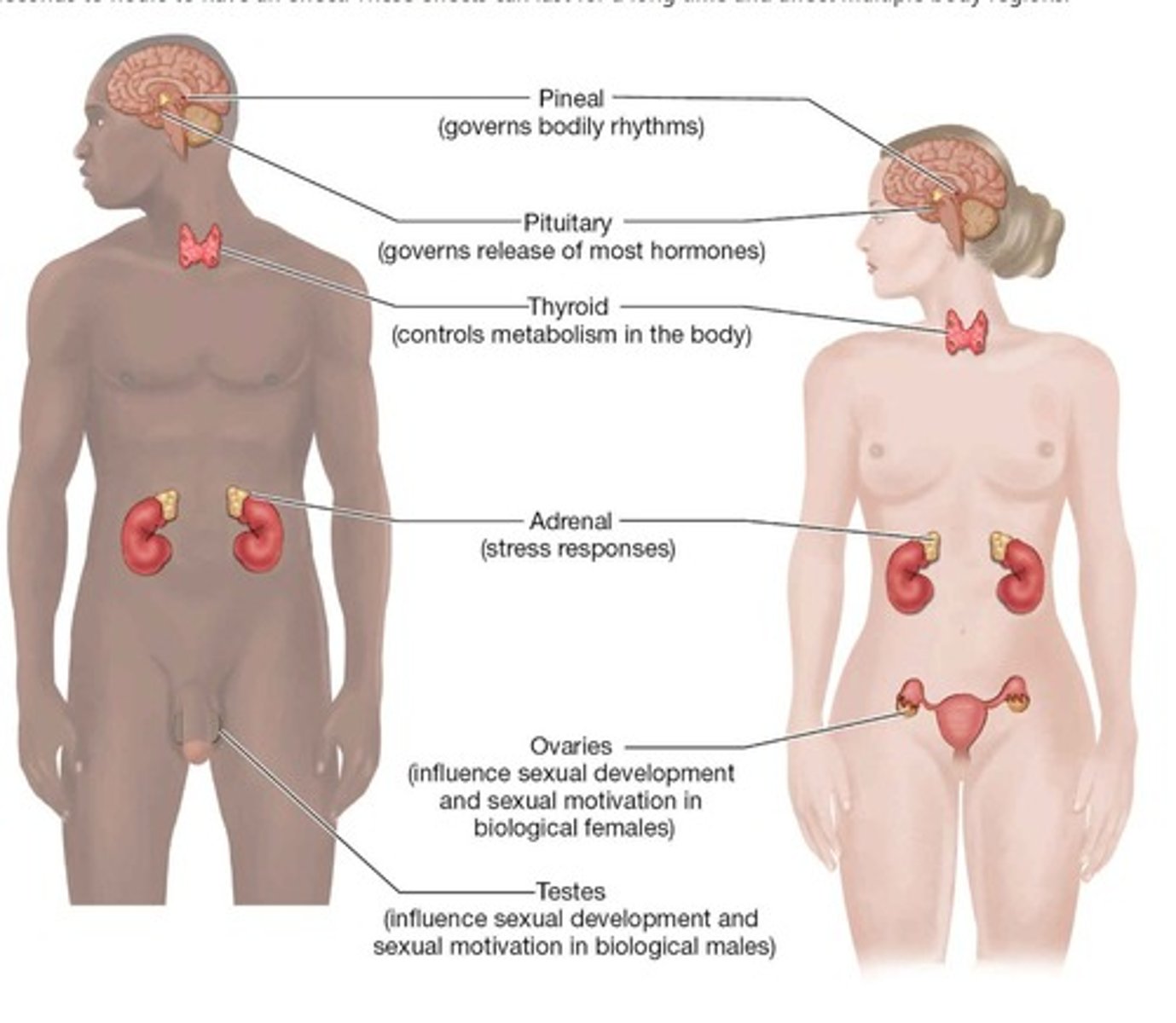
endocrine system + parts
A bodily communication system that uses hormones to influence many aspects of the body, mental activity, and behavior.
The endocrine system also influences your mental activity and behavior, perhaps making you feel stressed when you are studying for exams.
how does the endocrine system communicate with the rest of the body?
The endocrine system communicates with the body by releasing chemical messengers called hormones directly into the bloodstream.
These hormones travel throughout the body, acting on specific target cells and organs to regulate functions such as metabolism, growth, reproduction, and mood.
glands in the endocrine system
The endocrine glands include the pineal gland, the adrenal glands, the pituitary gland, the thyroid, and the testes or ovaries
The glands in the endocrine system work with the nervous system by releasing chemicals that influence mental activity and behavior.
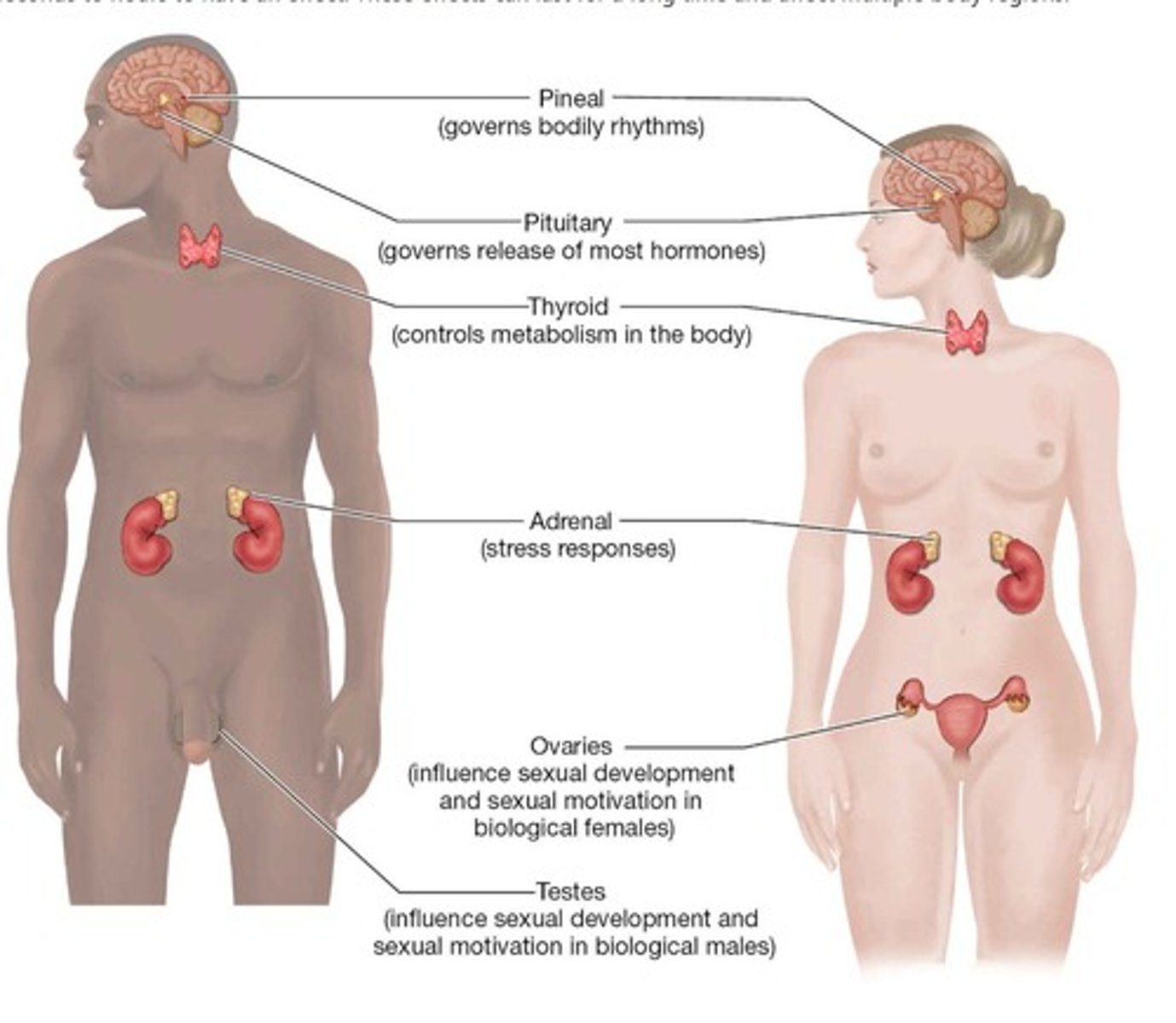
Horomones (endocrine system)
Chemicals released from endocrine glands that travel through the bloodstream to targeted tissues; the tissues are later influenced by the hormones.
Neuroplasticity
the ability within the brain to constantly change both the structure and function of many cells in response to experience or trauma
A property of the brain that causes it to change as a result of experience or injury.
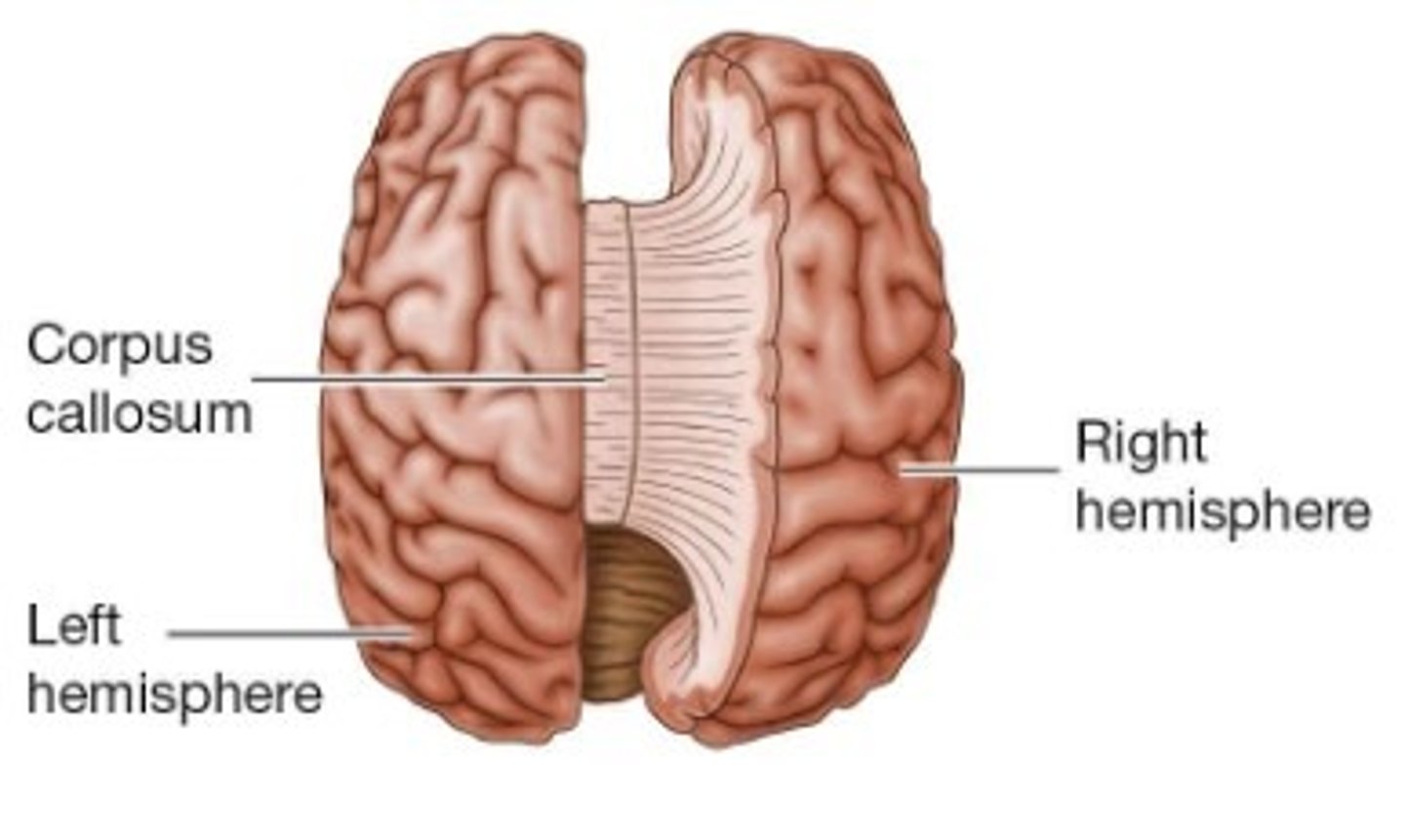
corpus callosum
hemispheres are connected by a structure called the corpus callosum.
This massive bridge consists of millions of axons. It lets information flow between the left and the right hemispheres
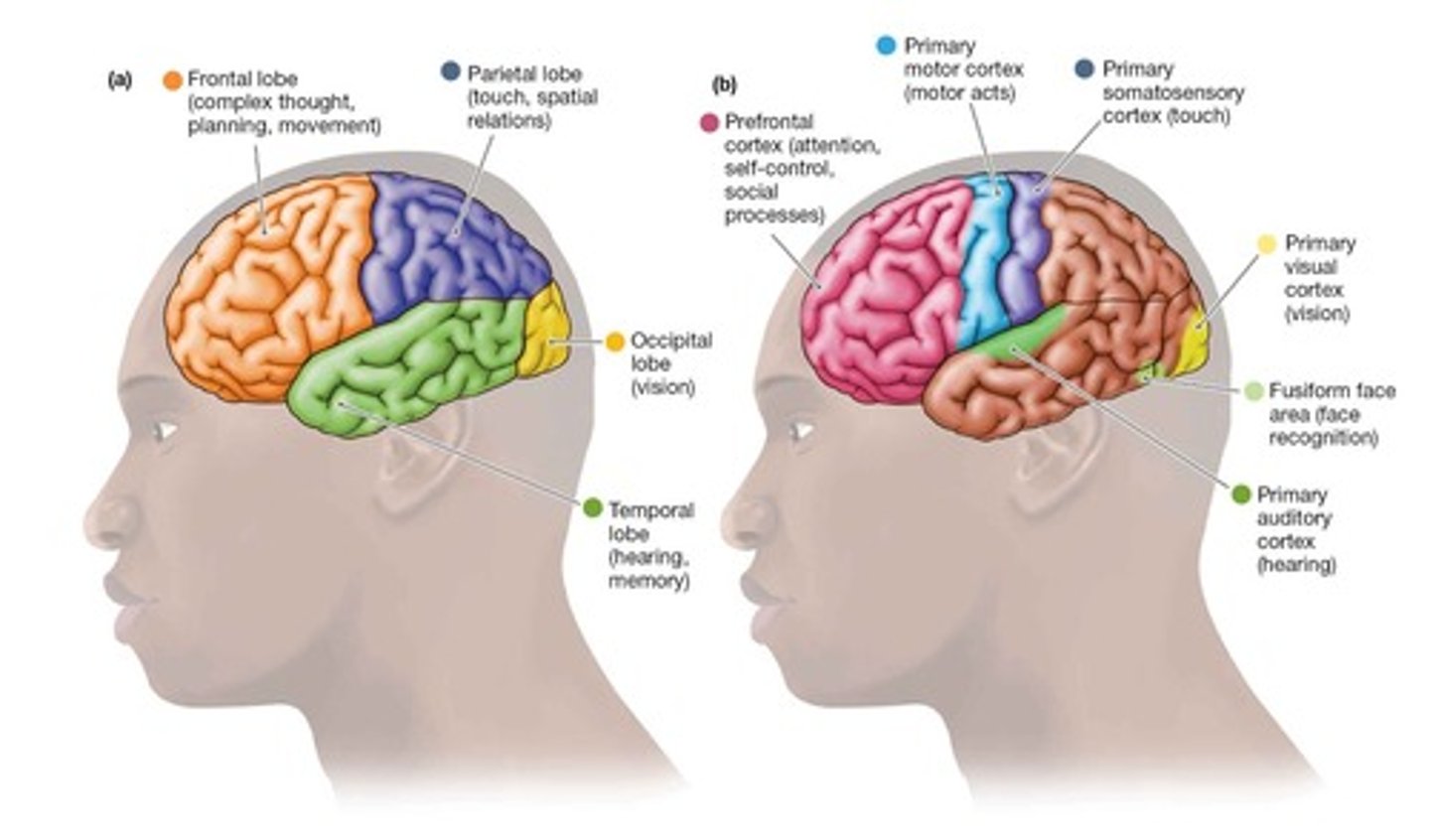
frontal lobes
Regions of the cerebral cortex at the front of the brain
important for movement, planning, and complex processes (rational thought, attention, self-control, social processes, and so on).
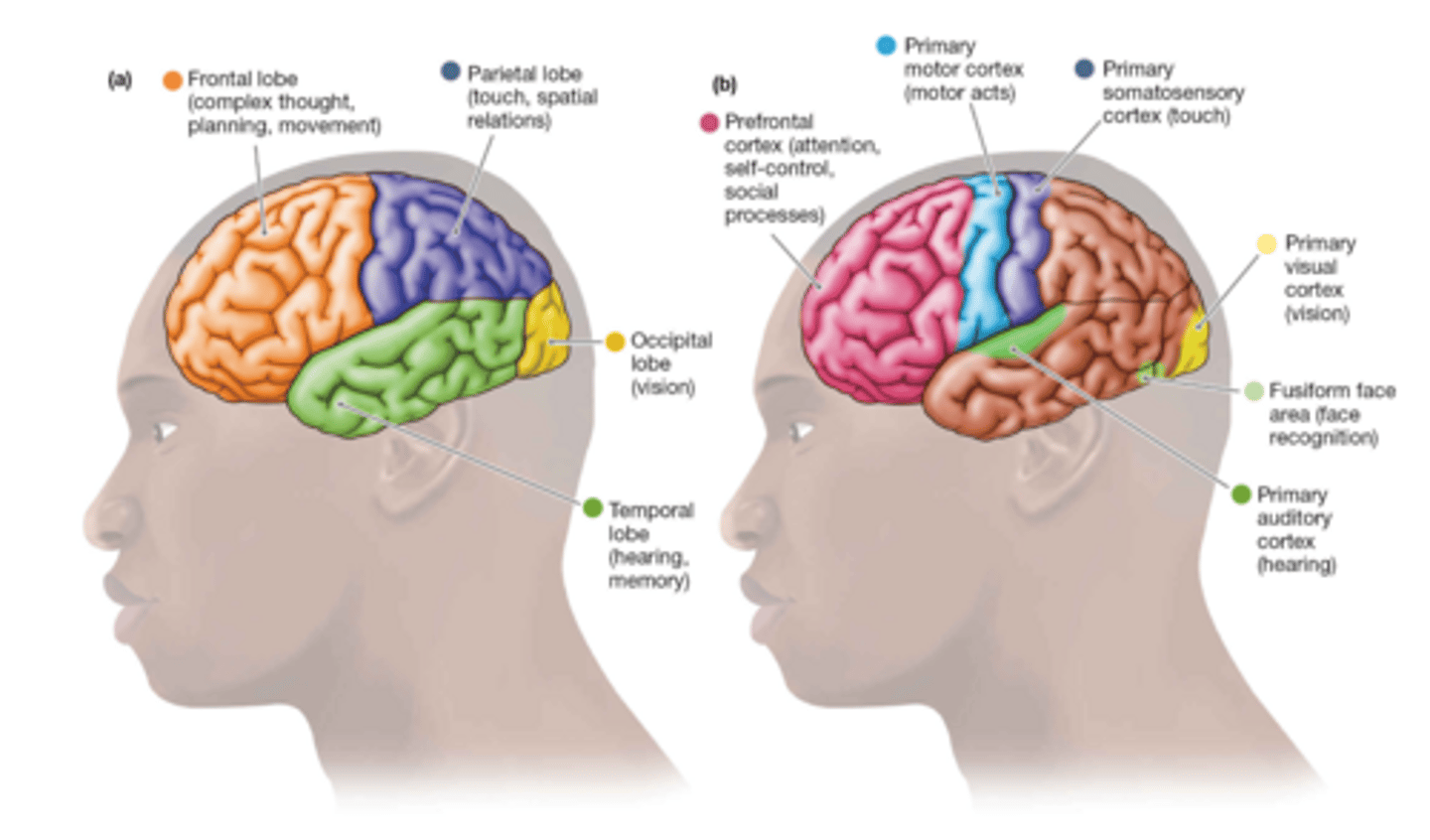
motor cortex
The rear portion of the frontal lobes is the primary motor cortex, which includes neurons that send messages directly to the spinal cord to move the body's muscles
the motor cortex in one hemisphere controls the other side of body: The left hemisphere controls the right arm, for example, whereas the right hemisphere controls the left arm. So if you are right handed, you use the primary motor cortex in your left hemisphere to write.
parietal lobe
Regions of the cerebral cortex in front of the occipital lobes and behind the frontal lobes
important for the sense of touch and for picturing the layout of spaces in an environment.
somatosensory cortex
This area is a strip of brain matter in the front part of the lobe, running from the top of the brain down the sides.
In the primary somatosensory cortex, touch information from one body part registers in the cortex near regions where touch information is registered from nearby body parts
occipital lobe
Regions of the cerebral cortex at the back of the brain important for vision.
primary visual cortex
The primary visual cortex is an important processor of visual information.
The primary visual cortex is surrounded by a patchwork of secondary visual areas. These areas process various qualities of the visual input, such as its colors, forms, and motions.
temporal lobe
Regions of the cerebral cortex below the parietal lobes and in front of the occipital lobes important for hearing and for recognizing objects, such as faces.
primary auditory cortex
the region of the superior temporal lobe whose primary input is from the auditory system
thalamus
A subcortical forebrain structure; the gateway to the brain for sight, sound, touch, and taste sensory information before that information reaches the cortex
hypothalamus
A subcortical forebrain structure involved in regulating bodily functions. The hypothalamus also influences basic motivated behaviors.
amygdala
A subcortical forebrain structure involved in detecting and responding to threats; it also plays a vital role in learning to associate things with emotional responses and in processing emotional information.
hippocampus
A subcortical forebrain structure; it is associated with the formation of new memories and with spatial navigation.
pons
A hindbrain structure above the medulla; it regulates sleep and arousal and coordinates movements of the left and right sides of the body. sleep, arousal, left-right body movement coordination (hindbrain)
medulla
A hindbrain structure at the top of the spinal cord; it controls survival functions such as heart rate and breathing. breathing, heart rate, other survival mechanisms (hindbrain)
Substantia nigra
is important for initiating voluntary movements. This region is critical for the production of dopamine, the neurotransmitter that motivates behavior and controls normal motor function. initiation of voluntary motor activity (midbrain)
cerebellum
A hindbrain structure behind the medulla and pons; it is essential for motor learning, coordination, and balance. motor learning, coordination, balance (hindbrain)
brain lobes
frontal, parietal, occipital, temporal