Introduction to Marxian Economics -- Background (Ruccio)
 Call Kai
 Learn
Learn Practice Test
 Spaced Repetition
 Match
Match Flashcards
 Knowt Play
1/7

There's no tags or description
Looks like no tags are added yet.
Name | Mastery | Learn | Test | Matching | Spaced | Call with Kai |
|---|
No analytics yet
Send a link to your students to track their progress
8 Terms
Explain neoclassical economics in terms of its:
Perspective on labor theory of value
Idea of markets for factors of production and what they have
What demand is determined by
Households’ decisions & incomes, what determines the prices of commodities, and households’ relationships to firms
Equilibrium and what exactly it entails
The diamond-water paradox as a rebuttal to the labor theory of value
Diamonds have a higher price because they have a higher marginal utility than water, although water is more useful
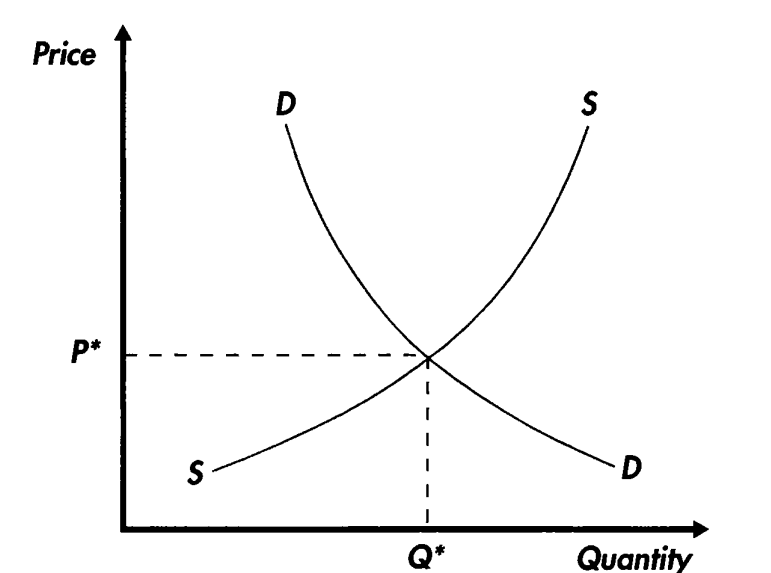
Markets: there are markets for each factor of production (labor, capital, land) and each of them has a corresponding set of:
Supply curves
Demand curves
Equilibrium price
Quantity (where quantity supplied = quantity demanded)
Demand is determined by human preferences which are assumed to be GIVEN and PREDICTABLE
Households:
Make self-interested decisions in choosing between commodities.
Commodities’ prices correspond to their preferences or utilities.
Household incomes derive from sum of wages + profits + rents they obtain when they sell factors of production to the firms that produce the goods and services they purchase.
These “factor” incomes are determined by SUPPLY and DEMAND.
Since all firms are price-takers (they take prices as given when making utility- and profit-maximizing decisions) the economy reaches an equilibrium. This is when
limited means of available resources = unlimited desires of consumers
Sum of household spending for goods and services produced by firms = total of incomes paid by firms to households for factor incomes (incomes created in markets for factors of production)
Explain the ethics of neoclassical economics.
All households are equal (although households have different # of wealth due to utility-maximizing decisions), because:
They are all price-takers who are led to make decisions ensure their individual utilities = everyone else’s.
Everyone gets what they deserve, because:
Consumers purchase commodities at prices equal to their preferences
Incomes households use to purchase goods and services are the sum of wages, profits, and rents they receive for selling factor services
Everyone receives the right reward for their decisions, because:
Households pay for factor services according to their contributions to production
What main features of government policy stemming from neoclassical economics did Keynes challenge? How did he challenge them?
Decrease in wages restores full employment — Keynes argued that lowering wages would lead to less spending and therefore more unemployment
Government budget deficits (when a government spends more money than they receive in revenue) should be avoided at all costs — Keynes argued that if anything, they’re a good thing because governments could stimulate private spending in order to move economies back to full employment
Any attempt to raise aggregate demand (total # of goods & services demanded) would only raise prices and leave employment unchanged — Keynes argued that aggregate demand would decline.
With an elastic (changeable) aggregate supply curve at less than full employment, output would fall to less than full employment.
Also, there are no automatic mechanisms within capitalism to restore full employment.
Aggregate demand can be increased w/o provoking inflation
What did Keynes think about investment decisions made by households and capitalists? What would be the only thing that would save capitalism?
Households use a larger and stabler share of their income for consumptions.
But investors engage in a much more volatile set of decisions because they don’t have complete information about the future.
Capitalists are guided by “animal spirits” — an urge to act beyond quantitative benefits and probabilities
Investment demand (total desire of businesses to spend $ on capital goods) is made unpredictable by capitalists looking at what other capitalists are doing
The only thing that would save capitalism would be for the government to step in with:
Aggressive fiscal policy (deficit spending, or the # by which spending > revenue over a particular period of time)
Accommodating monetary policy (expanding the money supply and lowering interest rates)
What three foundations can classical political economy be reduced to?
The labor theory of value
The “invisible hand” of the market
Comparative advantage in trade
Explain the two effects of the division of labor that Adam Smith writes about.
The division of labor has the following effects:
It increases productivity, and thus increases production.
The extension of the division of labor within factories propels a division of labor within capitalism as a whole, because:
Firms specialize in the production of some goods, which they can then trade in markets with other producers.
Expansion of markets → more division of labor + higher productivity. This increases the wealth of nations.
What did David Ricardo say about specialization of production?
If nations:
Specialize in the production of commodities for which they have a relative (or comparative) advantage
Trade them for goods from other countries
Both countries benefit
What was Jean-Baptiste Say’s argument that led to the establishment of “Say’s Law”?
Commodity production causes incomes to be paid to those who supply the factors of production used in producing goods and services.
Because sale price of these commodities = wages + rents + profit, incomes generated during the course of producing commodities would be enough to purchase all commodities brought to market.
Say’s Law: “supply creates its own demand”