Bio 222 Week 2: Temperature Regulation + BMR, Size & Metabolism in Animals
 Call Kai
 Learn
Learn Practice Test
 Spaced Repetition
 Match
Match Flashcards
 Knowt Play
1/39

There's no tags or description
Looks like no tags are added yet.
Name | Mastery | Learn | Test | Matching | Spaced | Call with Kai |
|---|
No analytics yet
Send a link to your students to track their progress
40 Terms
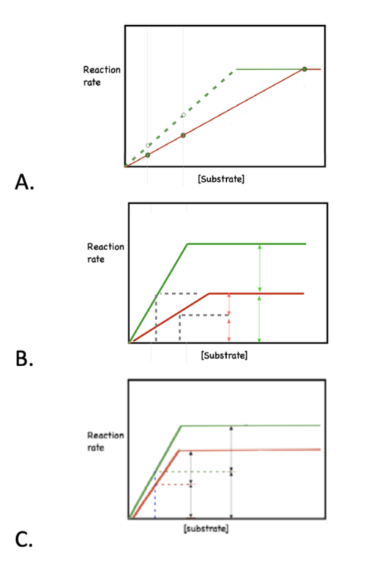
Which graph might represent two quantities of the same enzyme?
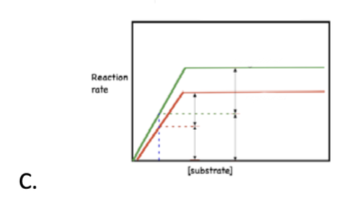
Graph C! Although it has different Vmax values, their Km is the same.
An experiment in which product is measured after excess substrate is provided to a series of tubes, each of which contains a different enzyme concentration would be useful for determining…
The Vmax but not the Km of the enzyme at any concentration. (Although you can use this experiment to create a standard curve which allows you to then make a MM graph >:( hmph )
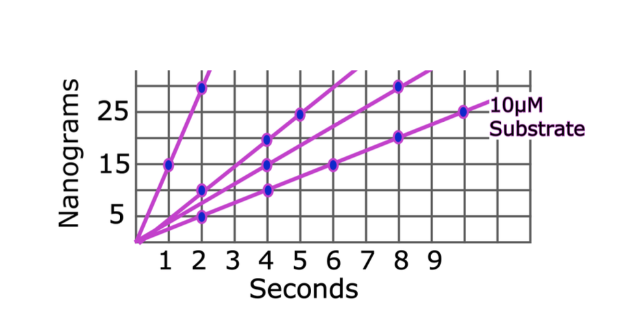
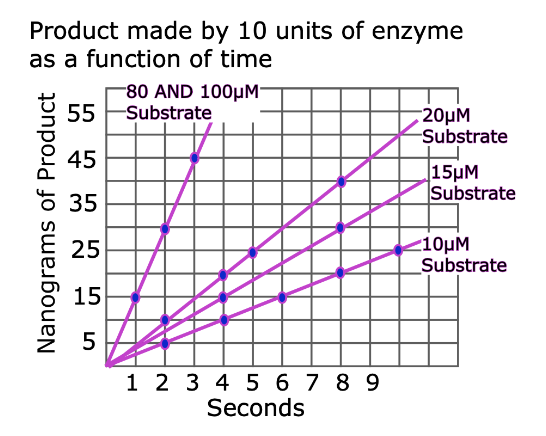
What point on an MM plot can be generated from the 10 μM line in this graph?
(10, 2.5)
What is the Km of this enzyme?
30
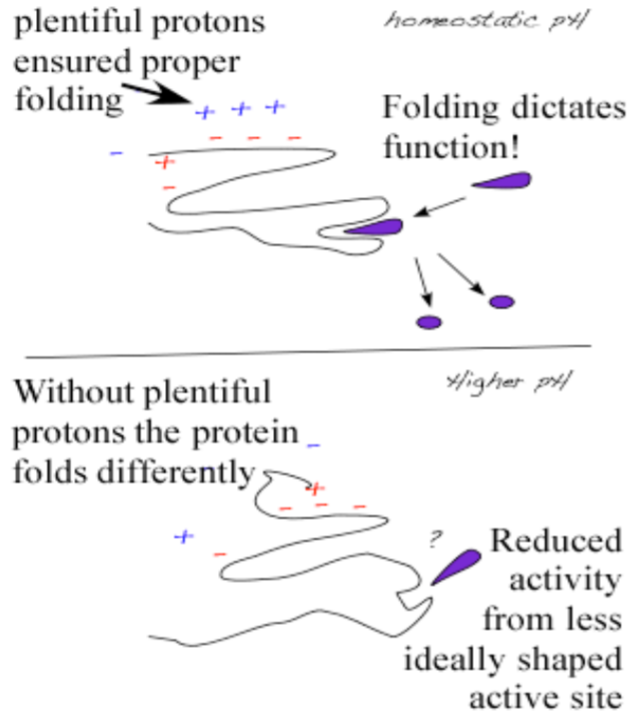
How does temperature effect enzyme?
It may influence enzyme folding and flexibility
An increase in temperature causes more collisions, which increase reaction rate
Enzymes denature at high temperatures (exact temp varies)
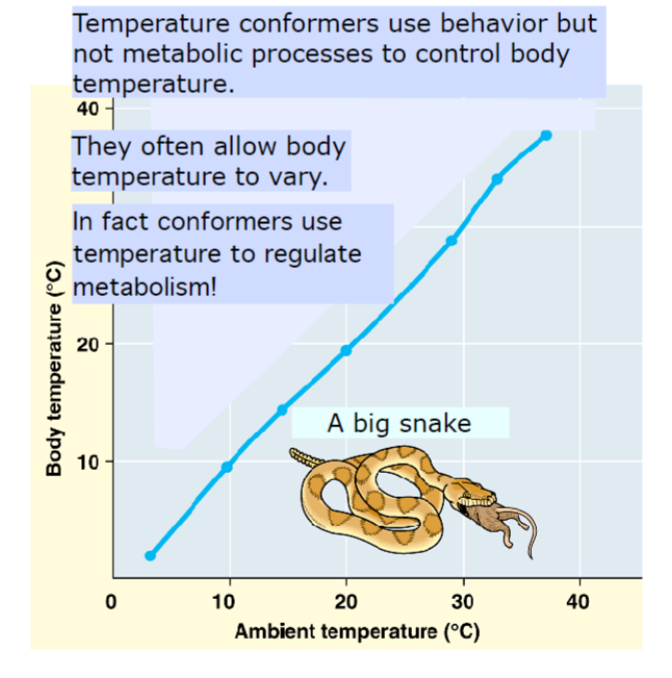
What is a conformer?
An animal (ectotherm) that uses different environments to regulate body temperature. Some examples of conformers are reptiles or insects.
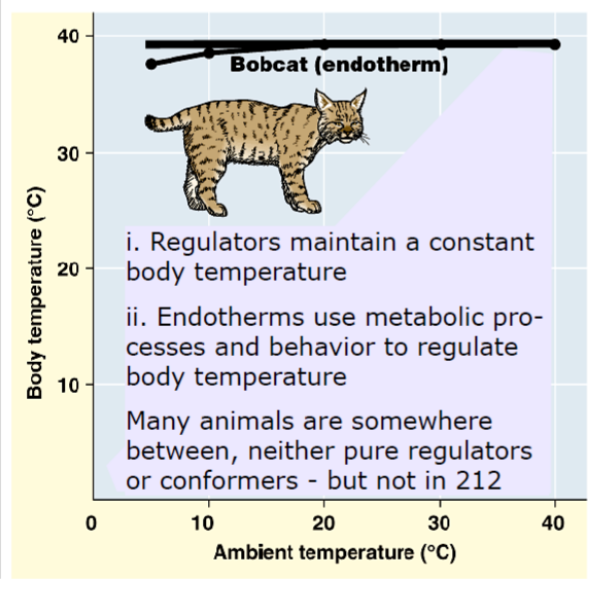
What is a regulator?
An animal (endotherm) that uses metabolic processes to regulate body temperature. Some examples of regulators are humans and other mammals.
What are some rules about energy usage and metabolism?
Bigger animals expend less fuel than smaller animals because it is the number of cells that makes bigger animals bigger – NOT larger cells or more dense cells (think of how a shrew needs to consume as much as three times its body)
Bigger animals spend less on temperature regulation
Bigger regulators burn more fuel on average than smaller regulators (but smaller animals burn it quicker???)
Bigger regulators burn less fuel per unit mass (e.g. gram) than smaller regulators
Regulators burn more fuel in general than conformers (most of our calories are spent on BMR)
Regulators have a basal metabolic rate that is about 10x as high as a similarly-sized conformer. (They can do about 10x the amount of sustained work as well)
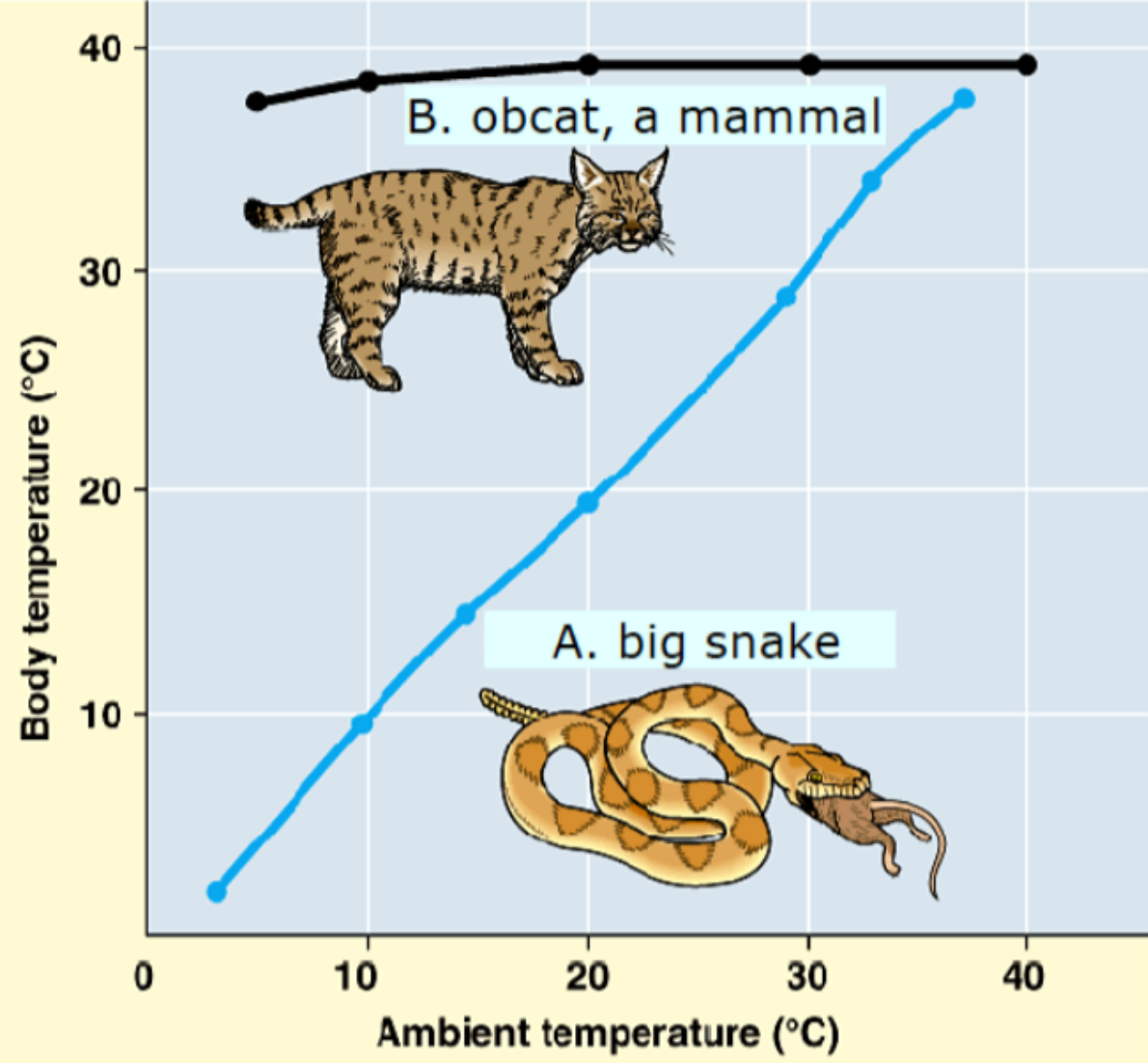
Which is the temperature conformer and which is the regulator?
The snake is the conformer and the bobcat is the regulator.
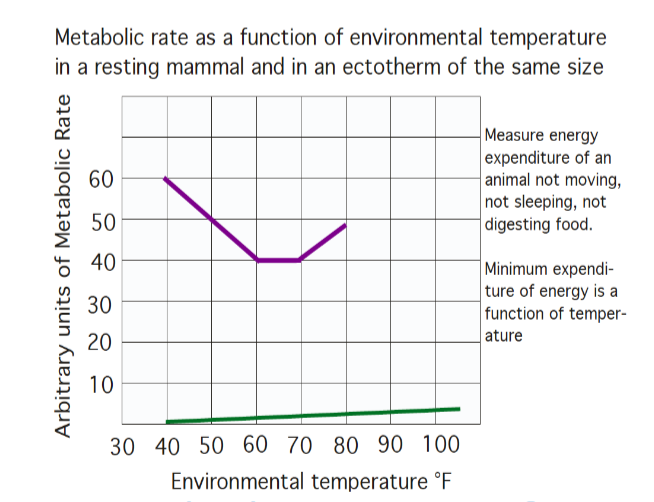
Which is the temperature conformer and which is the regulator?
The green line is the conformer and the purple line is the regulator.
What is aerobic scope?
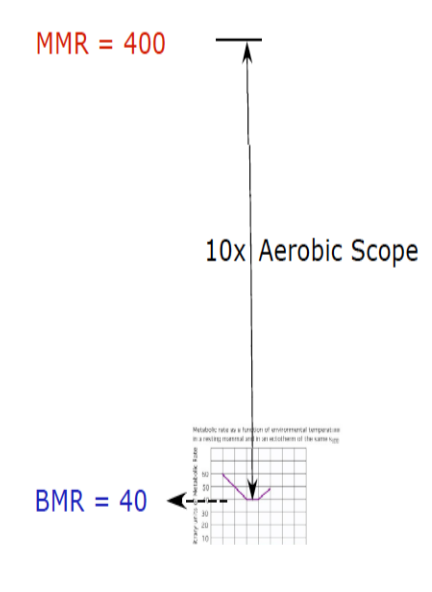
The ratio of maximal sustained MR (MMR) to the basal MR (BMR).
The MMR is USUALLY 10x the BMR (but for example if the aerobic scope is 11 then it would be 11x the BMR)
(As a rule of thumb, an endotherm will have a resting metabolic rate of 10x that of an ectotherm of similar size.)
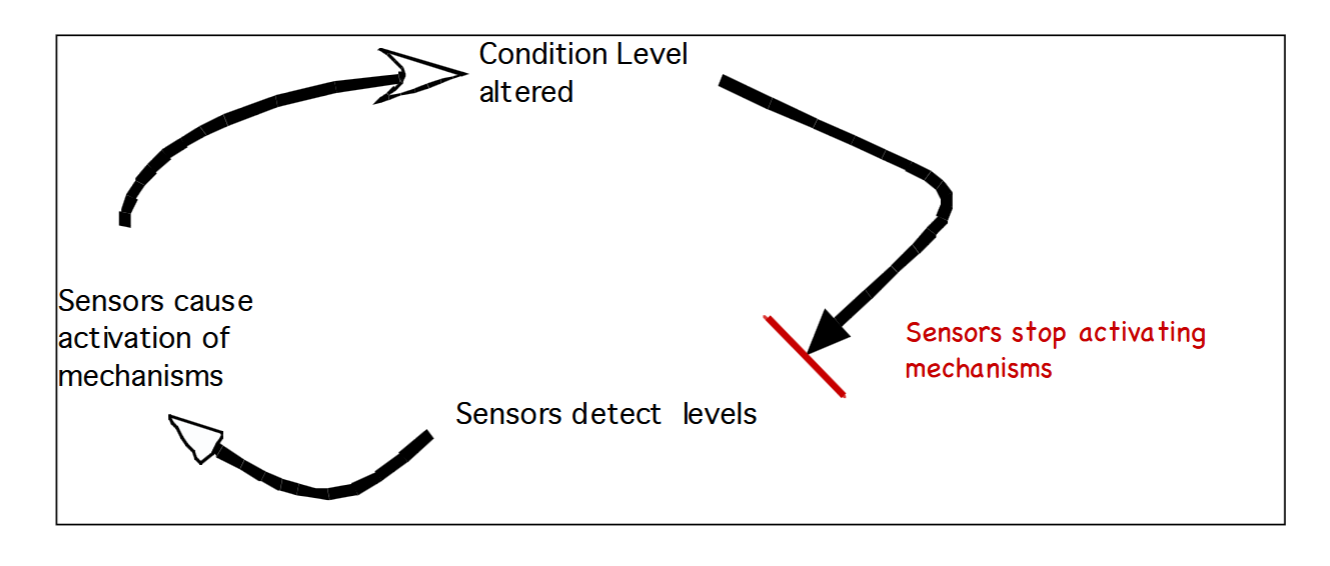
Is the feedback loop for temperature negative or positive?
It is negative, making sure it doesn’t overshoot because the activity is turned off by the result of the activity.
Negative feedback loops bring some condition back to a set point when they succeed. In contrast, a positive feedback loop would not turn itself off, continuing in a “vicious cycle.”
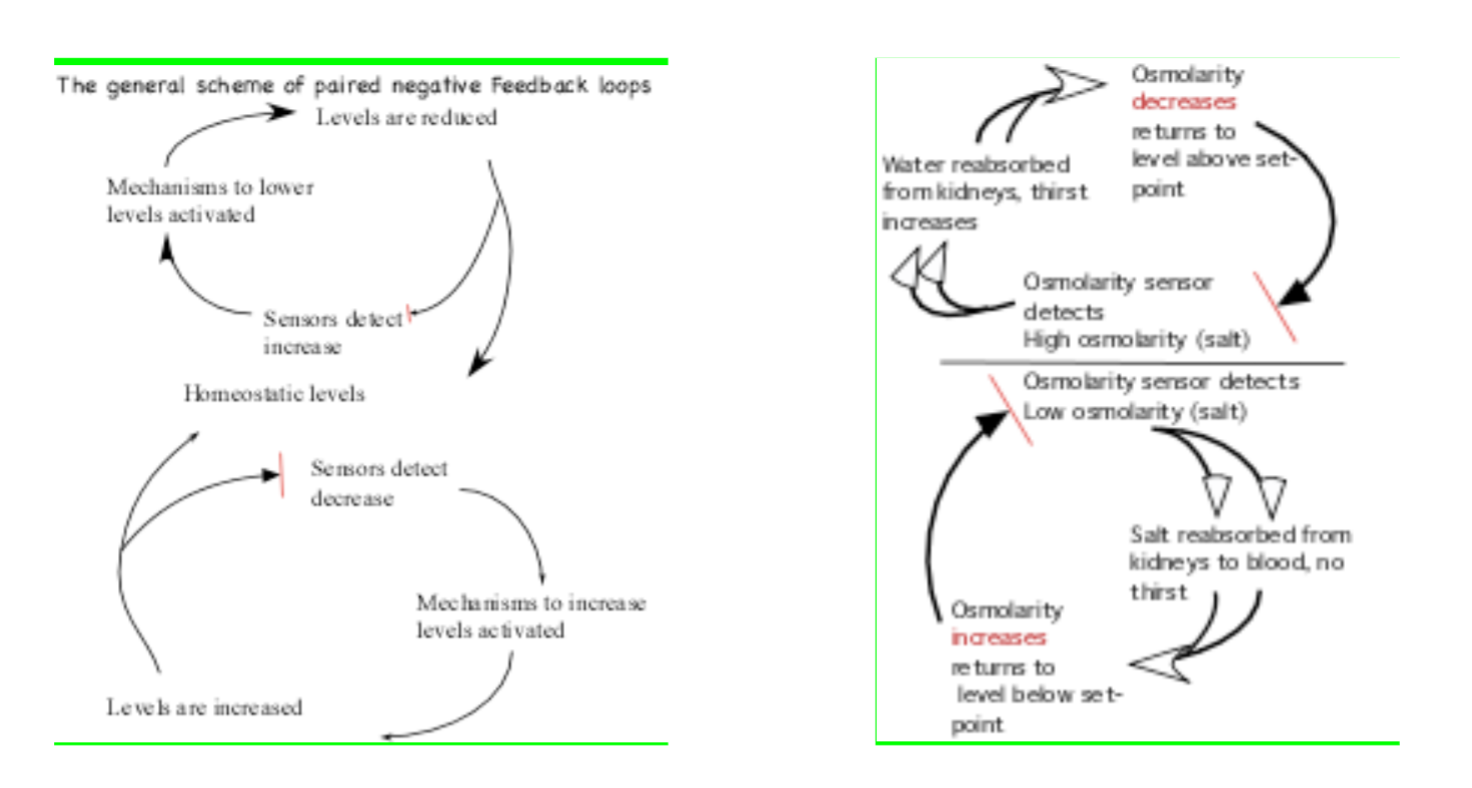
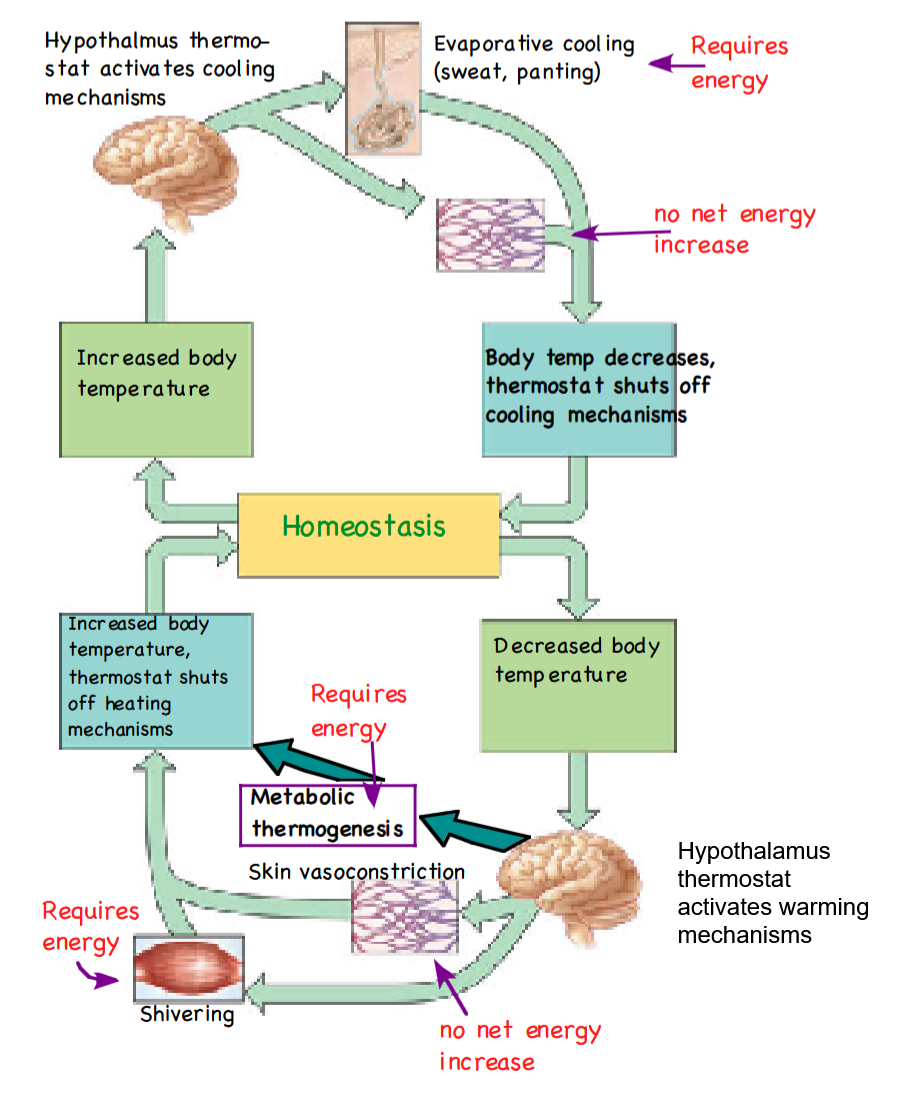
Which of these processes requires ATP to function? Shivering or metabolic thermogenesis?
Shivering requires ATP to function, using muscles without doing any net work in order to generate heat.
Metabolic thermogenesis, on the other hand,
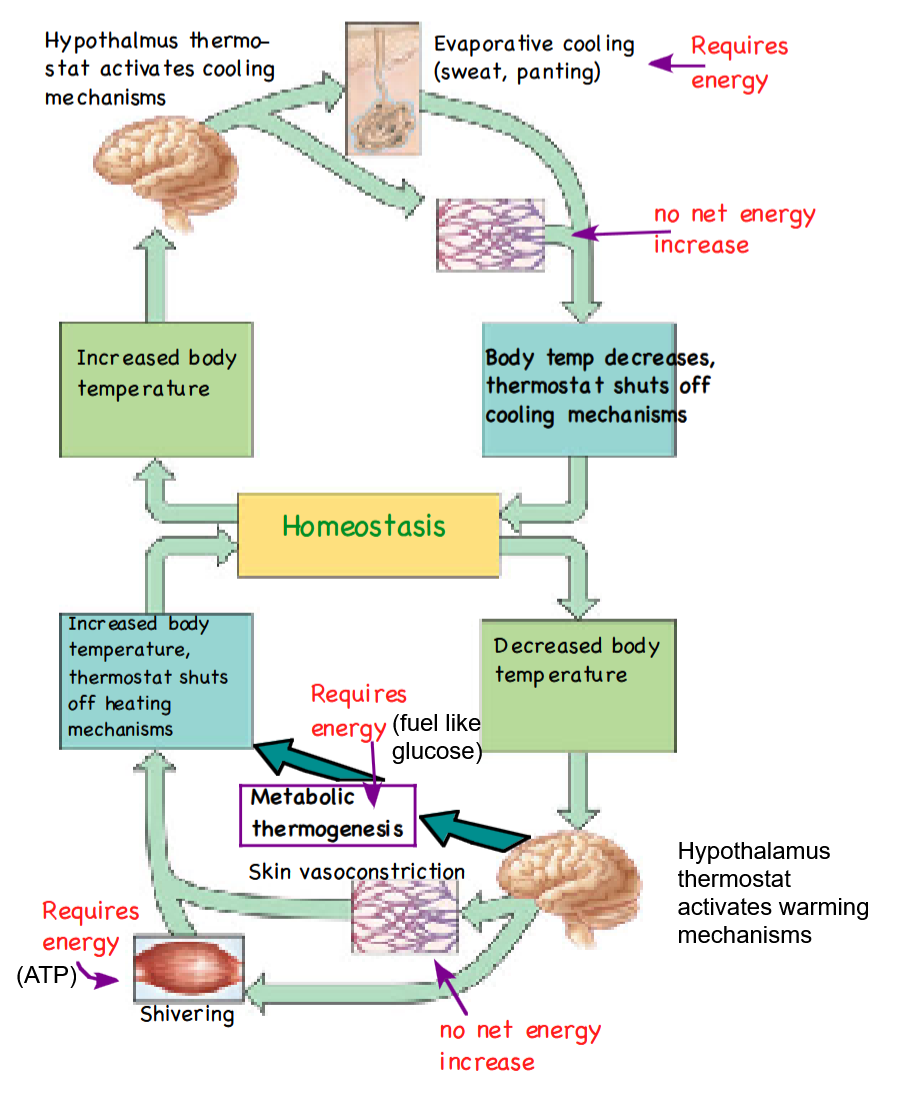
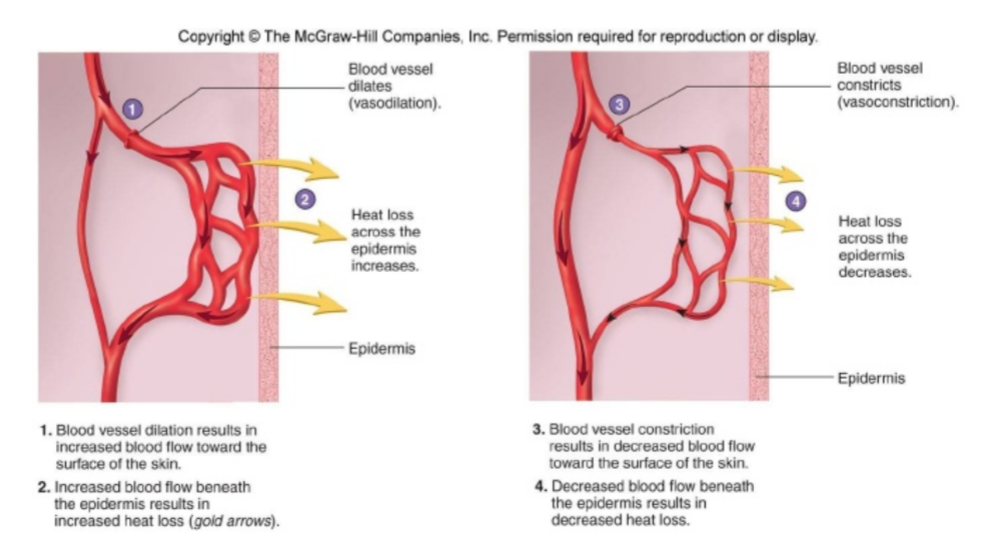
What is vasodilation?
Increased blood flow towards the surface of the skin (dissipates heat).
Blood localization is used both within and outside of the thermoneutral range.
(Keep this in mind for HW problems).
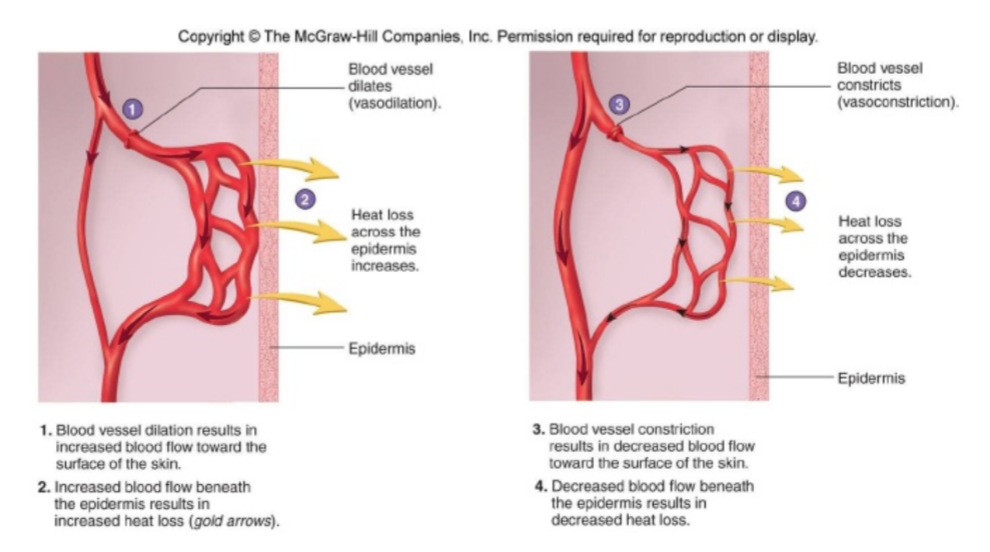
What is vasoconstriction?
Decreased blood flow towards the surface of the skin (keeps heat inside).
Blood localization is used both within and outside of the thermoneutral range.
(Keep this in mind for HW problems).
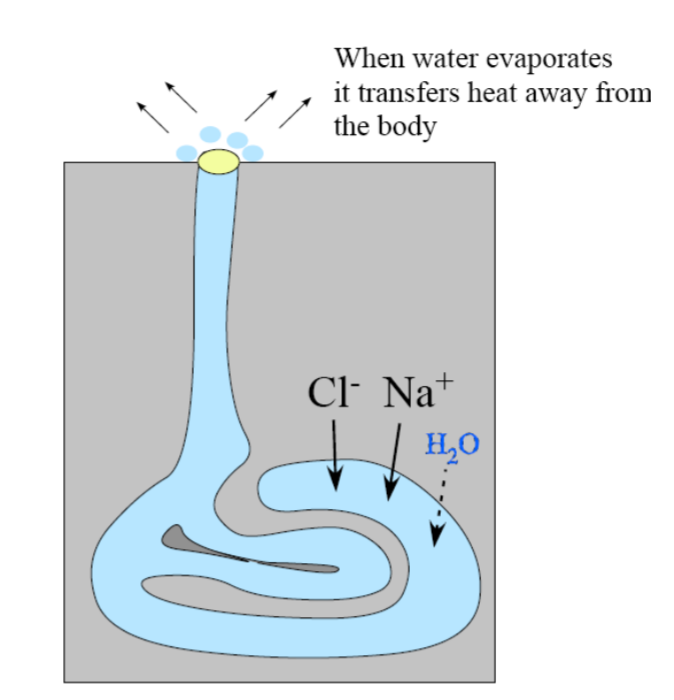
How does sweating work?
Fuel (ATP) is used to move Na+ and Cl- into the lumen of the sweat gland. As a result, water enters the sweat gland via osmosis.
(Remember: Solute enters, so does water)
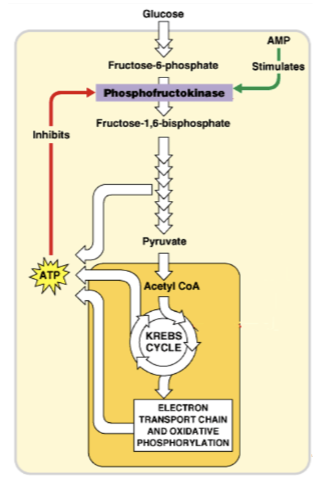
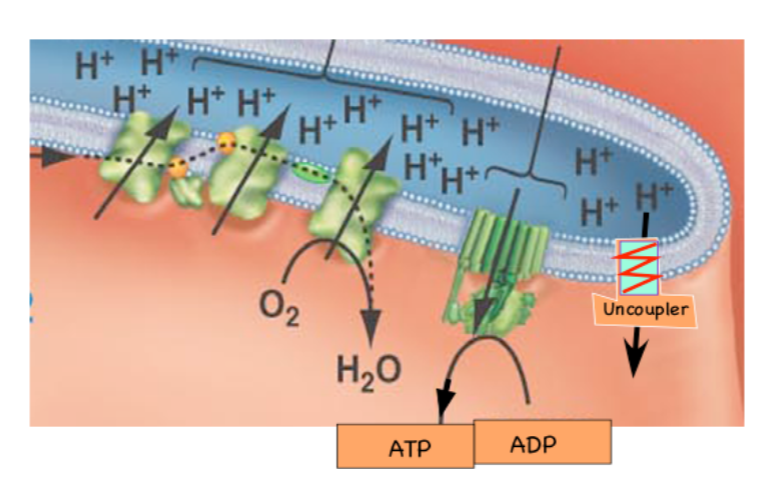
Carrying out metabolism generates heat. Cells can’t just crank up aerobic respiration without increasing demand for ATP though, without creating an excess of ATP (?). How do they get around this?
Uncoupler proteins! These allow the ETC to run faster by providing a second site for protons to exit the inner mitochondrial space, generating more heat without ATP.
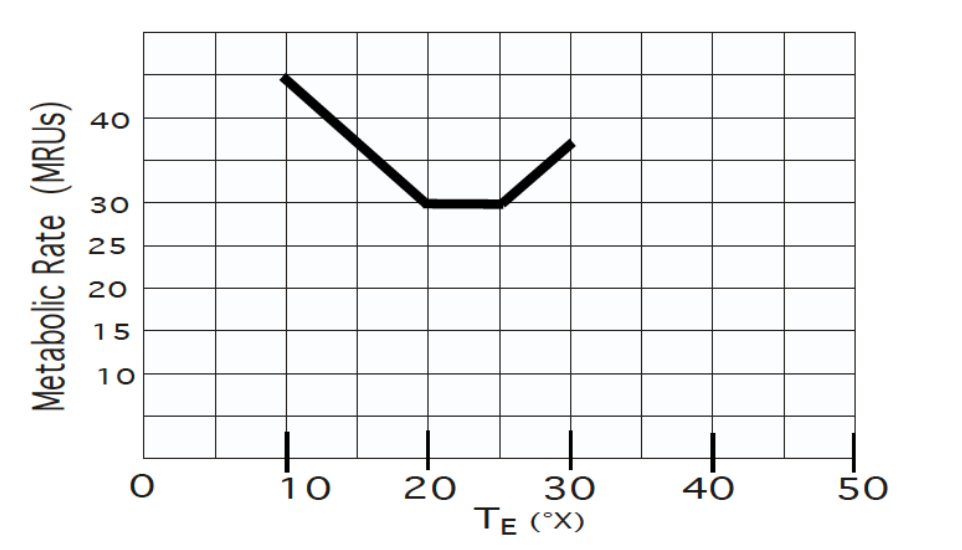
What is the highest environmental temperature at which you would find uncoupler activity in this animal?
20°, because uncouplers increase metabolic rate to heat an animal and in this graph 20° is the lower critical temperature.
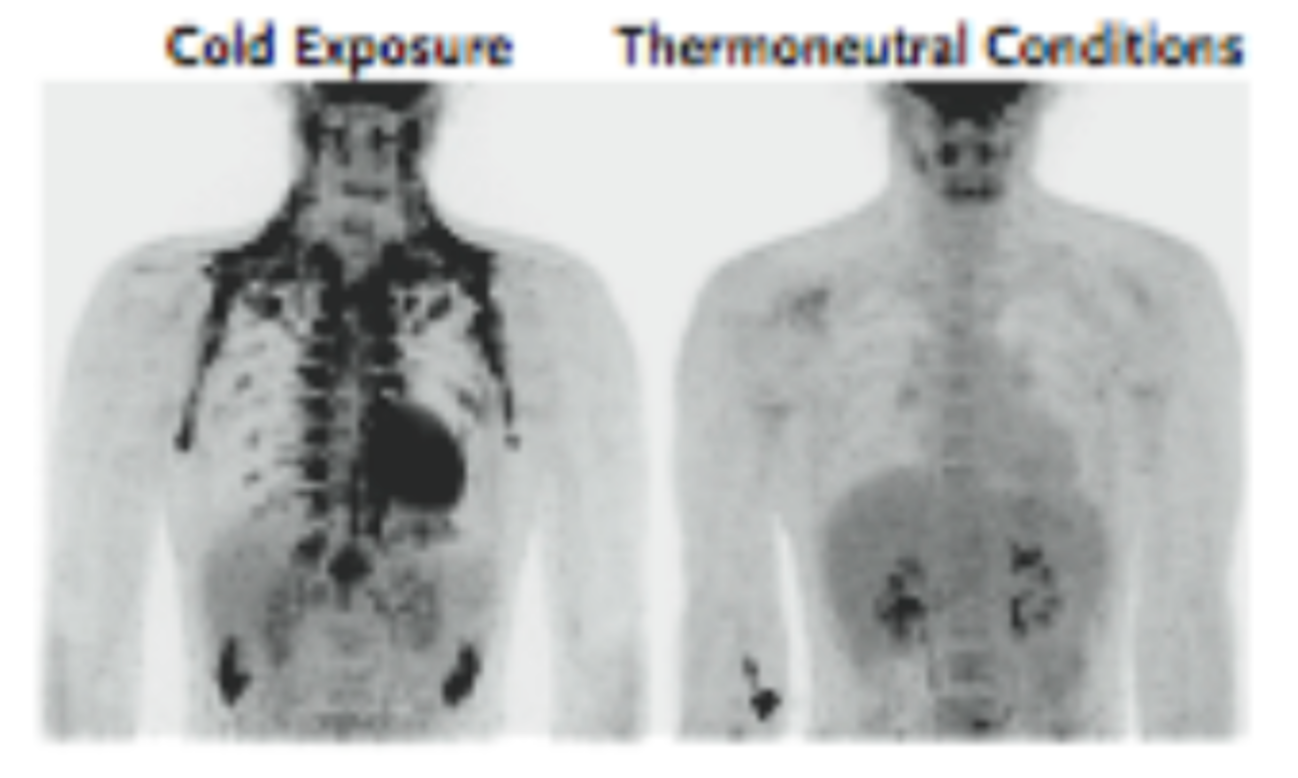
Brown fat quantities increase with persistent cold exposure and are sharply reduced in obese individuals.
Brown fats have lots of uncouplers.
(Not sure this question is important tbh, might delete later…)
If Mckenzie has a cost of heating of 6 MRu/degree, a BMR of 30, a cost of cooling of 4 MRu/degree, an aerobic scope of 11 and a lower critical temperature of 24, what would you predict would be her MMR (maximal MR)
330
(Note that in this case, the MMR is NOT 10x the BMR but instead 11x because that’s the aerobic scope)
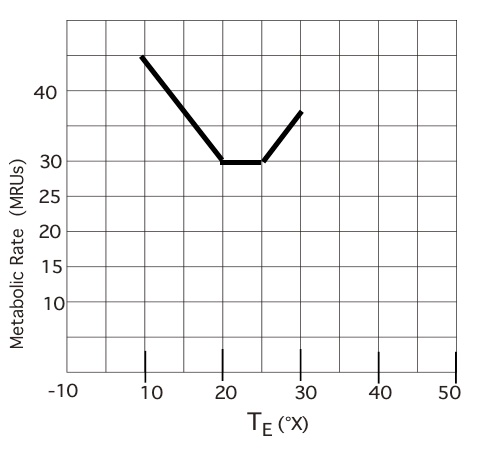
BMR:
Lower Critical Temperature:
Upper critical temperature:
MR while in the thermoneutral range:
Cost of heating (which is always a positive number):
Body temperature:
Temperature at which animal is spending 6 MRU to stay warm:
BMR: 30
Lower Critical Temperature: 20
Upper critical temperature: 25
MR while in the thermoneutral range: 30 (same as BMR)
Cost of heating (which is always a positive number): 1.5 ← (slope)
Body temperature: 40
Temperature at which animal is spending 6 MRU to stay warm: 16
^ Able to find through recognizing that it’s asking for the temperature when the animal is at a metabolic rate of 36. From there, you can use the equation y = 1.5x + 60 to find out that when x = 16, y = 36
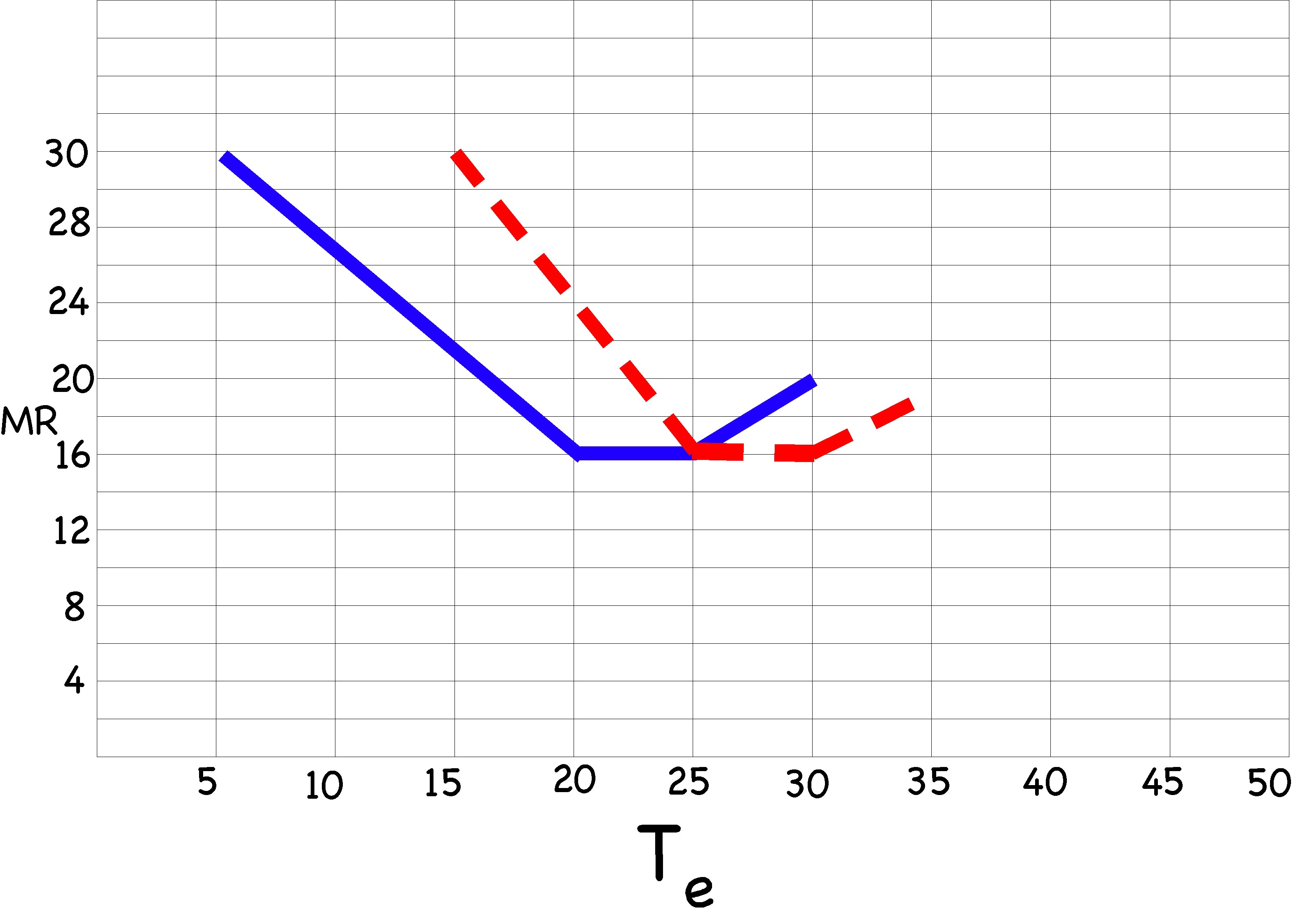
What is the temperature at which the cold acclimated animal switches from normal respiration to respiration that includes spending metabolic energy to generate heat?
20 (the blue line is the cold acclimated animal, and it’s basically just asking for its lower critical temperature)
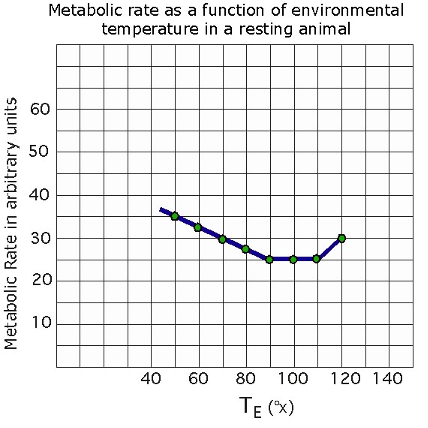
True or False:
The cost of cooling of this animal > the cost of heating for this animal
True!
The cost of cooling is 5/10 = 0.5 MRU/degree
The cost of heating is 5/20 = 0.25 MRU/degree
True or False:
A temperature regulating animal in this set of questions changes its body temperature set point as one aspect of cold acclimation.
False. A temperature regulating animal’s body temperature stays the same even when acclimated to the cold.
The atu mutants were originally identified as defective in their ability to maintain a normal average metabolic rate at room temperature (22°C). Why do you suppose these flies prefer colder temperatures?
Flies prefer colder temperatures because conformers use temperature to regulate metabolism.
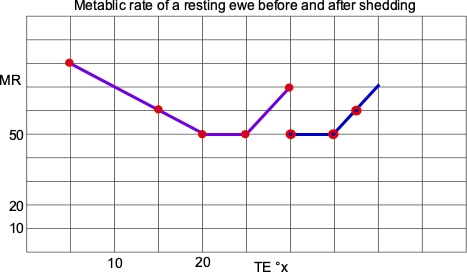
The body temperature of the cold acclimated ewe:
The upper critical temperature of the warm acclimated ewe:
The cost of heating of the warm acclimated ewe:
The temperature at which warm and cold acclimated ewes burn the same amount of fuel when at rest:
The body temperature of the cold acclimated ewe: 45°
The upper critical temperature of the warm acclimated ewe: 35°
The cost of heating of the warm acclimated ewe: 10/3 MRU/degree
The temperature at which warm and cold acclimated ewes burn the same amount of fuel when at rest: 27.5° (found using the cost of cooling for the warm acclimated ewe using the body temperature since it would stay the same and then finding where they overlap)
If in an animal cell the |equilibrium potentials|* of sodium and potassium are essentially equal then at resting potential the |driving force| of sodium/potassium is greater.
We can infer from this that the resistance to flow through sodium/potassium channels is greater.
If in an animal cell the |equilibrium potentials|* of sodium and potassium are essentially equal then at resting potential the |driving force| of sodium is greater.
We can infer from this that the resistance to flow through sodium channels is greater.
True or False:
A lion burns less fuel than does a house cat.
False. Lions are bigger and thus burn more fuel in total.
True or False:
A 5 pound cat burns less fuel than a 5 pound snake.
False. Temperature regulation ensures that regulators are always burning wayyyy more than conformers.
True or False:
8 grams of house cat tissue burns more fuel than 8 grams of lion tissue while in the respective intact animals.
True. On a cell basis, smaller animals do burn more per gram than bigger animals.
The cost of evaporative cooling in people is the cost of ....
Moving ions into sweat glands.
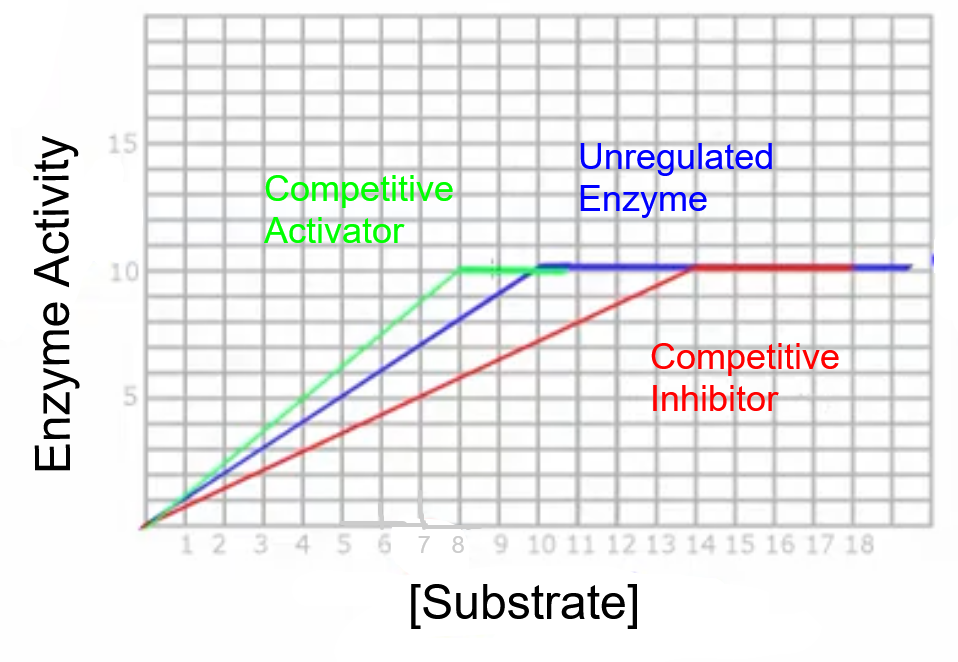
Competitive regulators change the of enzymes but NOT the __.
Competitive regulators change the Km of enzymes but NOT the Vmax.
(Notice that at a certain point on the graph the presence of competitive activators or inhibitors have no effect on the rate of enzyme activity)
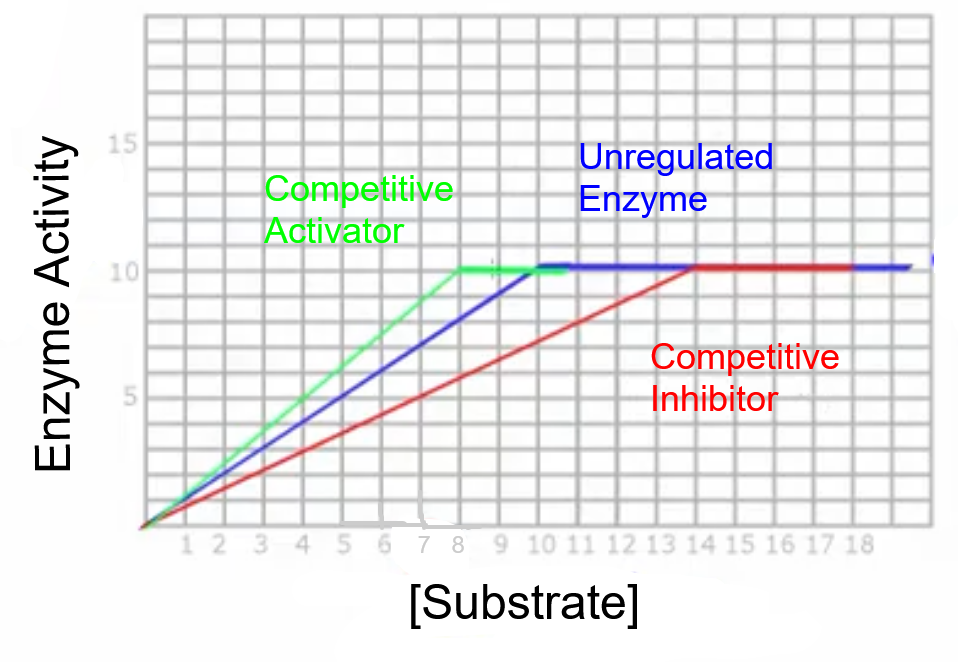
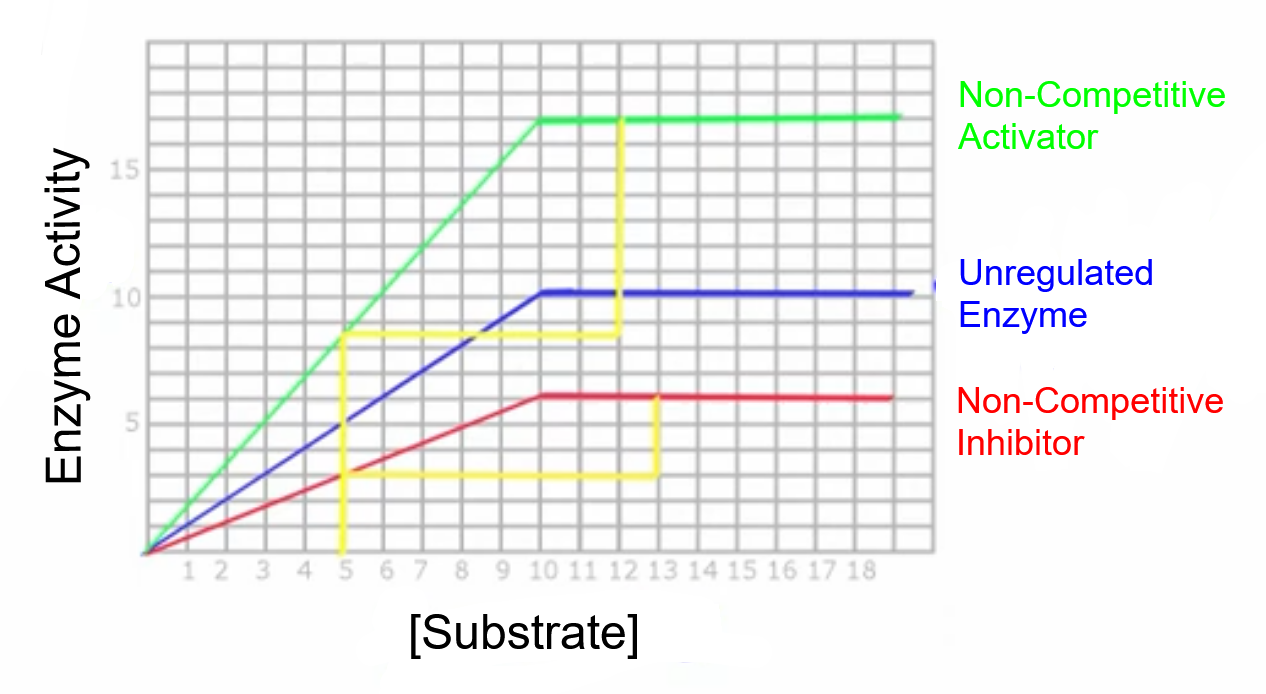
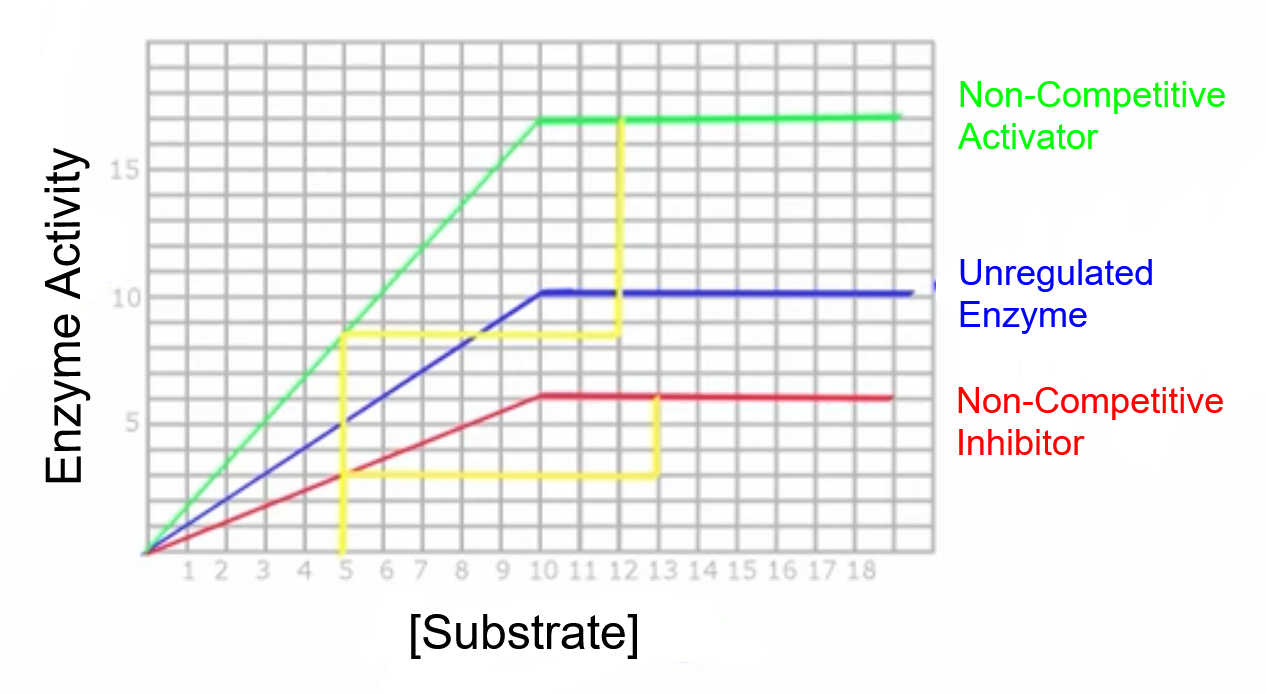
Non-competitive regulators change the ____ of enzymes but NOT the __.
Non-competitive regulators change the Vmax of enzymes but NOT the Km.
(Notice that although it may look like the concentration of enzyme has changed, it hasn’t!)