7.18 - Corporate turnaround game
 Call Kai
 Learn
Learn Practice Test
 Spaced Repetition
 Match
Match Flashcards
 Knowt Play
1/8

There's no tags or description
Looks like no tags are added yet.
Name | Mastery | Learn | Test | Matching | Spaced | Call with Kai |
|---|
No analytics yet
Send a link to your students to track their progress
9 Terms
Coordination equilibrium
pure strategy Nash equilibrium with extra properties
Unilateral deviation by any player harms the deviator + benefits no-one
Van Huyck et al. (1990) recap of OV & results
Group output proportionate to effort of “weakest link”
Returns to e of “weakest-link” exceed marginal private cost of e
Incentive: To match lowest effort level of any other group member
If game repeated (and weakest link’s effort revealed after each round), we see rapid drift of effort (and min. effort in group) towards lowest possible level.
suggest “bad” equilibria may emerge and persist, even when better equilibria exist
Brandts & Cooper (2006) - OV
Extends weakest link game framework - weakest effort payoff
4 subjects (‘employees’) in a group (‘firm’) - fixed groups to simulate real life
employees choose from 4 effort levels (and informed of others choice at end of round)
Choose independently + no communication → Implicit assumption that you cant be forced to put in 40 hours/effort in real life as individual e not observable
Payoff same structure as weakest link - a + Bmin(ei→n) - cei
Payoff max when matching min effort level of someone else as b > c
NE when all choose same (pareto ranking of different levels though)
30 rounds with partners matching (10 round per bonus rate b - same b for all i,j… and all told b at start of block of 10)
Does raising B have ‘corporate turnaround’ effect (failure when all give e = 0) and does it persist when bonus dropped
Tests if magnitude of B has effect + effect if B reduced after raise + length of time underperforming & B
Can see others effort BUT manager can only see weakest link
when only min effort seen less of a turnaround effect seen (B&C later paper)
Brandts & Cooper (2006) - RESULTS (block 1 → 2)
By end of block 1 (made so that all ‘firms’ fail :
45 have ≥ 1employee choosing e = 0 (26 have all 4 employees doing so)
avg min effort = 5.86 (between lowest and 2nd lowest e)
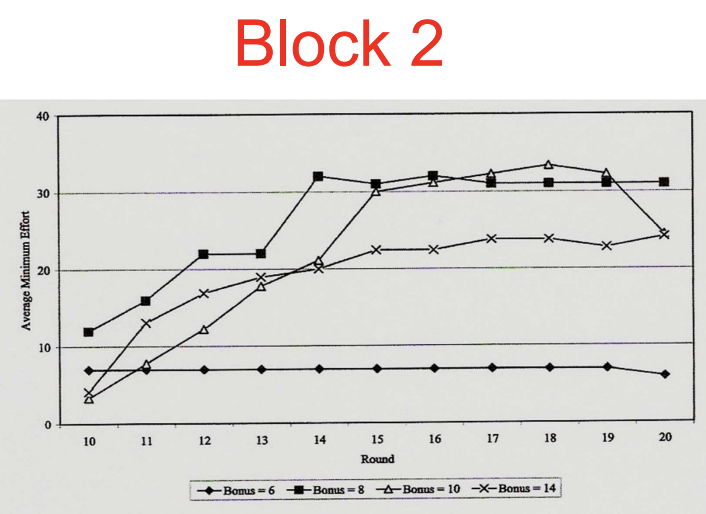
Block 2
changing b makes potential payoffs steeper but still no incentive to increase e if others dont
If b = 6 still then e unchanged BUT if b rises, then avg min e increases for next 4-5 rounds then a plateau
Firms do turn around BUT change in bonus more important than bonus level
Salient occasion to try for a better equilibrium - Depends on shift of expectations of min e
Effect of bonus rise gradual + heterogeneous
In round 20 20% choose e = 0 BUT 40% choose e = 40 (clustered across firms)
Firms that respond well tend to have ‘Strong leaders’ + ‘Responsive followers’
Brandts & Cooper (2006) - Strong leaders & responsive followers
Strong leaders - Raise effort by at least 20 between Rd10 and Rd11
The more strong leaders in rd.11 -> the higher the avg min e at end of block 2
Responsive followers - Raise effort once they can that see co-employees have done so
Brandts & Cooper (2006) - RESULTS (block 2 → 3)
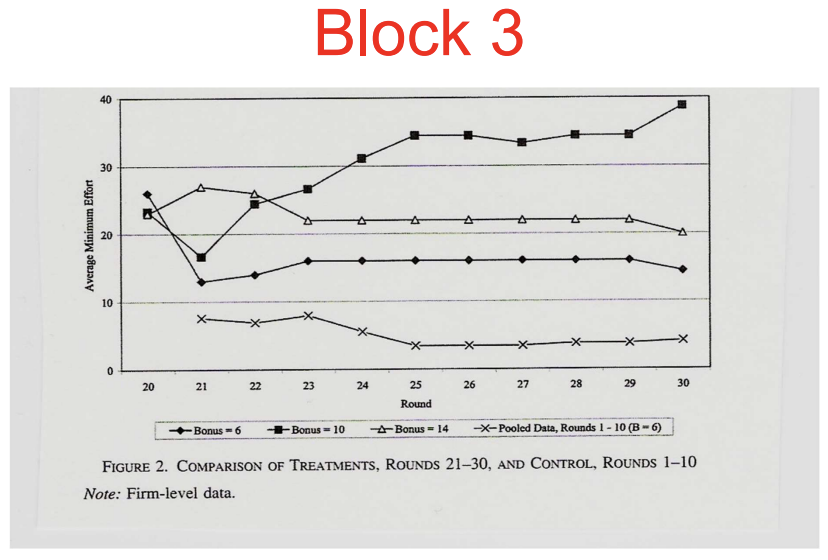
Immediate drop in effort after cut in bonus
BUT Recovery for cut to 10 group & Semi recovery + plateau even for cut to 6 firm
Firm with b = 6 now still higher than in block 1
Current payoff not only thing that matters → History has an effect as well
Changes expectations of min e
No race to the bottom - temporary bonus has persistent effects
Brandts & Cooper (2006) - claims
History matters - Temporary bonus rate rise can have persistent effects
Expectations change of their “co-workers’” effort
Anything that changes beliefs in coordination games can influence coop
B&C argue bonuses act as coordinating devices by driving team members expectations of each another
change in b can shift out of bad equilibrium
As salient moment seized by strong leaders
May generalise but may not as:
Perfect complementarity in effort across individuals
Complete unobservability of individual effort to employer / bonus payer
B&C (2006) - Example of real world weakest link
a firm producing via an assembly line where the slowest worker determines the speed of the entire line
Countries may fail to develop when the simultaneous industrialisation of many sectors of an economy can be profitable for each of them, but no sector can break even if industrialising alone
needs all to increase together
Brandts & Cooper (2006) - Results - Effect of time on corporate turnaround
An extended history of bad outcomes makes employees more prone to pessimism
With a late increase of the bonus rate, there still exists a cohort of employees who try to move to higher effort levels BUT When others don't rapidly follow their lead from the pessimism, they give up and cut their own effort levels
Driven by differences in the willingness of employees who initially respond positively to the bonus hike to remain at these high effort level