LING 314 - FINAL
 Call Kai
 Learn
Learn Practice Test
 Spaced Repetition
 Match
Match Flashcards
 Knowt Play
1/629

There's no tags or description
Looks like no tags are added yet.
Name | Mastery | Learn | Test | Matching | Spaced | Call with Kai |
|---|
No analytics yet
Send a link to your students to track their progress
630 Terms
What is OpenFace
tool = quantifying facial movement from video
goal = turn video frames into numeric data
non-invasive
what can OpenFace track?
facial landmarks (68 points), head pose, eye gaze, action units
Action Units (AUs)
movements of specific facial muscles
acts as proxy for underlying muscle activity
what does AU correspond to?
contraction/activity of specific muscles
detection - OpenFace
finds where the face is in each frame
alignment - OpenFace
it “straightens” the face so that movements are measured the same way even if the person tilts their head
tracking - OpenFace
places 68 dots on the face and follows them as they move
what does the Output CSV show?
presence vs. intensity, landmark coordinates, confidence
Presence VS. Intensity - OpenFace
Classification = is the AU happening (0 to 1)
Regression = how intense is the movement (0 to 5 scale)
Landmark Coordinates (x, y) - OpenFace
each of the points from 9 to 68 both have a x and y-value
tell you the exact pixel location of every point on the mouth and jaw
confidence - OpenFace
a score from 0 to 1; how sure the AI is about its tracking
Jaw is made up of 2 parts
upper jaw (maxilla) and lower jaw (mandible)
Mandible
only movable part of the jaw
important for speech and mastication
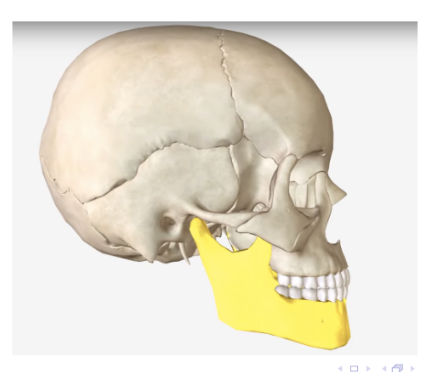
how is mandible formed
two bones fused at the mental symphysis (chin joint)
mentum = chin
body of mandible
horseshoe-shaped lower part, holding lower teeth
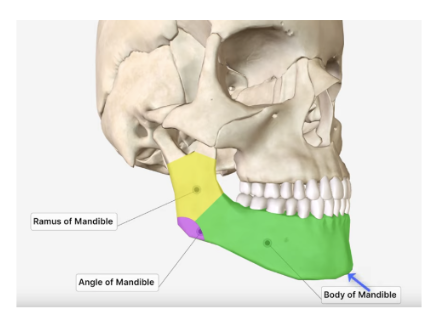
Ramus - mandible
the vertical part connecting to the skull
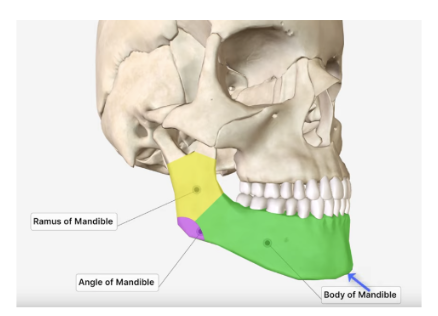
Angle - mandible
where the body meets the ramus
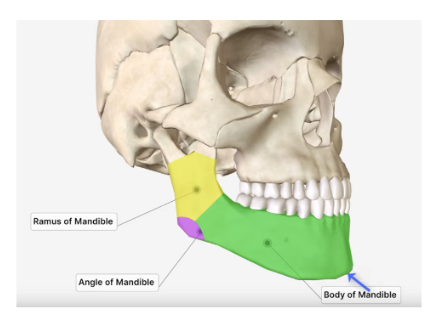
Condyle and Coronoid Process
two protrusions at the top of the ramus
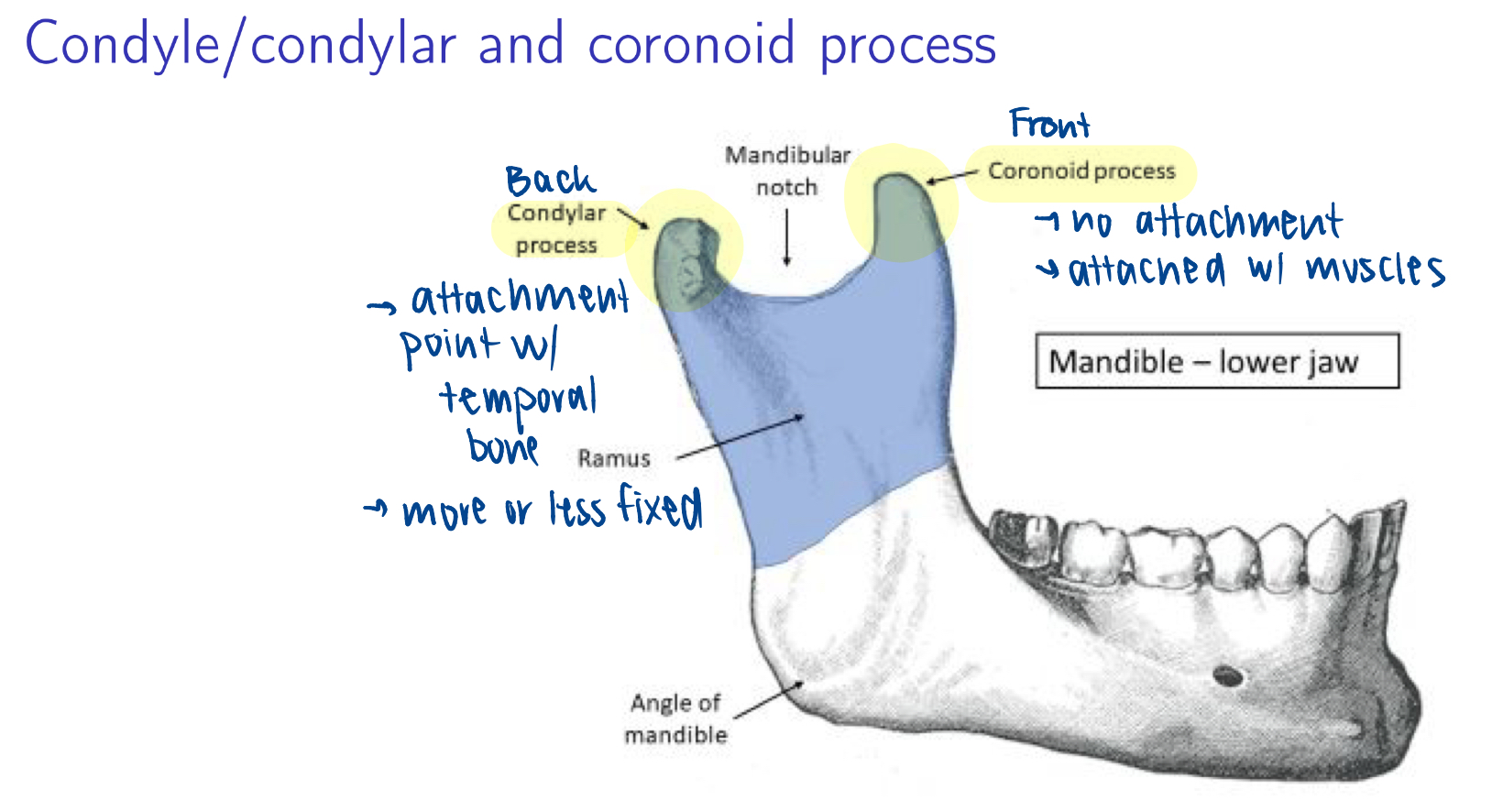
Mandibular Notch
depression b/w the condyle and coronoid process (rip
mental protuberance
triangular projection on the anterior part of the mandible located at the midline
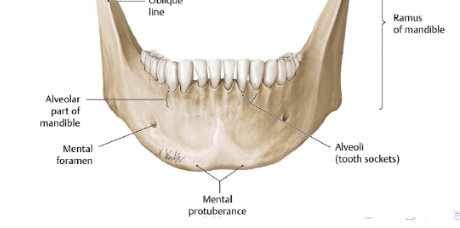
where are mental spines located?
in midline on the lingual (inner) surface of mandible
at the mandibular symphysis
how many mental spines are there?
2 superior (outside)
2 inferior (inside)
forming a pair above and below each other
Superior Mental Spines (upper)
origin for the genioglossus muscle
Inferior Mental Spines (lower)
origin for the geniohyoid muscle
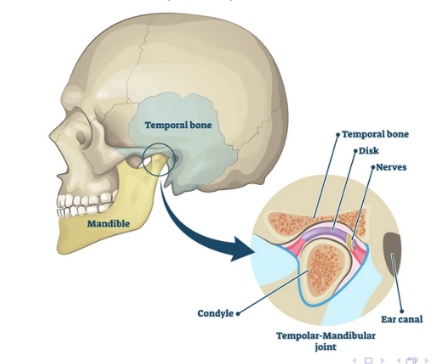
temporomandibular joint (TMJ)
connects the mandible to the temporal bone of skull
consist of the condyle of the mandible and the mandibular fossa of the temporal bone
cushioned by a fibrous articulator disk for smooth movement
mandibular foramen - location
located on the internal surface of the ramus of the mandible
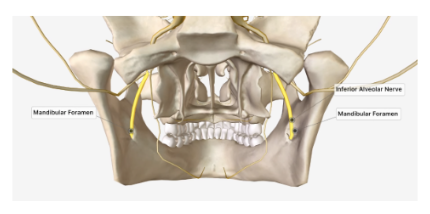
mandibular foramen - structure
an opening that serves as the entry point for the inferior alveolar nerve and vessels
vessels supply blood to the lower teeth and surrounding bone
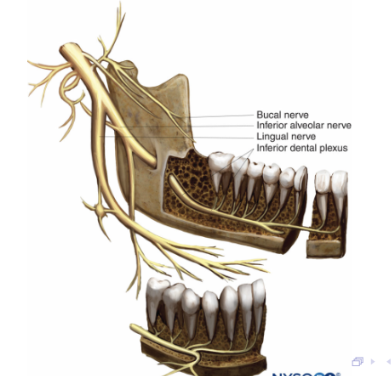
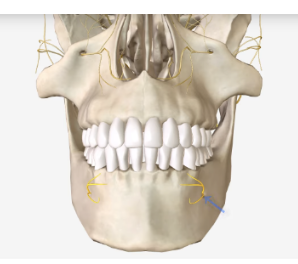
mental foramen - location
situated on the external surface of the mandible, near the apex of the mandibular premolar teeth
mental foramen - structure
small opening that allows the passage of the mental nerve and blood vessels
What are the jaw muscles important for?
mastication (chewing) and speech
elevators (lifters) and depressors (lowers)
Masseter Muscle - Function
elevates the mandible (jaw closing)
Masseter Muscle - Origin
zygomatic arch
Massester Muscle - Insertion
Ramus and angle of the mandible
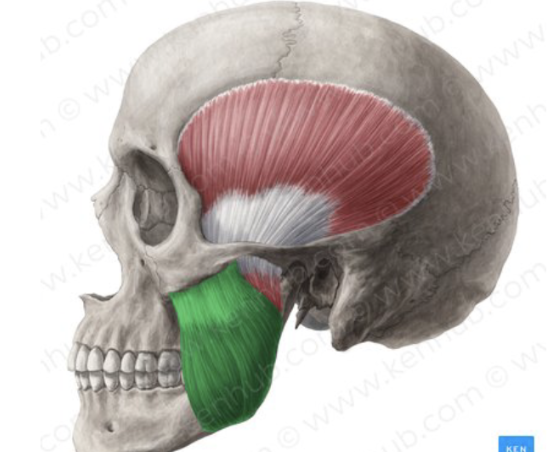
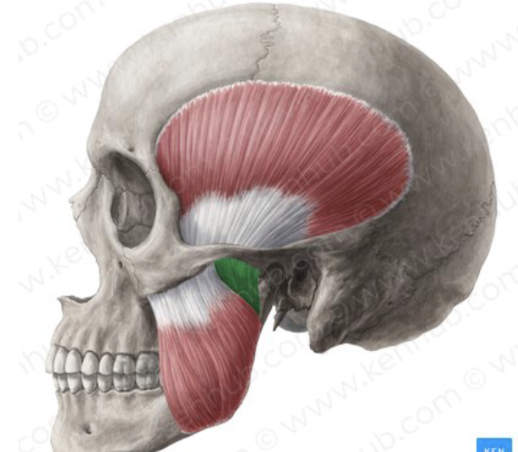
Masseter Muscle - division
into 2 parts; deep and shallow head
Shallow Head
(attachment point = zygomatic arch)
Deep Head
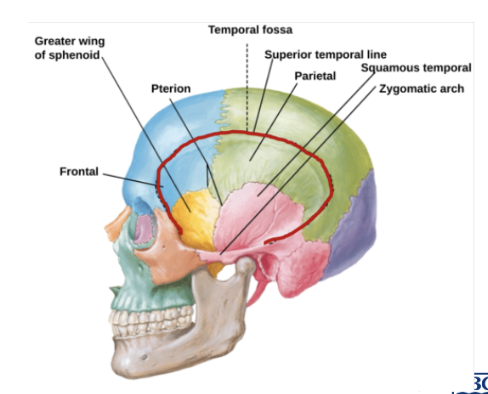
temporal fossa
shallow depression on the lateral aspect of skull
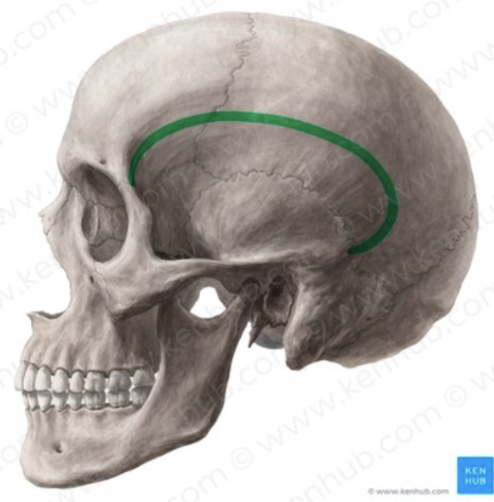
Temporal Fossa - Origin
origin of the temporals muscle
What are the temporal fossa bony boundaries?
Frontal bone (inferior lateral part)
Parietal bone (inferior portion)
Temporal bone (squamous part)
Sphenoid bone
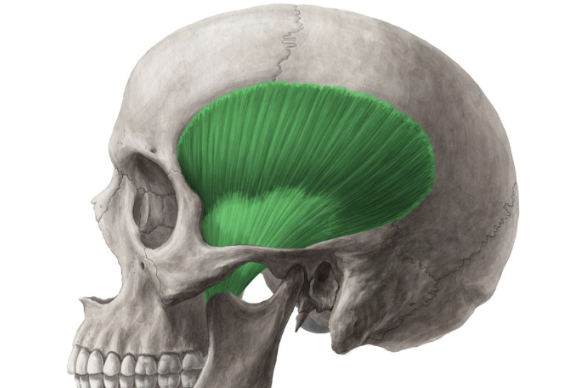
Temporalis Muscle - Function
elevates and retracts the mandible (fast closing)
Temporalis Muscle - Origin
Temporal fossa
Temporalis Muscle - Insertion
Coronoid process of mandible
Fibers of the temporals muscle
fan-like shaped - for wide range of jaw movements
vertical (anterior) fibers - elevate mandible
horizontal (posterior) fibers - retract mandible (moves backward)
Temporalis Muscle is helpful for…
side to side (chewing), retract/backwards, protrusion
muscles DONT push
Pterygoid Muscle types
2 types
Medial Pterygoid
Lateral Pterygoid
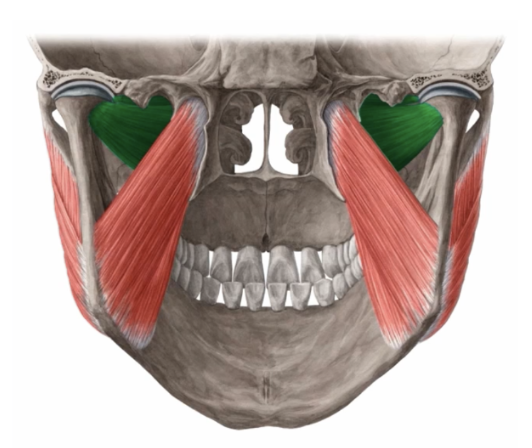
Medial Pterygoid - Origin
sphenoid bone, palatine bone and maxilla
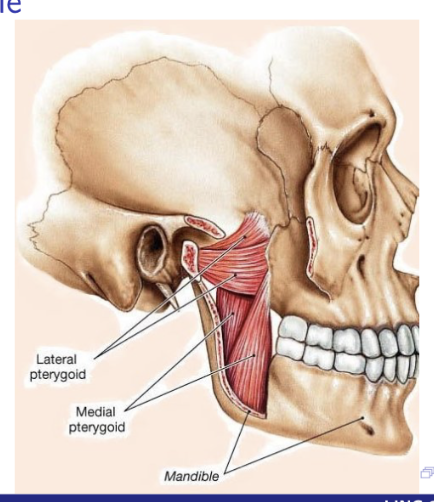
Medial Pterygoid - Insertion
inner surface of the mandible
Medial Pterygoid - Function
Elevates the mandible (elevates jaw)
Lateral Pterygoid - Origin
sphenoid bone and maxilla
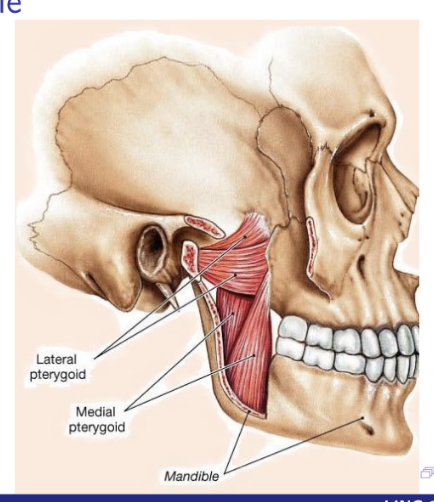
Lateral Pterygoid - Insertion
TMJ disc and condyle of the mandible
Lateral Pterygoid - Function
controls side-t-side movement of the jaw
helps in protrusion of the jaw
What are the jaw depressor muscles
anterior belly of the digastric muscle
mylohyoid
geniohyoid
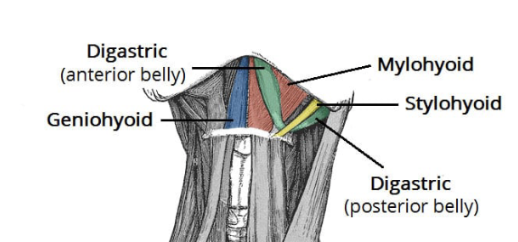
What are the jaw depressor muscles responsible for?
lowering the mandible
stablizie the hyoid bone and help in tongue movenment
Why are depressors at the front of jaw
leverage is better
if you pull from somewhere closer to open it up and you get assistance from gravity
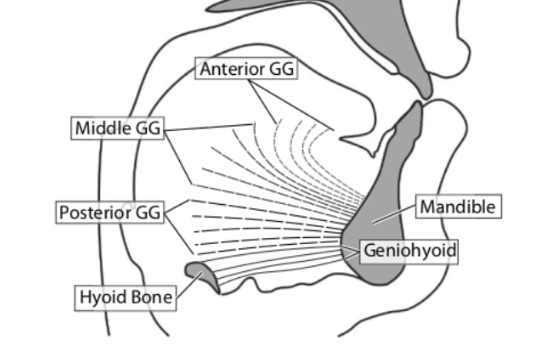
Genioglossus (GG) - Origin
mental spine of the mandible
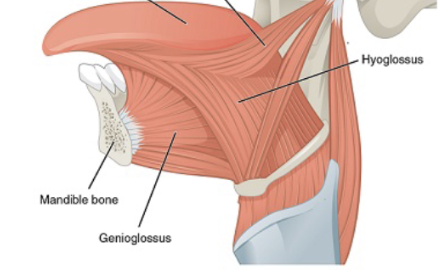
Genioglossus (GG) - Insertion
thru/out the tongue, from tip to root
Genioglossus (GG) - Actions
protracts, depresses, and can groove the tongue
Types of Genioglossus
Anterior — GGa
Middle — GGm
Posterior — GGp
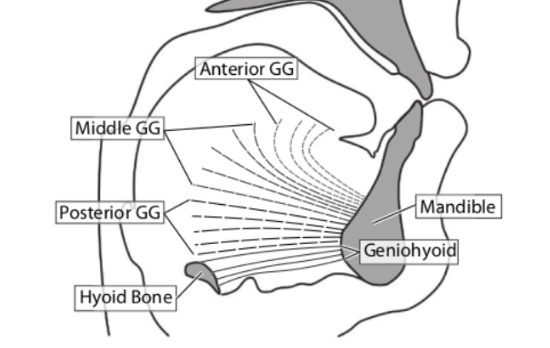
Anterior - GGa
lowers and retracts tongue front
(curved towards the front)
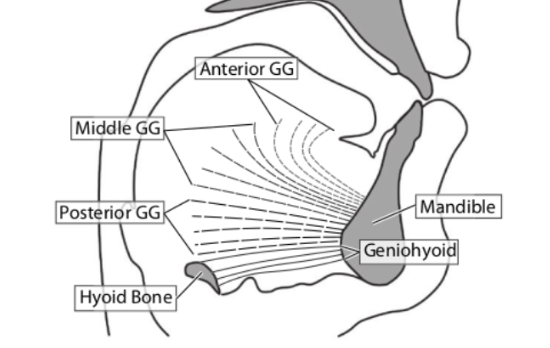
Middle - GGm
lowers and pulls forward tongue body; create groove
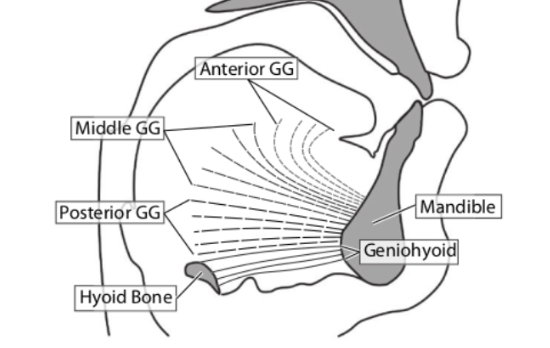
Posterior - GGp
pulls tongue root forward
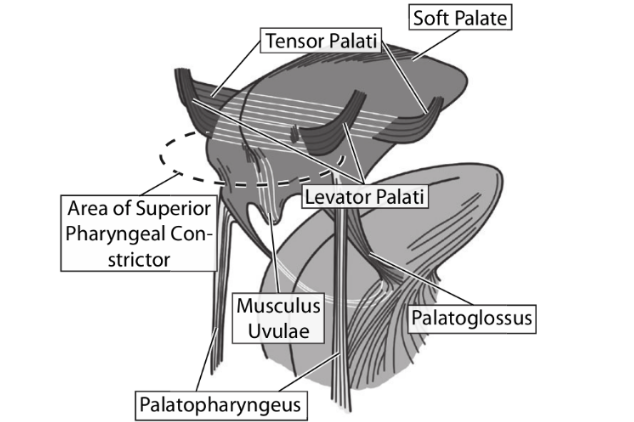
Palatoglossus (PG) - Origin
palatine aponeurosis
Palatoglossus (PG) - Insertion
Sides of the tongue body
Palatoglossus (PG) - Action
elevates the tongue, assists in uvular constrictions and narrows the oropharyngeal isthmus (OPI)
Hyoglossus (HG) - Origin
greater horn of the hyoid bone
Hyoglossus (HG) - Insertion
sides of the tongue
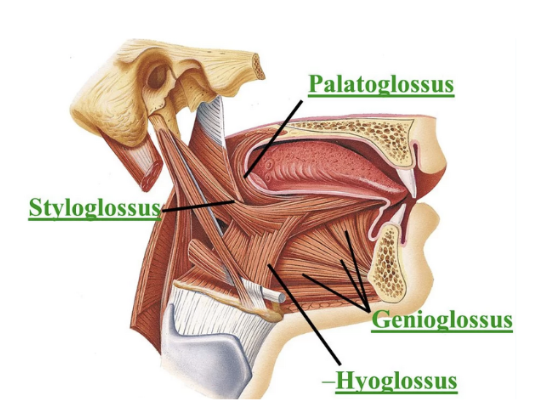
Hypoglossus (HG) - Actions
pulls the tongue down and back, especially the back of the tongue
Styloglossus (SG) - Origin
styloid process of the temporal bone
Styloglossus (SG) - Insertion
sides of tongue, interlocks with intrinsic tongue muscles
Styloglossus (SG) - Actions
raise and retract the tongue; role in speech
important for isometric contraction
Infrasound
< 20 Hz (elephants seismic activity)
Audible Range
20 Hz - 20,000 Hz (Human hearing)
Ultrasound
20kHz - 100 MHz
Speech Research 2MHz ~ 8MHz
higher freq = better resolution but less depth penetration
Hyper sound
above ultrasound (boundary b/w ultrasound and hyper sound is not wel-established)
Piezoelectric Crystals
materials can convert mechanical energy into electrical and vice versa
generate waves
Piezoelectric Effect
converting mechanical to electrical energy
What do sound waves travel thru?
the body and interact with different tissues
different structures in the body reflect these sound waves back to the transducer to different degrees (based in density and composition)
soft tissues and fluid-filled organs allow
most sound waves to pass thru
denser structures like bones reflect
more sound waves back to the transducer
at the boundary of 2 mediums…
much of the transmitted wave bounces back (reflection)
what does time and strength do the echoes to return tell us
distance and characteristics of the tissues encountered
how does the ultrasound generate images
processes the echoes received by the transducer to do so
what do the images produced show
size, structure and any pathological lesions within the organs and tissues
what do professionals use the images for?
to diagnose, monitor and guide treatments
contour analysis
need to summarize trends shows in multiple contours
ultra sound for speech
tongue shapes/fronting/retraction in vowels
tongue root advancement/retraction in vowels
tongue shape in bunched vs. retroflexed
what are the 4 major extrinsic tongue muscles
genioglossus
palatoglossus
hypoglossus
styloglossus
4 main intrinsic muscles of the tongue
superior longitudinal
inferior longitudinal
transverse
vertical
superior longitudinal muscle - location
beneath the mucous membrane on the upper surface of the tongue
runs along the length of tongue
superior longitudinal - structure
fibers that run longitudinally from the root to the apex of tongue
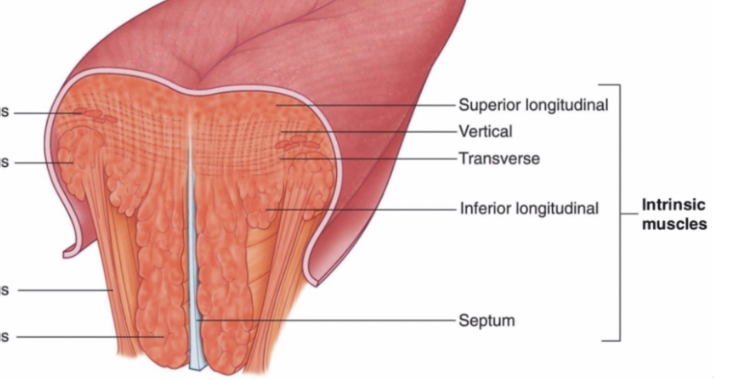
superior longitudinal - function
when contracts,
shorten the tongue along the surface
shortening cause the upward curl (tip)
What kinds of sounds is the superior longitudinal muscle used for?
retroflex
Inferior Longitudinal Muscle - Location
underside of tongue
side of genioglossus, medial to the hypoglossus muscles
Inferior Longitudinal Muscle - Structure
extends from root to apex
parallel to superior longitudinal muscle but on tongue’s under surface
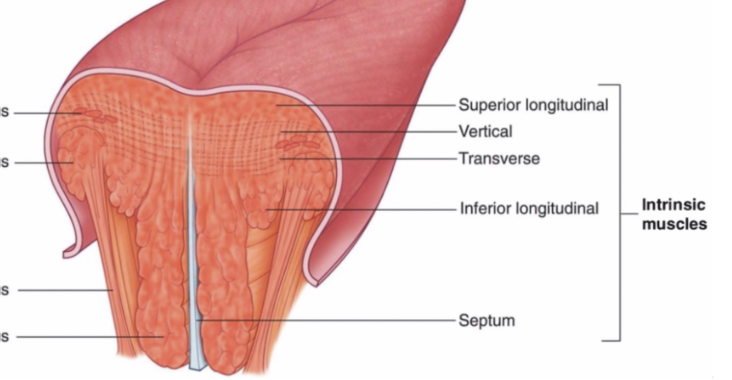
Inferior Longitudinal Muscle - Functions
contraction shortens the length along underside of tongue
shortening causes the downward curl
tongue tip goes down
Transversus Muscle - Location
originates at the lingual septum inserts into the lingual margin (lateral edge of tongue)
Transversus Muscle - Structure
the fibres run laterally across the tongue
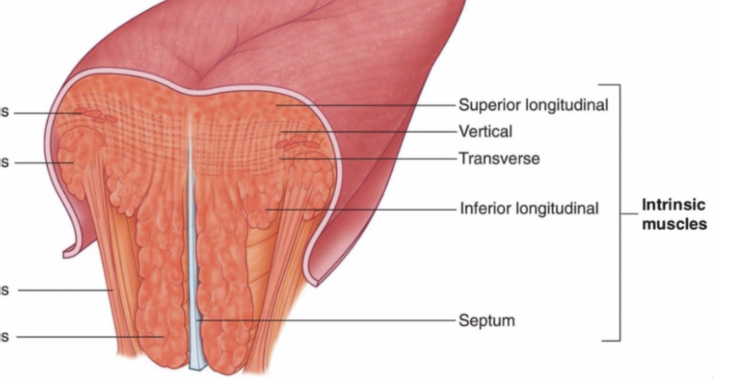
Transversus Muscle - Functions
narrows tongue from side-to-side (cylindrical shape)
can elongate and vertically thicken the tongue
help in protrusion
Verticalis Muscle - Location
runs the opposite of transverse muscle