M5S4: Enthalpy, Entropy, Free Energy
 Call Kai
 Learn
Learn Practice Test
 Spaced Repetition
 Match
Match Flashcards
 Knowt Play
1/19

There's no tags or description
Looks like no tags are added yet.
Name | Mastery | Learn | Test | Matching | Spaced | Call with Kai |
|---|
No analytics yet
Send a link to your students to track their progress
20 Terms
Enthalpy change of formation, ΔfH
Enthalpy change when 1 mole of a compound is formed from its elements
Enthalpy change of atomisation of an element, ΔatH
Enthalpy change when 1 mole of gaseous atoms is formed from an element
Enthalpy change of atomisation of an compound, ΔatH
Enthalpy change when 1 mole of compound is converted to gaseous atoms
First ionisation energy
Energy needed to change 1 mole of gaseous atoms into 1 mole of gaseous 1+ ions
Second ionisation energy
Energy needed to change 1 mole of gaseous 1+ ions into 1 mole of gaseous 2+ ions
First electron affinity
Energy needed to change 1 mole of gaseous atoms into 1 mole of gaseous 1- ions
Second electron affinity
Energy needed to change 1 mole of gaseous 1- ions into 1 mole of gaseous 2- ions
Lattice enthalpy ΔLEH
Enthalpy change when 1 mole of solid ionic compound is formed form its gaseous ions
Enthalpy change of hydration, ΔhydH
Enthalpy change when 1 mole of gaseous ions is dissolved in water
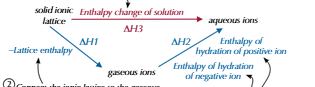
Enthalpy change of solution, ΔsolH
Enthalpy change when 1 mole of solute is dissolved in a solvent, such as water
Factors affecting lattice enthalpy
Ionic charge: Higher charge on ions = stronger electrostatic attraction between ions so more energy released when lattice forms
Ionic radius: Smaller ionic radius of ions = higher charge density of that ion = greater electrostatic attraction = more exothermic enthalpy
Born-Harber cycle
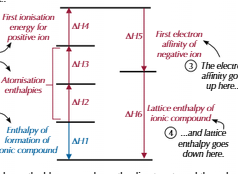
How to find enthalpy change of solution
Factors affecting enthalpy of hydaration
Ionic charge: Ions with greater charge have greater ΔhydH because higher charge = better at attaching water molecules
Ionic radius: Smaller ions have greater ΔhydH because greater charge density = attract water molecules better so more exothermic ΔhydH
Entropy
Measure of dispersal of energy in system
Tells how much disorder there is - num ways particles can be arranged & num was energy can be shared out
Factors affecting entropy
Physical state
Dissolution - dissolving solid ↑ entropy
Num particles - more gas particles ↑ entropy
Entropy equation
ΔS = Sproducts - Sreactants
Free energy
Measure used to predict whether a reaction is feasible
Feasible reaction
Once started, will carry on to completion without energy being supplied to it
If ΔG is negative/= 0, reaction is feasible
Free energy formula
ΔG = ΔH - TΔS