Marine noise pollution - L20
 Call Kai
 Learn
Learn Practice Test
 Spaced Repetition
 Match
Match Flashcards
 Knowt Play
1/19

There's no tags or description
Looks like no tags are added yet.
Name | Mastery | Learn | Test | Matching | Spaced | Call with Kai |
|---|
No analytics yet
Send a link to your students to track their progress
20 Terms
Whats the difference between noise and sound?
Noise = unwanted sounds that disrupts organisms
Sound: signals we are interested in (what we want to study)
How fast travels sound in water compared to in air?
Sound travels 4,5 times faster in water than in air
Give examples of sources of sounds in the marine, both physical/geological, biological and anthropogenic
Physical/geological (natural sources):
Waves
Rain
Geological activity
Biological sources:
Fish calls
Marine mammals
Birds
Anthropogenic sources:
Ships
Sonar
Construction/pile driving
Sesmic surveys/air guns
What is noise pollution?
Noise pollution = harmful/unwanted sound that negatively affects organisms
Stops quickly when the source is removed
What types of noise are there and whats their impact?
Continuous noise:
Long duration
Leads to chronic impact
Example: shipping traffic
Impulsive noise:
Short, intensive noise
Leads to acute impact
Example: sonar, pile driving
What distinguishes sound pollution from other types of pollution?
Sound pollution is non-persistent
Pollution stops when the sound is removed
Effects may still remain biologically important
Why is sound pollution in the marine important?
For marine organisms sound is essential for:
Communication
Navigation
Predator/prey detection
Habitat selection
→ Noise disrupts these essential functions
Where does the marine sound pollution come from? How does these sounds affect fish and invertebrates?
Ships and boats:
Increased stress levels (fish)
Increased risk of predation (fish)
Reduced ability to select suitable habitat (fish and coral larvae)
Pile driving:
Increases metabolic rate in fish and mussels
Slower growth and worse body conditions (mussels)
Sesmic surveys/air guns:
Zooplankton: increased mortality
Scallop larvae: developmental delays and malformations, disrupted reflexes (adults)
Squid: strandings of giant squid
Fish: physiological changes, decreased catch rate
Wind farm operations:
Crabs: disrupted settlement
What kind of effects can noise pollution have in the marine life? What does the effects depend on?
Different kinds of effects:
Physiological effects
Behavioral effects
Ecological/survival effects
Effects depend on:
Hearing rages
Sound frequency and intensity
Life stage
Type of noice
Duration of exposure
Give examples of physiological effects of noise pollution in the marine
Physiological effects include both hearing damage and broader stress responses
Physiological effects:
Auditory effects (hearing damage)
Permanent threshold shift (PTS)
Temporart threshold shift (TTS)
Stress responses
Metabolic changes: ventiliation, heart rate
Reproduction and developement
Death
Injury and developmental abnormalities
Increased metabolic rate
Give examples of behavioral effects of noise pollution in the marine
Noise changes how animals behave and communicate
Effects:
Altered movement and feeding
Disrupted communication
Changes in signaling/calls
Avoidance behavior (whales stopping feeding dives during sonar exposure)
How does sound affect reef fish settlement?
Sound enhances reef fish settlement:
Negative effect: for long transport away from the reef the sound from ships can be disrupting, and lead the fish far away from the reefs
Positive effect: shorter transport, that travel close to the reed, can help the fish by leading them to the reef
Give examples of ecological/survival effects of noise pollution in the marine
Noise effects can scale up to affect survival and ecosystems
Effects:
Increased predator risk (fish respond slower to predator)
Reduced survival rates
Disrupted settlement
Reduced habitat selection ability
What is temporary threshold shift (TTS)?
TTS is a temporary loss of hearing sensitivity after sound exposure. Animals recover hearing over time. TTS can also spread to frequencies above the exposure frequency (higher effect after exposure stoped)
What is permanent threshold shift (PTS)?
PTS is permanent hearing loss caused by intense/prolonged noise exposure. Unlike TTS, recovery does not occur.
What is behavioral response studies (BRS)?
BRS are controlled exposure experiments used to study how animals react behaviorally to sound exposure. Often used with tagged whales and sonar playback experiments.
What is the EU marine strategy framework directive (MSFD)?
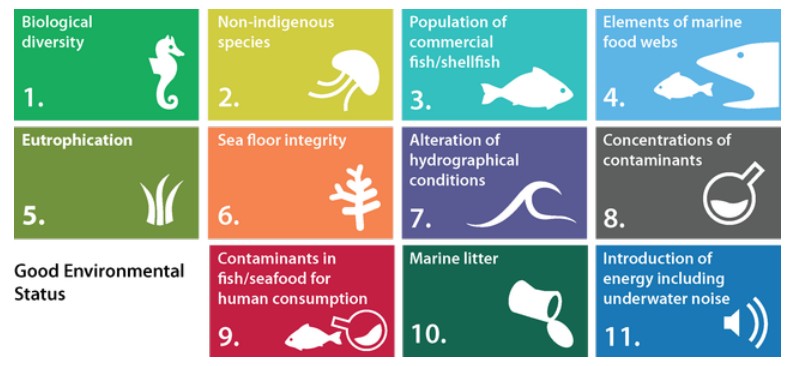
The MSFD is the EU framework for achieving “Good Environmental Status” (GES) in marine waters
Descriptor 11 regulates underwater noise
Includes monitoring of continuous and impulsive noise and setting environmental threshold values
How is sound monitored and mitigated (reduced)?
Monitoring:
EU MSFD:
Continuous monitoring of shipping noise and registers for impulsive noise sources
Requires member states to define environmental threshold values and assess wheter noise levels harm marine ecosystems
Mitigation examples:
Shutdown
Ship speed reduction
Improved ship/hull/propeller design
Route management and protected areas
IMO (international maritime organization) and GloNoise partnership work to reduce noise through international guidelines and management strategies
What ocean sound policies exist in different contries?
EU:
MSFD regulates underwater noise
Monitoring and threshold systems exist
USA:
NMFS (National Marine Fisheries Service) regulates major noise-producing activities such as industry, airguns, pile driving, drilling and construction
Norway:
Essentially no formal ocean-noise regulation system
No formal measurement or assessment requirements
Global efforts:
IMO/GloNoise shipping-noise mitigation initiatives
What global efforts has been done to reduce marine noise pollution?
Global efforts to reduce marine noise pollution are still limited, but some important international initiatives exist:
IMO (International Maritime Organization) developed international guidelines to reduce underwater noise from shipping.
GloNoise partnership (IMO, UNDP, GEF) works globally to monitor and reduce shipping noise.
Particularly Sensitive Sea Areas (PSSAs) use shipping-route management to protect vulnerable ecosystems.
EU MSFD introduced monitoring systems and some of the first quantitative underwater noise limits.