reactions of alkenes
 Call Kai
 Learn
Learn Practice Test
 Spaced Repetition
 Match
Match Flashcards
 Knowt Play
1/7

There's no tags or description
Looks like no tags are added yet.
Name | Mastery | Learn | Test | Matching | Spaced | Call with Kai |
|---|
No analytics yet
Send a link to your students to track their progress
8 Terms
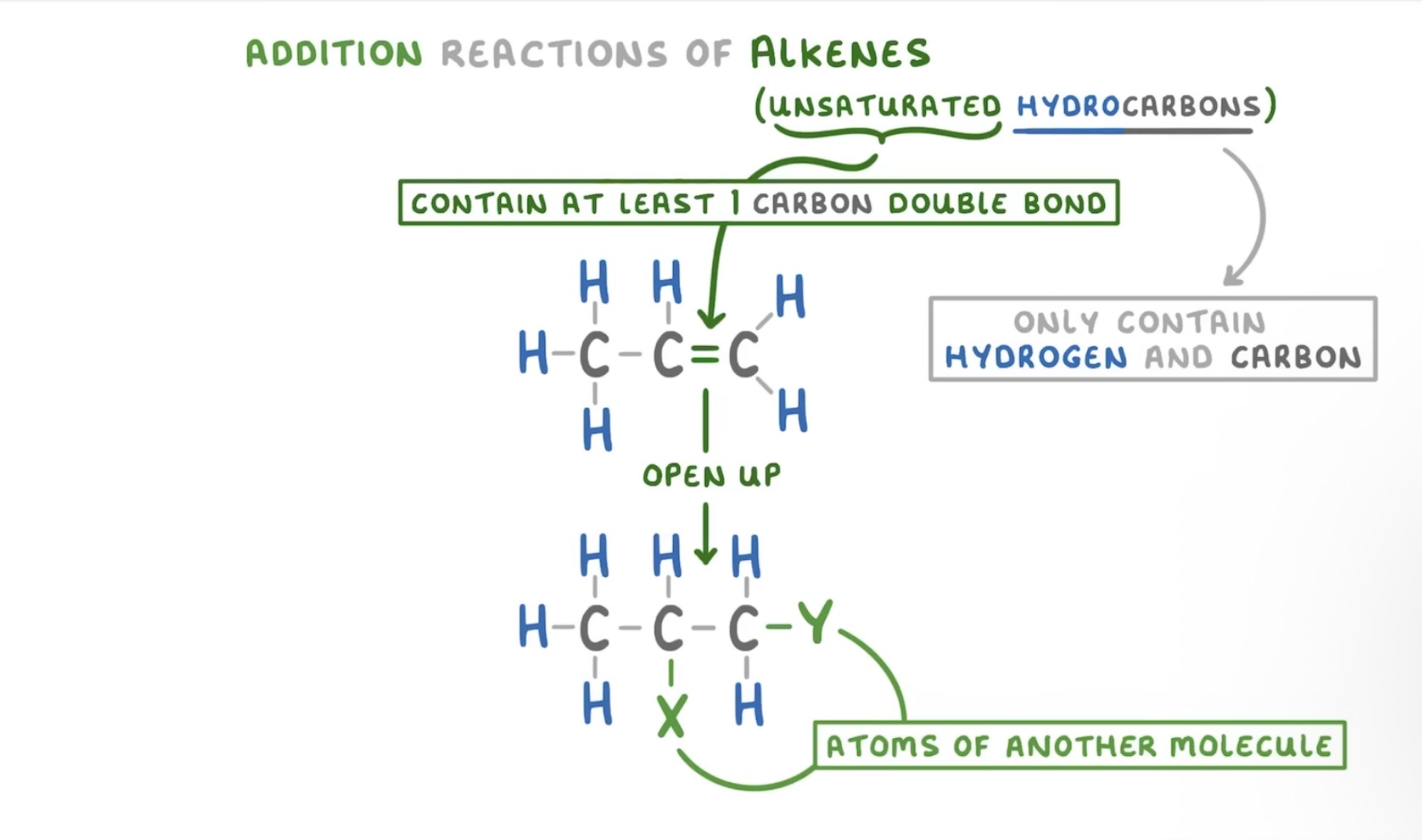
Why can alkenes undergo addition reactions
Because alkenes have a double bond it allows them to undergo addition reactions this is because the carbon carbon double bond can open up and allow the 2 carbons of o bond to atoms of another molecules
Note
Alchols are soluble in water to form neural solution
As carbon atoms number increases the solubility decreases
Alchols release energy when combusted , combusting alchol in air produces carbon dioxide and water
What are the 3 types of addition reactions
Additional reactions with hydrogen , water and halogens
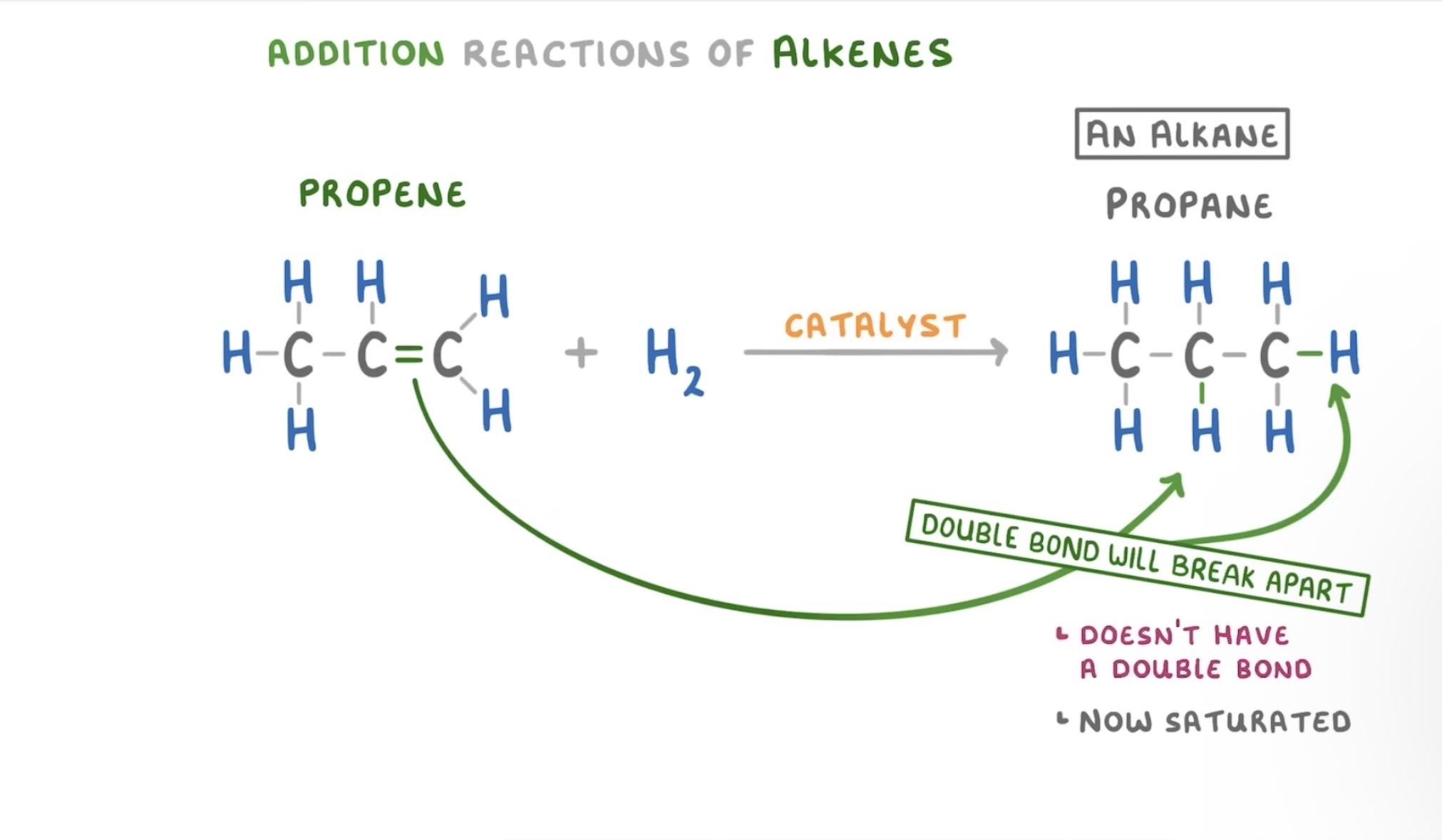
Describe the addition reaction with hydrogen
Hydrogen can react with the double bonded carbons to open up the double bond and form the equivalent saturated alkane
The required a catalyst to take place
The product doesn’t have a double bond so it’s now a saturated alkane
Describe the addition reaction with water give example with ethanol
Alkene (ethene) reacts with water which requires a catalyst and high temperatures to take place so water will be in the form of vapour
When they react the double bond opens up and the water molecule will split into hydrogen atom and O-H group
The product is an alcohol because of the O-H group (so product is ethanol )

Once reaction between ethene and water has taken place in addition reaction what happens
Need to separated ethanol from any unreacted ethene and water
Ethene is easy to separate because of its low boiling point so if we cool down mixture Ethene stays as a gas while water and ethanol condense to liquids
Need to separate ethanol and water using fractional distillation
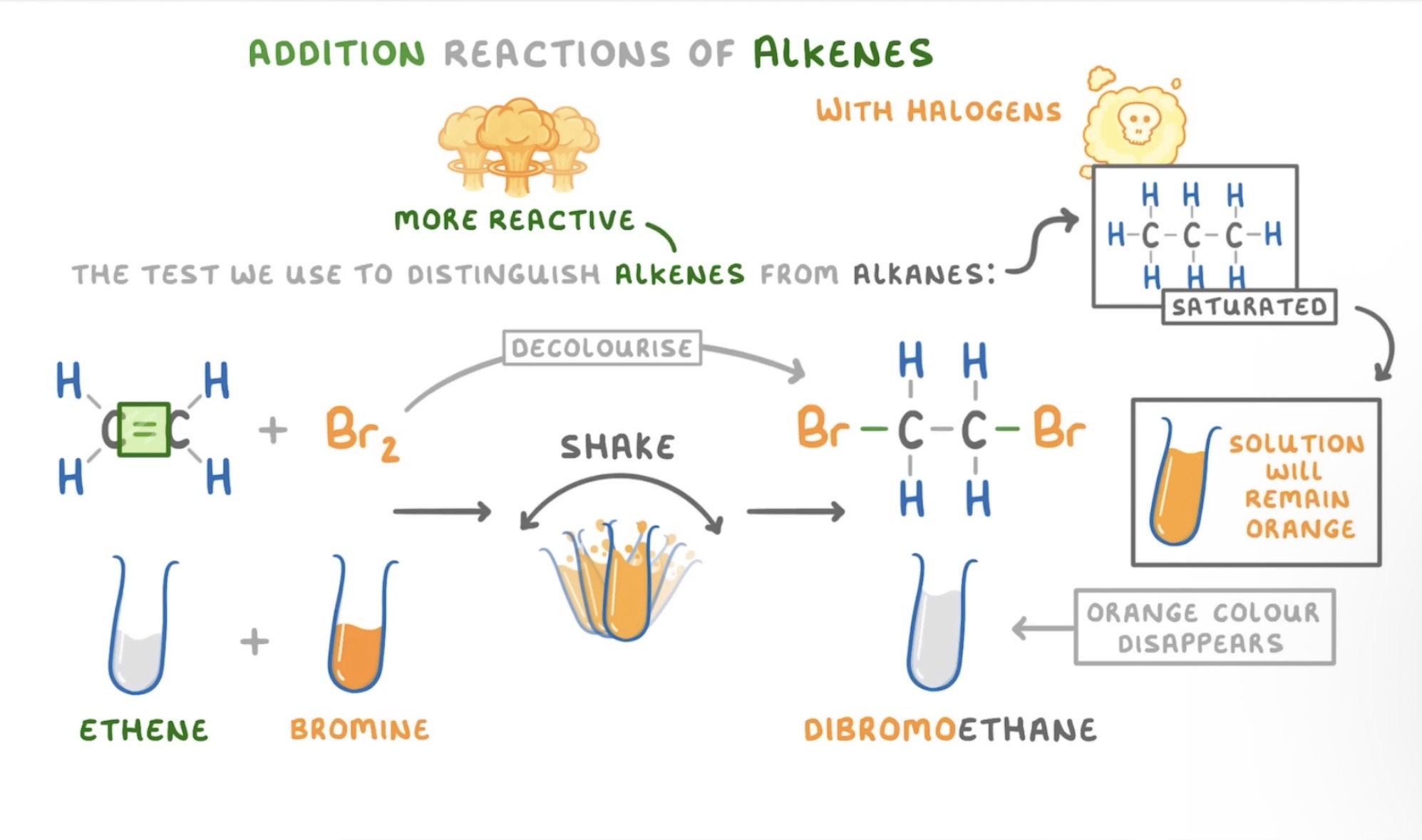
Describe the reaction of alkenes with a halogen
Alkenes will react with halogens such as bromine chlorine and iodine the molecules formed are saturated with the C=C each becoming bonded to a halogen atom and name formed is a di(halogen+alkane) e.g. dibromoethane

How/why do alkenes decolourise the bromine water in the test for alkenes but alkanes can’t
Because alkenes have double bonds they are more reactive so can react with bromine to decolourise it
However, alkanes are saturated so they don’t have any double bonds for the bromine to be added to meaning if we add bromine water it o a solution of alkanes the solution will remain orange because the bromine won’t react