Comprehensive Economics Notes: Market System, Business Economics, Macroeconomics, and the Global Economy
 Note
 Call Kai
 Learn
 Practice Test
 Spaced Repetition
 Match
 Flashcards
 Knowt Play
1/64

Earn XP
Description and Tags
Vocabulary practice flashcards covering all core economic definitions across Units 1 to 4: the market system, business economics, government policy, and the global economy.
65 Terms
Needs
The basic necessities required to live a life, such as food and shelter.
Wants
The non-essential desires of individuals, such as luxurious vehicles.
Scarce Resources
Insufficient economic resources available to satisfy unlimited human needs and desires.
Capital-Intensive Production
A production process that relies primarily on the use of machinery and equipment to manufacture goods and services.
Labor-Intensive Production
A production technique that relies predominantly on human labor rather than machinery to produce goods and services.
Opportunity Cost
The value or benefit of the next best alternative foregone when making a decision between competing options.
Capital Goods
Goods utilized and consumed by firms to produce other products, such as machinery, tools, or raw materials.
Consumer Goods
Final goods purchased and consumed directly by households and consumers.
Production Possibility Curve (PPC)
A diagram illustrating the maximum combinations of two products an economy can produce within a given time period using its resources effectively and efficiently.
Economic Growth
An increase in the productive potential or output capacity of an economy over a specific period of time.
Recession
A sustained fall in the productive potential or overall output of an economy over a period of time (negative economic growth).
Rational Decision
A choice made by consumers or producers based on a thorough cost-benefit analysis aimed at maximizing personal utility or profit.
Consumer Inertia
The reluctance of consumers to switch suppliers or brands despite cheaper alternatives being available, often driven by fear of unknown risks or lower quality.
Substitutes
Goods or services that can be used in place of one another as viable alternatives (e.g., tea and coffee).
Complements
Goods or services that are commonly consumed together, meaning demand for one affects demand for the other (e.g., tea and sugar).
Demand
The quantity of a good or service that consumers are willing and able to purchase at various price levels over a specified period.
Supply
The quantity of a good or service that producers are willing and able to provide to the market at given prices over a specific period.
Equilibrium Price
The market-clearing price at which the quantity demanded by consumers exactly matches the quantity supplied by producers.
Excess Demand
A market imbalance occurring when quantity demanded exceeds quantity supplied at the prevailing price, creating a shortage.
Excess Supply
A market condition occurring when the quantity supplied is greater than the quantity demanded at a given price, resulting in unsold surplus stock.
Price Elasticity of Demand (PED)
A quantitative measure of the degree of responsiveness of quantity demanded to a percentage change in the price of a good (PED=%ΔP%ΔQD).
Price Elasticity of Supply (PES)
A quantitative measure of the responsiveness of quantity supplied to a percentage change in the price of a good (PES=%ΔP%ΔQS).
Income Elasticity of Demand (YED)
A measure of the sensitivity of the quantity demanded of a product to a percentage change in consumer income level (YED=%ΔY%ΔQD).
Inferior Goods
Products for which consumer demand decreases as income levels rise, characterized by a negative income elasticity (YED<0).
Normal Goods
Products for which consumer demand increases when consumer income increases, characterized by a positive income elasticity up to 1.
Market Failure
A situation wherein the private market forces of supply and demand fail to allocate scarce resources efficiently or meet broader social welfare goals.
External Costs
Negative spillover effects and damages imposed on uncompensated third parties as a result of private production or consumption decisions (e.g., pollution).
External Benefits
Positive spillover effects enjoyed by third parties from the production or consumption decisions of individuals or firms (e.g., community benefits of education or vaccination).
Public Goods
Goods characterized by non-excludability (individuals cannot be barred from access) and non-rivalry (consumption by one person does not reduce availability to others).
Privatization
The transfer or sale of state-owned enterprises, assets, or public service provisions to private sector ownership and operation.
De-industrialization
The structural decline in the manufacturing and secondary sector of an economy alongside the growth and dominance of the tertiary sector.
Labor Productivity
The total volume or value of output that can be produced per worker or unit of labor input over a designated time period.
Division of Labor
The organizational practice of breaking down a production process into smaller, distinct operations where individual workers specialize in narrow tasks.
Fixed Costs
Expenses that remain constant regardless of the volume of output produced by a business, such as factory rent or development costs.
Variable Costs
Operational expenses that change directly and in proportion to the level of output generated, such as raw material costs.
Economies of Scale
The cost advantages and reduction in long-run average production costs gained by a firm as its total scale of output expands.
Diseconomies of Scale
The upward rise in average production costs experienced when a firm expands beyond optimal capacity, leading to inefficiencies, bureaucracy, and communication breakdown.

Minimum Efficient Scale (MES)
The lowest point of production output at which a firm achieves its lowest possible long-run average cost.
Monopoly
A market dominated by a single seller that controls 25% or more of total market share, protected by formidable barriers to entry.
Natural Monopoly
An industry where high infrastructure setup costs enable a single large supplier to supply the entire market at a lower average cost than multiple competing firms.
Oligopoly
A market structure dominated by a small number of large, interdependent firms that compete through differentiated goods and non-price strategies.
Cartel
A formal collusive agreement among competing firms in an oligopoly to coordinate prices, restrict output, or divide market territory.
Derived Demand
Demand for a factor of production, such as labor, that is directly generated by the demand for the final goods and services that the factor produces.
Trade Union
An organized association of workers formed to protect and advance their legal rights, working conditions, benefits, and wage rates through collective bargaining.
Gross Domestic Product (GDP)
The total monetary value of all finished goods and services produced within the geographical borders of a country over a specific time period.
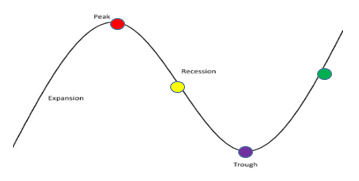
Economic Cycle
The recurring periodic fluctuations of an economy across phases of expansion (boom), downturn (recession), trough (slump), and recovery.
Inflation
A sustained and broad general increase in the price level of goods and services within an economy over a period of time.
Demand-Pull Inflation
A form of inflation caused by aggregate demand exceeding an economy's productive capacity, driving up prices.
Cost-Push Inflation
Inflation driven by rising costs of production, such as raw material prices, wages, or taxes, which firms offset by raising selling prices.
Unemployment
The economic state where individuals who are capable of working and actively seeking employment are unable to secure a job.
Current Account
A primary component of a nation's balance of payments recording visible trade (goods), invisible trade (services), and net cross-border primary and secondary incomes.
Progressive Taxation
A taxation structure where the proportion of income paid in tax increases as an individual's income level rises, aimed at narrowing wealth inequality.
Regressive Taxation
A tax system where lower-income earners pay a higher proportion of their total income relative to higher-income earners, as the tax rate or fee is fixed.
Fiscal Policy
The macroeconomic instrument through which a government adjusts tax rates and spending levels to influence aggregate demand in the economy.
Monetary Policy
The manipulation of benchmark interest rates and the overall domestic money supply by a central bank to manage macroeconomic targets.
Quantitative Easing
An unconventional monetary policy tool where a central bank purchases financial assets directly from commercial banks to inject liquidity and lower borrowing costs.
Supply-Side Policies
Government economic measures focused on improving efficiency, deregulation, incentives, and competitive potential to expand aggregate supply.
Multinational Companies (MNCs)
Large enterprise organizations that maintain operational facilities, assets, and offices across multiple nations while based at a central corporate headquarters.
Tariff
A customs duty or tax levied directly on imported goods and services to increase their domestic price and protect domestic industries.
Quota
A government-imposed physical limit on the quantitative volume of a particular good that can be imported into a country during a specified time.
Dumping
The international trade practice whereby an exporter sells large volumes of products in a foreign market at prices below their domestic production costs.
Trading Bloc
An intergovernmental regional alliance where member countries agree to reduce or completely eliminate tariffs and trade barriers among themselves.
Exchange Rate
The external purchasing value of one national currency expressed directly in terms of another country's currency.
Currency Appreciation
A rise in the foreign exchange value of a country's currency driven by the free market forces of supply and demand.
Currency Depreciation
A decrease in the external exchange value of a floating national currency caused by shifting forces of market demand and supply.