Sensation and Perception
 Call Kai
 Learn
Learn Practice Test
 Spaced Repetition
 Match
Match Flashcards
 Knowt Play
1/110

There's no tags or description
Looks like no tags are added yet.
Name | Mastery | Learn | Test | Matching | Spaced | Call with Kai |
|---|
No analytics yet
Send a link to your students to track their progress
111 Terms
Sensation
The process of detecting a physical energy (a stimulus) from the environment and converting it into neural signals
Reception
the stimulation of sensory receptor cells by energy (sound, light, heat, etc)
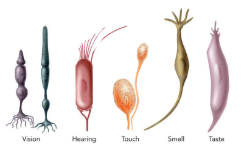
Sensory Receptors
specialized cells that detect stimulus information and transmit it to sensory (afferent) nerves and the brain
Transduction
The process that converts energy, such as light or sound waves, into the form of neural messages.
In all the sense organs, it is the job of sensory receptors to convert incoming stimuli information into electrochemical signals—neural activity.
Transmission
delivering this neural information to the brain to be processed
Absolute Threshold
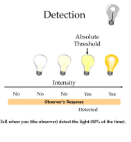
Absolute Threshold – is the weakest amount of a stimulus that a person can reliably detect.
The minimum stimulation needed to detect a stimulus 50% of the time.
Will differ person to person
Stimuli you cannot consciously detect 50% of the time are subliminal
Signal Detection Theory
a theory predicting how and when we detect the presence of a faint stimulus (signal) amid background stimulation (noise).
Assumes there is no single absolute threshold
Detection depends on a person’s psychological state:
experience
expectations
motivation
alertness
Difference Threshold
Minimum difference between two stimuli required for detection 50% of the time, also called just noticeable difference (JND).
Weber’s Law
Two stimuli must differ by a constant minimum percentage (rather than a constant amount), to be perceived as different.
Weber fraction: k = δI/I.
Sensory Adaptation
diminished sensitivity as a consequence of constant stimulation
Ever forgotten you are wearing a watch?
Ever gotten used to a smell?
Then why don’t things disappear from your vision? (walls, clock)
adaptive quality - awareness for protection!
Sensory Interaction
the process by which our five senses work with and influence each other
Example: smell + texture + taste = flavor
When one sense affects another sense
The taste of strawberry interacts with its smell and its texture on the tongue to produce flavor
Phototransduction (Vision)
the conversion of light energy into neural impulses that the brain can understand
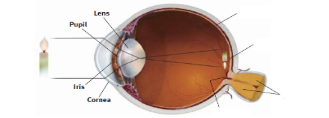
Cornea
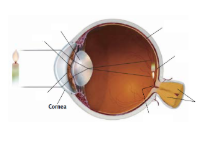
eye’s clear, protective outer layer covering the pupil and iris.
Light first enters the eye through the cornea.
Pupil
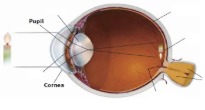
small adjustable opening in the center of the eye through which light enters.
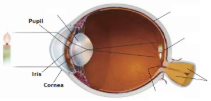
Iris
ring of muscle tissue that forms the colored portion of the eye around the pupil
controls the size of the pupil opening by expanding and contracting over the pupil.
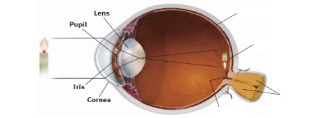
Lens
transparent structure behind the pupil
changes shape to help focus images on the retina.
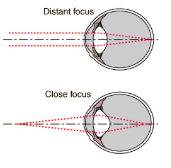
How does the lens change shape?
To focus the rays, the lens changes its curvature and thickness in a process called accommodation.
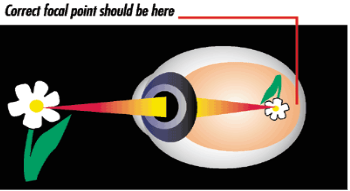
Myopia
Nearsighted Vision
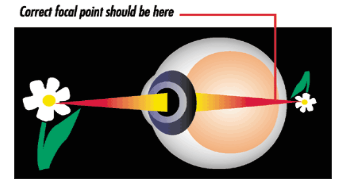
Hyperopia
Farsighted Vision
Retina
light-sensitive inner surface of the eye
Contains sensory receptors (rods & cones) plus a layer of neurons that begin the processing of visual information
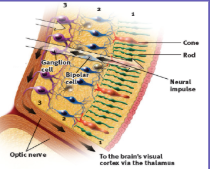
What happens in the retina
Light waves transduced into neural impulses by the rods and cones
2. then passed to the bipolar cells and the ganglion cells.
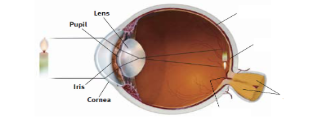
Blind Spot
Point where the optic nerve leaves the eye because there are no receptor cells located there.
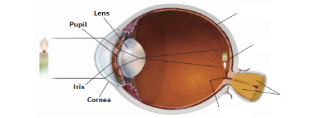
Fovea
central focal point in the retina, around which the eye’s cones cluster.
area of greatest visual acuity (sharpness of focus)
Optic Nerve
The optic nerve carries the impulse to the thalamus in the middle of the brain and then on to the visual cortex of the occipital lobes.
Photoreceptors
Light-sensitive cells (neurons) in the retina that convert light energy into neural energy.
Rods
Photoreceptors that are especially sensitive to dim light, but not color. (125 million/eye)
Detects black, white and grey, responsible for peripheral and twilight vision
Cones
Photoreceptors that are especially sensitive to colors but not dim light. (7 million/eye)
Cones are responsible for our ability to “see” colors

Visual Cortex
most visual information is sent here before moving to other visual areas for further analysis
located in occipital lobe
is the part of cerebral cortex
In the visual cortex, the brain begins working by transforming neural impulses into visual sensations of color, form, boundary and movement.
This process is called parallel processing

Parallel Processing
the simultaneous processing of several aspects of a stimuli
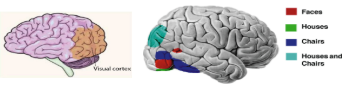
Shape Detection
Specific combinations of temporal lobe activity occur as people look at shoes, faces, chairs and houses.
different parts of visual cortex used to identify different images
Feature Detection
Nerve cells in the visual cortex respond to specific features, such as edges, angles, and movement.
It is the reason we are able to detect the distinct features of Snoopy & his cooked turkey
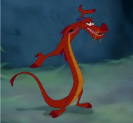
Color
The dragon is anything but red.
The dragon rejects the long wavelengths of light that to us are red- so red is reflected of and we see it
Also, light has no real color.
It is our mind that perceives the color.
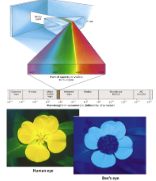
Light Energy
Humans detect visible light.
Light travels as an electromagnetic wave.
Wavelengths:
Blue = short
Green= medium
Red = long
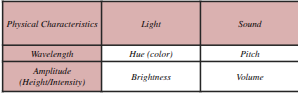
Physical Characteristics of Light
Light travels as an electromagnetic wave
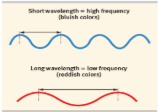
Wavelength
what hue (or color) am I seeing?
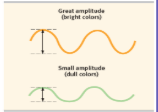
Amplitude
how bright is the color I am seeing?

Young-Helmholtz Trichromatic (three-color) Theory
the retina contains three different types of color receptors (cones)— (sensitive to red, green, or blue)
when receptors fire, colors are mixed and we get combinations that make up the spectrum that we see in the world
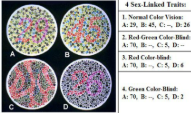
Color Blindness
Genetic disorder in which people are blind to green or red colors
They lack functioning red or green sensitive cones
These people have dichromatic (two-color) vision
Supports Trichromatic Theory
Dichromatic Vision
People with dichromatic vision have two types of cone cells that work, but one type is not fully functional.

Protanopia
Blindness to Red

Deuteranopia
Blindness to green

Tritanopia
Blindness to blue
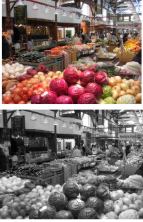
Monochromatic Vision
People with monochromatic vision, also known as complete color blindness, can only see shades of gray, black, and white.
This is a very rare type of color blindness.
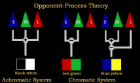
Opponent Process Theory
Further up in the optic nerve, neurons work in pairs to help process color vision signals.
Red-Green = Xmas
Blue-Yellow = Beach
Black-White = Oreo
We cannot see certain colors together in combination (red-green, blue-yellow, and white-black). These are antagonist/ opponent colors.
After Images
The ghostly birds are called afterimages.
As you stare at the red bird, light-sensitive cells at the back of your eyes become less responsive to red light. This is a result of the Opponent Processing theory.
Color perception is controlled by the activity of two opponent systems; a blue-yellow mechanism and a red-green mechanism
there are some color combinations that we never see, such as reddish-green or yellowish-blue.
Eg. When you shift your gaze to the birdcage, your visual system “subtracts” red light from the white light that’s being reflected from the white background. White light minus red light is blue-green light.
Prosopagnosia
A neurological disorder characterized by the inability to recognize faces.
It is not related to memory loss, vision problems, or learning disabilities.
Often caused by damage to the fusiform gyrus, a region of the brain that plays a key role in facial perception
Blindsight
A condition where individuals who have lost conscious vision due to damage in the visual cortex of the brain can still respond to visual stimuli.
Even though they cannot consciously "see" objects in their field of vision, they can detect their presence and movement without being aware of it.
It provides insights into how the brain processes visual information at an unconscious level.
Audition
the sense or act of hearing
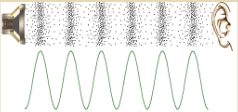
Sound Waves
Sound waves are compressing and expanding air molecules → travels as a wave of air pressure.
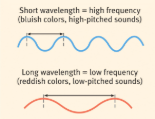
Frequency
What pitch am I hearing? (high tone or low tone)
determined by the wavelength of sound.
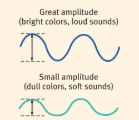
Volume (loudness)
How loud is the sound I am hearing?
determined by the amplitude
Outer Ear
Collects and sends sounds to the eardrum
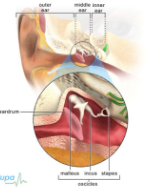
Middle Ear
Chamber between the eardrum and the cochlea.
Contains three tiny bones (hammer, anvil, stirrup) that concentrate the vibrations of the eardrum on the cochlea’s oval window.
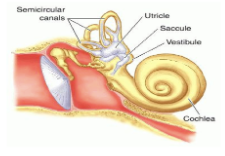
Inner Ear
Innermost part of the ear, containing the cochlea, semicircular canals, and vestibular canals.
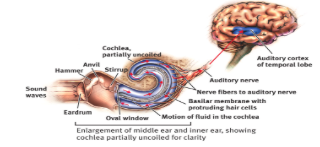
Cochlea
Coiled, bony, fluid-filled tube in the inner ear that transforms sound vibrations to auditory signals.
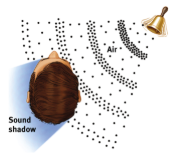
Sound Localization
Because we have two ears, sounds that reach one ear faster than the other ear cause us to localize the sound.
Time differences as small as 1/100,000 of a second can cause us to localize sound.
The head acts as a “shadow” or partial sound
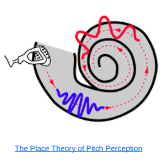
Place Theory
Pitch (how high or low something is) is determined by location of vibration along the basilar membrane
But this doesn’t explain low-pitch since we haven’t found specific positions for those on the bm
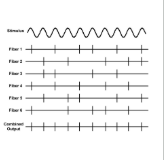
Frequency Theory
Pitch is determined by frequency hair cells produce action potentials
If the frequency of the sound is 100 waves per second then the neuron fires at 100 pulses per second
But we can hear frequencies above 1000 waves per second but neurons can’t fire faster than 1000 pulses per second.
Volley Principle
Pattern of sequential firing creates a combined high frequency signal
Conduction Hearing Loss
Hearing loss caused by damage to the mechanical system that conducts sound waves to the cochlea.
Less common than sensorineural
Surgery
Sensorineural Hearing Loss
Hearing loss caused by damage to the cochlea’s receptor cells or to the auditory nerve, also called nerve deafness.
Hearing aid to amplify sound
Cochlear Implant
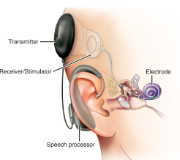
Coclear Implants
work by translating sounds into electrical signals that are transmitted to the cochlea and, via the auditory nerve, relayed to the brain.

Taste (Gustation)
Chemical Sense
Four basic tastes: Sweet, Salty, Sour, Bitter
Recently, receptors for a fifth taste have been discovered called “Umami” (savory)
from Japanese word meaning pleasant/savor
Recognizes glutamates and nucleotides
And now.. oleogustus (“fatty”)
Papillae
Those bumps on our tongue are called Papillae.
Papillae help grip food while your teeth are chewing - and they contain your taste buds
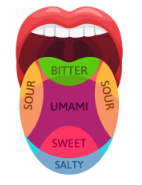
Transduction of Taste
taste buds shaped like miniature onions
receptors for taste
chemicals dissolved in saliva activate taste buds
produce nerve impulses that reach areas of the brain’s parietal lobe
brain transforms impulses into sensations of taste
Taste differs person to person
Supertaster - tongues more densely populated with fungiform papillae (taste buds), giving them a stronger ability to taste what others could not (25%)
Medium taster - average # of taste buds (50%)
Nontaster - a person who has a decreased ability to perceive taste, especially bitter or spicy flavors; have fewer taste buds than other people (25%)
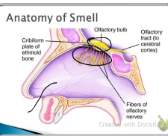
Smell
Another chemical sense!
Odorants enter the nasal cavity to stimulate 5 million receptors to sense smell.
Unlike taste, there are many different forms of smell.
NOT processed by the thalamus → olfactory bulb
Smell & Memories
The brain region for smell (in red) is closely connected with the brain regions involved with memory (limbic system).
That is why strong memories are made through the sense of smell.
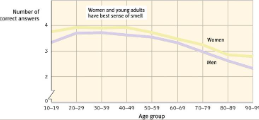
Age, Gender, and Smell
Ability to identify smell peaks during early adulthood, but steadily declines after that.
Women are better at detecting odors than men.
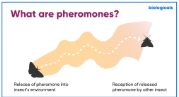
Pheromones
Chemical signals released by animals (and potentially humans) that can influence the behavior or physiology of others of the same species.
Used by animals as a form of communication
Can trigger immediate behavioral responses, such as attraction or alarm.
Pheromone Detection
Often detected through the vomeronasal organ (VNO), located in the nasal cavity. However, the presence and role of the VNO in humans is still debated.
Pheromone Pathway
Signals are sent from the VNO (or olfactory system) to the hypothalamus, influencing emotions, behaviors, and hormonal responses.
Touch
skin is the largest sense organ
There are receptors for pressure, temperature, and pain
Touch appears to be important not just as a source of information, but as a way to bond with others
Touch Localization
depends on the relative lengths of the pathways from the stimulated parts to the brain.
Pain
tells the body that something has gone wrong.
Usually results from damage to the skin and other tissues.
A rare disease exists in which the afflicted person feels no pain.
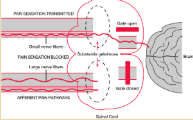
Gate-Control Theory
Melzak and Wall (1965, 1983) proposed that our spinal cord contains neurological “gates” that either block pain or allow it to be sensed.
Kinesthetic Sense
The sense of our body parts’ position and movement
Keeps us informed about movement of body parts & their position in relation to each other.
Muscle Movement, Posture, & Joints
Information comes from stretch receptors, the tendons, & the internal organs.
Vestibular Sense
Hair cells in the inner ear bend in relation to the position & movement of the head
Biological gyroscope located in the inner ear
In the semi-circular canals and the vestibular sacs
Liquid moves when the head moves and signals the brain
gives information that the brain uses to help us maintain our balance and to sense changes in our movement through space.
Essential for balance, coordination, & equilibrium
Basics of Perception
We do not actually experience the world directly, but instead we experience it through a series of “filters” we call senses.
The brain senses the world indirectly because the sense organs convert stimulation into the language of the nervous system: neural messages
Bottom Up Processing
Analysis of the stimulus begins with the sense receptors and works up to the level of the brain and mind.
Starting with the sensory input, the brain attempts to understand/make sense.
process this way when we have no prior knowledge → start @ bottom with individual pieces of data and work our way up to a theory or conclusion
relies more on sensation than perception
Example: You’re on a hike and see a long, slim, slithering creature on the ground… you process… ah!
Top Down Processing
Information processing is guided by higher-level mental processes as we construct perceptions, drawing on our experience and expectations.
Guided by experience and higher-level processes, we see what we expect to see.
process this way when have prior knowledge → start at top & work way down as process specific details based on expectations/experiences
relies on perception over sensation
An experienced hiker, you expect to see snakes on your hike so windy stick, lizards, etc. all seem like snakes.
Selective Attention
concentration on certain stimuli in the environment and not on others, enabling important stimuli to be distinguished from peripheral or incidental ones
failure of attention to particular physical or emotional stimuli
Cocktail Party Effect
Our ability to attend to only one voice among many.
Inattentional Blindness
refers to the inability to see an object or a person in our midst.
failing to see visible objects when our attention or focus is directed elsewhere
Change Blindness
refers to failing to notice changes in the environment
failing to notice changes in the visual environment
Schemas and Perception
Schema a collection of basic knowledge about a concept or entity that serves as a guide to perception, interpretation, imagination, or problem solving.
could be a mental model that provides a frame for interpreting information
What do you think of when you hear “dorm room”?
Perceptual Sets
a tendency to perceive things in a certain way to a specific situation or stimulus based on their expectations, experiences, beliefs, and context
Listeners “hear” diabolical messages in rock music because they are prepared to “discover” certain messages, and therefore they do.
Influenced by experience, context, motivation, and emotion
Context Effects
top down influence on perception as we are influenced by experiences, ideas and emotions
In which picture does the center dot look larger?
Perception of size depends on context.
Parapsychology
The study of paranormal phenomena, including ESP and psychokinesis (the ability of the mind to move objects).
ESP
The controversial claim that awareness can occur apart from sensory input. Includes:
telepathy: mind to mind communication
clairvoyance: seeing remote events
precognition: seeing the future
Gestalt Psychology
a school of thought interested in how people naturally organize their perceptions according to certain patterns.
main principle: the whole is different from the sum of its parts -- computer screen image (sum) pixels (parts)
We see the world as we want instead of what it is.
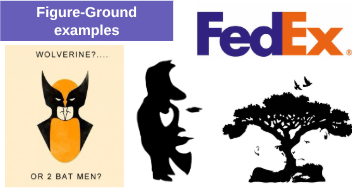
Figure Ground
the organization of the visual field into objects (the figures) that stand out from their surroundings (the ground)
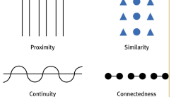
Grouping
After distinguishing the figure from the ground, our perception needs to organize the figure into a meaningful form using grouping rules
Proximity, similarity, closure(+continuity & connectedness)
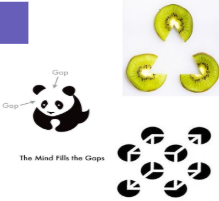
Closure
we fill in the spaces and see disconnected or incomplete figures as complete figures

Proximity
see objects close together as a unit
Similarity
See Image
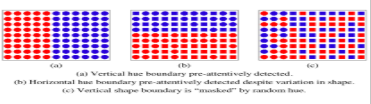
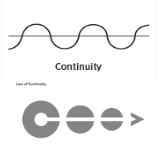
Continuity
we perceive smooth, continuous patterns rather than discontinuous ones.
objects either in a straight line or smooth curve are more easily seen as a unit (together)
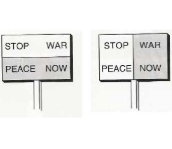
Connectedness
The Principle of Common Region states that objects that are within the same region are perceptually grouped together.

Perputual Constancy
Our tendency to perceive objects as stable and unchanging despite changing sensory information
Color constancy
Lightness constancy
Size constancy
Shape constancy
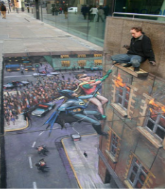
Depth Perception
he ability to perceive objects three-dimensionally (binocular and monocular cues)
Allows us to turn 2-D images into 3-D perceptions
Depth perception enables us to judge distances.
Binocular Cues
depth cues that depend on the combination of both eyes (the two eyes work together)
Monocular Cues
depth cues that depend on one eye