veronica cards
 Call Kai
 Learn
Learn Practice Test
 Spaced Repetition
 Match
Match Flashcards
 Knowt Play
1/271

There's no tags or description
Looks like no tags are added yet.
Name | Mastery | Learn | Test | Matching | Spaced | Call with Kai |
|---|
No analytics yet
Send a link to your students to track their progress
272 Terms
The client is a 46-year-old male who comes to the emergency department having difficulty breathing which has worsened over the last twenty four hours.
ACTIONS:
- auscultate the lungs for adventitious breath sounds
assess for tactile fremitus
POTENTIAL CONDITIONS:
- Lobular pneumonia
PARAMETERS TO MONITOR:
- respiratory rate & pulse
crackles
A 20-year-old nulliparous female college student sees the nurse because she has missed her last two menstrual periods. She reports she has not had sexual intercourse in one month. The nurse requests a pregnancy test, which is negative.
Based on this client's history, which assessment is most important for the nurse to obtain?
Body weight, hirsutism, thyroid enlargement
When preparing a female client for an abdominal examination, the nurse should provide her with which instruction?
Empty your bladder just prior to the examination
During the precordium assessment, the nurse palpates the apical impulse of a client on the 5th intercostal space left clavicular line. The pulse is more vigorous than expected.
Which action should the nurse taken in response to this finding?
Determine if the client has a history of heart disease
In auscultating for the presence of a carotid artery bruit, the nurse places the bell of the stethoscope at which location?
lower half of the neck
The nurse continues the respiratory assessment of a client's chest excursion by placing both hands as seen in the picture.
Which instruction should the nurse give the client?
Take a deep breath
The nurse assesses a young adult female who was brought to the emergency department by her boyfriend because she has not been feeling well all day and he believes she is getting worse.
Which finding supports the nurse's suspicion that the client is experiencing appendicitis?
Periumbilical pain localizing to right lower quadrant
When conducting a physical examination, the nurse uses a tuning fork to assess for which condition?
hearing loss
The client is a 76-year-old female who arrived at the ED via ambulance form an ALF after a fall. The client called for help using her medical alert necklace. She reports feeling dizzy and lightheaded for the past two days. The client is unable to recall the events that led up to the fall and states, "I do not know how long I was down."
Past medical history includes COPD, hypertension, and carotid artery stenosis. She smokes half a pack of cigarettes daily for 40 years. Attempted to quit smoking 5 years ago after a right carotid endarterectomy. The nurse is admitting the client to the stroke unit and preparing to complete a focused neurological assessment.
Which assessments would the nurse allow? (Select all that apply)
Glasgow coma scale
Pupil size
Cranial nerve function
Muscle tone
Level of consciousness
The client is a 73-year-old male with history of left sided stroke. Right side has increased weakness and a decrease in ROM. Lives in an ALF. Has minimal confusion and is able to answer simple questions. For each joint, click to specify what time of ROM was being assessed based on findings. Each category with have one response.
extension: elbow only able to straighten joint 20 degrees
extension: wrist able to bend back toward forearm
abduction: shoulder unable to move arm away from the body
The nurse is obtaining a health history for a client during an annual physical examination. When evaluating the client for menopausal symptoms, which finding indicates the client is perimenopausal?
drenching night sweats
The nurse is doing a health assessment of a client who smoked three packs of cigarettes every day for the last twenty years before quitting two years ago. How should the nurse document the client's pack-years?
60 pack per year
(3packs/day x 20 years = 60packs/year)
An adult comes into the clinic for an annual physical. Heart sounds are loudest for S1 at the ________ and for S2 at the _________.
(S1) apex of heart, (S2) base of heart
The nurse is performing a head-to-toe physical exam on a known victim of intimate partner violence. The visual exam reveals several round, flat, pinpoint, red spots. How should the nurse document this finding?
Petechiae
The nurse asks a female client about the proverb "Glass Houses,
" and she replies, "It will break the windows.". Which conclusion
should be documented about this client's response?
impaired thinking
In assessing a client's neck, the nurse hears a blowing swish. when auscultating the area over the left carotid artery, but hears no sound over the right carotid artery. How should the nurse document this finding?
left carotid artery bruit present; no bruit heard in the right carotid artery
To assess a client pupillary reaction to accommodations, what action should the nurse take?
observe pupil size when focusing on a near object and then a far object
During an abdominal assessment, a client with a temperature of 103° F (39.4° C) experiences pain and abruptly stops inhaling during deep palpation. Which prescription is most important for the nurse to implement?
nothing by mouth
When inspecting an adult woman's skin the nurse observes several areas of ecchymosis on her trunk and extremities. Which
information in the client's history requires additional follow-up by the nurse?
takes an oral anticoagulant
The nurse is examining an older female client and suspects that she has a dysfunction in her hip region. Which procedure should the nurse perform to further assess for hip dysfunction?
abduct each hip while the client is supine
While auscultating a client's abdomen, the nurse hears a low-pitched blowing sound in the upper midline area. Which is the likely indication of this finding?
possible renal artery stenosis
An adult client exhibits an allergic reaction to an Insect bite. The nurse should observe the client's skin for which finding?
wheals
When assessing a client's rectal bleeding, which findings should the nurse document?
color characteristics of each stool
An older adult male arrives at the healthcare center with lower abdominal discomfort and frequent urination. The nurse asks the client to provide a urine sample. After an extended period of time, the client returns with only a few drops of urine. Which action should the nurse implement?
evaluate for bladder distention
A 29 year old male client informs the nurse that he came to the clinic to see if, "Maybe I have lung cancer or something," and wants to get checked out since, "I can't seem to get rid of this body-wracking dry cough that has been hanging around for the
last six weeks." Which computer documentation of this client's concerns should the nurse enter?
describes having a "body-wracking dry cough" of 6 weeks duration
A client is being evaluated for environmental allergies. While examining the client's nasal passage, which finding suggests to the nurse that the client is experiencing allergic rhinitis?
intranasal edema and swelling of turbinates
While completing a health assessment for a client being admitted with bilateral pneumonia, the nurse asks the client to describe the sputum. Which communication technique should the nurse use to obtain this information?
open ended questioning
NGN- When assessing the mid abdominal region of a client with an abdominal aortic aneurysm, which action should the nurse implement?
auscultate for bruit
(IF NGN "turn off suction" for multiple answers)
A adult client presents with complaints of gnawing epigastric pain. The pain is worse when is hungry and abates if he eats something. What problem do these symptoms suggest?
peptic ulcer disease
An older male client reports to the nurse that his feet are cold. Before covering the client's feet which assessment should the nurse complete? (select all that apply)
assess volume of pedal pulses
observe color of the feet and toes
palpate dorsal surface of feet for warmth
1 multiple choice option
The nurse should anticipate difficulty visualizing the point of maximal impulse (PMI) in which client?
a 54 year old who is 5 feet tall and weights 300 pounds
The nurse observes the presence of brittle, concave curves to the nails of a client on assessment. Which information should the nurse obtain from the client that may explain the appearance of the nails?
iron deficiency anemia
During an admission assessment, which approach should the nurse use to assess a client's speech patterns?
note the client's responses during the initial interview
The nurse observes an older adult client walking aimlessly in the hallway and staring straight ahead with a blank expression. How should the nurse enter documentation of this finding in the client's electronic medical record (EMR)?
wandering behavior with flat affect
When performing a neurological assessment on an alert client, the nurse observes that the client's pupils are both round, 3mm in size and responds briskly to life. Which notation should the nurse use when documenting the assessment?
PERRL
PERRLA Abnormalities; Includes unequal, dilated, or fixed pupils.
While interviewing a newly admitted older female client, the nurse observes that the client ignores questions asked by the nurse, and speaks loudly to her son who brought her to the hospital. Whichaction should the nurse implement first?
stand directly in front of the client and ask about any hearing loss
The nurse is assessing a young adult female who is 5'5 and has a BMI score of 32. Based on this BMI, what should the nurse deduce about this client's general health?
obese, serious threat to well-being
In assessing tactile fremitus in the client with suspected pneumonia, the nurse should perform which action?
place the palm of the hand on the chest wall to feel vibrations while the client speaks
While percussing the borders of the heart, the nurse picks up an area of dullness beginning at the 5th left intercostal space and moving upward ot the 2nd left intercostal space at the sternal border. What do these findings indicate?
cardiac enlargement
A client complains of stomach pain and localizes it in the middle section of the abdomen below the xiphoid process. Which abdominal location should the practical nurse document the client's pain?
epigastric region
The nurse is performing an initial assessment of a client who has an expressionless facial affect, slurred speech, and red conjunctivae. Which question should the nurse ask first? "Have you..."
been sleeping well?
An adolescent female client comes to the clinic troubled by breast tenderness before her menstrual periods. On examination, the nurse notes generalized lumpiness of both breasts with no discrete masses and no nipple discharge. Which action should the nurse take?
request a return visit after her menstrual period for a breast exam re-check
The nurse is examining a female client who states she has no complaints, so has not had a physical examination for over 5 years. The nurse palpates enlarged lymph nodes in the axilla. Which findings is most important for the nurse to describe when reporting to the healthcare provider?
nontender, firm lymph nodes
When family members express their concern about their father's recent memory loss, which assessment should the nurse suggest?
determine if the client can recall what he ate for breakfast
Which assessment finding supports the client statement, "my feet swell all the time"?
2+ pitting edema of ankles bilaterally
The nurse assesses a client who comes to the clinic with neck stiffness and discomfort. Which finding of the cervical spine should the nurse inquire further about lifestyle habits?
evaluation of cranial nerve XI reveals flexion is maintained against full resistance
Client present with itching and pain in the left ear that started several days after beginning swimming lessons. The nurse observes the discharge coming from the air with musty odor. How should the nurse expect the year to appear when performing in otoscopic examination?
red edematous ear canal with no visualization of tympanic membrane
The nurse completes palpation of the thoracic region on an adolescent client. Which finding is considered normal for this adolescent client?
nontender
The nurse is obtaining a health history for a client prior to a scheduled cholecystectomy. While interviewing the client, which assessment technique should the nurse use when asking about the client's use of illegal drugs and alcohol?
ask specifically about alcohol, marijuana, cocaine, heroin
To objectively confirm the presence of fever, before taking the client's temperature, which action should the nurse take?
place the dorm of the hand on the client's forehead
The nurse observes that a client is experiencing melena. Which serum laboratory test should the nurse monitor in response to this finding?
hematocrit
While completing an admission assessment for a client with gastrointestinal bleeding, the nurse inspects the perineal area and anus. Which findings indicates a normal appearance of the anus?
increased pigmentation and coarse skin
During assessment of a client's abdomen, the nurse observes that the client's umbilicus is depressed and below the surface of the abdomen. What action should the nurse take in response to the observation?
document the normal finding
Which skill should the nurse have an older client demonstrate to evaluate performance of daily living activities?
sorting a collection of socks
After placing a client in a supine position, the nurse uses the diaphragm of the stethoscope to auscultate bowel sounds and hears a loud, high pitched almost continuous gurgling in two quadrants. Which action should the nurse implement?
auscultate the remaining two quadrants
A male client who is admitted for an acute brain attack reports the onset of burning sensation in his hands and legs. Which action should the nurse implement to identify additional findings that are consistent with the client's paresthesia?
evaluate clients muscle strength and hand grips
A client grimaces while preforming range of motion of the left knee during an annual health assessment. Which movements should the nurse utilize to assess the client's ability to normally perform range of motion on the right knee?
extension, flexion, hyperextension
While observing a client's face, which assessment finding requires immediate intervention by the nurse?
oral mucosa is cyanotic
While assessing the legs of a female client, the nurse observes leathery-looking skin. The client reports aching tired legs that swell if she stands for long periods of time. To screen for venous insufficiency, the nurse should ask the client if she has experienced which subject finding?
decreased pain when legs are elevated
The nurse performs a two-point discrimination test by applying two sterile needles lightly to the fingertips and moving the needle tips in ever-closing distances.
A middle-aged adult client senses two points at a distance of 3 mm on the fingertips and 10 mm on the palms of the hands. Which interpretation of this finding is accurate?
normal sensory finding
While completing an admission assessment, the nurse is unable to palpate the client's left dorsalis pedis (DP) pulse. Which intervention is most important for the nurse to implement?
use a doppler to assess an audible DP pulse
The nurse completes palpitation of the abdomen on an older adult client. Which finding is considered normal for the client?
peristaltic waves
The nurse has just completed palpation maneuvers for lymph nodes on an older adult female client. Which findings are considered normal for this elderly client?
nodes are non-palpable
The nurse observes a red rash located in multiple body folds of an obese client. When interviewing the client which information is most important for the nurse to obtain?
current medication use
The nurse is assessing the perianalvare of a female client who states she has chronic constipation and has bright red blood on the toilet paper after having a bowel which finding the nurse report that is most consistent with ct complaints?
shiny blue sac around anal opening and a linear split
Which finding should raise the greatest concern for a nurse who us performing an ear nose and throat ENT examination?
An ulceration under the tongue that has been present for the last three weeks
A male client reports the onset of a burning sensation in his hands and legs. How should the nurse document this finding in the electronic medical record?
paresthesia reported
The nurse examines a client admitted with a deep, constant pain in the abdomen that radiates to the back. Which finding is most important for the nurse to report to the healthcare provider?
an audible abdominal bruit
During a health assessment for a young adult female client's gynecological annual screening, the client reports amenorrhea. The nurse calculates the client's body mass index as 16. Which finding should the nurse document in the electronic medical record that indicates an expected rationale for this condition?
trains for competition and runs 12 miles everyday
The nurse applies pressure over an area of the lower abdomen where the client reports pain. The client denies pain upon palpation, but reports pain when the pressure is released. Which action should the nurse implement?
notify the healthcare provider of the rebound tenderness
When assessing a client's skin, which finding should the nurse report to the healthcare provider?
bluish discoloration of the nail beds
While conducting a mental status examination of a newly admitted male client, the nurse notes that his head is lowered and he stares at his hands with a blank look on his face. Based on these observations, which question should the nurse ask this client?
how are you feeling today?
To assess a female client for hirsutism, which action should the nurse take?
assess the appearance of the client's face
A client reports to the emergency department with pain and swelling of the right hand and wrist from a fall injury that occurred when playing basketball. During the admission assessment the client reports sharp intense pain on movement of the hand and wrist to the nurse which additional assessment should the nurse perform?
measure nailed capillary refill time
Which assessment technique provides the nurse with the best
data related to the client level of peripheral perfusion?
measuring cap refill
To assess for muscle atrophy in the legs, which action should the nurse take?
compare the appearance of the legs bilaterally
When assessing a client from the lower extremities, which finding requires the immediate intervention by the nurse?
right calf swelling and tenderness
While assessing a client, the nurse notes an audible expiratory wheeze and a respiratory rate of 30 breaths per minute. What action should the nurse implement?
administer a respiratory aerosol treatment
The nurse is assessing the visual acuity of a client who reports changes in vision. How many feet away from the ceiling chart should the client stand?
20 feet
The nurse is performing a pulmonary assessment for an adult who arrives at the clinic for an annual physical examination. Which assessment findings should the nurse identify as a normal finding?
the ribs articulate at a 45 degree angle with the sternum
Following a cerebral vascular accident CVA a male client prescriptions include neurologic assessment every eight hours and bed rest the assessment tool includes evaluation of the clients posture. What action should the nurse implement?
document that posture could not be evaluated due to prescribed bedrest
The nurse is conducting a physical assessment of a young adult. Which information provides the best indication of the individual's nutritional status?
condition of the hair, nails, and skin
A client is admitted with a diagnosis of right lower lobe pneumonia. Which breath sound is the nurse most likely to auscultate over the right lower lobe?
coarse crackles
While performing a mental status examination, which question should the nurse ask when attempting to evaluate a patient's
judgement?
do you write checks if you know the bank account is overdrawn?
the nurse is assessing elderly client in a community health clinic what assessment findings is an indicator for immediate medical
follow-up?
a change of awareness in surrounding
The nurse observes that an adult clients abdomen is round and protuberant what additional findings require the most immediate follow-up assessment?
contour appears asymmetric
client returns to the clinic for a follow up visit after being
treated for bladder infection while examining the client which
finding indicates in expected response to the treatment?
pain score 1 out of 10 with urination
In assessing a client's heart sounds, the nurse heart S1 and S2 after placing the diaphragm of the stethoscope at the second intercostal space just to the right of the sternum while the client is supine in bed. Which action should the nurse take next?
move the diaphragm of the stethoscope to the left of the sternum
During the admission of an older adult female, the nurse notes the presence of kyphosis. The client tells the nurse that she has a history of osteoporosis. To obtain additional information related to this finding, the nurse should question the client about what additional information in her history?
decreased height
A 75-year-old client with a recent history of a cerebrovascular accident (CVA) presents with right hemiparesis. The nurse tests
the deep tendon reflexes on the right side and elicits a brisk 4+ response. Which interpretation of this finding is accurate?
hyperactive response consistent with an upper motor neuron disorder
A male client arrives at the clinic for follow-up health assessment after recent antibiotic treatment for pneumonia without hospitalization. Which technique should the nurse implement to assess for adventitious lung sounds?
press the stethoscope's diaphragm firmly on the skin over each lung field
Which assessment technique should the nurse use to confirm the presence of papilledema in a client with a rapidly decreasing level of consciousness?
inspection
While obtaining a health history a make client tells the nurse that he sometimes experience shortness of breath
the nurse determined that the ct respiration are regular and deep and his respiratory rate is 14 what is best nursing action?
ask the client to describe the episode of dyspnea in more detail
An older adult client with a history of heart failure is brought to the clinic by a family member. Which findings confirm to the nurse that the client is experiencing an exacerbation of the HF? (Select all that apply)
jugular venous distention
dyspnea
peripheral edema
During the admission assessment, the nurse observes that a client has a limping gait. What assessment should the nurse complete next?
ask about pain while bearing weight
The nurse is assessing a female client who states that her hemorrhoids are inflamed and hurt constantly. Which intervention is best for the nurse implement to complete a focused assessment?
position client in left lateral position to inspect perianal area for fissures or sacs
While assessing a client, the nurse observes that the client has a frequent productive cough. What follow-up assessment should the nurse evaluate first?
sputum characteristics
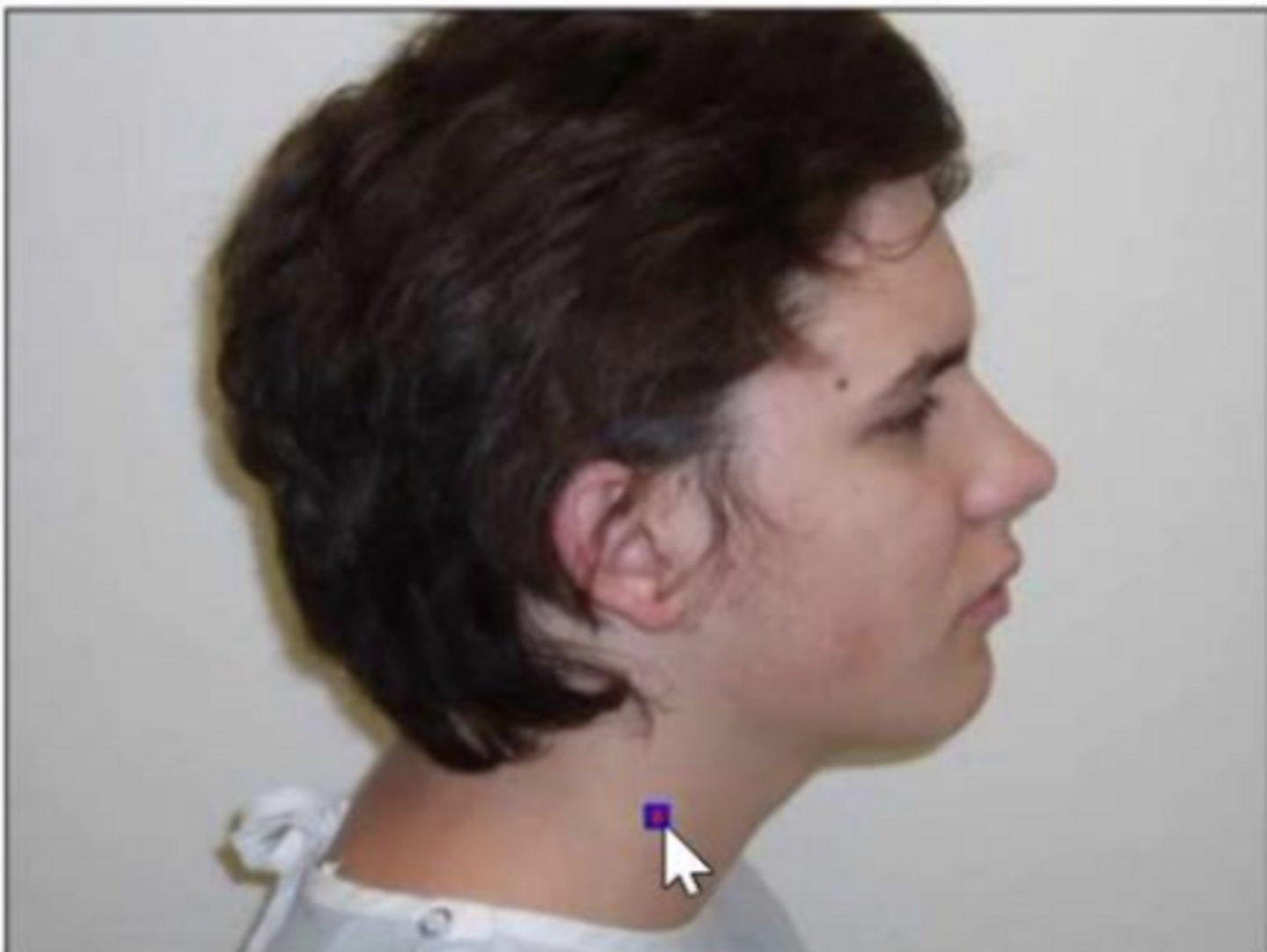
The nurse continues a neurologic assessment of the cranial nerve XI (spinal accessory) for a client as seen in the picture. Which instruction should the nurse give the client to complete this assessment?
shrug shoulders against resistance
When entering a client's room, the nurse observes that the client is in a tripod position. What action should the nurse take?
observe for signs of respiratory distress
Which method is best for the nurse to use in determining early development of ascites?
successive measurements of abdominal girth