Health Year 10 Revision Semester 1 Exam
 Call Kai
 Learn
Learn Practice Test
 Spaced Repetition
 Match
Match Flashcards
 Knowt Play
1/107

There's no tags or description
Looks like no tags are added yet.
Name | Mastery | Learn | Test | Matching | Spaced | Call with Kai |
|---|
No analytics yet
Send a link to your students to track their progress
108 Terms
Macronutrients
Needed and consumed in larger amounts (MACRO)
Micronutrients
Needed and consumed in smaller amounts (MICRO)
Types of Macronutrients
-Carbohydrates
-Fats
-Protein
Types of Micronutrients
-Vitamins
-Minerals
Water
Technically not a nutrient but required in larger amounts
Carbohydrates
-Provides us with fuel (glucose) for energy (kj)
-Source of dietary fibre
Carbohydrates types
-Starchy (low GI)- cereal, bread
-Sugary (high GI)- soft drinks, lollies
Glycaemic Index (GI)
The glycaemic index is a ranking of carbohydrates on a scale of 0 and 100
This scale describes how quickly the carbohydrate is digested (broken down) and absorbed into the blood.
Low GI = 55 or less
(Starchy Carbohydrates) Slow absorption, keeping us feeling ‘full’ for longer.
Medium GI = 55 – 69
(Starchy Carbohydrates)
High GI = 70 +
(Sugary carbohydrates) Fast absorption, making us hungrier sooner and therefore consume more food = more calories (KJ)
Fibre
Fibre is a type of carbohydrate
Benefits of eating fibre
Produces feelings of fullness by slowing down glucose absorption.
Reduces the amount of cholesterol absorbed by the body which reduces the risk of cardiovascular disease.
Fibre absorbs water which adds bulk to faeces and assists in regular waste removal which decreases risk of colorectal cancer.
Food Sources with Fibre
Bran
Wholemeal bread
Grains and seeds
Fruit and vegetable
Fats
Provide fuel for energy (KJ)
Provides cushioning for vital organs
Absorbs and transports the fat-soluble vitamins
Good fats
Monounsaturated
Polyunsaturated
Bad Fats
Saturated
Trans Fats
Good fats - Polyunsaturated and monounsaturated fats
Increases levels of good cholesterol (HDL) which assists with the removal of bad cholesterol (LDL) in the body.
Transports fat soluble nutrients around the body.
Bad fats – Saturated and trans fats
Have no use in the body.
Cause a build-up of bad cholesterol (LDL) which is stored in the circulatory system or as excess fat around internal organs.
Types of polyunsaturated fats
oily fish, like salmon, walnuts, seeds
Types of monounsaturated fats
olive oil, avacado, nuts
Types of saturated fats
fatty meats, full cream dairy
Types of trans fats
baked products, fried foods
Protein
Primary function is the growth, maintenance and repair of body cells
It is a third source of energy (KJ) in extreme circumstances. Only if carbohydrate and fat stores become depleted
Protein food sources
Fish, eggs, tofu
Minerals types
calcium and phosphate
Mineral function
Required for the building of bones and other hard tissues.
Minerals food source
Dairy products, salmon, soy products.
Vitamins
Regulates the absorption of calcium and phosphorus from the foods we eat.
Vital for bone development and strength, cell growth and maintaining a healthy immune system.
Vitamin Types
Vitamin D
Vitamin food sources
Found in fatty fish and fish liver oils.
Australian Guide to healthy eating
-Guide which visually represents the proportion of the five food groups recommended for consumption each day.
-The Australia Guide to Healthy Eating accompanies the Australian Dietary Guidelines.
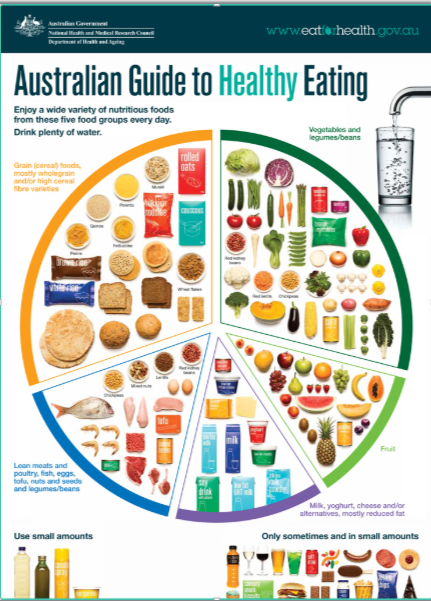
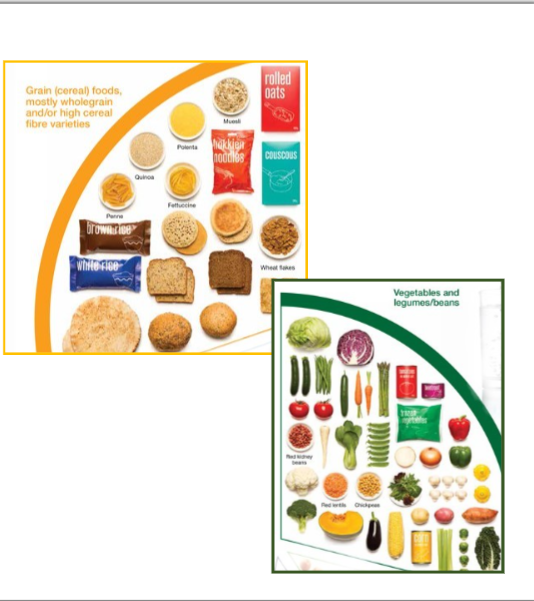
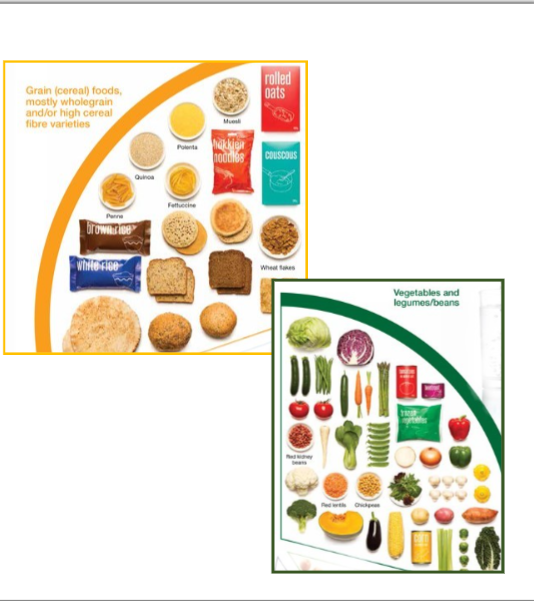
The main part of your daily diet should include these two sections.
They are high in CHOs.
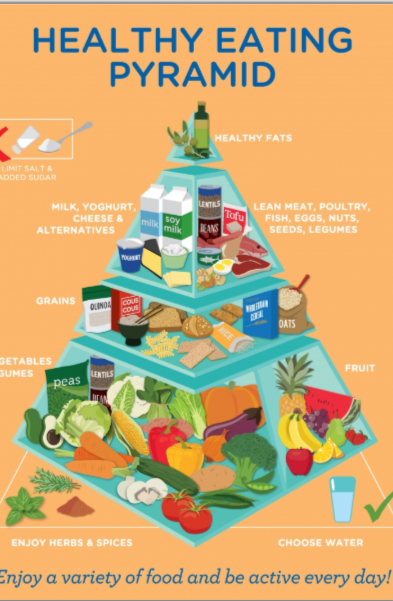
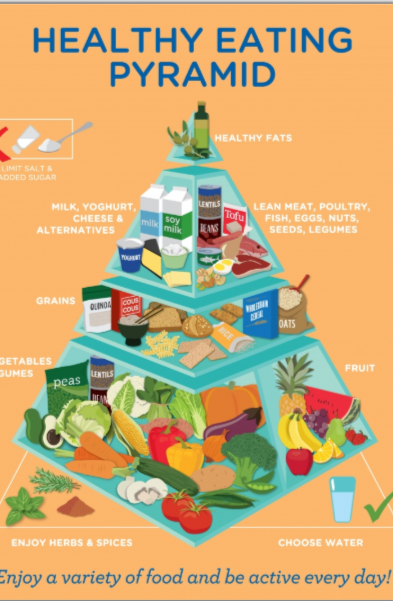
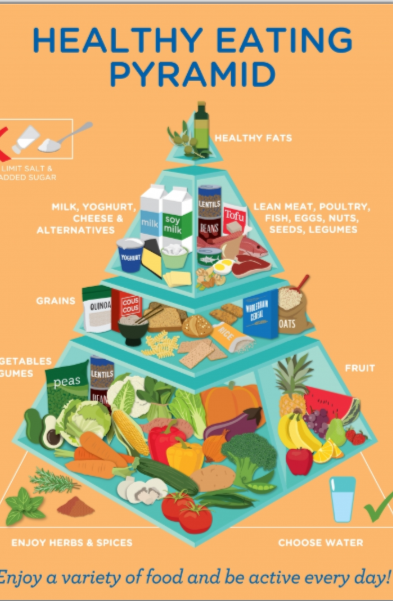
The Healthy Eating Pyramid
A simple visual guide to the types and proportion of food we should eat for good health
The foundation layer makes up of what we should eat most, plant foods
Cooking your own meals will help reduce salt and sugar
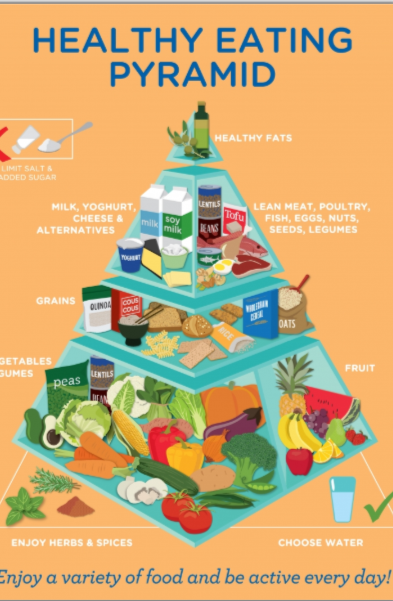
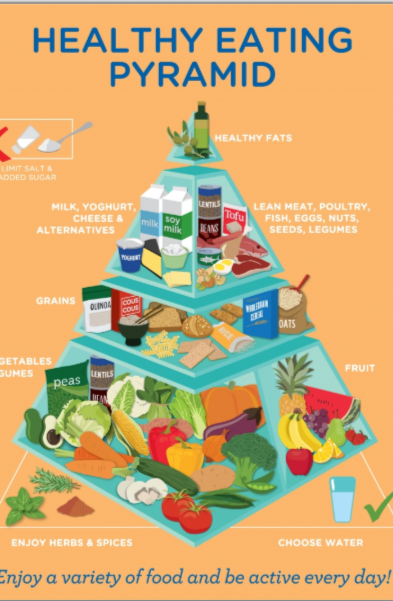
Foundation layers of the Pyramid (first 2)
The foundation layers include the three plant-based food groups:
vegetables and legumes
fruits
grains
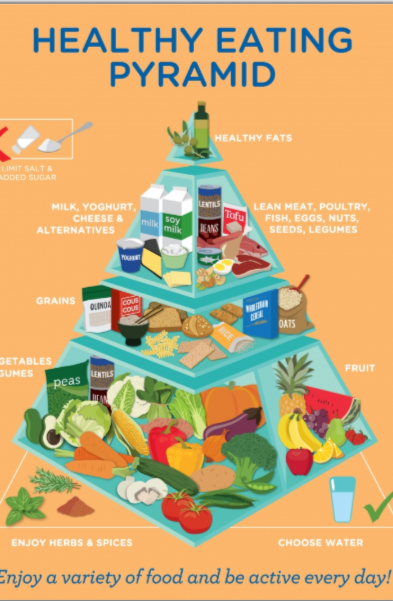
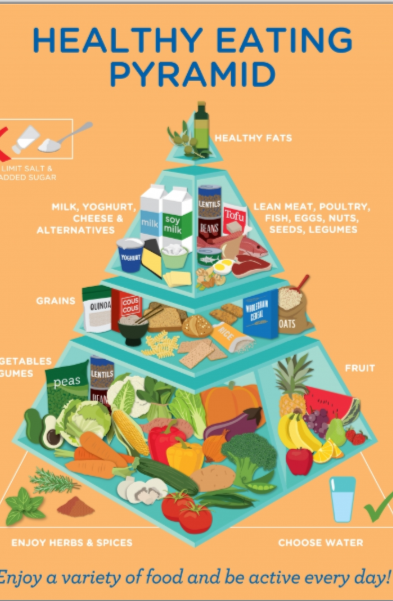
The middle layer of the pyramid
The middle layer includes the milk, yoghurt, cheese & alternatives and the lean meat, poultry, fish, eggs, nuts, seeds, legumes food groups. These are primarily proteins.
The top layer of the pyramid
The top layer represents healthy fats, which we need in small daily amounts to support heart and brain function. It recommends choosing foods with healthy fats over those high in saturated and trans fats.
Additional messages of the pyramid
Enjoy herbs and spices
Herbs and spices provide a range of flavours, aromas and colour to our food without added salt or sugar.
Choose water
Choose water as your main drink to avoid sugary options, hydrate and support essential functions in the body.
Limit salt and added sugar
Limit our intake of salt and added sugar to reduce blood pressure, the risk of CVD and unrequired energy intake.
Positives of AGHE and HEP
They are visual so can be easily understood by all ages and cultural groups
Covers food from all food groups
Variety of foods cater for cultural differences
Negatives of AGHE and HEP
Not all foods are shown, so people may not be able to place foods on the models
Doesn’t include composite foods. Eg, fruit pie
Doesn’t show serving sizes.
Health Star Rating
The Health Star Rating is a front-of-pack system that rates packaged foods from ½ to 5 stars based on their nutritional profile and recommended daily intake, with more stars indicating a healthier choice and helping consumers easily compare similar foods.
Barrier to bring about dietary change
Time constraints and convenience
Food marketing
Willpower
Personal preference
Health status
‘An individual’s or population’s overall level of health, taking into account various aspects such as life expectancy, amount of disability, levels of disease risk factors’
Health indicators
‘Standard statistics that are used to measure and compare health status (e.g. life expectancy, mortality and morbidity rates)
Life expectancy
An indication of how long a person can expect to live, it is the number of years of life remaining to a person at a particular age if death rates do not change.
Mortality
refers to death, particularly at a population level
Morbidity
Refers to ill health in an individual and the levels of ill health in a population or group.
Incidence and Prevalence
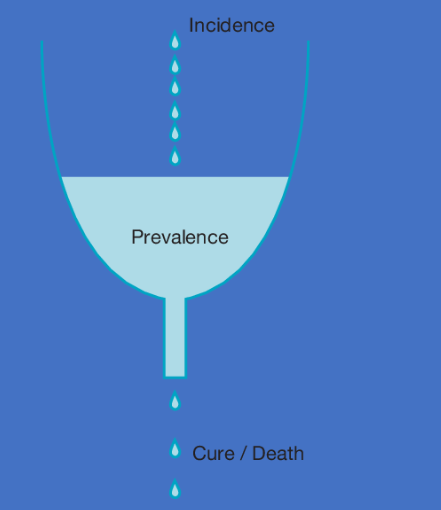
Both measure morbidity.
Incidence refers to the number of new cases of a condition in a given period.
Prevalence refers to the total number of cases of a condition in a population in a given time.
Diet related illnesses
These occur from too much or too little of particular nutrients Type 2 Diabetes, Osteoporosis, Cardiovascular Disease (CVD)
Type 2 diabetes in terms of incidence
High intake of sugar means body can not regulate glucose; this means there is an increase in the body’s insulin resilience Increasing incidence of diabetes.
Type 2 diabetes in terms of morbidity
High intake of sugar means body can not regulate glucose; this means there is an increase in the body’s insulin resilience. Increasing morbidity of diabetes.
Cardiovascular disease in terms of mortality
High intake of fat can lead to an increase in cholesterol due to LDL (bad fats) not being removed by HDL (good fats). This increases the risk of heart disease, increasing mortality due to heart attack.
Cardiovascular disease in terms of life expectancy
High intake of fat can lead to an increase in cholesterol due to LDL (bad fats) not being removed by HDL (good fats). This increases risk of heart disease, decreasing life expectancy due to heart attack.
What leads to Type 2 Diabetes
High intake of sugar
What leads to osteoporosis
Underconsumption of dairy foods
What leads to cardiovascular disease
High intake of fat
Osteoporosis in terms of morbidity
Osteoporosis – Underconsumption of dairy leads to decrease in calcium intake this means there is an increased risk of injury, increasing morbidity of broken bones.
Osteoporosis in terms of incedence
Underconsumption of dairy leads to decrease in calcium intake this means there is an increased risk of injury, increasing incidence of broken bones.
Physical Health and Wellbeing
Relates to the functioning of the body and its systems; it includes the physical capacity to perform daily activities and tasks.
Emotional Health and Wellbeing
The ability to recognise, understand and effectively manage and express emotions as well as the ability to display resilience.
Mental Health and Wellbeing
The state of a person’s mind or brain and the ability to think and process information. Enables an individual to positively form opinions, make decisions and use logic.
Spiritual Health and Wellbeing
The ability to form meaningful and satisfying relationships with others and the ability to manage or adapt appropriately to different social situations.
Characteristics of Physical Health and Wellbeing
-Energy Levels
-Body Weight
-Absence of Illness and Diseases
Characteristics of Mental Health and Wellbeing
-High Levels of Confidence
-Positive Thought Patterns
-Low Levels of Stress and Anxiety
Characteristics of Social Health and Wellbeing
-Supportive and well-functioning family
-Supportive network of friends
-Effective communication with others
Characteristics of Spiritual Health and Wellbeing
-Having a sense of belonging
-Have a sense of meaning and purpose in life
-Acting according to values and beliefs
Characteristics of Emotional Health and Wellbeing
-Experience appropriate emotions in a given scenario
-Adequately respond to and manage emotions
-Possess the ability to recover from misfortune


Life Expectancy
An indication of how long a person can expect to live, it is the number of years of life remaining to a person at a particular age if death rates do not change.
Mortality
Refers to death, particularly at a population level.
Morbidity
Refers to ill health in an individual and the levels of ill health in a population or group.
Incidence
Incidence refers to the number of new cases of a condition in a given period.
Prevalence
Prevalence refers to the total number of cases of a condition in a population in a given time.
Legal Drugs
Drugs can be legal if they are regulated and there are laws controlling the availability of them.
Illegal/Illicit Drugs
Illegal or illicit drugs are unregulated (have no price or quality controls) and therefore can be more dangerous than legal drugs.
Drug Offences
Possession (personal use)
Supplying (dealing to others)
Manufacturing and trafficking (making and distributing)
Drug Consequences
The punishment for these charges range from a warning, community service, good behaviour bond, small to large fines, to prison sentences.
The consequences depends on the severity of the crime (i.e. less for possession and harsher for trafficking), and the individual’s criminal history.
Stimulants
Stimulants act on the central nervous system, speeding up messages to and from the brain.
Eg. Cocaine and Nicotine
Stimulant Long-Term Effects
Mental Health Issues
Suspectible to cold and flu
Insomnia and exhaustion
Stimulant Short-Term Effects
Reduced appetite
Jaw clenching and teeth grinding
Feeling alert, energetic and confident
Depressants
Depressants slow down the functioning of the central nervous system.
Eg. Alcohol and Heroin
Short-Term Effects of Depressants
Slowed heart rate and breathing
Loss of concentration and confusion
Decreased reaction time
Long Term Effects of Depressants
Mental health issues
Poor working memory
Increased tolerance and dependence
Hallucinogens
A drug that causes hallucinations or distorts reality, often called a “trip”.
Eg. Marijuana and LSD
Short Term Effects of Hallucinogens
Relaxed and sensitive to emotions
Feeling of euphoria
Anxious and fearful, paranoia
Long-Term Effects of Hallucinogens
Possible flashbacks of a “trip”
Risks of Drug Use
Dependence
Mixing drugs can mask the harmful effects of each drug
Overdose
An overdose occurs when a person has an adverse reaction to the drug.
Factors that can cause an overdose:
Consuming too much of the drug
Impurities in the drug (what it has been “cut” with)
Mixing drugs, e.g. alcohol and ecstasy, which masks the effects of each drug
The body is not use to taking a certain drug
Signs and Symptoms of an overdose
Dizziness/loss of balance
Drowsiness
Managing an overdose
Stay Calm
Reassure
Seek aid
What do trends answer?
Who?
What?
When?
Direction?
Data?
WWWDD
Data
Use approximately/approx to illustrate the data
Drug Offences Consequences
The punishment for these charges range from a warning, community service, good behaviour bond, small to large fines, to prison sentences.
The consequences depends on the severity of the crime (i.e. less for possession and harsher for trafficking), and the individual’s criminal history.
How much alcohol is in a standard drink?
One standard drink contains 10g of pure alcohol
The legal BAC (Blood Alcohol Content) level in Australia
0.05
Males Responsible Drinking Rates
2 standard drinks in the first hour & no more than 1 standard drink for every hour after
Females Responsible Drinking Rates
1 standard drink in the first hour & no more than 1 standard drink for every hour after
Drinking Harm Minimisation
Keep count of your standard drinks
Know your limits
Have a glass of water between drinks
Consequences for underage drinking
Drinking underage - fine of $1000
Supplying a minor – fine of $19,000