memory
 Call Kai
 Learn
Learn Practice Test
 Spaced Repetition
 Match
Match Flashcards
 Knowt Play
1/58

There's no tags or description
Looks like no tags are added yet.
Name | Mastery | Learn | Test | Matching | Spaced | Call with Kai |
|---|
No analytics yet
Send a link to your students to track their progress
59 Terms
what is memory
the process of retaining information over time
what is encoding
the process of transforming sensory information so that it can be stored in memory
what is storage
the process of maintaining information in our minds
what is retrieval
the process of taking information out of memory storage
explain recall as a type of retrieval
when we reaccess a whole memory without aid
explain recognition as a type of retrieval
when we encounter information that we identify as something we have already learned
what does coding mean
the format in which memory is stored
what does semantic coding mean
storing memory according to meaning
features of the sensory register
large capacity, duration of less than a second, sensory coding
features of short term memory stores
capacity of 7±2 items, 18-30s duration, acoustic coding
features of long term memory store
potentially unlimited duration and capacity, coded semantically
who proposed the multi store model of memory
atkinson and shiffrin
what did atkinson and shiffrin argue about memory
it’s unidirectional and each store can be damaged independently
explain or draw out the MSM
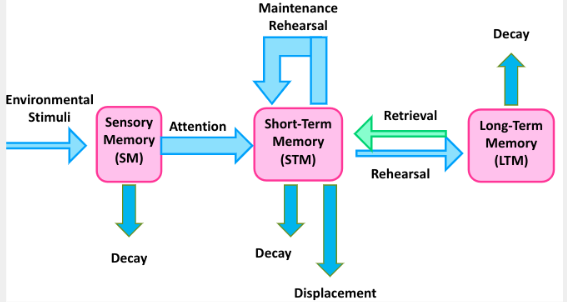
research support of Sensory Register
SPERLING
presented participants with grid of letters for 50 milliseconds and tested their recall
in condition 1 they were asked to recall as much of the grid as possible
in condition 2 they were asked to recall one row (specified afterwards)
C1 - average of 5. C2 - average of 3
concluded duration is short but capacity is large
research support for capacity of short term memory
JACOBS
asked participants to recall strings of letters/ numbers of different lengths
found average of 7 items were recalled
MILLER
replicated expect he used ‘chunking’
average increased slightly to 7±2 items
evidence for duration of long term memory
BAHRICK
studied weather participants would remember the names of their high school classmates
tested both recall and recognition
15 years after school recall was around 60% and recognition was 90%
48 years after school recall was around 30% and recognition was 80%
concluded ltm very long duration but better when using recognition
evaluate Bahicks research
high ecological validity because participants were asked to recall things from their own personal lives
since he was testing recall of things years before he couldn't control extraneous variables
research support for coding in STM and LTM
BADDELEY
four different groups where he asked participants to remember either semantically similar, semantically dissimilar, acoustically similar and acoustically dissimilar words
found participants recalling acoustically similar words had the most difficulty recalling them immediately after
20 minutes later participants recalling semantically similar words had more difficulty
concluded stm is coded acoustically and ltm is coded semantically
support for multi-store model of memory
CASE STUDY: HENRY MOLAISON
hippocampus was removed
Long-term memory store was damaged
short term memory store was intact and functional
supports the idea we have separate stores for memory
BRAIN IMAGES
different parts of the brain are active when we retain information for short and long periods of time
the frontal cortex is active when retaining short term memory
the hippocampus is active when retaining long-term memory
evaluate multi store model of memory
says we use rehearsal to transfer information from short-term memory to long-term memory but there are things we remember without rehearsing including non verbal information
who proposed the working memory model
Baddeley and Hitch
what do baddeley and hitch argue
STM is an active memory store which has multiple components
what does the phonological loop do
stores auditory/ verbal information and holds the order in which information is presented temporarily
what are the 2 subcomponents to the phonological loop
phonological store and articulatory process
what does the phonological store do
holds recent verbal and auditory information for a short duration (1-2s)
what does the articulatory process do
rehurses verbal information usually through subvocal repetition - capacity limited to the amount of words that can be said in 2 seconds. (easier to recall shorter words - word length effect)
what does the visuospatial sketchpad do
stores visual and spatial information as mental pictures
what are the 2 subcomponents of the visuospatial sketchpad
visual cache (stores visual info) and inner scribe (stores spatial and positional info)
what is the episodic buffer
a multi-modal store that combines information from all 5 senses to create a whole scene of an event. this can then be transferred to ltm to create episodic memories.
what is the central executive
manages activity of the 3 working memory stores and is responsible for directing relevant information to each store and dividing our attention across them.
research supporting WMM
KF CASE STUDY:
brain injury in motorcycle crash
only retain 1 word in stm (severely impaired verbal/ auditory short-term memory)
could retain photographs normally in stm
supports idea of multiple stm stores
his ltm could still function
GATHERCOLE AND BADDELEY:
group 1 had to perform one verbal task one visual
group 2 had to perform both visual
group 1 did better
concludes separate working memory stores for visual and verbal info
BRAIN IMAGING:
temporal lobe active for verbal info
occipital lobe active for visual info
concludes separate working memory stores for visual and verbal info
evaluate WMM of memory
existence central executive is not falsifiable
central executive may be made out of multiple independent cognitive processes (planning, attention and response inhibition)
evidence in favour of WMM are conducted in labs
what is the interference theory of forgetting
when we accidentally retrieve a similar memory instead of the intended original memory
explain P.O.R.N.
proactive interference is when an old memory is retrieved instead. retroactive interference is when new memories are retrieved instead.
explain cue dependant forgetting theory
suggests we rely on prompts we associate with a particular memory to trigger the original memory
external vs internal cues
external cues are features of the environment at the time when we encode a memory (eg. smell and weather) internal cues are features of our internal environment at the time of encoding (eg. thoughts and mood)
context dependent forgetting vs state dependant forgetting
CDF occurs when a person is unable to retrieve a memory because the external environment the memory was encoded in differs from the environment the memory needs to be retrieved in. SDF occurs when a person is unable to retrieve a memory because their internal state at the time of encoding differs from their internal state the memory needs to be retrieved in
research support for interference theory
UNDERWOOD
looked at participants recall of word lists
control group - one word list. experimental group - multiple word lists and asked to recall the last
CG - 80% accurate. EG- 20%
concluded we forget due to proactive interference
UNDERWOOD AND POSTMAN
gave participants word pairs
CG - one list of word pairs. EG - two lists with same first words, asked to recall first
recall of the control group was much better
concluded we forget due to retroactive interference
evaluate interference theory
supporting studies are laboratory
only explains forgetting in the presence of similar memories
research supporting cue dependant forgetting
GODDEN AND BADDELEY
tested effect of external cues on retrieval
made 2 groups of participants learn word lists underwater and on land
the recall of word lists were tested either in the same or different environment they learnt in
participants recall was better when in the same context
evaluate cue dependant forgetting
studies supporting lack ecological validity
cue dependant forgetting is less relevant to procedural memories
what 4 things can create false memories
schema
post-event discussion
leading question
anxiety
what are false memories
when we retrieve a memory and reconstruct it into an event that did not actually happen
what 4 things influence false memories
schema
leading questions
post event discussion
anxiety
explain schemas creating false memories
we use our pre existing schema to help fill in the gaps of a memory, this can lead to incorrectly modifying memories to fit our schema
explain anxiety creating false memories
low arousal/ anxiety results in low accuracy
moderate arousal/ anxiety results in high accuracy
high arousal/ anxiety results in low accuracy
this on a graph would show an inverse u shape
research for leading questions affecting EWT
LOFTUS AND PALMER:
showed participants a video of car crash
asked some participants leading questions about the way the car crashed (using words like smashed)
participants judged the cars to be moving way quicker than they were
week later participants were asked a leading question about broken glass
participants had a false memory of seeing broken glass
concluded EWT can be influenced by leading questions
evaluate loftus and palmer
demand characteristics
lacked ecological validity
research for anxiety affecting EWT
LOFTUS (1979):
participants heard arguing in one room and then a man stormed out
in one condition the man was holding a pen covered in grease (low anxiety)
in another condition the man was holding a knife covered in blood (high anxiety)
when asked to identify the man low anxiety group was 49% accurate
when asked to identify the man high anxiety group was 33% accurate
YUILLE AND CUTSHALL:
investigated memory accuracy of real life witnesses of gun shooting 5 months prior
recall was accurate
findings didn’t support inverted u-turn
what is the cognitive interview
a type of interview process proposed by Fisher et al aimed to improve the memory recall of EWT
what are the 4 components of the cognitive interview
change perspective
change order
report everything
mental reinstatement
What is Report Everything in the Cognitive Interview
The witness is encouraged to report every detail, even if it seems unimportant or irrelevant. Small details can trigger more accurate memories and may be important to the investigation.
What is mental reinstate the Context in the Cognitive Interview
The witness mentally recreates the original environment and emotional state of the event. This is based on context-dependent forgetting and helps improve recall.
What is Reverse the Order in the Cognitive Interview
The witness recalls the event in a different chronological order. This prevents reliance on expectations or schemas and increases accuracy.
What is Change Perspective in the Cognitive Interview?
The witness recalls the event from another person’s perspective. This can access different retrieval cues and uncover additional details.
research for cognitive interview
GEISELMAN:
a confederate with a blue rucksack entered a classroom and stole a projector
used the cognitive interview with one group when questioning who stole is
used leading questions on both groups, suggesting the bag was green
group the cognitive interview was less affected by leading questions
evaluate the cognitive interview
less effective interviewing children - introduced the enhanced cognitive interview
what is meant by the F-scale?
a questionnaire developed by Adorno developed as a way of measuring authoritarian personality theory.