Hell World: Term 1 Week 8: Hellenistic Athens
 Call Kai
 Learn
Learn Practice Test
 Spaced Repetition
 Match
Match Flashcards
 Knowt Play
1/34

There's no tags or description
Looks like no tags are added yet.
Name | Mastery | Learn | Test | Matching | Spaced | Call with Kai | Chat |
|---|
No analytics yet
Send a link to your students to track their progress
35 Terms
What are the key events in Hellenistic Athens?
324/3 Harpalus Affair
323–322 Lamian War and Death of Demosthenes
317–307 Rule of Demetrios of Phaleron
307–301 Demetrios I Poliorcetes controls Athens
297–295 Tyranny of Lachares
294–288 Demetrios I Poliorcetes controls Athens
267–262/1 Chremonidean War
262/61–229 Antigonid rule
229–200 Athens free of Macedonian control
200–197 Second Macedonian War
171–168 Third Macedonian War
167/66 Athens takes control of Delos
146 Battle of Corinth and Roman annexation of Greece
86 Sullan destruction
31 Battle of Actium
What was the battle that led to Athens becoming part of the Macedonian Kingdom?
The battle that lead to Athens becoming part of the Macedonian kingdom- the Battle of Chyroneah 338
What occurred just before the death of Alexander?
Just before the death of Alexander there was a fairly dramatic event that involved a treasurer of Alexander named Harpalus who fled with 5000 talons from the treasury and he went to Athens where he had political connections. Demosthenes got tied up in this affair as he received money from Harpalus
Explain the Lamian War?
Upon the death of Alexander, Athens revolts from Macedonian rule with alliance of Greek cities (excluding Sparta).
Initial successes made under the general Leosthenes (picked by the Athenians), initially he is able to march through Thermopoli and win a series of battles and eventually Antipater besieged in Lamia but Leosthenes is killed during the siege by a sling bullet. New strategos, Antiphilos, has to lift siege to battle a relief army led by Leonnatus defeated in spring 322 BCE.
Major setbacks followed in spring/summer 322 BCE, with the arrival of a large navy lead by Cleitus and a land army led by Craterus.
Major defeats by sea at the Battle of Amorgos and by land at the Battle of Crannon in late summer/fall proved decisive and the Athenian army and their allies were defeated.
Explain the death of Hypereides and Demosthenes
Hypereides and Demosthenes fled into exile and then committed suicide, these deaths of two public statemen was a bit critical turning point in the early Hellenistic state of Athens
Write out what Plutarch wrote on the death of Demosthenes
Plutarch, Life of Demosthenes 28.1–29.4:
“Since they dispersed themselves to different places, Antipater sent his soldiers about to arrest them, under the command of Archias the so-called Exile-hunter…This Archias, then, finding that Hypereides the orator and Aristonicus of Marathon and Himeraeus the brother of Demetrius the Phalerean had taken refuge in the sanctuary of Aeacus at Aegina, haled them away and sent them to Antipater at Cleonae. There they were put to death, and Hypereides, it is said, also had his tongue cut out… Moreover, on learning that Demosthenes had taken sanctuary in the temple of Poseidon at Calauria, Archias sailed across to the island in small boats, and after landing with Thracian spear-men tried to persuade the fugitive to leave the temple and go with him to Antipater, assuring him that he would suffer no harsh treatment…And when Archias began to threaten him angrily, ‘Now,’ said he, ‘thou utterest the language of the Macedonian oracle; but a moment ago thou were acting a part. Wait a little, then, that I may write a message to my family.’ With these words, he retired into the temple, and taking a scroll, as if about to write, he put his pen to his mouth and bit it, as he was wont to do when thinking what he should write, and kept it there some time, then covered and bent his head. The spear-men, then, who stood at the door, laughed at him for playing the coward, and called him weak and unmanly, but Archias came up and urged him to rise, and reiterating the same speeches as before, promised him a reconciliation with Antipater. But Demosthenes, now conscious that the poison was affecting and overpowering him, uncovered his head…”
Who wanted to end democracy in Athens?
Antipater takes measure to end radical democracy (the democracy where every male born citizen could vote and had equal possibility to partake in public life)
How did Antipater kill democracy?
Antipater got rid of this by introducing a minimum welathr acquirement to become a citizen of Athens, they must have 2000 drachma to be a citizen
Overnight a huge portion of the Athenian citizen body lost their position due to this- possibly 12,000 men were disenfranchised
What did Antipater allow some of the men to do?
Antipater allowed some of these men to rellcoate to Thrace- politically motivated strategy to get these anti-macedonian democrats away from Athens, prevents the Athenians fromr evolting again
This was not very successful
Write out what Plutarch wrote about this:
Plutarch, Life of Phocion 28.4:
“Now, the garrison, owing to the influence of Menyllus, did no harm to the inhabitants; but the citizens who were deprived of their franchise because of their poverty numbered more than twelve thousand, and those of them who remained at home appeared to be suffering grievous and undeserved wrongs, while those who on this account forsook the city and migrated to Thrace, where Antipater furnished them with land and a city, were like men driven from a captured city”
What happens after Antipater dies?
Antiapter dies and he choses Demetrius osPhalerum to succeed him instea doff Cassander, this creates a lot of fighting and Cassander eventually comes to power. He eventually appoints Demetrius of Phalerum to become a ‘dictator of life’ in Athens
Who is Demeterius of Phalerum and what did he seek to do?
Ca. 350–280 BCE.
Appointed by Cassander to govern Athens from 317–307 BCE. A true philosopher king, Demetrius of Phalerum was a student of Theophrastus and Aristotle. He sought to improve Athens through an extensive legislative agenda aimed at curbing the influence of the wealthy. Appointed to extraordinary office of epimeletes/nomothetes in 317 (The Parian Marble B 13 (317/6): “Demetrius
enacted laws for the Athenians”) and served at archon in 309/308 BCE.
How did Demetrius aim to curb the influence of the wealthy?
One of the first reforms taken is to broader the democracy again (Demetrius), he shifts it to 1000 drachma not 2000. He also allows people who had moved away to come back to Athens- this earns him a lot of goodwill amongst the Athenian civic body
What role did he have in the city of Athens?
We are unsure what his political role int he city of Athens was because there are few inscriptions from this period that survived
Ancient sources written much later included word such as ‘law-giver’ and ‘care-taker’ to describe his position
Was Demetrius well liked and if so give an example of where
Yes:
Decree of Aixone honouring Demetrios of Phaleron, 316/15 BCE (IG II2 1201):
“Gods. Aristokrates son of Aristophanes proposed: since Demetrios son of Phanostratos of Phaleron is a goodman concerning the Athenian People and the deme of the Aixoneans, and when war broke out in the country and the Piraeus and the city were separated because of the war, having served as an envoy he reconciled the Athenians and restored unity and obtained peace for the Athenians and the country, and chosen as [epimeletes/nomothetes] by the Athenian People he established good [laws][in the interests of the city], and later . . .”
What are the sumptuary laws and who created them?
Demetrius created sumptuary laws, these laws deal with te regulation of lavish displays of wealth
What did Cicero write on these laws?
‘He, then, lessened extravagance not only by the provision of a penalty for it, but also by a rule in regard to the time of funerals; for he ordered that corpses should be buried before daybreak. But he also placed a limit upon newly erected monuments, providing that nothing should be built above the mound of earth except a small column no more than three cubits in height, or else a table or small basin;’- Cicero, on the laws 2.66
How was Demetrius viewed as a figure and give examples fromtexts of these opinions
Demetrius created sumptuary laws, these laws deal with te regulation of lavish displays of wealth
Diogenes Laertius, Life of Demetrius 5.75:
“He was a pupil of Theophrastus, but by his speeches in the Athenian assembly he held the chief power in the State for ten years and was decreed 360 bronze statues, most of them representing him either on horseback or else driving a chariot or a pair of horses. And these statues were completed in less than 300 days, so much was he esteemed.”
Athenaeus, The Deipnosophists 12.541G:
“And Demetrius Phalerum, as Duris says in the sixteenth volume of his Histories, being possessed of a revenue of twelve hundred talents a year, and spending a small portion of it on his soldiers, and on the necessary expenses of the state, squandered all the rest of it on gratifying his innate love of debauchery, having splendid banquets every day, and a great number of guests to feast with him. And in the prodigality of his expense in his entertainments, he outdid even the Macedonians, and, at the same time, in the elegance of them, he surpassed the Cyprians and Phoenicians. And perfumes were sprinkled over the ground, and many of the floors in the men's apartments were inlaid with flowers, and were exquisitely wrought in other ways by the artists. There were also secret meetings with women, and other scenes more shameful still. And Demetrius, who gave laws to others, and who regulated the lives of others, exhibited in his own life an utter contempt of all law. He also paid great attention to his personal appearance, and dyed the hair of his head with a yellow colour, and anointed his face with rouge, and smeared himself over with other unguents also; for he was anxious to appear agreeable and beautiful in the eyes of all whom he met.”
Identify this:
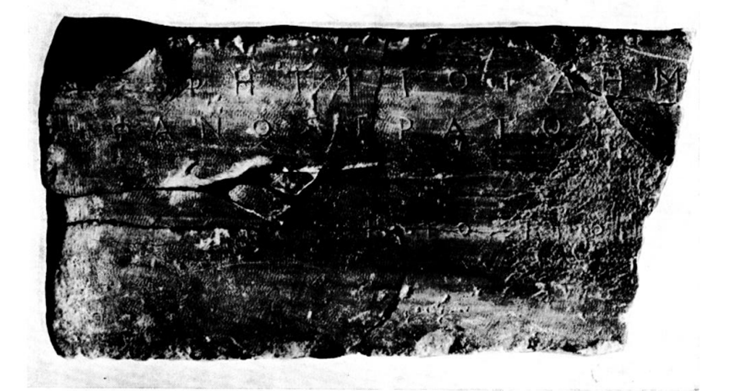
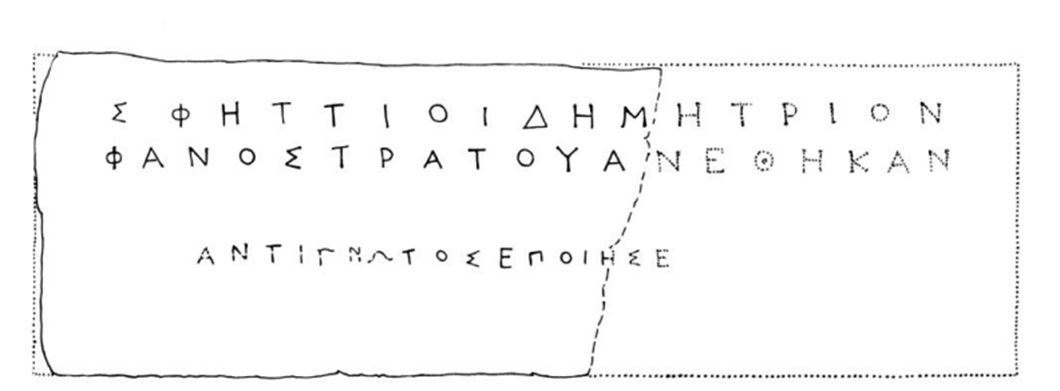
Statue of Demetrios of Phaleron dedicated by demesmen of Sphettos, ca. 315 BCE (SEG 25.206):
“The Sphettians dedicated (this statue of) Demetrios son of Phanostratos.
Antignotos made it.”
Notably, the size of the original base (0.79 x 1.24 x 0.245 m.) and cuttings indicate that it was an equestrian monument.
Give an example of a monument dedicated before the sumptuary laws
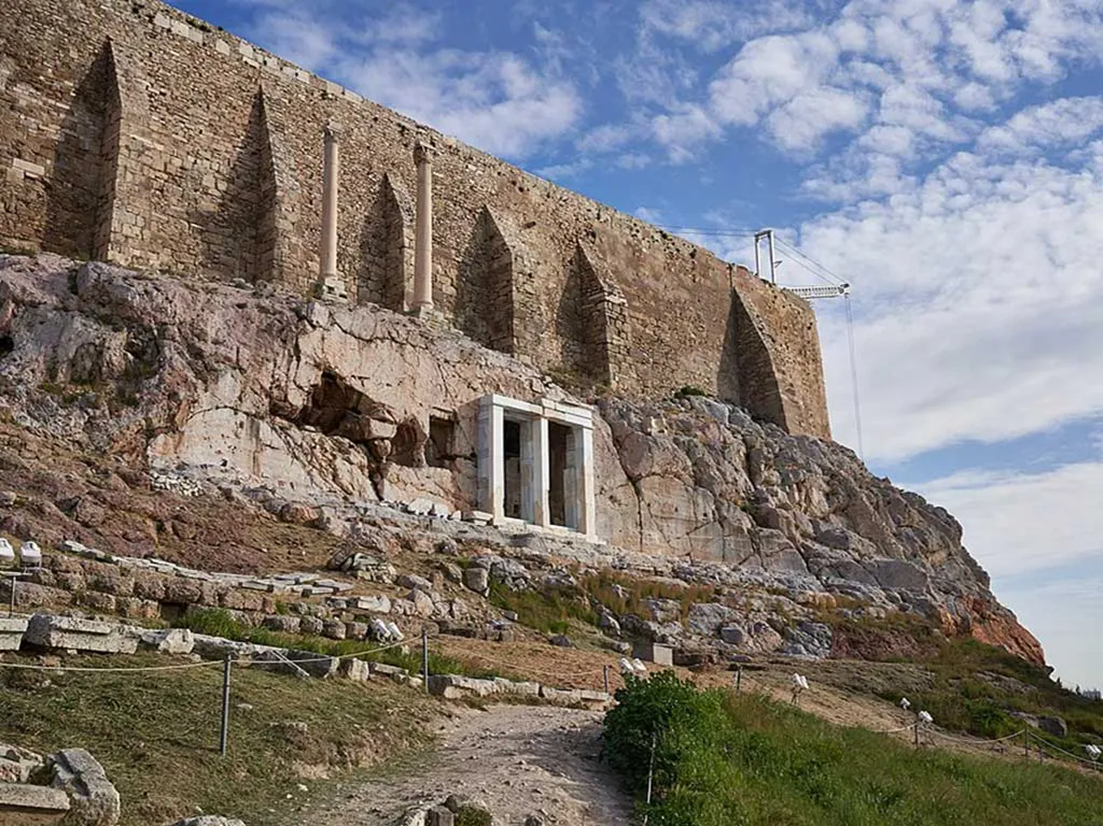
Thrasyllus Monument
320/319 BCE. Badly damaged in the Siege of the Acropolis in 1826–1827.
One of the last great choregic monuments of Athens before the anti-sumptuary laws introduced by Demetrius of Phalerum.
What happened to Demetrius of Phalaerum?
Demetrius of Phalerum is driven out of Athens by Demetrius Poliorecetes.
How does Demetrius Poliocretes portray himself?
Demetreius poliocretes portrays himself as the liberator of the Athenians (at least metaphorically)
They appears to have set up a number of public honours to him (specifically as the liberator of Athens)
Did this fond reputation of him survive?
This fond reputation did not survive- he apparently also started living a life of luxury and set up an apartment for himself in the Parthenon where he kept his lovers. Later on after the defeat of Philip 5th they got rid of Demetrius and all Macedonian kings- some evidence for this includes a dismantled bronze statue that was thrown down a well
Explain the Chremonidean war (who did the Athenians make an alliance with, was it successful, why do we know that it took place?)
Start of the third century BC, Athens tries to losen itself from the control of the Macedonian kings. Athens creates an alliance with Sparta- idea here is to bring together a great land power and a great sea power to defeat the \Macedonians
This wasn’t very successful- a major weakness for us as historians as we have no account of this war- we know it took place because of an inscription describing the alliance and some brief allusions to how it ended. We don’t know how long it took or what events took place during the war
Write out this inscription that we have
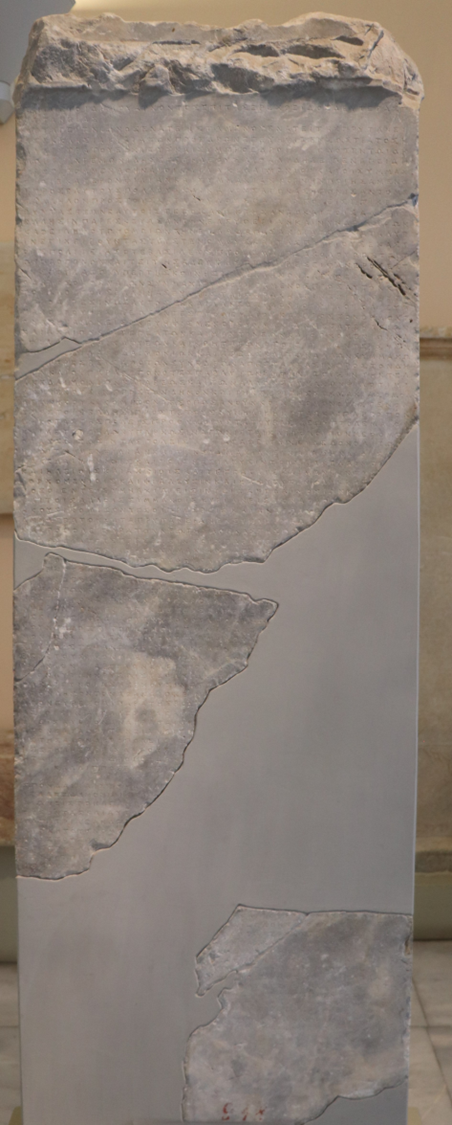
Alliance between Athens and Sparta (IG II3 1 912.7–44: 269/268 BCE):
“Chremonides son of Eteokles of Aithalidai proposed: since in earlier times the Athenians and Spartans and the allies of each made a common friendship and alliance with each other and contested many noble struggles alongside one another against those attempting to enslave their cities, from which they both obtained glory for themselves and won freedom for the other Greeks; and now when a similar emergency has gripped all of Greece because of those attempting the destuction of both the laws and the traditional constitutions of each, king Ptolemaios (Ptolemy II) in accordance with the predilection both of his ancestors and of his sister is manifest in his concern for the common freedom of the Greeks, the Athenian People having made an alliance with him and voted to encourage the rest of the Greeks to make the same choice, and in the same way the Spartans, being already friends and allies of king Ptolemaios and to the Athenian People, have voted for an alliance…in order, therefore, that, there being collective unanimity among the Greeks against those who now have wronged us and who have broken their truces with the cities, they might be enthusiastic champions with king Ptolemaios and each other, and for the rest of time might save the cities through their unanimity, for good fortune, the People shall decide…”
How were the Ptolemies involved in trying to free Athens from Macedonian control?
Ptolemaic garrison on the east coast of Attica.
Demonstrates a significant Ptolemaic investment in campaign to free Athens from Macedonian control.
Ultimately unsuccessful and Athens remains under Antigonid control until the outbreak of the Second Macedonian War (229 BCE).
What is the Dema wall and what role did it play in the Chremonidean War?
Dema Wall
Late 4th–early 3rd century BCE.
While the date of the construction is disputed, it is likely that the wall played an important role in the Chremonidean War, preventing the Spartan army from coming to the aid of the Ptolemaic and Athenian forces.
Who was there a close and lasting relationship between after this war?
A close and lasting relationship between Athens and the ptolemies, when Pausanias visited Athens in the second century Bc there are many monuments set up in honour of the ptolemies
Explain Athens and Delos (and Athens relationship with Rome)
Athens supports the Romans to gain their independence from the Macedonians. Perses is defeated by the Romans in 168BC
The Athenians asked to regain control over the island of Delos, they did gain control over this land and were able to widely export their products through the central medieterrean region- they export sculpture a lot (delos was a big port area)
This led to a lot of investment in Athens, wealthy Romans begin to dedicate monuments: part of a broader shift that sees Athens become a cultural power, it becomes essentially a college where young Romans would come to study at the philosophical schools
Identify and analyse this monument:
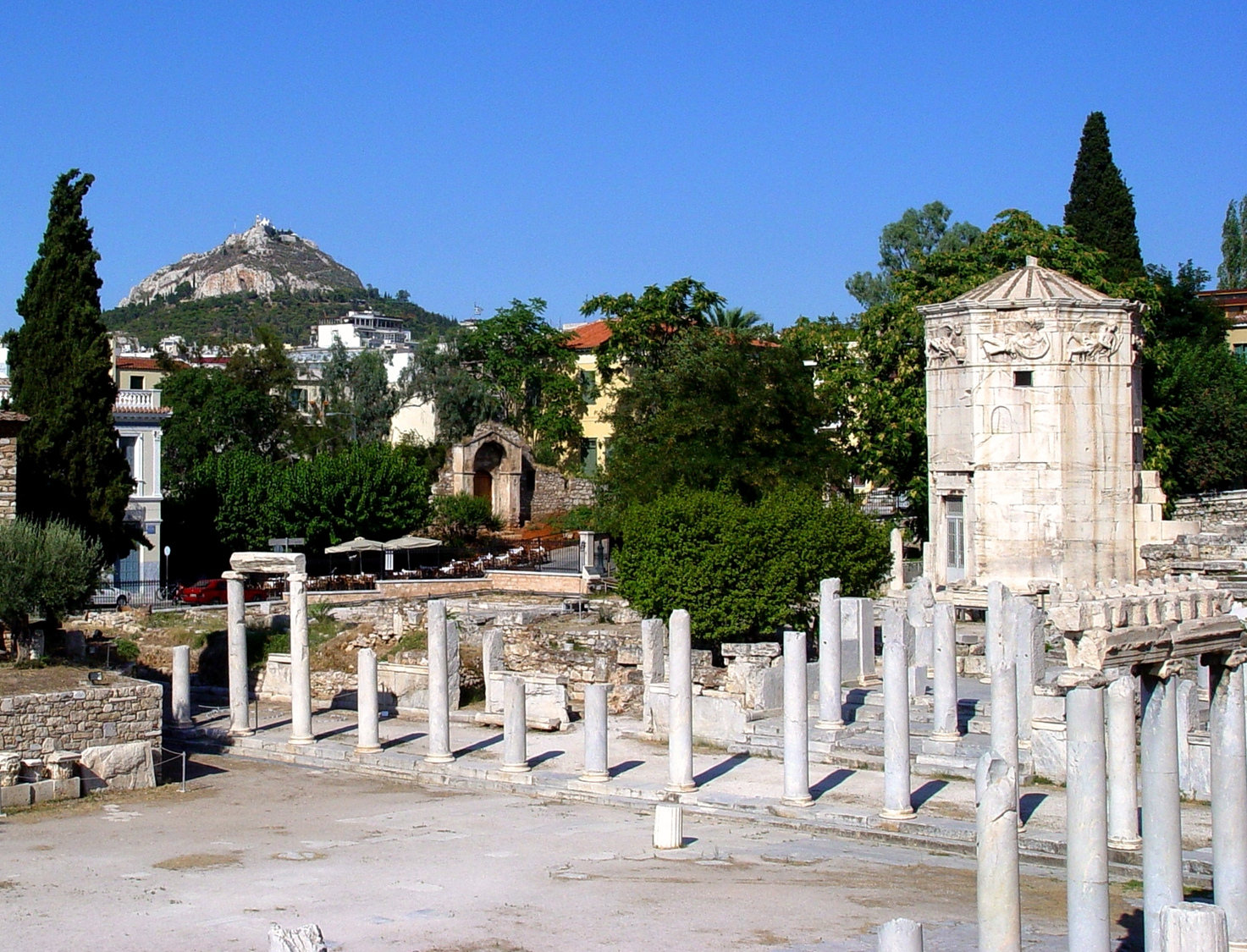
Tower of the Winds
AKA Horologion of Andronikos
2nd century BCE.
Choice of location may indicate the presence of a Hellenistic market in this area destroyed by Sulla?
One of the best-preserved structures from ancient Athens.
Innovative design product of scientific research: Ptolemaic benefaction?
What was the sullan destruction?
Sulla on his own initiative decided to punish the Athenians and allowed his men to sack and loot parts of the city, this caused a number of destruction depositis to form
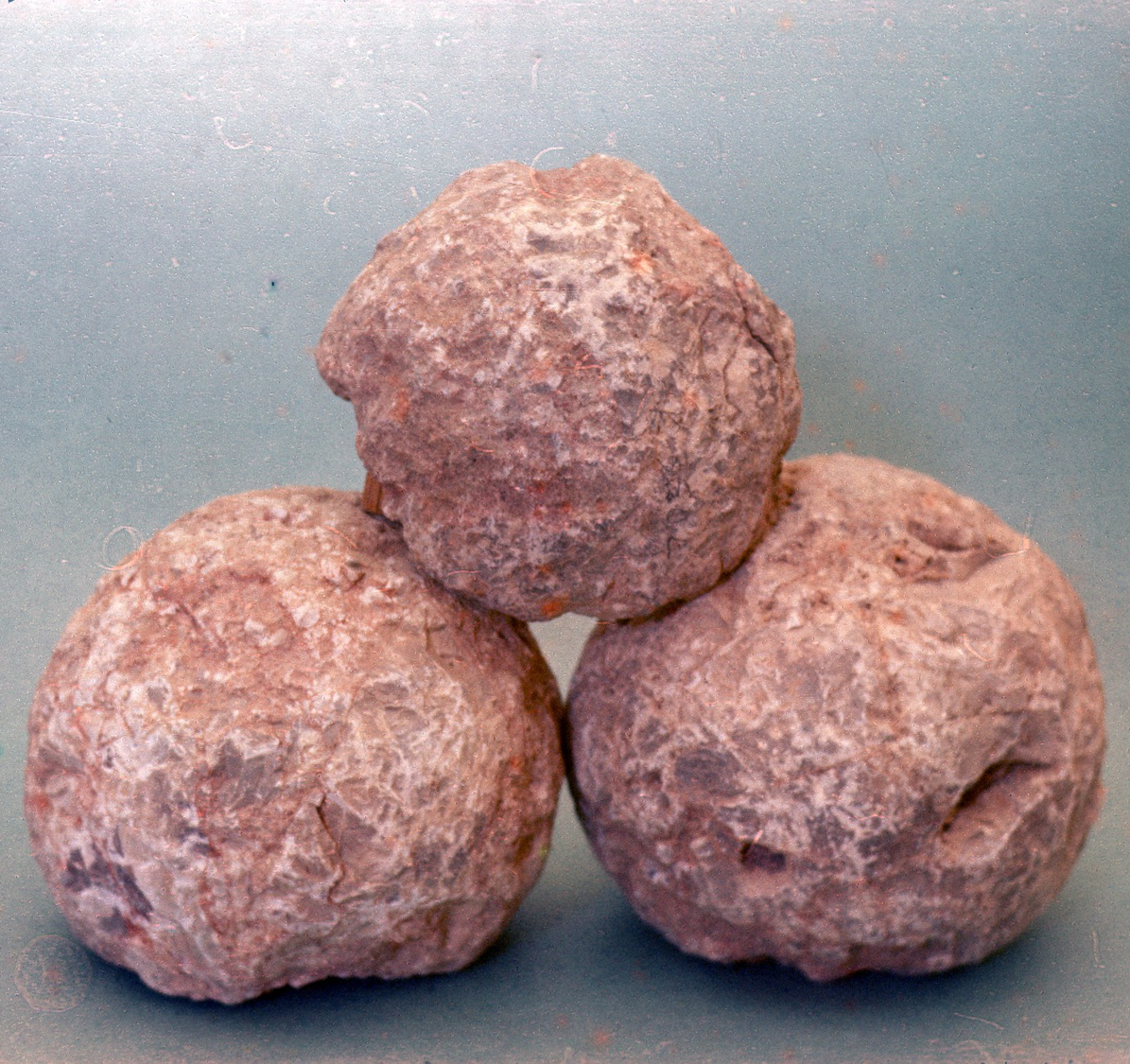
Remannats of some of the artillery the used to take the city e.g. small catapults (used for phycological warfare)
What evidence is found of the sullan destruction?
Catapult missiles found in the Athenian Agora
1st century BCE.
Only scattered evidence for the siege and destruction of Athens has been located, mainly at the points of entry into the city (around the Dipylon Gate) and in parts of the Athenian Agora.
Psychological warfare: These catapult balls may have been more to frighten the inhabitants and get them to capitulate rather than to inflict significant damage.
Identify these statues:
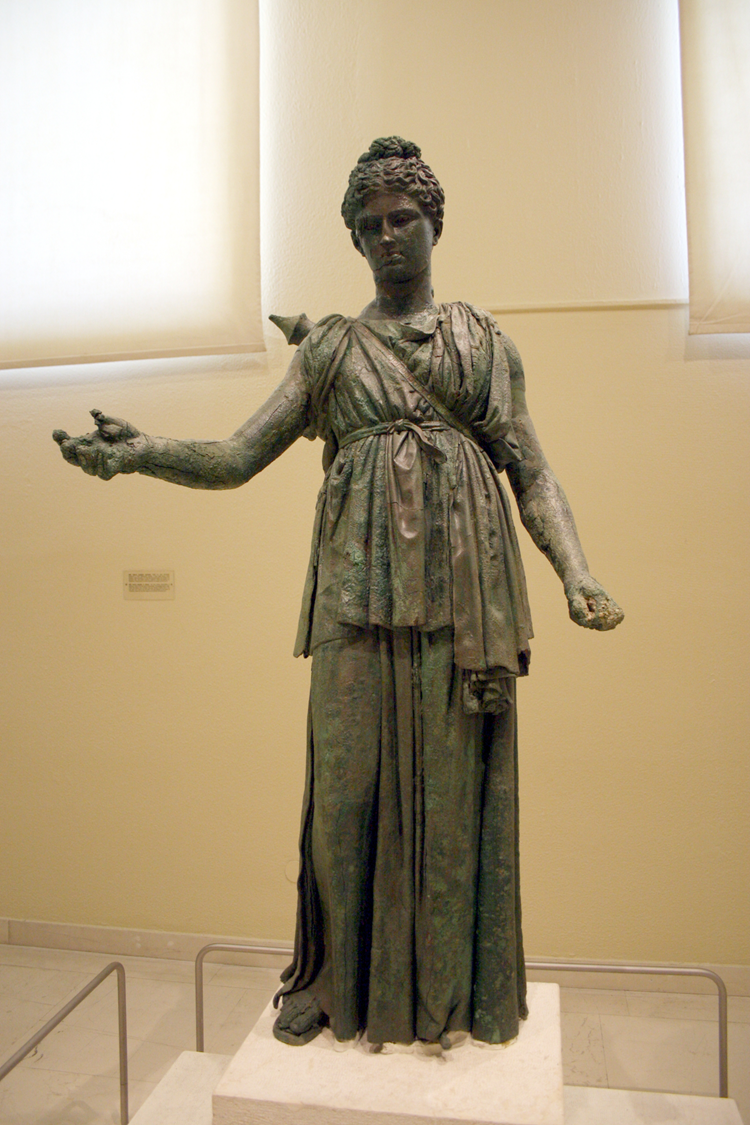
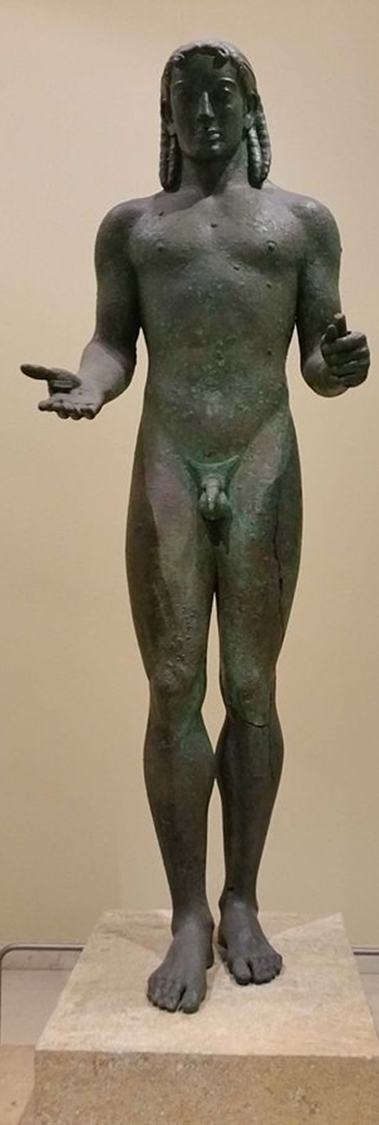
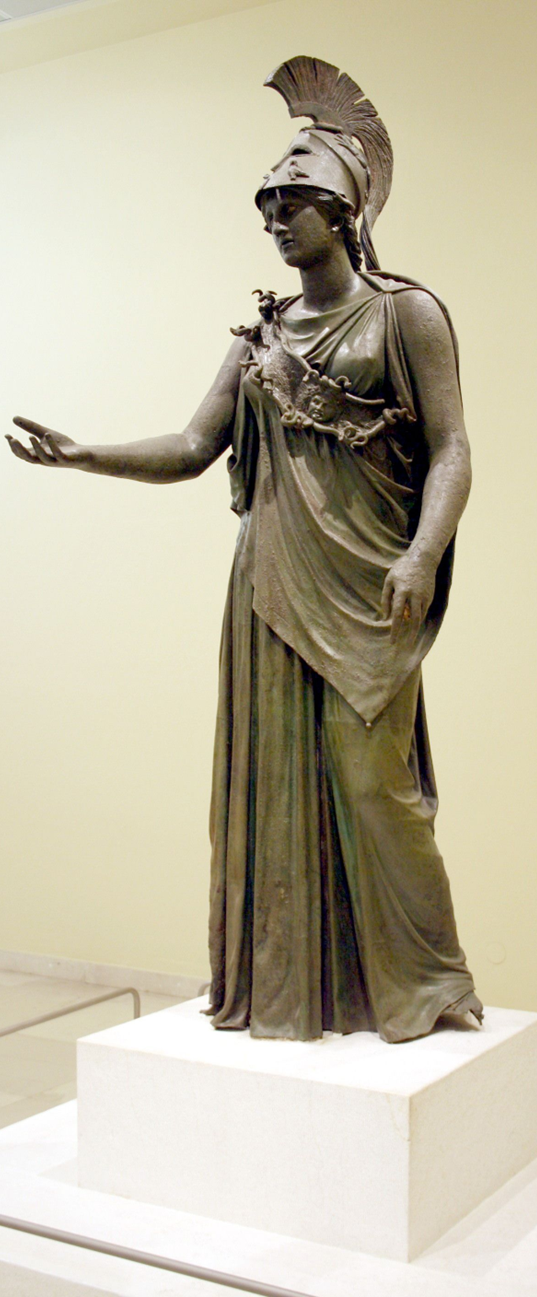
Piraeus Bronzes
Found in debris of Sullan sack in 86 BCE.
Originals prepared for shipment?
OR Neo-Attic products?
Kouros appears to have been repaired, perhaps suggesting that it is older?
Unending debate!
Identify and analyse this statue:
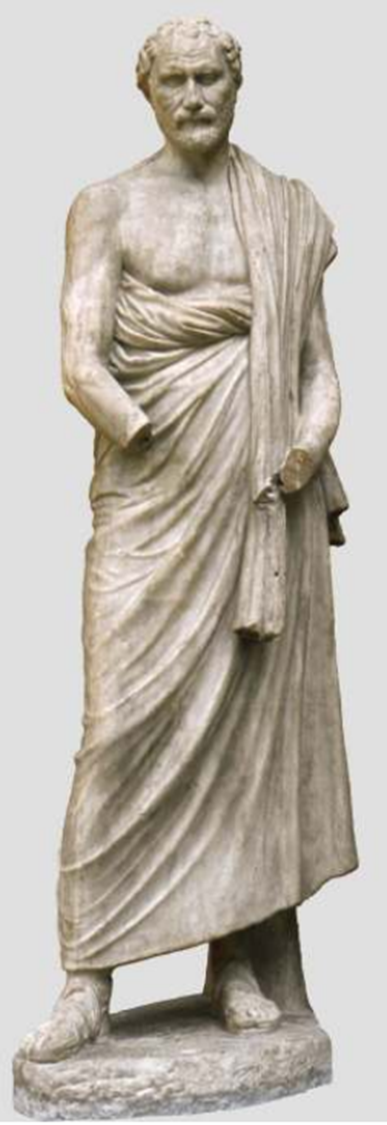
Portrait of Demosthenes
Original set up in 281/280 BCE near the Altar of the Twelve Gods in the heart of the agora and attributed to the sculptor Polyeuktos by ancient authors (Plut. Vit. X orat. 847a). Over 50 copies on the head and 3 complete marble statues survive (including at left in Glyptotek).
Plutarch Life of Demosthenes 30.5–31:
“A little later (i.e. after his death) the Athenian people, rendering worthy honor to him, set up a bronze statue and decreed that the eldest member of his family should have public maintenance in the Prytaneion. The much-quoted epigram was inscribed on the base of the statue, "If you had had power equal to your resolution, Demosthenes, the Macedonian Ares would never have acquired dominion over the Greeks." Those who say that Demosthenes himself composed this, at Kalauria, when about to take the poison, talk complete nonsense ...... The statue stands with fingers interlocked, and beside it grows a plane tree of no great size.”
Identify and analyse this statue:
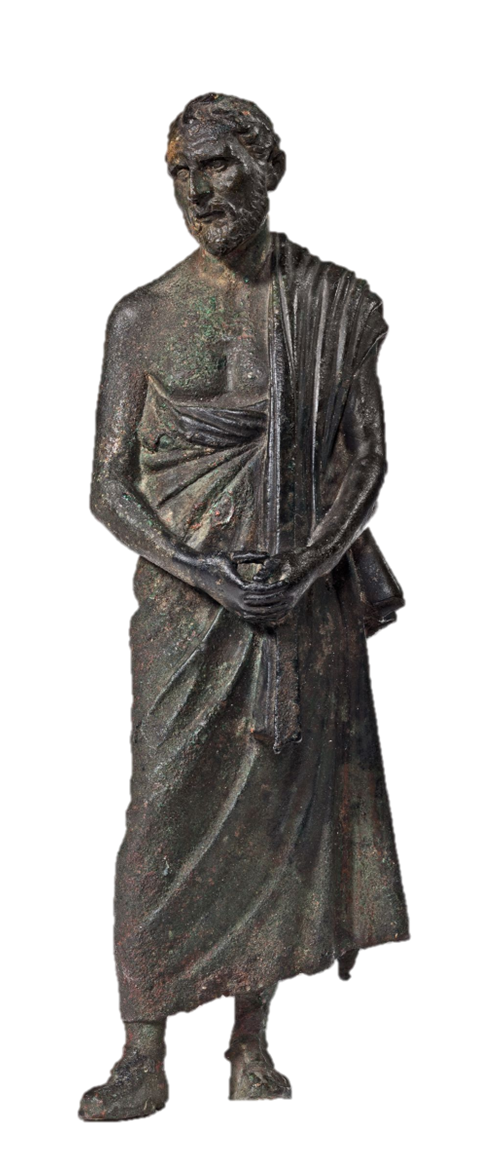
The Harvard Demosthenes
1st century BCE-2nd century CE.
H: 23.2 cm.
First attested on the art market in Istanbul in 1924 and was said to have been found “near Ankara” with another marble statuette. Donated to Harvard Art Museums in 2007.
It is a faithful copy of the original statue in the original material (bronze). Most replicas that we have are in marble.
Note the folded hands! Original design.