Astronomy Lab Final
 Call Kai
 Learn
Learn Practice Test
 Spaced Repetition
 Match
Match Flashcards
 Knowt Play
1/76

There's no tags or description
Looks like no tags are added yet.
Name | Mastery | Learn | Test | Matching | Spaced | Call with Kai |
|---|
No analytics yet
Send a link to your students to track their progress
77 Terms
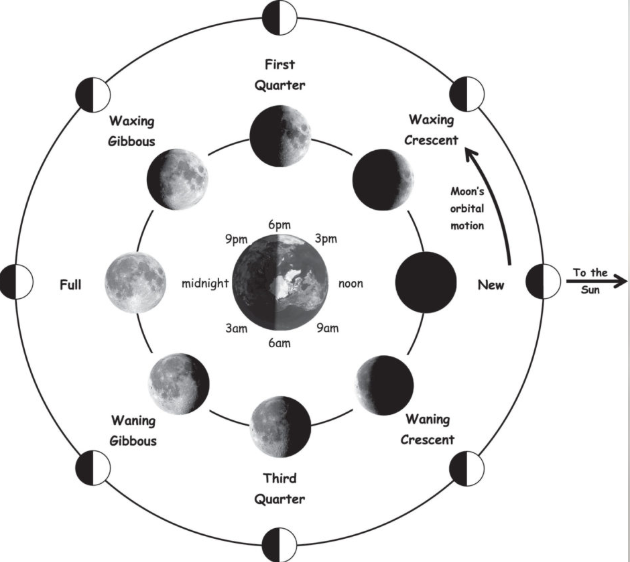
Why does the moon exhibit phases?
The sunlit portion we can see changes as the moon orbits the Earth
The light from the phases of the moon comes from…?
Sunlight reflected by the Moon
Are moon phases also caused by Earth’s shadow?
NO! Moon phases are not caused by Earth’s shadow. The moon can only enter Earth’s shadow when it is opposite the Sun, and therefore full.
What is the moon’s timeline and path?
A month; rises in the East and sets in the West, however, like the Sun, shifts position across the background stars from West to East; counterclockwise motion
How many days does it take for the moon to complete a full cycle of phases, in days?
A month or roughly 29.5 days
Waning (lamen’s terms)
decrease in magnitude, importance, brilliancy, intensity, etc.
Waxing (in lamen’s terms)
to increase in size, quantity, volume, intensity, etc.
Gibbous (in lamen’s terms)
convex, rounded — also hunch-backed, having a hump
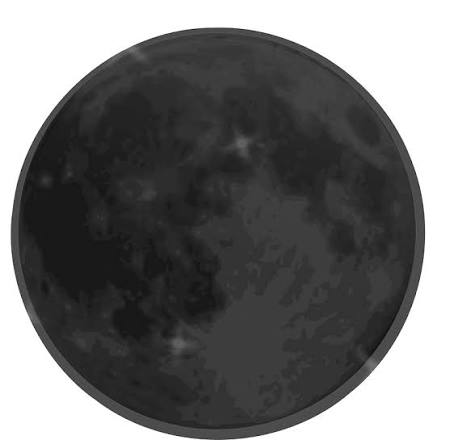
First Moon Phase
New moon (12pm)
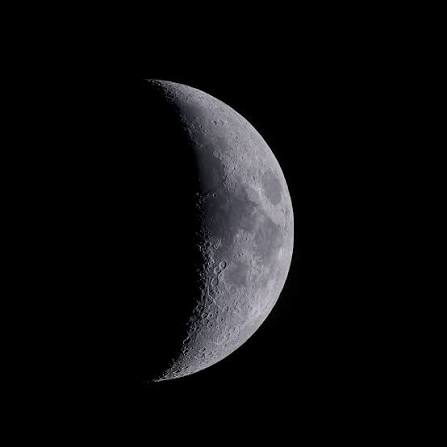
2nd Moon phase
Waxing crescent (3pm)
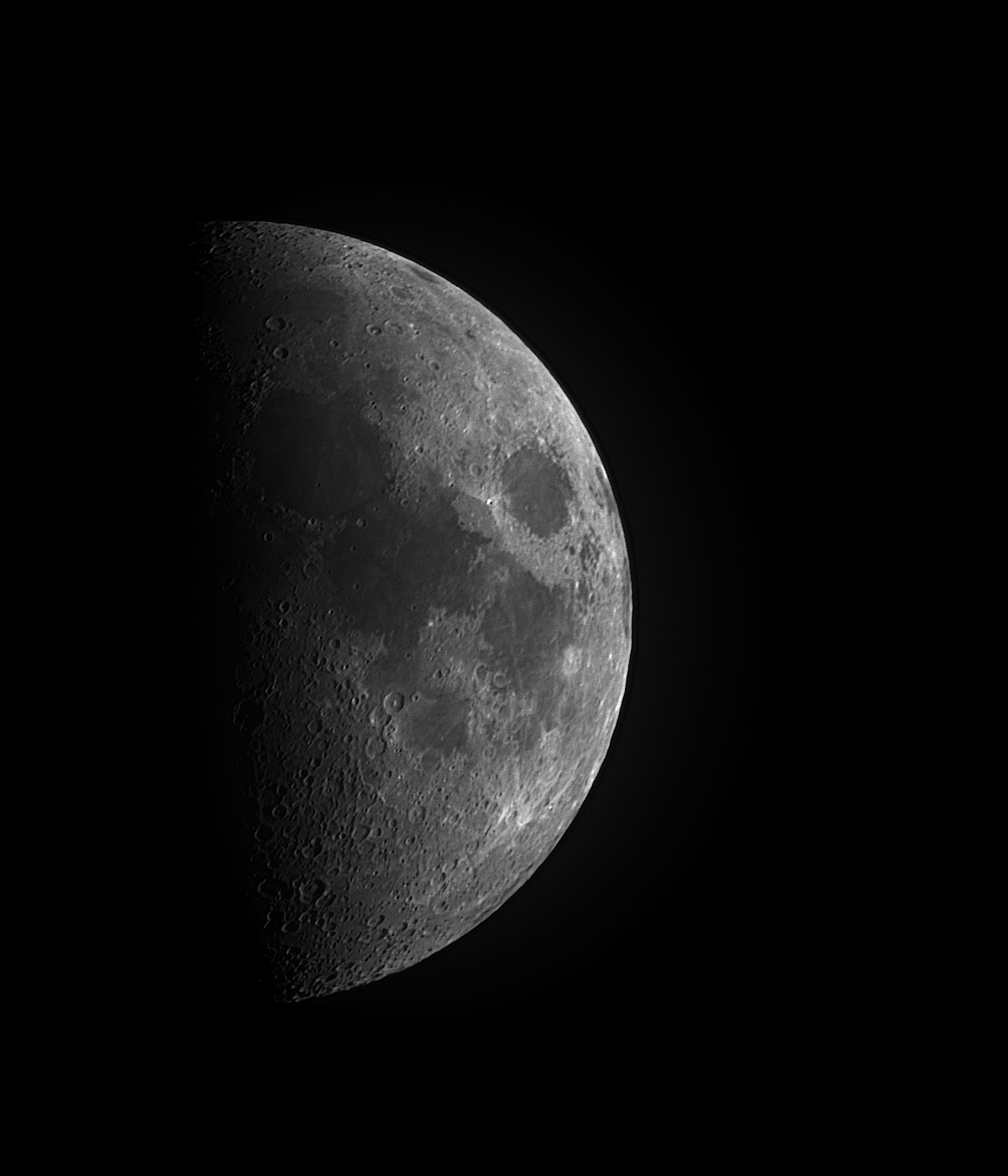
3rd Moon Phase
First quarter (6pm)
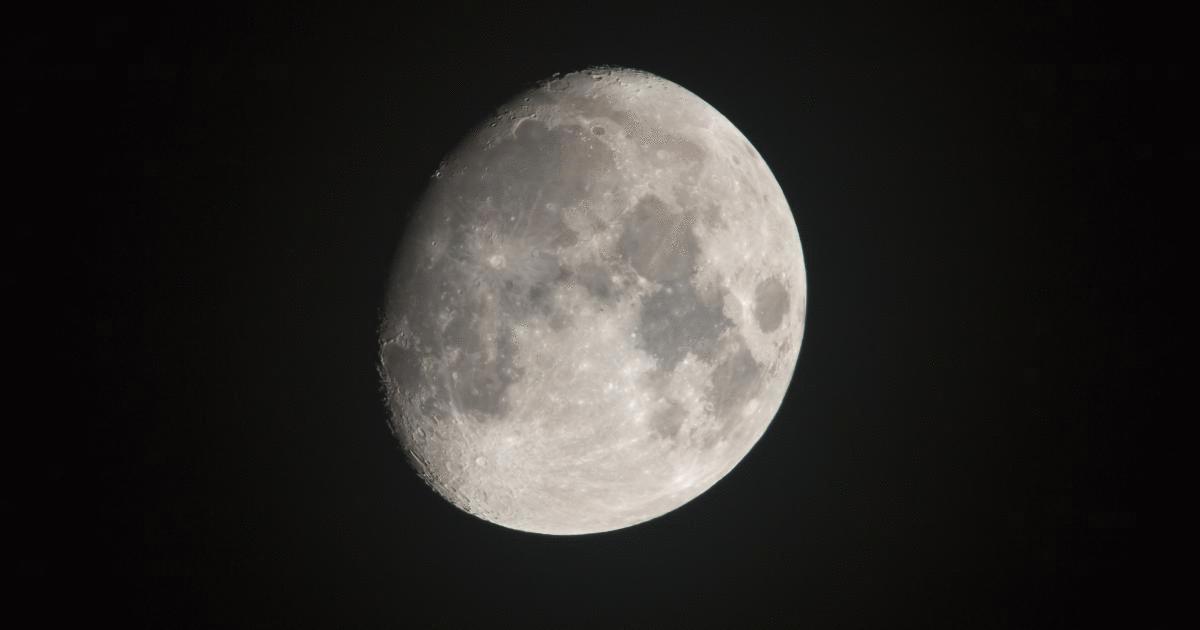
4th Moon Phase
Waxing gibbous (9pm)
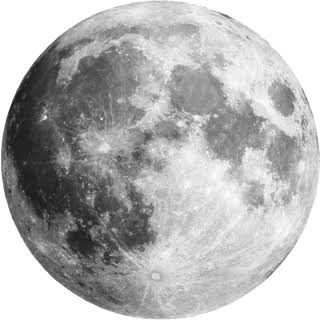
5th Moon Phase
Full moon (12am)
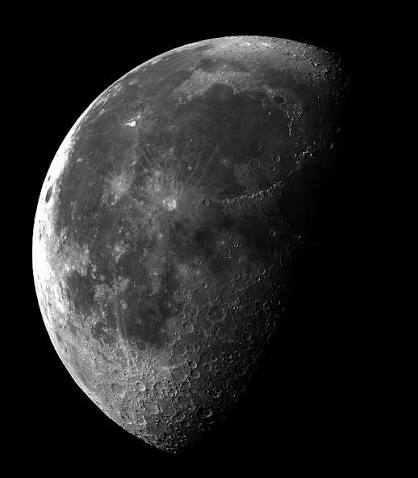
6th Moon Phase
Waning gibbous (3am)
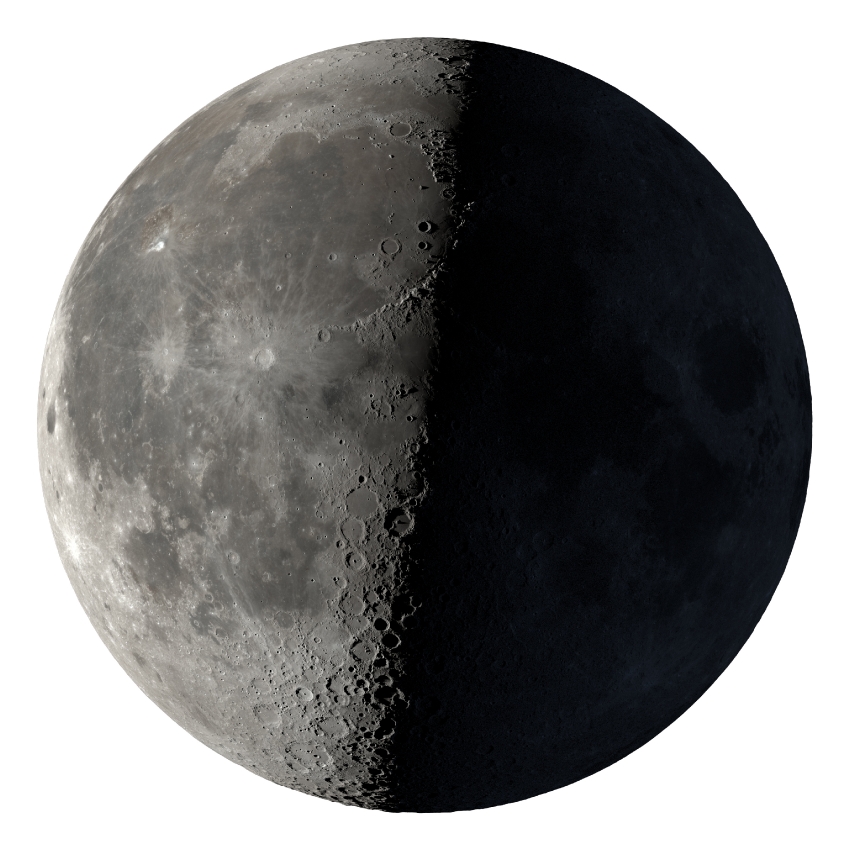
7th Moon Phase
3rd/Last quarter (6am)
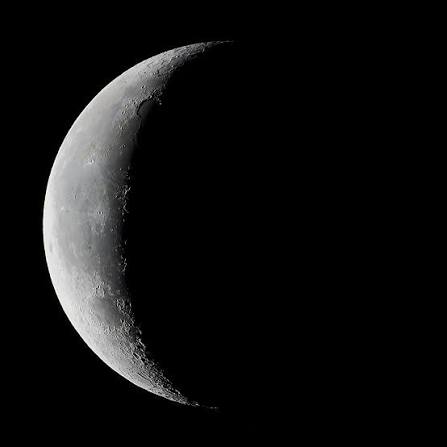
8th Moon Phase
Waning Crescent (9am)
If the Moon is a waxing crescent phase tonight, then what lunar phase will you see in approximately two weeks?
Waning Gibbous
If there is a new Moon today, then what phase will the Moon have in 11 days?
Waxing Gibbous
If the Moon is midway in the waning crescent phase, it…?
Rises at 3am
What time of day will you see the first-quarter moon rise (cross the horizon)?
Noon
How long is the Moon in transit when its rising/setting?
It takes roughly six hours to rise, and six hours to set, so about 12 hours total
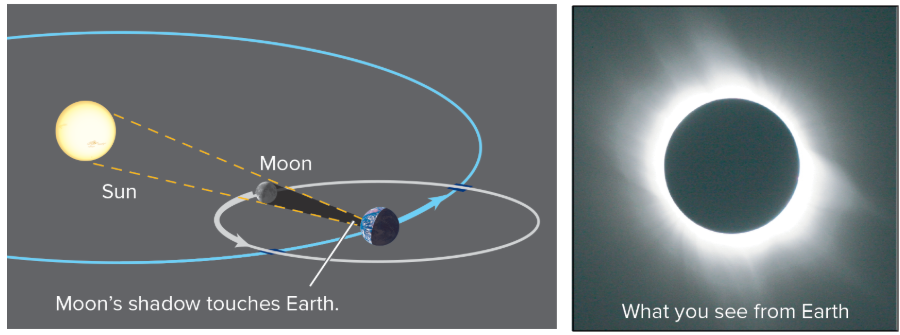
Solar Eclipse
Whenever the Moon passes directly between the Sun and Earth and block our view of the Earth; MUST be a New Moon
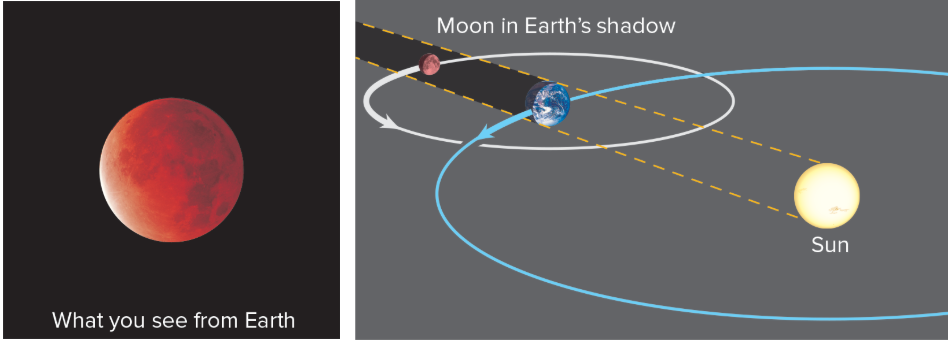
Lunar Eclipse
Whenever the Moon passes through the Earth’s shadow as it moves through the portion of its orbit opposite of the Sun; MUST be a Full Moon
If we know the moon’s position in the sky and its phase, we can estimate the…?
Time
New moon is near the Sun in the sky and therefore…?
Rises and sets with the Sun
First Quarter is about 90° east of the Sun and therefore…?
Highest at Sunset
Full moon is opposite the Sun and therefore…?
Rises near sunset, highest around midnight
Third Quarter is about 90° west of the Sun and therefore…?
Highest around Sunrise
Crescent an gibbous phases are “in-between” phases and therefore…?
Rise, transit and set times fall between the neighboring anchor phases (new, quarter, full)
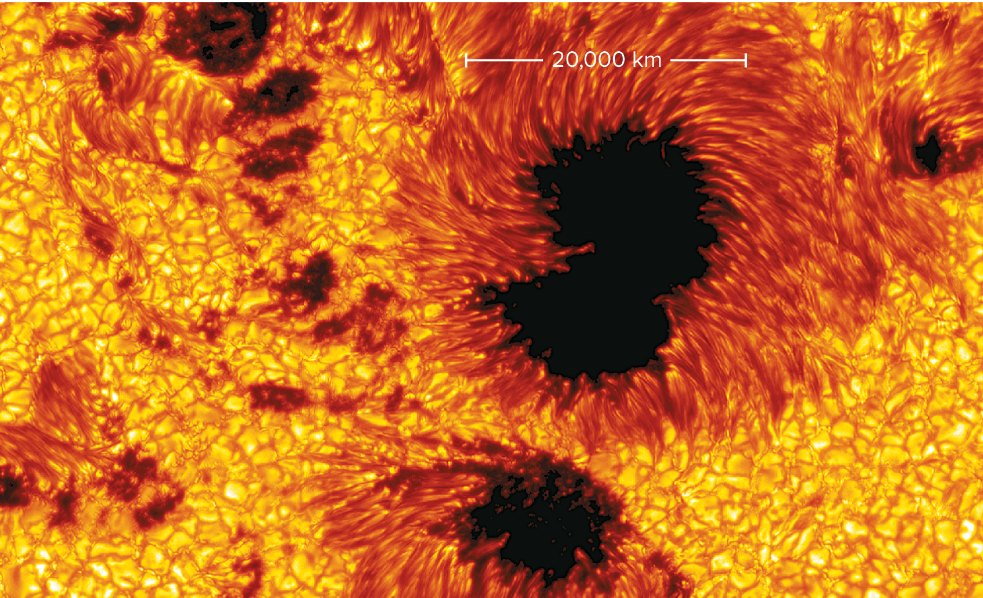
What are sunspots?
A dark, cooler region on the Sun’s visible surface (photosphere) created by intense magnetic fields.
Can range up to thousands of kilometers across
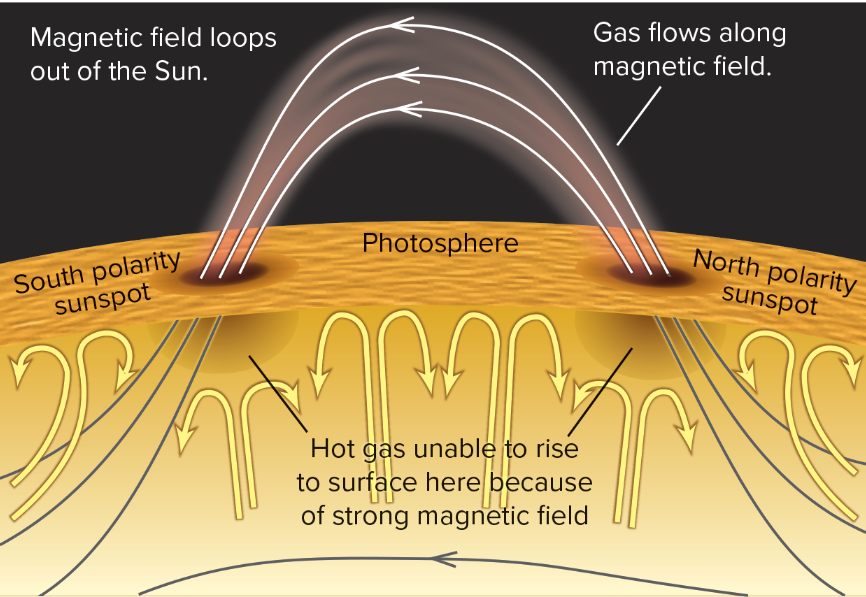
What causes sunspots to occur?
Magnetic fields
Intense region of the Sun’s magnetic field emerges through the surface of the Sun, creating opposite spots of polarity. Gas pressure confines the spot.
Strong magnetic fields block the flow of hot gas upward toward the surface, making the spot cooler.
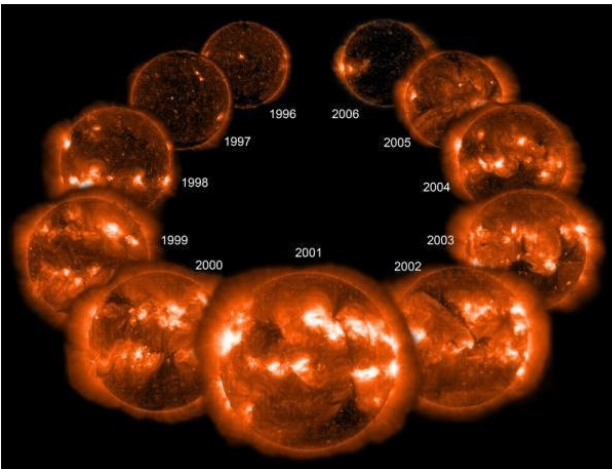
What is the typical calendar for the solar cycle?
11 years
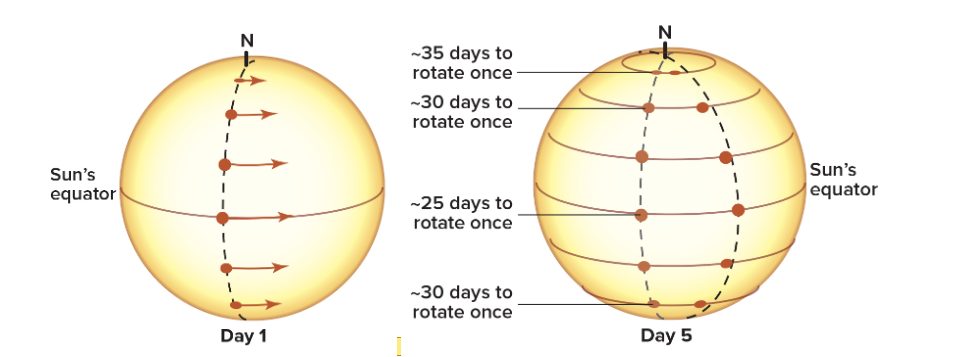
What is differential rotation?
The Sun’s surface rotates faster at the equator than at the poles
—>Areas near the north pole take 30 days to complete one rotation, but areas near the equator take only 25 days.
What is solar noon?
When the Sun is on the meridian; highest in the sky and shadows are the shortest
How do you find solar noon?
Use a SAD (solar angle device) to facilitate the sun’s movements in the sky; its a flat surface mounted with a perpendicular mast; SAD is oriented to be level with the ground and shadow so a cut out of a “V” falls on the surface
How do you calculate the altitude of the Sun using the mast?
Typical altitude of the Sun is 0° and its + the angular distance of the Sun above the closest horizon, so whatever closest azimuth is measured. Altitude° = tan⁻¹ ((length of the mast)/(length of the shadow))
The Sun’s altitude is increasing from one week to the next the closer we approach summer…?
Yes, this is true
Over multiple observational periods, the Sun’s altitude changes to be…?
Higher in the sky over multiple days

What a continuous spectrum?
A complete rainbow of colors; produced from a hot solid, liquid or dense gas
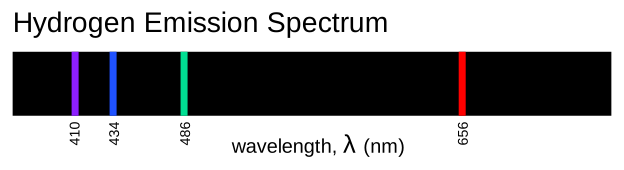
What are emission lines?
Bright lines against a dark background; produced from a hot, low-density gas
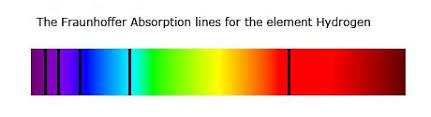
What are absorption lines?
Similar to a continuous spectrum but with dark lines; produced from a low-density gas
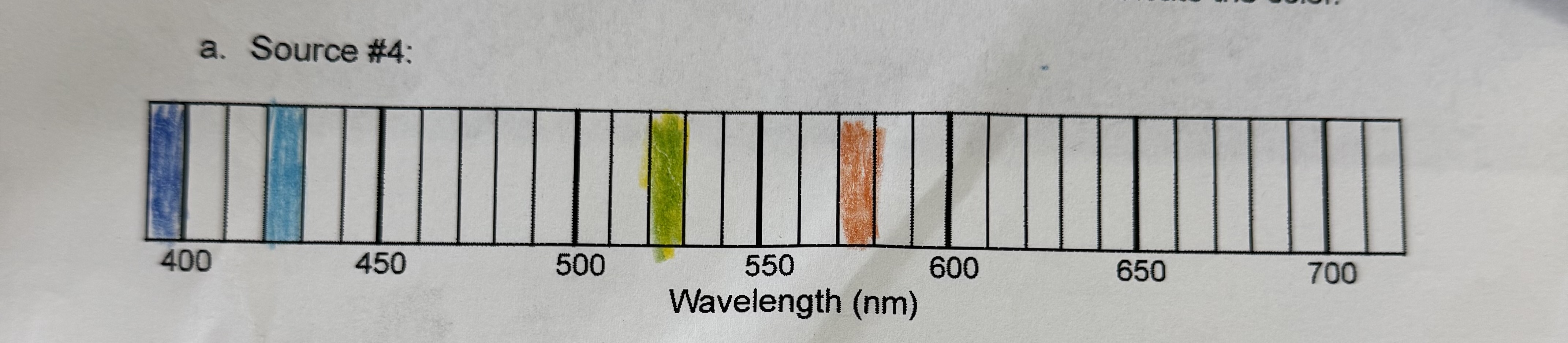
Why would these visible lines be made of Mercury?
We were given a set number of wavelengths on a table for Mercury, and the number of wavelengths match the number of lines drawn.

Why would these visible lines be made of Helium?
We were given a set number of wavelengths on a table for Helium, and the number of wavelengths match the number of lines drawn.
Different gases produce different wavelengths of light in their emission line spectra…?
True, true, true
What is an H-R diagram?
A graph of stellar luminosity versus surface temperature, organizing and interpreting stellar properties.
When many stars are plotted, distinct regions appear, revealing how stars differ in size, brightness and evolutionary stage
What is luminosity? (vernal axis)
Total energy a star emits per second
often plotted in solar units Lₛᵤₙ
H-R diagrams often use absolute magnitude than luminosity
What is absolute magnitude?
Brightness scale where smaller (more negative) M means brighter
Measures how much light an object emits
What is apparent magnitude?
Indicates how bright an object appears to us in the sky
What is Surface Temperature? (horizontal axis)
Measured in Kelvin (K)
Often labeled by spectral class (hot —> cool, O, B, A, F, G, K, M) or by color/wavelength
Temperature usually decreases to the right on an H-R diagram
Main Sequence on an H-R Diagram
Stars along a diagonal band, where stars spend most of their lifetimes fusing hydrogen into helium in their cores
“Adulthood” of the star
Follow regular patterns that relate to their mass.
Giants and Supergiants on an H-R Diagram
A star that has used up most of the hydrogen in its core and has expanded as its internal structure changes (hydrogen continues in shells around the core in many cases)
Located in the upper-right region of the H-R diagram
Cool, but luminous —> very large radii (physically big)
White Dwarfs on an H-R Diagram
Small, hot, leftover cores of stars like the Sun after they have shed their outer layers
Not doing normal fusion, cooling over time as they radiate away stored thermal energy
Located in the lower-left region of the H-R diagram
Hot, but dim —> small radii (very compact)
Key equation connecting L, T, and Radius
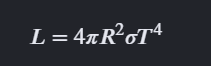
Key equation connecting L, T, and Radius - RELATIVE TO THE SUN FORM


This equations explains why…?
Cool + very luminous —> large radius (giants/supergiants)
Hot + faint —> small radius (white dwarfs)

How could you find luminosity using this equation?
You’re given R = 1, T = 2, therefore:
1² = 1 × 1 = 1
2⁴ = 2 × 2 × 2 × 2 = 16
16 is the luminosity!

How do you find radius using this equation?
You’re given L= 1, T = 9, therefore:
9 = R²(1)⁴
9 = R²
R = √9
R = 3
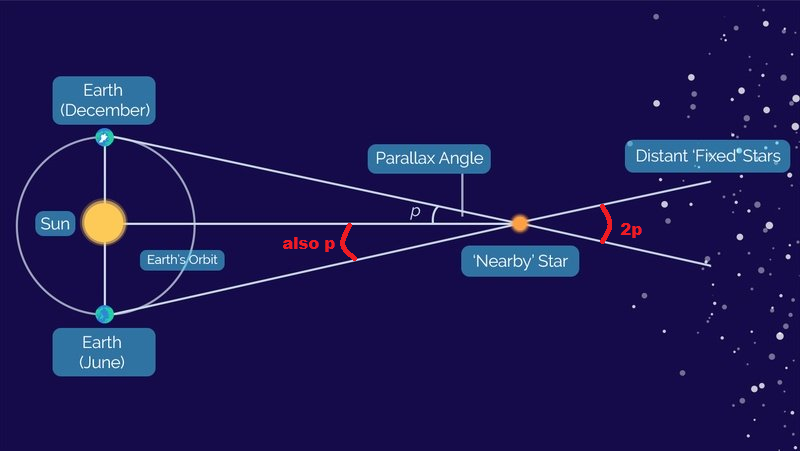
How do we determine the distance of a star?
By the parallax angle (measure of the apparent shift of an object against a distant background when viewed from two different positions)
What is the parallax angle of a star that is 2pc away?
Formula: D = 1/P —> D = ½ = 0.5
How much is an arcsecond?
1/3600 of a degree
How much is a parsec?
3.26 ly
Rule of thumb about magnitudes…?
Brighter objects have smaller magnitudes —> fainter objects have larger magnitudes
What is the formula connecting apparent, absolute magnitude and distance?

Which star is closer, Star A (absolute magnitude = +1, apparent magnitude = +2) or Star B (absolute magnitude = +1, apparent magnitude = +5)?
Star A (smaller apparent magnitude = closer on the scale)
The star Antares have an apparent magnitude of 1.1. The star Vega’s apparent magnitude is 0.0. Which star looks brighter and why?
Vega is brighter because the apparent magnitude is a lower number, making the star appear to burn brighter and hotter than other stars.
A distant galaxy has an apparent magnitude of 15, can we see it with our naked eyes…?
No, because we cannot go beyond an apparent magnitude of 4.
A distant galaxy has an apparent magnitude of 15, can we see it with a 1-m telescope…?
Yes, because the telescope’s reach is beyond the apparent magnitude of the distant galaxy, thus making it easily visible
Rule of thumb about the colors of stars…?
Only two colors, red and blue
Hotter the star, bluer the color — cooler the star, redder the color
What is Wein’s law?
Formula: λpeak = 3 x 10⁶ / T
λpeak Is the wavelength of the star (in nanometers)
T is the star’s surface temperature
What is the equation for a star’s connection between color, size and luminosity?
L = (4πR)² x (σT)⁴
(4πR)² —> surface area of a sphere with radius R
(σT)⁴ —> says that a star with a hotter surface temperature T emits more light per unit area
The larger the magnitude, the brighter the star…?
No, that is FALSE
Which spectral type is the hottest?
O0
Which spectral type is the coolest?
M9 is the coolest
How does temperature on the Sun compare to other stars?
Sun is higher on the spectral scale so it is cooler than most of the other stars on the list
Star A has a temperature of 3,500K and Star B is 10,000K. Both stars have the same luminosity. Which star is bigger?
Star A
Key words: same luminosity
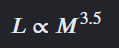
What is the relationship described in this equation?
Stars along the main sequence have masses determined by their luminosity and temperature