2.2.4 SOCIAL Social Psychology of Humour
 Call Kai
 Learn
Learn Practice Test
 Spaced Repetition
 Match
Match Flashcards
 Knowt Play
1/63

Earn XP
Description and Tags
1-36: Describe what humour is and its various types Discuss the theoretical explanations of humour Explain the social functions of humour and laughter Discuss how humour can help explain real world issues such as prejudice and discrimination Discuss how humour can help solve real world issues such as improving stress and health
Name | Mastery | Learn | Test | Matching | Spaced | Call with Kai |
|---|
No analytics yet
Send a link to your students to track their progress
64 Terms
Warren and McGraw (2016): definition of humour
a psychological response characterised by the positive emotion of amusement, the appraisal that something is funny, and the tendency to laugh
sense of humour definition
the ability to perceive what is ludicrous, or amusing, or expressing it in speech, writing, or another composition
what is ‘humour’ derived from?
ancient Greeks’ study of medicine
taught the balance of fluids in the human body- known as humors- controlled human health and emotion
Latin: humor- body fluid
Latin: humor
body fluid
humour: broad term
anything people say/do to elicit laughter
captures cognitive processes related to how we deem something as funny
can influence our health
essential components of humour
social context
cognitive - perceptual processes
emotional response
vocal-behavioural expression of laughter
→ these four components common to almost all instances of human
what type of phenomena is humour?
a social phenomenon
needs to be a stimulus, often perceived as out of the ordinary/incongruent with typical ideas - cognitive/perceptual processes
social context of humour
we laugh/joke much more with others than by ourselves (Martin & Kuiper, 1999)
provides us with opportunities for play- serves important social, emotional, and cognitive functions (Bateson, 2005)
cognitve - perceptual processes of humour
involves idea, image, text, or event that is in some way absurd, surprising, or out of the ordinary
we need to cognitively appraise the stimulus as nonserious or unimportant, putting us into a playful frame of mind at least momentarily (Gervais & Wilson, 2005)
what do we need to do, cognitively, to find something funny + who is this according to?
to cognitively appraise the stimulus as nonserious or unimportant, putting us into a playful frame of mind at least momentarily (Gervais & Wilson, 2005)
emotional response of humour
comprises an emotional response that is elicited by these cognitive appraisals (as nonserious/unimportant) (Szabo, 2003)
referred to as mirth- pleasurable feeling, joy, happiness
mirth
pleasurable feeling, joy, happiness
comprises the emotional response elicited by cognitive appraisals of humourous stimuli
vocal-behavioural expression
of laughter
mirth is expressed as smiling/laughing, communicating to others we are in a playful state (Van Hooff, 1972)
Van Hooff, 1972: how is mirth expressed + impact?
as smiling/laughing, communicating to others we are in a playful state
describe the four essential components of humour as a step by step
social context- with others
absurd/surprising stimulus → cognitive appraisal of this as nonserious or unimportant → playful frame of mind → emotional response of mirth → vocal-behavioural expression of laughter/smiling → communicating to others we are in a playful state
types of humour
jokes
spontaneous conversational humour
unintentional humour (physical or linguistic)
jokes
short, amusing stories consisting of a setup and a punchline
setup of a joke
includes all but last sentence
creates, in the listener, particular set of expectations about how the situation should be interpreted
punch line of a joke
suddenly shifts the meaning of setup in an unexpected and playful way
creating perception of nonserious incongruity that is neccessary for humour to occur
what proportion of day to day humour do jokes make up?
fairly small
72% is spontaneous conversational humour
besides verbal forms of humour, non-verbal means used to create it day to day- e.g. exaggerated facial expressions
how does 72% of daily laughter occur? (Martin & Kuiper, 1999)
from spontaneous conversational humour
occurs spontaenously during social interactions either in response to funny comments or amusing anecdotes
what is spontaneous conversational humour?
more context-dependent than joke-telling, so not as funny when recounted after
laughter occurs spontaneously during social interactions either in response to funny comments or amusing anecdotes
many different forms of SCH (Norrick, 2003)
some forms: anecodotes, wordplay, irony
difference contextually between jokes and spontaenous conversational humour
SCH usually more context dependent than joke telling and therefore is not as funny when recounted afterwards
Norrick (2003) highlights what about spontaneous conversational humour
it takes many different forms
anecdotes
wordplay
irony
anecdotes
relaying an amusing story about oneself or someone else
form of SCH
wordplay
creating puns, witty responses, or wisecracks that play on meaning of words
form of SCH
irony
a statement where the literal meaning is different (juxtaposing) from the intended meaning
form of SCH
unintentional humour types (Nilsen and Nilsen, 2000)
physical
linguistic
also called accidental humour
unintentional humour: physical
includes minor mishaps and blunders
funny when they occur in surprising and incongruous manner
person experiencing them is not seriously hurt or badly embarrassed
unintentional humour: linguistic
arises from
misspellings, mispronunciations, errors in logic
and
speaker confusions like Freudian slips, malapropisms, and spoonerisms
Freudian slips
errors in speech/incorrect word use that supposedly reflect unconscious thoughts
accidental linguistic humour can arise from this
malpropisms
incorrect usage of a word in place of a different word with different meaning but with a similar sound
resulting in nonsensical often humourous utterance
can be (usually is) unintentional or for comedic effect
accidental linguistic humour arises from this
spoonerisms
phonemes/morphemes in a word are swapped, e.g. belly jeans
‘belly jeans’ instead of ‘jelly beans’ is an example of a…
spoonerism
calling your teacher ‘mum’ is an example of a…
Freudian slip
‘doggy dog world’ is an example of a…
malpropism
theoretical explanations of humour
evolutionary theory
superiority theory
incongruity theory
relief theory
evolutionary theory of humour- evidence to support
humour and laughter are a universal aspect of human experience (Apte, 1985; Lefcourt, 2001)
developmentally, laughter is one of the first social vocalisations (after crying) emitted by human infants (McGhee)
→ even born Deaf or Blind children can laugh without having ever perceived the laughter of others (Provine, 2000)
laughter/humour observed in chimpanzees, bonobos, orangutans, and gorillas (Preuschoft and van Hooff, 1997 and 2003)
laughter appears to have originated in social play + be derived from primate play signals (Burling, 1993)
humans now adapted to mental play with words = humour
experienced cross culturally → contributes to idea of laughter = innate
evolutionary origins of humour and laughter suggest they likely have…
important socioemotional functions that have contributed to our survival as a species
Miller (2000): evolutionary theory
suggests witty sense of humour, like linguistic skills and creativity, is an indicator of superior intelligence, enhancing one’s ability to compete successfully for resources and mates
Dunbar (1996): evolutionary theory
laughter is a form of “vocal grooming” which, like physical grooming in primates, facilitates social bonding
Ramachandran (1998): evolutionary theory
views laughter as a “false alarm”, signalling to others that a stimulis or event is unimportant and nonserious
superiority theory of humour suggests human results from…
a sense of superiority we feel from the belittling of another person or of one’s own past blunders or foolishness
Plato + humour
superiority theory
stated laughter originates in malice
we laugh at what is ridiculous in other people, feeling delight instead of pain when we see even our friends in misfortune
Gruner (1997): superiority theory
views humour as “playful aggression”
generations of men responded to their sudden victories in violent encounters with roars of triumph
triumph thought of as early origin of laughter
evolved into our modern day humour, ppl can now use language to make fun of those inferior
why we find pranks funny
Schadenfreude
Schadenfreude
harm-joy/mirth
the joy of another’s misfortune
strength/s of superiority theory
studies show aggressive elements in jokes and the perception of pain in others contribute to the funniness of the humour
Zillmann & Bryant, 1974; Deckers & Carr, 1986
limitation/s of superiority theory
little evidence that all humour involves some form of aggression and that aggressive people enjoy all types of humour more than non aggressive ppl (Ruch & Hehl, 1998)
animal studies suggest facial displays associated w humour (playful face, smiling, laughter) only occur in context of friendly social/play activities, not aggression (van Hooff, 1972)
essentially unfalsifiable, Gruner defined playful aggression so broadly that he claims the theory seems to account for all humour
if lump humour into one single category, ignore other means of humour being categoried
so has largely been replaced by more modern theories
incongruity theory of humour suggests that…
the perception of incongruity is the crucial determinant in whether or not something is humourous (Suls, 1972)
however, for incongruity to be funny, it must also be resolved or make sense in some way
incongruity theory - what makes incongruence funny?
resolution - go back and search for ambiguity in the joke setup that can be interpreted differently so punch line makes sense
incongruity theory- focus on what + what necessary?
cognitive component of humour
set up and punchline both necessary
human comprehension of joke as a problem-solving task
which word is where the ambiguity is?
A lady went into a clothing store and asked “May I try on that dress in the window?” “Well,” replied the sales clerk doubtfully, “don’t you think it would be better to use the dressing room?”
window
what do we search for in where to make sense of the punch line of a joke?
ambiguity in the joke set up that can be interpreted in a different way
Suls, 1972
incongruity theory
incongruity resolution model
comprehension of humour viewed as a process of problem solving
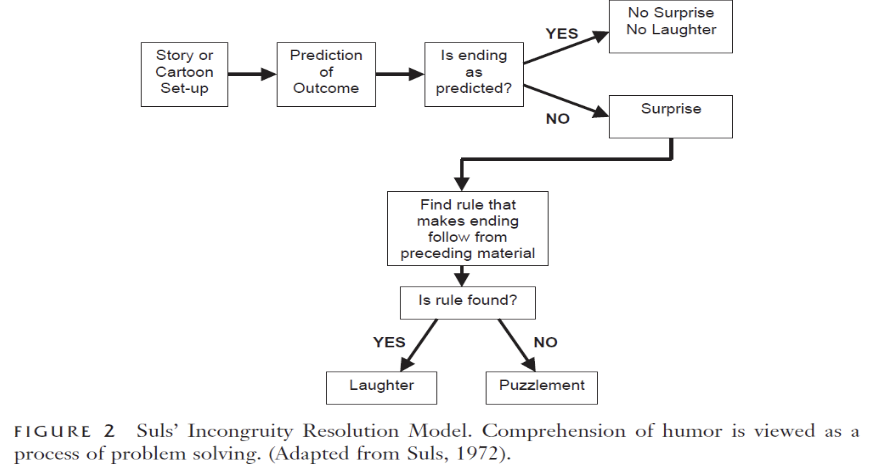
Suls’ Incongruity Resolution Model: for laughter
1) story or cartoon set up → 2) prediction of outcome → 3) is ending as predicted? — no —→ 4) surprise → 5) find rule that makes ending follow from preceding material → 6) is rule found? —- yes—> 7) laughter
according to Suls’ incongruity resolution model, what would have to happen for there to not be laughter?
if ending IS as predicted → no surprise, no laughter
if ending is not predicted, eliciting surprise, but NO rule can be found that makes ending follow from preceding material → puzzlement
evidence support for incongruity theory
Shultz & Horibe, 1974- suggest resolution of incongruity needed for smth to be perceived as funny
evidence against incongruity theory
Deckers, 1993 study- incongruity w/o resolution still capable of humour
Pollio + Mers, 1974- joke funnier when can see punchline coming
much research only based on jokes, may not apply to other types of humour without a setup punchline joke format
Shultz & Horibe, 1974: procedure
presented different versions of several jokes to children aged 6, 8, 10, 12
original joke
resolution removed joke
incongruity removed joke
which condition are these jokes examples of, from Shultz + Horibe (1974)
Waiter, what's this? That's bean soup, ma’am.
I'm not interested in what it's been, I'm asking what it is now
Waiter, what's this? That's tomato soup, ma’am.
I'm not interested in what it's been, I'm asking what it is now
Waiter, what's this? That's bean soup, ma’am.
That's what I thought, but I wasn't sure.
original
resolution removed
incongruity removed
Shultz + Horibe, 1974: results
by age 8, children found the original versions of the jokes funnier than resolution removed or incongruity removed versions
Shultz + Horibe, 1974: findings
when children are old enough to engage in cognitive processes and problem solving → they appreciated resolvable incongruity and found jokes with these elements funnier
suggesting that resolution of incongruity is needed for something to be perceived as funny
Deckers, 1993: procedure
size-weight illusions studies
Ps pick up items where there is incongruity between size and weight of items
no resolution as to why object is heavier/lighter than expected
Deckers, 1993: findings
ppl laugh when they pick up an object heavier/lighter than expected
→ incongruity without resolution is still capable of eliciting humour