science
 Call Kai
 Learn
Learn Practice Test
 Spaced Repetition
 Match
Match Flashcards
 Knowt Play
 Podcast
1/15

There's no tags or description
Looks like no tags are added yet.
Name | Mastery | Learn | Test | Matching | Spaced | Call with Kai |
|---|
No analytics yet
Send a link to your students to track their progress
16 Terms
1. Which sub-atomic particle of some atoms is free moving and involved in electricity and what is its charge?
Electrons.
2. Explain why metals are all conductors of electricity.
Metals are all conductors of electricity because they have free moving electrons within them.
3. Name the two types of electricity.
Static and current.
4. Explain the difference between the two types of electricity.
In static electricity electrons jump from one point to another, whereas, in current electricity electrons flow through a conductor.
5. a) Explain why metals are good electrical conductors.
Metals are all good conductors of electricity because they have free moving electrons within them.
b) Explain why materials like plastics, rubber and wood are insulators because they cannot conduct electricity.
Insulating materials like plastics, rubber and wood cannot conduct electricity because they do not have free moving electrons within them, their electrons are all tightly bound to atoms.
c) How is static electricity generated?
Static electricity is generated by rubbing two insulating materials together.
d) Opposite charges ___ each other, whereas, like charges ___ each other.
Opposite charges attract each other, whereas, like charges repel each other.
6. a) What three things do electrical circuits require in-order to work?
Power supply (battery), an energy user (bulb), and a conducting pathway (wires).
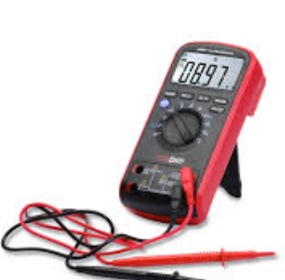
8. a) What is the name of this device and what can it be used for?
Multimeter - it can be used as both an ammeter (to measure the current) and a voltmeter (to measure the voltage supplied or transformed).
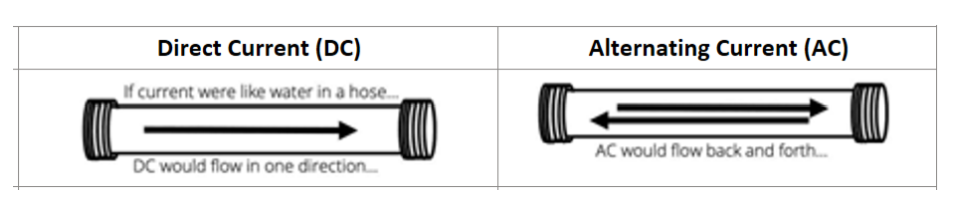
9. Explain the difference in how current (electrons) move in alternating current circuits and direct current circuits.
10. a) What is magnetism?
Magnetism is a non-contact force that acts on objects over distance, like gravity.
b) Name two chemical elements that a permanent magnet can be made from.
Iron and nickel.
d) What is an electromagnet made of, and how does it work?
An electromagnet is made of a coiled wire, usually copper, through which electrons flow, to create a magnetic field.
An electromagnet is made of a coiled wire, usually copper, through which electrons flow, to create a magnetic field.
A permanent magnet is always magnetised, whereas, an electromagnet can be turned on and off.
f) Name two everyday objects that make use of an electromagnet.
Electric motors, Maglev trains, fridges, freezers, MRI machine, electric doorbell to name some things.