Exame 2
 Call Kai
 Learn
Learn Practice Test
 Spaced Repetition
 Match
Match Flashcards
 Knowt Play
1/227

There's no tags or description
Looks like no tags are added yet.
Name | Mastery | Learn | Test | Matching | Spaced | Call with Kai |
|---|
No analytics yet
Send a link to your students to track their progress
228 Terms
physics branch that studies energy & its transformations
Thermodynamics
4 factors that speed up diffusion rate
higher temp, concentration, & SA
lower viscosity & solute
First Law of Thermodynamics
Energy Conservation:
Energy cant be created/destroyed
It can only be transferred/transformed
Result of more reactions breaking than building up
↑ Disorder
Law that states energy transformations ↑ disorder of universe
Second Law of Thermodynamics
Word for disorder (second law of thermodynamics)
Entropy
Ultimate source of energy in universe
Sunlight energy
What is the general energy transformation order in our universe
Light → Glucose → ATP → motion → heat
energy of motion/work & 2 examples
energy of storage/rest & 2 examples
Kinetic Energy: light & heat
Potential Energy: chemical glucose & ATP
What ATP stands for:
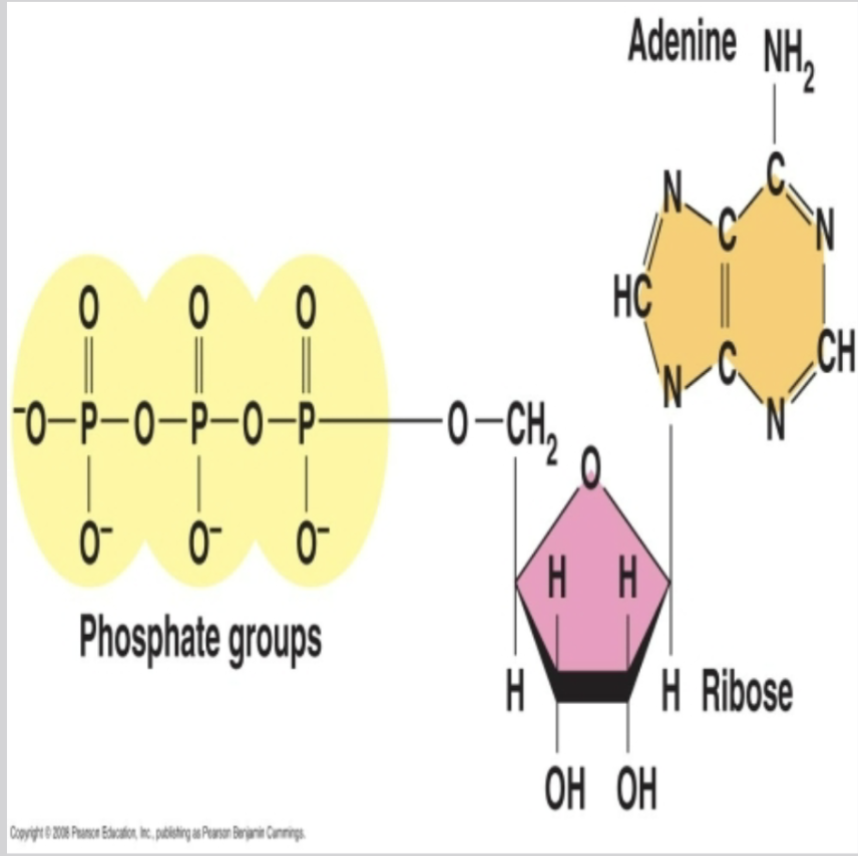
Adenosine Triphosphate
What kind of organic molecule is ATP?
What is it made up of?
Nucleotide:
1 adenine-nitrogenous base
3 phosphate groups
allows for intake O2 (goes through blood stream into body cells) release Co2
Breathing
Series of reactions by cells that sometimes use O2 & glucose to make ATP usable energy
Cellular Respiration
Aerobic vs Anaerobic Cellular Resp
use or not oxygen?
how much ATP produced from 1 glucose molecule
Aerobic:
uses O2 ✅
36 NET ATP
Anaerobic:
does not use O2 🚫
2 NET ATP
How do Aerobic and Photosynthesis relate?
Opposites:
aerobic- uses glucose & O2 to make CO2, H2O, & ATP
photo- uses CO2, H2O, & light energy to make glucose & O2
Reaction where electrons moved from one molecule to another & 2 example processes
Redox Reactions
photosynth & cellular resp
gain of electron vs loss of electrons in redox reactions
oxidation is loss
reduction is gain
*(oil rig)
Which molecule do electrons belong to in redox reactions
H+ (hydrogen)
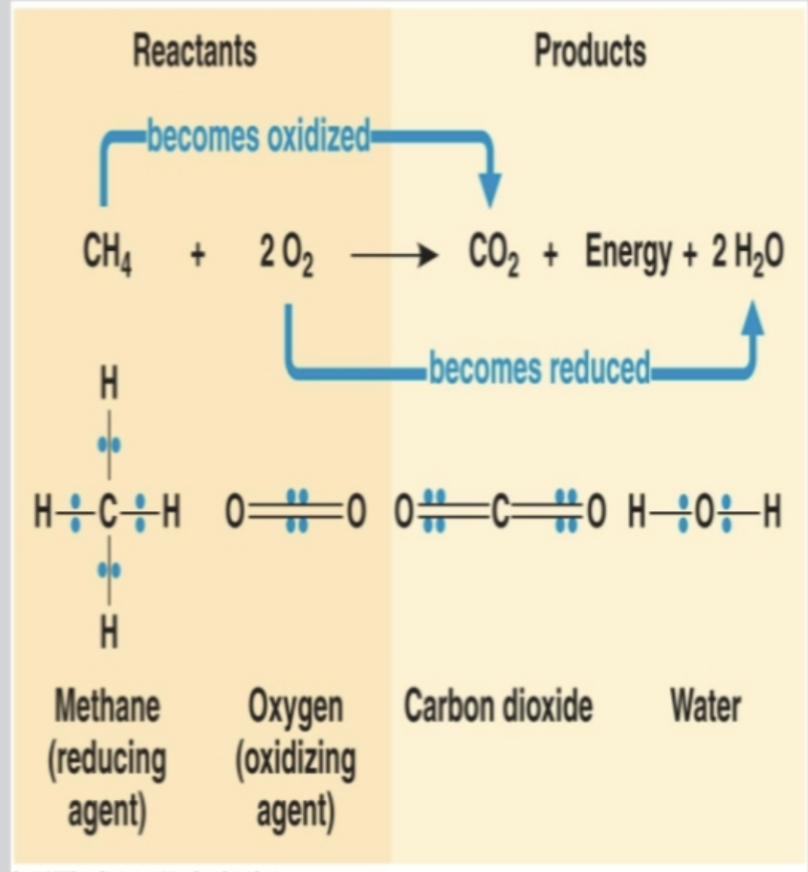
Explain how Combustion is Redox
Methane oxidized → CO2 (loss H+ & electrons)
Oxygen reduced → H2O (gain H+ & electrons)
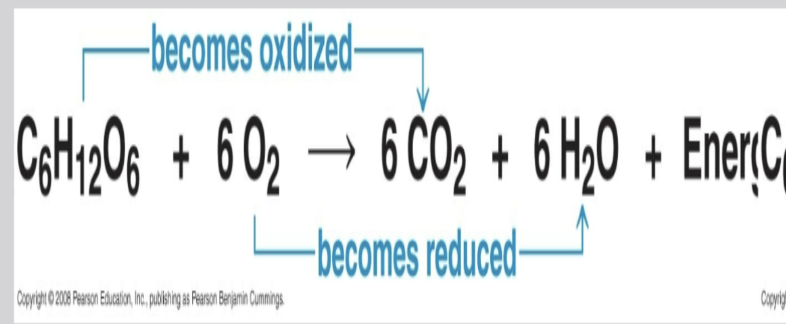
Explain how Aerobic Respiration is Redox
Glucose oxidized → CO2 (loss H+ & electrons)
Oxygen reduced → H2O (gain H+ & electrons)
What general reaction allows for production of ATP
In Glycolysis & Krebs?
In ETC & redox reactions?
Phospholyration
Substrate Level Phospholyration
Oxidative Phospholyration
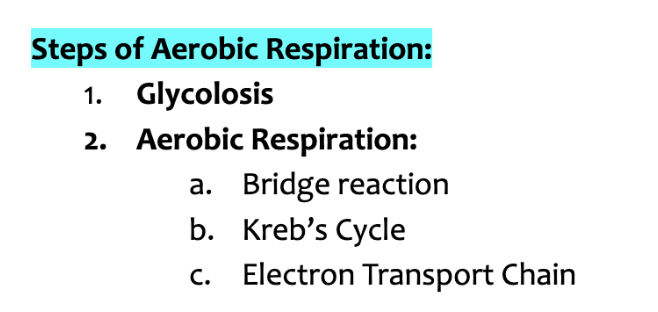
What are the 5 major steps in Cellular Respiration
Glycolosis
Aerobic Respiration:
Bridge Reaction
Krebs Cycle
Electron Transport Chain
split 1 glucose into 2 pyruvic acids
Glycolosis
Glycolosis:
location
o2 requirement?
uses
products
Cytoplasm
No
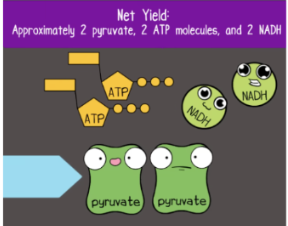
2 ATP
4 ATP (2 NET)
2 Pyruvate
2 NADH
temporary electron carrier
what does it exist as?
how does it convert?
NADH
NAD+
gains electron → NADH
release their electrons in final step and what process
Electron Carriers
Electron Transport Chain (ETC)
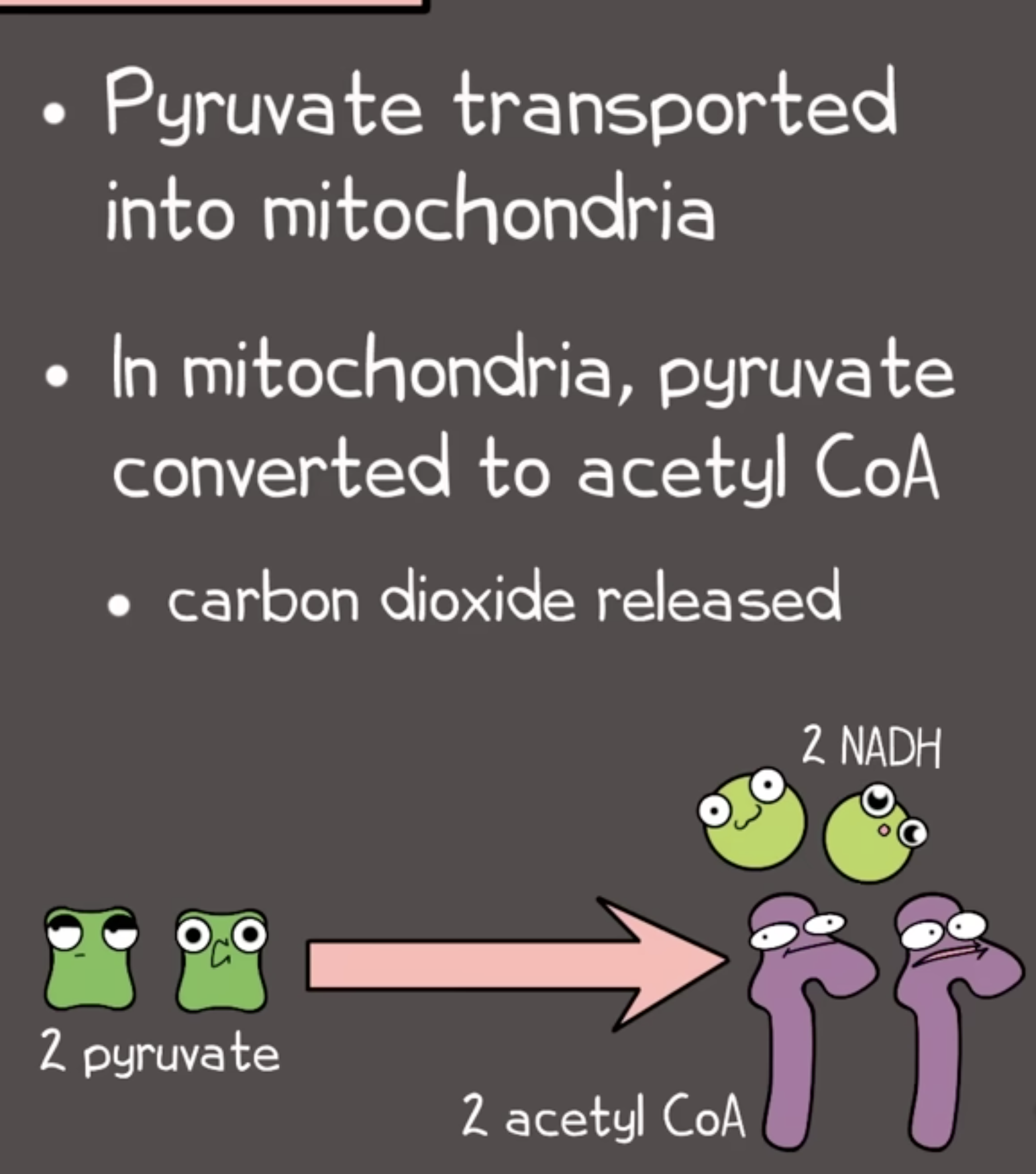
Bridge Reaction:
location
converts
produces
Mitochondrial Envelope 💌
2 pyruvate → 2 acetyl CoA
0 ATP
2 CO2
2 NADH
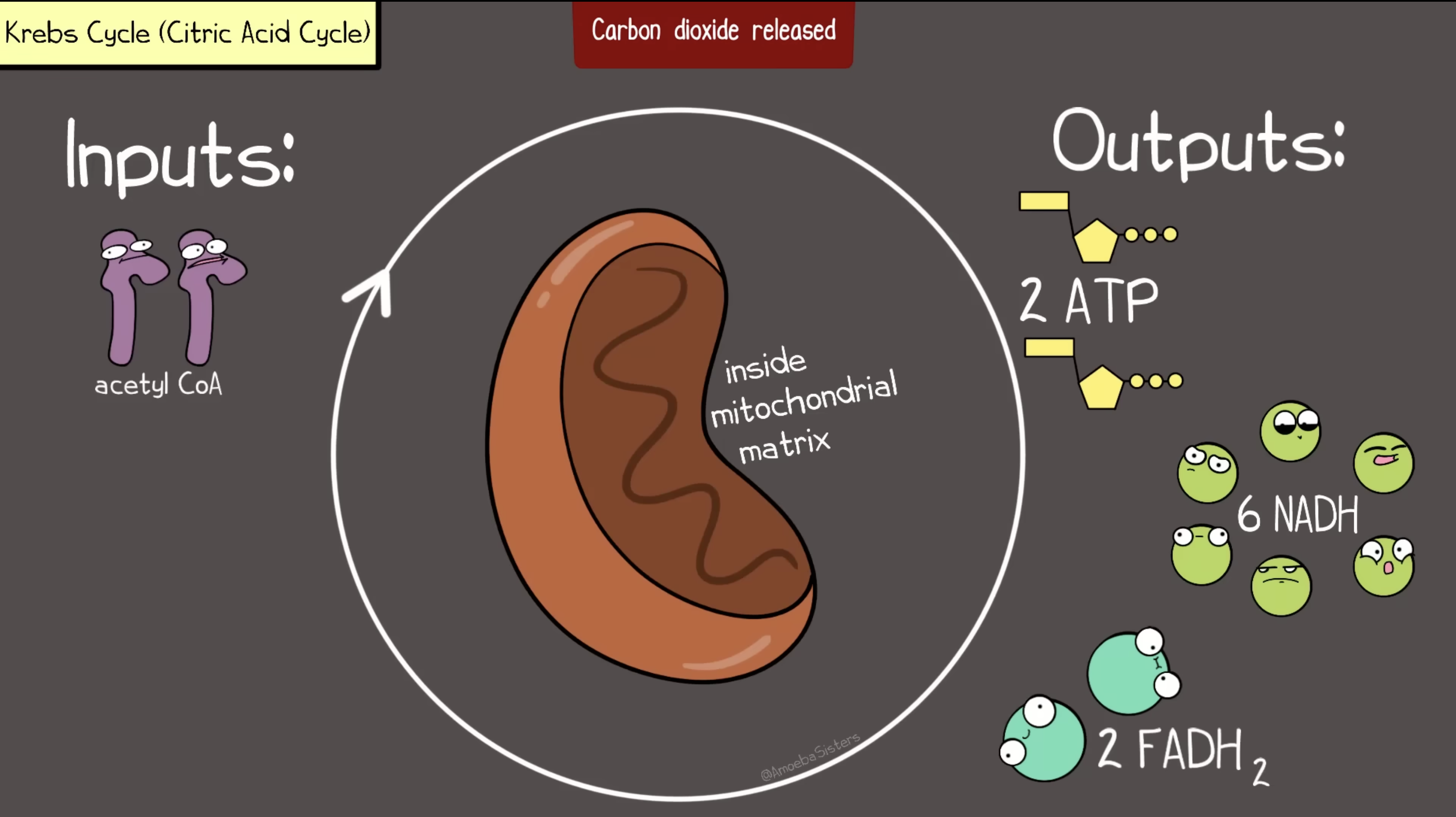
Krebs Cycle:
location
input
products (2 cycles)
Mitochondrial Matrix
2 Acetyl CoA →
2 ATP
2 FADH2
4 CO2
6 NADH
Electron Transport Chain (ETC):
location
input
output
Cristae 💎
input-
10 NADH (each 3 ATP→30 ATP)
2 FADH (each 2 ATP→4 ATP)
output-
34 ATP (32 NET bc 2 used to ship NADH)
Final H+ electron acceptor in ETC and what it produces
O2
makes H2O when H+ and O2 electrons combine
ETC series of integral proteins in the inner membrane of mitochondrion where electrons pass through to release NADH & FADH’s electrons
Cytochrome Complex
Anaerobic Cellular Resp:
need O2 & mitochondria or no?
location
converts
2 steps
neither
cytoplasm
1 glucose → 2 ATP
Glycolosis & Fermentation (Lactic or Alcohol)
Anaerobic Resp’s Glycolosis:
converts
output
1 glucose → 2 pyruvate
2 NET ATP, & 2 NADH
Alcohol Fermentation
converts
output
occurs in what 2
2 pyruvate → 2 ethanol
2 CO2
yeast & plants 🌱🍞
In Alcohol and Lactic Acid Fermentation, what give back electrons?
2 NADH
Lactic Acid Fermentation
converts
occurs in what 2
2 pyruvate → 2 lactic acids
bacteria &
animal muscle cells (when no O2)
High ATP & citric acid levels inhibit what enzyme, and resumes when they drop
Phosphofructokinase 🍋
Who coined term cell
Robert Hooke
Who invented first light microscope, seeing animalcules (protists)
Anton von Leeuvewnhoek:
3 components of Cell Theory
All cells:
are the basic units of life
comprise all organisms
all arise from preexisting ones (division)
Microscope that uses glass lenses, light, & limited mag of 40-1,000x
Light Microscope
Uses magnetic lenses & beam of electrons
Great magnification +300k
Allows to see small cells & their structure
Electron Microscope
Type of Electron Microscope that allows to see thin cell sections
Transmission (TEM)
Type of Electron Microscope that allows to see external surface of cells
Scanning (SEM)
Cells are measured in?
Micrometers μm
How big are prokaryotic cells (i.e. cyanobacteria)
1-10 μm
How big are eukaryotic cells (i.e. protists, fungi, plants, animals)
10-100 μm
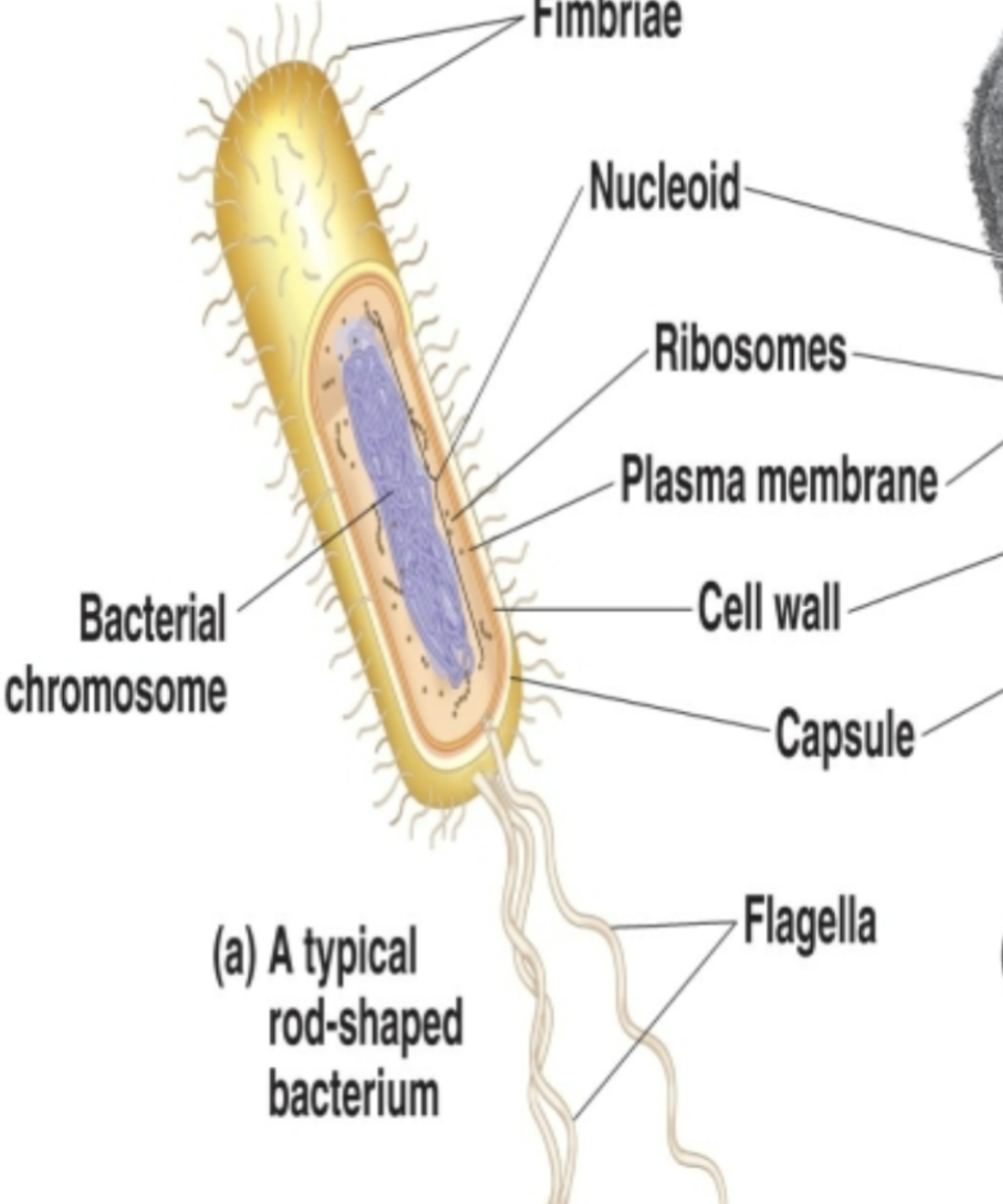
simple cells with unbound DNA
Prokaryotic Cells
Where is DNA found in prokaryotes
cytoplasm’s “nucleoid region”
Fluid of cell
Cytoplasm
phospholipid bilayer that regulates what moves in/out
Cell Membrane
What are prokaryotic cell walls made of for protection?
Peptidoglycan
Jelly like coating & what hair like structure attaches to it
Capsules; pilli
Tiny structures for protein synthesis
Ribosomes
Long whip like tails for movement
Flagella
Larger more complex cells with highly organized many organelles
Eukaryotic Cells
double membrane covering that covers some cells
Envelope
Structure that provides shape & structural support for cell
Cell Wall
Cell walls are made up of what in
algae & plants vs
fungi & slime molds
cellulose
chitin
Structure that all cells have
Cell Membrane
3 functions of cell membrane
regulates move in/out cell
give surface for chem reactions
surrounds cytoplasm to protect from external enviro
How thick is a cell membrane
7.5-10 nm thin
Plasma membrane component that:
acts as a barrier that separates cytoplasm from extracellular fluid
Phospholipids
Plasma membrane component that:
is a transport protein
integral proteins
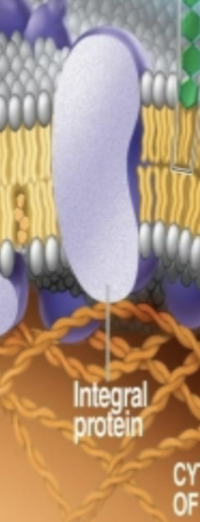
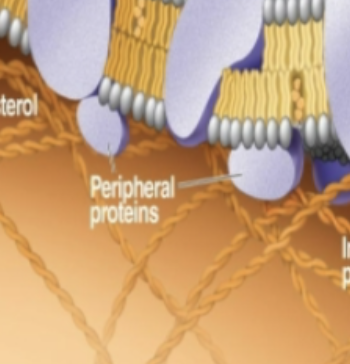
Plasma membrane component that:
is a protein for receiving chemical signals
peripheral protein
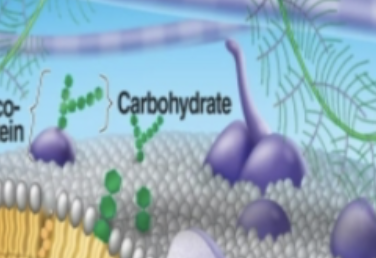
Plasma membrane component that:
is used for attachment to other cells or surfaces
Carbohydrates
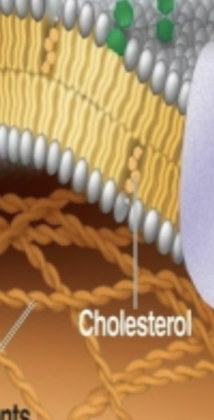
Plasma membrane component that:
holds membrane together with flexibility
Cholesterol
carbs attached to phospholipids
Glycolipids
carbs that attach to integral proteins
Glycoprotein
Control center of the cell that holds DNA
Nucleus
Fluid in nucleus
Nucleoplasm
Structure inside nucleus that produces ribosomes
Nucleolus
fluid in cell that has water & dissolved solutes
Cytoplasm
protein matrix/network that runs through cytoplasm
Cytoskeleton
Cytoplasm & cytoskeleton are found in what kind of cells?
all cells
hollow tube of tubulin protein used to separate DNA cell division
Microtubule
thin strips of protein actin used to move substances thru cytoplasm
Microfilaments
rope like fibers of keratin protein to protect against trauma
Intermediate Fibers
dense network of fine/wispy proteins that anchor cell structures in cytoplasm
Microtabeculae
Membrane bound for storage
Vacuoles
Contractile vs Central vs Fat Vacuole
Contractile vacuole: in protozoans, expels/stores water
Central vacuole: in plants, stores water & starch
Fat vacuole: in animals to store triglycerides
site of cellular resp to convert glucose to ATP
Mitochondria
What 3 cell structures have an envelope w inner & outer membranes?
Chloroplasts
Nucleus
Mitochondria
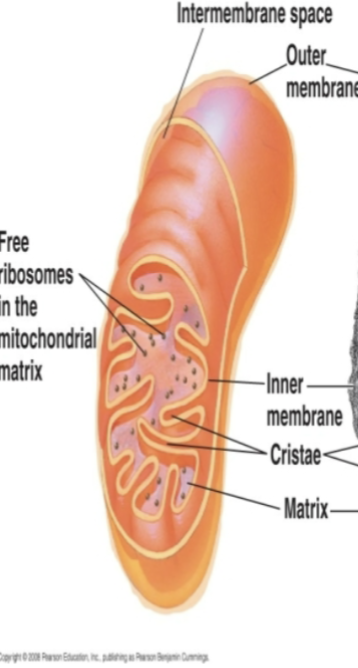
Fluid in mitochondrion
Matrix
Folds in inner mitochondrial membrane
Cristae
Site of photosynthesis in plant & algae
Chloroplast
Energy rich fluid in chloroplasts
Stroma
Chloroplast membranous disk covered by light trapping pigments
Thylakoid Disks
Chloroplast stack of thylakoid disks
Granum
Tiniest cell structure in ALL cells, site of protein synthesis
Ribosomes
What are the 2 locations in Ribosomes?
large & small subunits
Free Ribosomes vs Bound Ribosomes
free: attached to cytoskeleton proteins
bound: attached to ER
What is between the 2 subunits of Ribosomes, translating to build protein
RNA threads 🧵
Membrane bound sacs of hydrolytic enzymes
Lysosomes
digest food & waste, break down damaged cells, & destroy foreign antigens
Lysosomes
Membrane bound sacs of catalytic enzymes & where found
Peroxisomes (all eukaryotes)
breaks down hydrogen peroxide in water & oxygen
peroxisomes
Systems of wavy membranous channels with compartments that form vesicles
ER~ Endoplasmic Reticulum
Has ribosomes to process & package protein
Rough ER
Lacks ribosomes for lipid synthesis, calcium storage, & detoxification
Smooth ER