11. Language
 Call Kai
 Learn
Learn Practice Test
 Spaced Repetition
 Match
Match Flashcards
 Knowt Play
1/97

There's no tags or description
Looks like no tags are added yet.
Name | Mastery | Learn | Test | Matching | Spaced | Call with Kai |
|---|
No analytics yet
Send a link to your students to track their progress
98 Terms
Language is the means by which...
we transmit information about the past, present and future
Language is uniquely _______________
human
Which language network is critical for language production and comprehension?
left perisylvian language network
Language processing is ___________-lateralised around the __________________
left
sylvian fissure
Key areas of the left perisylvian language network
Wernicke's area - posterior end of the superior temporal gyrus
Inferior parietal lobe - including the supramarginal gyrus and angular gyrus
Inferior frontal cortex - includes Broca's area and the insular cortex
Which structures also serve as key structures in the left hemisphere network?
white matter tracts
Aphasia
deficits in language comprehension and production that accompany neurological damage
Aphasia may be accompanied by
dysarthria, apraxia
dysarthria
speech problems caused by loss of (motor) control over articulatory muscles
apraxia
Deficits in the motor planning of articulations
Broca's aphasia
speech difficulties in absence of severe comprehension problems (production problem)
Speech problems in Broca's aphasia (3)
Spontaneous speaking - uneven, effortful, telegraphic speech.
Repeating - deficits in finding and pronouncing the right word, accompanied by apraxia of speech.
Listening for comprehension - difficulty with complex syntax
How has the idea that Broca's area is responsible for speech deficits in aphasia been challenged?
Dronkers (1996):
- found that about ½ of Ps with lesions to Broca's area had Broca's aphasia, others did not have aphasia
- also portion of the insula was lesioned in all aphasia Ps
- Broca never dissected his patient's brains
- He preserved them in a Paris museum
- This allowed for high resolution MRI of two of Broca's patients (Dronkers et al., 2007) - Tan (Leborgne) and LeLong
What areas are Broca's area comprised of?
pars opercularis and pars triangularis of the inferior frontal gyrus
Leborgne's Brain
lesions went well beyond Broca's area including insular cortex and parts of basal ganglia, lesions much larger and not specific to Broca's area
LeLong's brain
lesion affected half of pars opercularis (sparing pars triangularis); narrower lesion
Wernicke's aphasia
difficulty understanding written or spoken language
Although they can produce grammatically correct speech it is often nonsense
Most severe forms of Wernicke's aphasia are seen when ______________________________ is also lesioned
the surrounding cortex in the posterior temporal lobe
The KE family
- Half the family members suffered from severe speech and language disorders (Hurst et al., 1990); developmental dyspraxia.
- Researchers found bilateral abnormalities in several motor-related regions, specifically low levels grey matter in the Broca's area and high levels in the Wernicke's areas, with a 25% reduction in the volume of the caudate nucleus.
Arcuate fasciculus and damage to this structure
large neural fibre tract connecting Broca's and Wernicke's areas
damage = conduction aphasia: Can understand words that are heard or seen, and they are able to hear own speech errors but cannot repair them. Problems producing spontaneous speech, as well as repeating speech and sometimes using words incorrectly.
Two properties of a word
1) meaning
2) spoken or written language
spoken language
a phonological (sound-based) form
written language
an orthographic (vision-based) form
mental lexicon
a mental store of info about words (brain's dictionary) that includes semantic info, syntactic info and details of word forms (spelling and sound patterns)
What does the mental lexicon include?
- semantic info
- syntactic info
- details of word forms
semantic info
words' meanings
syntactic info
how words combine to form sentences
details of word forms
spelling and sound patterns
Agreement and disagreement on mental lexicon
The mental lexicon is central to most language theories
Disagreement: Are there separate lexicons for production and comprehension?
Once we have perceptually analysed words (through sound, writing or gesture), 3 functions of mental lexicon are hypothesised
1) lexical access
2) lexical selection
3) lexical integration
lexical access
output of perceptual analysis activates word-form attributes in mental lexicon (e.g., semantic and syntactic info)
lexical selection
the representation that best matches the input is identified (i.e., selected)
lexical integration
the final stage where words are integrated into a full sentence or larger context to understand the meaning of the whole message
There are ______ organising principles of the mental lexicon
4
1) morpheme
the smallest unit of representation in the mental lexicon (smallest meaningful unit of language)
Example: the word defroster has 3 morphemes (de-fros-ter)
Organising principle of mental lexicon
More frequently used words are accessed more quickly
- Example: the word 'people' is accessed more quickly than the word 'fledgling'
3) phoneme
the smallest unit of sound that makes a difference in meaning; words are clustered together in the lexicon that differ by a single letter or phoneme (e.g., bat, hat, cat, sat)
Organising principle 4 of mental lexicon
Representations in the mental lexicon are organised according to semantic relationships between words
- Ps are faster to identify a target word (e.g., truck) after being primed with a semantically related word (e.g., car)
Semantic organisation is indicated by...
faster reaction times after priming
Neural substrates of mental lexicon: Martin et al. (1996) found that there are separable brain networks for...
biological vs. human made objects
Biological object network
- composed of lateral fusiform gyrus
- superior Temporal Sulcus,
- areas implicated in early visual processing (medial occipital lobe)
Human-made object network
medial fusiform gyrus, middle temporal gyrus, premotor area
Other studies indicate a network that connects the __________________ to the ___________________________
inferior temporal lobe (i.e., the posterior fusiform gyrus)
left anterior temporal lobe
Tyler et al. (2011) - domain specific vs. domain general level; which is faster and why is this?
What lesions are involved?
Was the same found with control Ps?
- Domain-specific level (Tiger or Knife)
- Domain-general level (Living or Non-living)
- Naming is faster for domain general - only need a subset of the features
- Living things have more features
- Harder to distinguish between living things than to distinguish between objects
- Patients with lesions to the anterior temporal lobes can not reliably name living things at the specific level (e.g., tiger or zebra).
- Indicates impairment in the integrating more detailed semantic information.
- Similar results are observed in studies of neurologically intact participants.
Which of the previous naming modulates anterior temporal lobe activity?
domain-specific but not domain general activity
Domain specific naming timecourse
EEG and MEG studies show a time course where domain specific naming occurs at about 300ms after stimulus onset
With spoken input/understanding speech, the listener must...
identify and distinguish relevant speech from other sounds
There are +/- __________ phonemes in English
40
From birth, infants can...
distinguish between any phoneme, in any language
Babbling has...
all phonemes but becomes more like native language over time
After the first year....
production/perception of nonnative phonemes goes away
What is the segmentation problem?
how do we detect the breaks between phonemes in spoken language?
How is the segmentation problem solved?
- We use rhythm and pitch (i.e., prosodic information) - working out where one word ends and another begins
- We also use the stress placed on the first vs. second syllable.
Speech is first processed in the
primary auditory cortex - high sensitivity to all auditory input
The further away from this area, the...
more specialised regions become to speech
Written input: Reading Words - when we learn to read, we are learning to link...
arbitrary visual symbols to meaningful words
In order to read, we must be able to analyze
the primitive features of visual symbols
Selfridge's (1959) model
proposed a highly influential model for visual stimulus processing (Pandemonium model)
bottom up and implied we process each letter serially
Image demon - receives sensory input
Feature demon - decode specific features e.g., vertical lines, right angles, continuous curves
Cognitive demons - 'shout' when receive certain combinations of features
Decision demon - 'listens' for loudest shout in pandemonium to identify input
McClelland & Rumelhart (1981)
- proposed a top-down model
- Unlike Selfridge's model, this model implies parallel processing (simultaneously processing each letter in word and the features of the letters)
- word layer, letter layer, feature layer
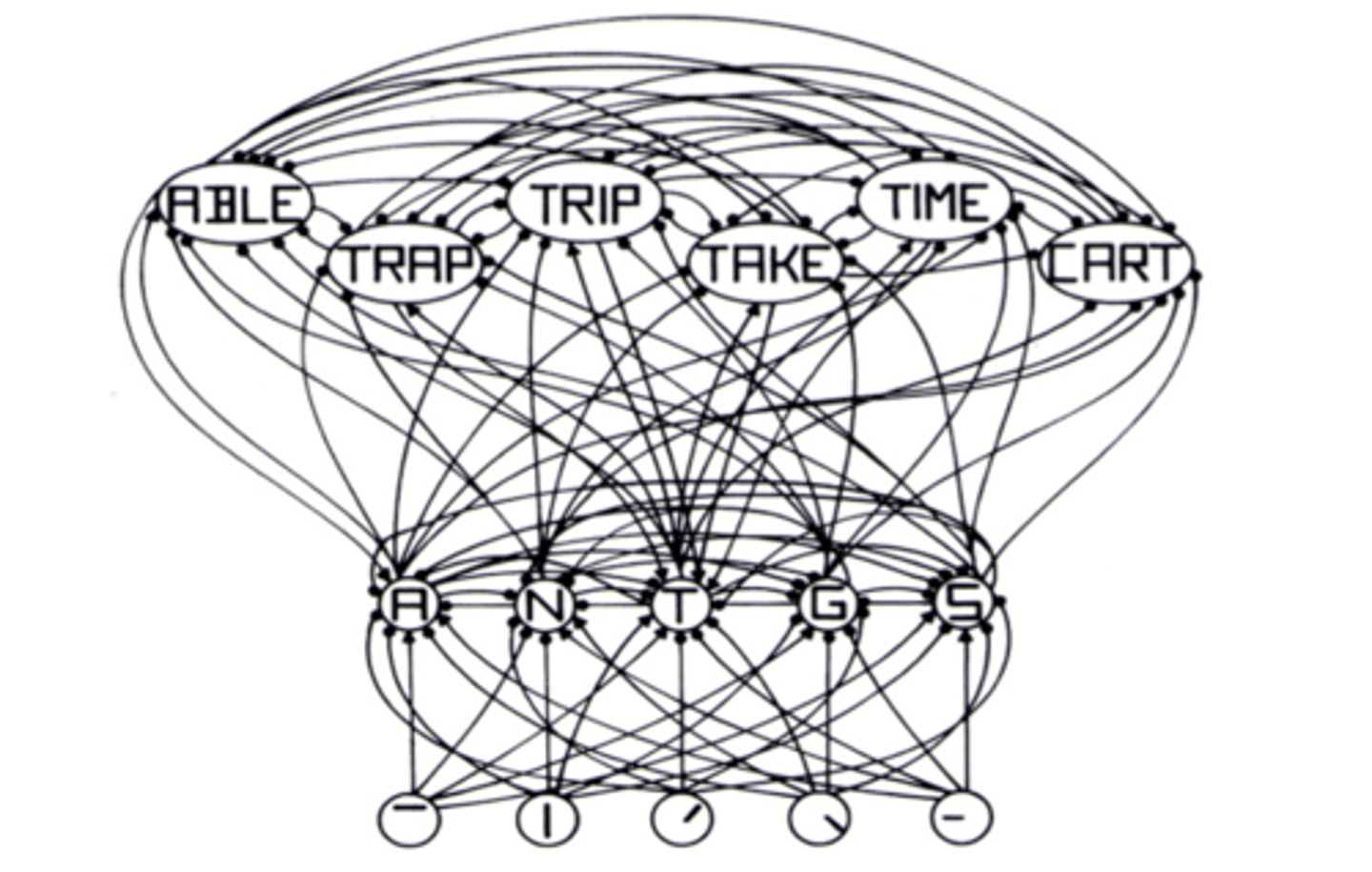
The VWFA
- The identification of orthographic units may take place in a part of the L. occipitotemporal region, called the visual word form area (VWFA)
- Its counterpart of the right side is the FFA
- Early PET studies showed the VWFA preferentially activated for word strings.
- Puce et al. (1996) found regions in the L. occipitotemporal region were activated by letter strings (vs. faces).
Cohen et al. (2000): words vs. non-words
- combined EEG and fMRI to map the spatial and temporal dynamics of reading.
- Showed Ps words and non-words and asked to repeat the word out loud.
- 150-160 ms: words and non-words both produced a negative deflection contralateral to hemifield.
- 180-200 ms: left lateralized negativity driven by VWFA activation.
- 240-360 ms: differences between words and non-words emerge driven by activity in the L. temporal lobe
The visual word form area is in the ________________________, whereas the fusiform face area is in the _______________________
left occipitotemporal lobe; right occipitotemporal lobe
Bouhali et al. (2014) - VWFA, FFA and connection to left perisylvian language network
used DTI (looking at white matter tracts) to examine how the VWFA and FFA are connected to the left perisylvian language network
VWFA (but not the FFA) is strongly connected to the left perisylvian language network
Later steps in language comprehension: questions about context
- Does context influence word processing before or after lexical access and lexical selection?
- E.g., the tall man planted a tree on the bank
- When does the sentences context influence activation multiple meanings of the word 'bank'?
- Do both the contextually inappropriate and appropriate become briefly activated, regardless of context?
- Does context constrain activation to contextually appropriate words?
Two types of representations are relevant to words in context
- Lower-level representations based on sensory input - identification of the word "bank"
- Higher-level representations - constructed from the context preceding the word "bank"
- Both lower and higher-level representations are important and at some point, they must interact
There are three types of models that explain how these lower and higher-level representations influence word comprehension, which are
1) modular models
2) interactive models
3) hybrid models
modular models
bottom up, no interaction between levels
higher-level representations cannot influence lower-level ones
interactive models
- both lower and higher-level representations can influence word recognition in parallel
- in these models, context can constrain the availability of word-form representations in the lexicon before sensory input. (e.g., McClelland's model)
Hybrid models
- sit in between modular and interactive models
- lexical access = modular
- lexical selection = interactive
- information is provided about word forms that are possible given the preceding context, thereby reducing the number of activated candidates.
Zwitserlood (1989): the principle behind cross-modal lexical decision task
- Target stimulus: auditorily presented word (e.g., general, generous)
- During the auditory priming participants are also visually primed with a related or unrelated word (army primes general, gift primes generous)
- The visual prime comes before or after the uniqueness point (i.e., vowel after "R", where words differ)
- Before the uniqueness point both possibilities (general and generous) should be activated
- After that point, visual priming of related words should facilitate word recognition
Cross-modal lexical decision task also used in context of short passages of text
- Target Word: Captain
- Auditory Competitor: Capital
- Before the uniqueness point (p) either the target word or competitor is likely to occur.
- Visual primes (before or after the uniqueness point) could be related to captain (e.g., ship) or unrelated to captain but related to capital (e.g., money)
- "With dampened spirits the men stood around the grave. They mourned the loss of their captain."
- Is the visual prime a word? (Y/N)
- Ps were significantly faster to say ship is a word (vs. money)
- Even when the whole word wasn't spoken yet (before the uniqueness point)
Cross modal lexical decision tasks conclude that
lexical selection is influenced by context
fMRI studies show that lexical access and lexical selection involve
- The superior temporal gyrus (STG)
- The middle temporal gyrus (MTG)
- And the dorsal IFG
Left MTG and STG are important for
translating word sounds into meaning
Dorsal IFG becomes more important during...
lexical competition
syntax
the way in which words in particular language are organised into grammatically permitted sentences
Grammar
collection of structural rules that govern composition of words, phrases and sentences in a particular natural language
Processing the structure of a sentence: semantic processing helps...
understand the meaning of an ambiguous word like "bank" coming at the end of a sentence
Every sentence has a syntactic structure - what is this?
we assign a word to a part of that syntactic structure
Semantic processing is linked to the ____________ wave
N400
By including a word in all capitals, we can identify whether EEG effects are due to....
surprisingness or violation of semantics
Neural generators of N400
- reduced and delayed in those with left-hemisphere damage and severe comprehension deficits; left laterality
- Intracranial recordings from the temporal lobe find an N400 like component
- MEG and fMRI studies also suggest the left temporal lobe is the likely neural generator of the semantic N400
Syntactic processing is linked to the _______ wave, also called ___________
This is present for
P600
syntactic positivity shift (SPS)
grammatically correct vs. incorrect sentences
Syntactic processing network
left inferior frontal gyrus; bilateral superior temporal brain regions
Neural model of language comprehension
- Memory-unification-control model (Hagoort, 2005)
- Divides language processing into three functional components: Memory, Unification, Control
component one of language comprehension - memory
- language-specific knowledge that is encoded and consolidated in long-term memory.
- Knowledge about the building blocks of language (e.g., phonemes, morphemes)
component two of language comprehension - unification
Integration of retrieved phonological, semantic, and syntactic info into a representation of an utterance
component three of language comprehension - control
language in social situations (e.g., bilingualism, taking turns in a conversation)
Areas involved in memory for language comprehension
Temporal lobes are important for storage and retrieval of word representations - Wernicke's area
Areas involved in unification for language comprehension
Left inferior frontal gyrus is important integrating info - Broca's area
Areas involved in control for language comprehension
ACC and DLPFC play a big role during cognitive control in language comprehension
left perisylvian language system - major language comprehension pathways
- there are 4
- Ventral pathways important for comprehension word meanings.
- Dorsal pathway that connects to the premotor cortex (speech prep).
- Dorsal pathway connects Broca's area (esp. BA44) with the STG and STS (syntactic processing).
Neural models of speech production (Levelt, 1989): 3 steps
1) prepare the message
2) put message in grammatically and phonologically correct form
3) articulate the message
Step 1: macroplanning
what you want to express
Step 1: microplanning
how you plan to express it
Nature of Levelt's model for language production
- Each stage in Levelt's model for language production occurs serially, and its output representation is used for input to the next stage
- Model avoids feedback, loops, parallel processing and cascades
- Early stages of model fit well with findings of ERPs recorded intracranially
Hierarchical state feedback control (HSFC) model
- combines motor and psycholinguistic approaches to speech production.
- Begins with the activation of a conceptual representation.
- This activates a word representation.
- Then parallel processing in sensory and motor systems.
- Once a word is activated projections to the motor and sensory systems occur in parallel
- The highest level (syllables) - integration of motor programs in Broca's area with the primary auditory cortex.
Lower level - articulation of speech. Motor production of phonemes integrated with somatosensory information.
Evolution of language
- Nonhuman primates' vocalisations can carry meaning and show evidence of rudimentary syntax
- In general, however, animal calls tend to be inflexible, associated with a specific emotional state, and linked to a specific stimulus
- Some researchers suggest that human speech and language evolved from hand gestures, or a combination of hand gestures and facial movement
- Greatest evolutionary brain changes we know of involve the size and function of the left temporal cortex, and, importantly, how this cortex is interconnected with inferior frontal and parietal cortex