Dynamics of Healthcare Rutgers Course Exam
 Call Kai
 Learn
Learn Practice Test
 Spaced Repetition
 Match
Match Flashcards
 Knowt Play
1/68

There's no tags or description
Looks like no tags are added yet.
Name | Mastery | Learn | Test | Matching | Spaced | Call with Kai |
|---|
No analytics yet
Send a link to your students to track their progress
69 Terms
Major Historical Effects in Healthcare
- ACA (2010)
- Arrival of Antibiotics (1940s)
- Implementation of Childhood
Universal Vaccination (1950s)
- Implementation of Medicaid and Medicare
Affordable Care Act
Signed into law in 2010 by Obama, aimed to increase access to health insurance while keeping healthcare costs down
Who is most likely to remain uninsured after the ACA?
- Non-elderly adults with income below 200% of the Federal Poverty Level whose employer doesn't provide health insurance
- Those unable to buy insurance because of the cost of premiums
- Hispanic, American/Alaskan Natives, and those living in the South and West in states that didn't expand Medicaid
Arrival of Antibiotics
1940, one of the things that signaled the end of the dominance of acute infectious diseases
Implementation of Childhood Universal Vaccination
1950, also one of the things that signaled the end of the dominance of acute infectious diseases.
- Public health program to prevent communicable diseases through vaccination programs
- Eliminated childhood infectious diseases such as measles, mumps, rubella, meningitis, hepatitis A and B, and polio
Implementation of Medicaid and Medicare
Implemented in 1965
- Medicaid: Insurance for the low incomed
- Medicare: Insurance for elderly adults 65 years or older
Healthcare Trends regarding Insurance
- In 2008, 17% of the population was uninsured
- In 1027, 10% of the population was uninsured
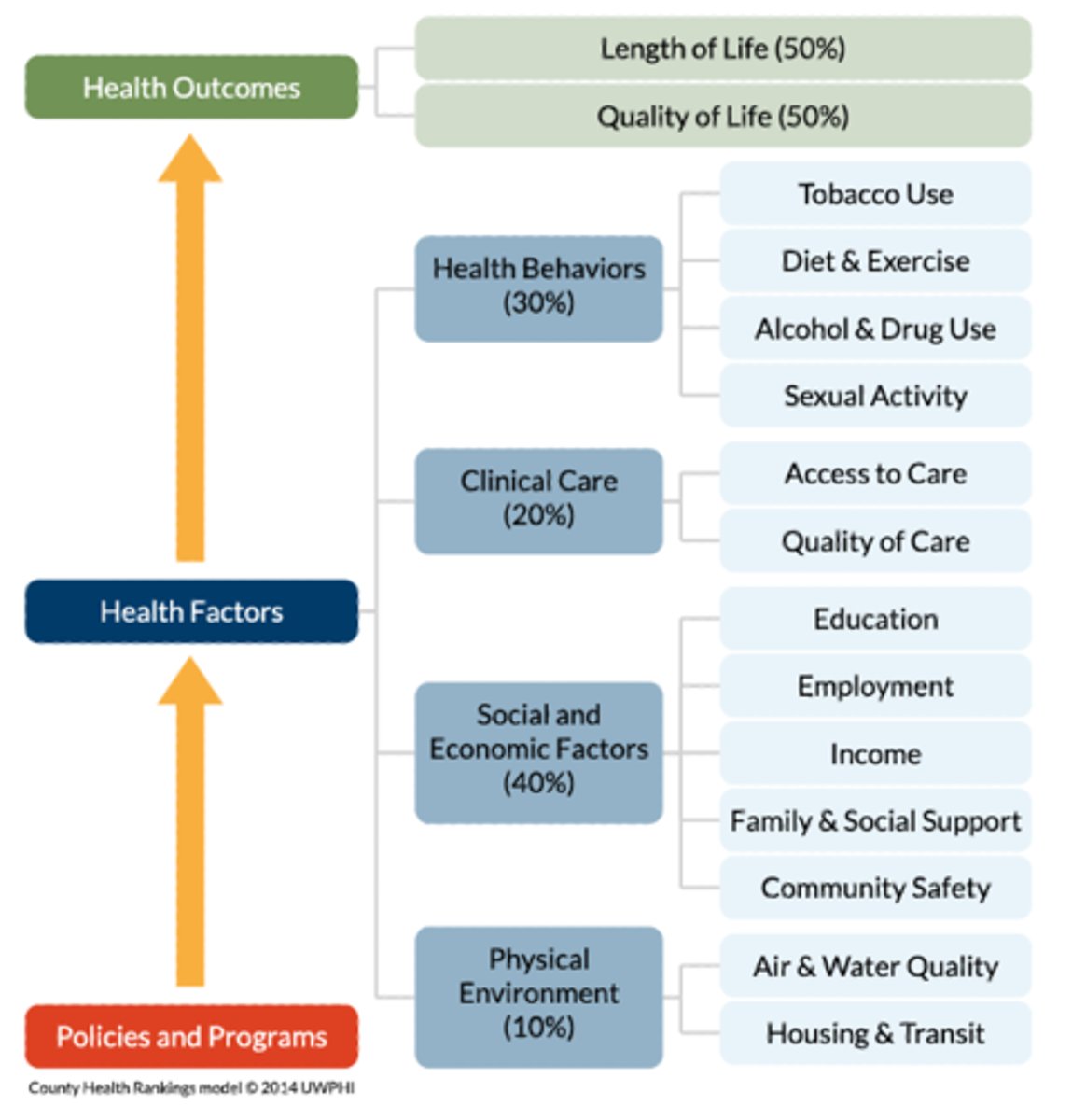
County Health Rankings
Technological Impact on Healthcare
- Improvement on sanitation and hygiene (systems for safeguarding food and drink)
-Better personal hygiene
-Improvement of nutrition
- Better surgical techniques
- New treatment methods
- New tests to facilitate accurate diagnoses
- Treatment of individual diseases
Overview of the US Healthcare System
The healthcare industry is a complex system that provides services:
- Diagnostic
- Therapeutic
- Preventive
No centralized healthcare delivery system in the United States!
Service providers for the US Healthcare System
Hospitals, clinics, government and volunteer agencies, pharmaceutical and medical equipment manufacturers, and private insurance companies
Categories of Healthcare Services
- Health promotion
- Disease prevention
- Diagnosis and treatment of illness
- Rehabilitation
- Chronic care
Healthcare Facilities
Places where persons involved in health industry work:
- Hospitals
- Health practitioner offices
- Free clinics
- Nursing and residential facilities
- Home health services
- Outpatient clinics
- Laboratories
- Ambulatory healthcare centers
- Government agencies
- Health departments
- Rehabilitation centers
Federally Qualified Health Centers (FQHC)
-Comprehensive safety net of primary and preventive care
- Nearly 1,400 centers in the United States
- Assistance in recruiting and staffing primary care providers through National Health Service Corps
- Patient-Centered Medical Home (PCMH) model
Privately Funded Free Medical Clinics (FMCs)
- Nonprofit, community-based or faith-based organizations
- National Association of Free & Charitable Clinics (NAFC)
- Receive little or no state or federal funds
Development and Services of Hospitals
- Key resource and center of the US healthcare system
- Deliver primary patient care
- Train health personnel
- Conduct research
- Disseminate information to consumers
- Accelerating technological advances and changing social factors have thrust hospitals into the grasp of big business
Hospital Facts
- Hospitals are the second-largest business in the United States.
- They employ approximately 40% of healthcare personnel.
- Their collective payroll accounts for at least one-third of the nation's health expenditures.
- Approximately 41% of federal health monies go to hospitals as reimbursement for patients who are enrolled in Medicare or Medicaid.
Development of Hospitals
- First hospitals were started around the civil war
- Emerged from almshouses
- Before the 1920s, doctors donated their services, and nurses and other staff revived low pay
- Social Security Act of 1965: Medicaid and Medicare provided a source of funds to hospitals
Ambulatory Care
- Care that is provided outside of institutional settings
- Most frequent contact that most people have with the healthcare system
- Principal health practitioners include: Physicians, nurses, dentist, medical lab technicians, physical therapists, medical and nursing assistants
Behavioral Health Services
- Mental health facilities began as warehouses for large numbers of poor, homeless, and social misfits
- Major breakthroughs led to the real treatment of mental illnesses
- National Institute of Mental Health (NIMH) created in 1945
- Development of psychophamaceuticals in the 1950s
- Community Mental Health Act of 1963
- Denistituionalization, drug addiction, opioid crisis, private health insurance limited treatment of metal illness and substance abuse
Consumer Rights
Patient's Bill of Rights
- Developed by the American Hospital Association (AHA) in 1973
- States the responsibilities of the hospital and staff toward patient and their families
- Patient Care Partnership replaces the Bill of Rights in 2003
- One of the patients most important legal rights is informed consent
Mission of the US Department of Health and Human Services (HHS):
To enhance and protect the health and well-being of all Americans by providing for effective health and human services and fostering advances in medicine, public health, and social services.
What is Health and Human Services responsible for?
- Medicare and Medicaid
- Public health
- Biomedical research
- Food and drug safety
- Disease control and prevention
- Indian health services
- Mental health services
Public Health Services
Focus on the community instead of the individual. Emphasis is on prevention in contrast to medical care in which the emphasis is treatment of disease
21st Century Healthcare
Healthcare system has undergone broad and often drastic changes
- Led to thousands of new jobs
- Created new professions
- Provided care to millions
Challenge to formulate a workable, affordable system for everyone
Healthcare Financing
Funded through a variety of private payer and public programs
Payments to Healthcare Providers
- Prior to the ACA: Fee for Service
Payment for each service at the time of service
Doctor, hospital, or clinic is finacially rewarded for volume rather than quality and cost control (value)
- After ACA: Capitation
Paying the practitioner or hospital a fixed amount for a specific service
Government funded health insurance
-Medicare and Medicaid
Benefit one in three Americans
History of Health Insurance in the US
- Government-sponsored healthcare efforts were initiated between 1915 and 1920 at the state level and in the 1930s at the federal level
- The most significant change in government healthcare financing was when Congress approved Medicare and Medicaid.
- First private hospital insurance plan was developed in 1929
- Demand for health insurance increases as medical technology advances
- Distributive health care
Changing the healthcare system, creating different ways of paying for health care
Managed Care
System in which employers and health insurers Chanel to the most cost-effective site of care
Health Maintenance Organization (HMO)
- Prepaid health insurance that only covers care provided by those inside the HMO network
- Patients must have a referral from a primary care provider to see a specialist.
- Consumer's cost is generally less than other facilities
- Physicians and providers agree to provide services for a specified cost, often with a cap on total patient visits or procedures during a benefit period
Private Health Insurance in the US
- Workers and employers share in the cost of premiums
- Most plans require copayments or co-insurance for office visits, hospitalizations, outpatient surgery, and prescription drugs
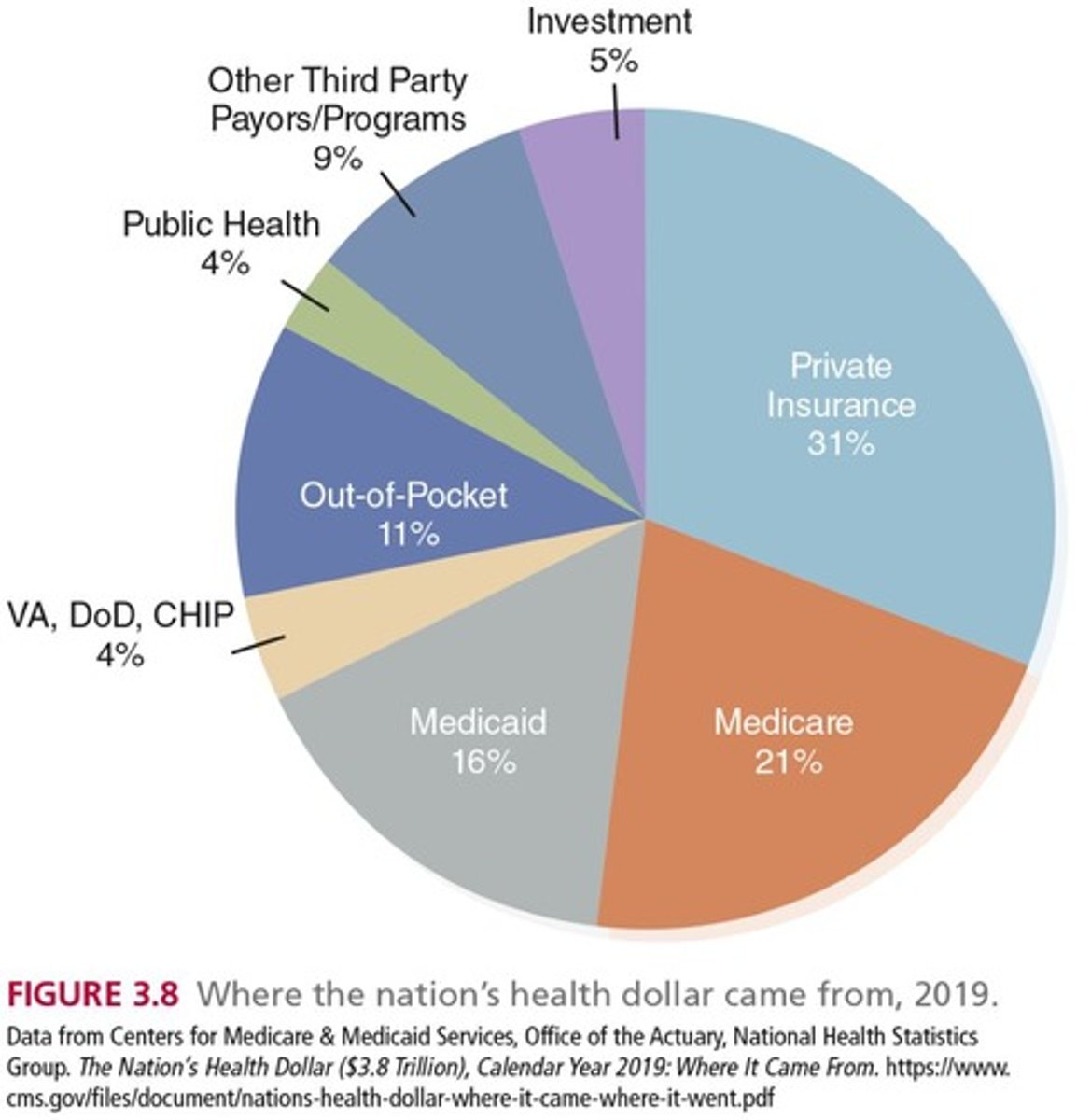
Healthcare Expenditures
Where the money went:
Hospital Care
Physician and Clinical Services
Home Health, Personal Care, Other
Prescription Drugs
Government Administration
Nursing Homes and Continuing Care
Investment
Dental Services
Other Professional Services
Effect on Healthcare Providers
- Changes in the way health care is being paid for in both the public and private sectors will impact healthcare personnel and career opportunities
- More healthcare services are being delivered in the community instead of in hospitals, nursing care facilities, and other institutions
- Healthcare workers can expect to find more jobs in clinics, ambulatory care centers, and home care agencies than in institutions
Future Demographic Changes and the Impact on Healthcare Needs
- The population 65 years of age and older will continue to increase dramatically through the year 2030
- More services will be required for the treatment of chronic and acute health conditions and disabilities
- Medicare beneficiaries with multiple chronic conditions
The common health problems of an aging population
- Chronic diseases are defined as conditions that last 1 year or more and requires ongoing medical attention, limit activities of daily living, or both
Most common chronic diseases in the elderly
- Arthritis
- Stroke
- Diabetes
- Chronic lower respiratory diseases
- Dementia
- Alzheimer's disease
Those with chronic diseases may have pre-existing health problems:
- Alcoholism
- Substance abuse
- Mental illness
- Developmental disabilities
Medicare
- Covered benefits apply mostly treatment of patients with acute illnesses who requires hospitalization and short-term skilled nursing care: Rehabilitation centers, nursing homes, home healthcare
- Medicare is divided into four parts: Deductibles and copayments
Medicaid
Medicaid-covered benefits:
Medicaid covers a broad range of services not covered by Medicare
Acts as supplemental insurance for the elderly and disabled
Pays their Medicare Premiums
Covers prescription drugs
Long Term Care
The help needed by people of any age who are unable to complete basic activities of daily living because of physical and/or mental impairment
Community Programs for Older Adults
Privately funded, long-term care providers that are regulated by federal and/or state governments in addition to nursing homes include
- Adult day care
- Residential care communities
- Home health agencies
- Hospice
Future Healthcare Professionals
- The future of health services will be concentrated among older and very old people
- This fact has important implications for the education and training of all healthcare personnel
- The impact of these changes will have an increasing role in the delivery of health care and on the economy of the United States
Overview of Healthcare Reform
Patient Protection and Affordable Care Act was modified by the Health Care and Education Reconciliation Act of 2010 --> Known as Affordable Care Act (ACA) or Obamacare
Affordable Care Act
ACA of 2010 was the most significant healthcare reform legislation in the United States since 1965, when Medicare and Medicaid were passed
Three goals of ACA
Decrease the number of the uninsured
Slow the rising costs of healthcare
Increase the quality and efficiency of healthcare
Access to Healthcare
- As a July 2020, Medicaid expansion has been adopted in 38 states
- Coverage gap for those with incomes too high to qualify for Medicaid and too low to qualify for premium subsidies
Medical Technologies
- Medical technology includes a multitude of products used to diagnose and monitor human conditions and diseases
- This technology also is available to treat diseases that were once considered high risk or even fatal and includes instruments used to perform less invasive operations
- Explain the concepts of confidentiality and security in protecting patient health information
Examples of Medical Technologies
- New medical and surgical procedures
- Drugs
- Medical devices
Health Information Technology
- Healthcare practitioners need the right information at the right time in order to make the right decisions
- Leveraging the many forms of health IT influences the probability of this happening
Health Insurance Portability and Accountability Act (HIPAA)
Governs all healthcare billing transactions. It establishes security and privacy standards
Electronic Health Records
- Refers to an individual patient health record stored in an computer database for easy access by physicians and other healthcare workers
- The information contained in the record is real time and offers a snapshot or picture of the patient's condition and treatment
Healthcare Workers Strong Traits
A strong desire to help others, a genuine concern for welfare or patients and clients, and the patience and emotional maturity to deal with people of diverse backgrounds in stressful situations
Three Categories of Health Care
Heathcare Practioners and Technical Occupations
Healthcare Support Occupations
Community and Social Service Occupations
Healthcare Practitioners and Technical Occupations
Diagnose or treating practitioners
- Provide direct clinical care
Healthcare Support Occupations
Represent the largest number of healthcare workers
- Typically under the supervision of clinical practitioners such a physicians, RNs, physical therapists, or dentists
Community and Social Service Occupations
Professionals who work with individuals to assist them in obtaining needed care or services
Projected Demand for Healthcare Personnel
- Health care provided 18 million jobs for wage and salary workers in 2018
- Projected to generate 2.4 million new jobs between 2019 and 2029
- Demand for healthcare personnel is expected to increase by 15% between 2019 and 2029 compared to 4% increase for all occupations
Employers of Healthcare Professionals
- Hospitals
- Offices of health practitioners
- Nursing and residential facilities
- Home health services
- Outpatient, laboratory, and other ambulatory services
Health Careers
- The health field, perhaps more than any other career area, offers wide-ranging opportunities to match almost any interest
- A health career does not automatically mean a hospital job or care of the sick
-Science and mathematics are required for some healthcare jobs, but many others do not emphasize these subjects
- Some health occupations take many years of preparation; others require two or fewer years of preparation to practice
- The cost of training must be balanced against what one can earn
- Don't sell yourself short—If you fear that training may be too hard for you, think twice
Common Core Knowledge
Health care is dynamic and complex that requires training in not only the science but also the intricacies of interpersonal skills
Medical Terminology
Anatomy and Physiology
Technical Skills
Infection Control
Medical Math
Communication (verbal, written)
Professionalism
The conduct, character, skill, and judgment of a trained person
Legal Concerns in Healthcare
Ethics and Confidentiality
Ethics
The study of moral choices that conform to standards of conduct
Code of ethics is a written lsit of a profession's value and standards of conduct (Hippocratic Oath)
Confidentiality
Refers to the healthcare professional's obligation to maintain patient information in a manner that will not permit dissemination beyond the healthcare provider
Two main legal issues
The legal right to practice in a particular health profession and staying out of trouble that might result in a lawsuit
Licensing
A right conferred by a governmental body to practice an occupation or provide a service
Certification
An action or process of providing an individual with an official document
Negligence
Someone failing to do something that a reasonably prudent person would do in the same or similar situation
Continuing Education Requirements
Because healthcare is always changing, healthcare professionals are called upon to learn new information