Biology - Final
 Call Kai
 Learn
Learn Practice Test
 Spaced Repetition
 Match
Match Flashcards
 Knowt Play
1/28

There's no tags or description
Looks like no tags are added yet.
Name | Mastery | Learn | Test | Matching | Spaced | Call with Kai |
|---|
No analytics yet
Send a link to your students to track their progress
29 Terms
What 7 explanations have been proposed about "The Problem of Altruistic Behavior" of animals? Which is believed to be the most common and important?
Mistakes
Apparent altruism is misplaced selfishness
Mexican free-tailed bats
Exploitation by natural enemies
Manipulated by a selfish, co-evolved natural enemy
Hosts feeding cuckoo chickens / intraspecific brood parasitism
Parental manipulation
white-fronted bee eaters
Group selection
almost universally rejected
Long-term selfishness
Florida scrub jay helpers
Reciprocity
time delayed mutation
rare because it requires advanced cognitive ability
Primate groomers, vampire bats
Kin selection → most common & important
What is Hamilton’s rule?
Helps us see how both genetic & ecological factors affect whether or not altruistic behavior is favored by NS
Altruism will be favored when:
rB > C, where
B = benefit to the recipient
C = cost of altruist
r = coefficient of relatedness
Define population as according to genetics & ecology
Genetics - an interbreeding group of individuals comprising one gene pool
Ecology - a group of individuals living in a particular place
What are the 2 "Primary Population Parameters" that decrease a population
Mortality
Emigration
What are the the 2 "Primary Population Parameters" that increase a population
Natality & Immigration
What are the basic measures of population ecology
Range
Abundance
Dispersion
Density (#/area)
crude vs. ecological
crude measures population size relative to the entire habitat area
ecological measures population size relative to the specific, habitable space actually used
absolute vs. relative estimate
What is the name of the interspecific interaction type in which:
(a) both species benefit
(b) one species benefits & the other is harmed
(c) both species are harmed
(a) mutualism
(b) predation/parasitism
(c) competition
What are the density-independent factors & density-dependent factors
Density-Independent: Usually physical (climatic factors)
Density-Dependent: Usually biological
Intra-specific vs. Inter-specific interactions
Positive density dependence (allee effect)
the more there are, the more are born
Negative density dependence
the more there are, the less are born (limited amount of food)
Give one of the population growth equations for exponential growth
Nt = N0R0t
Nt = N0ert
dN/dt = rN
Give the Pearl-Verhulst Equation for logistic growth of a population
dN/dt = rN (K-N/K)
What is the difference between Physiological Longevity & Ecological Longevity
P → potential longevity in absence of negative factors
E → actual longevity in the natural environment
Draw a graph showing the three different Survivorship Curves
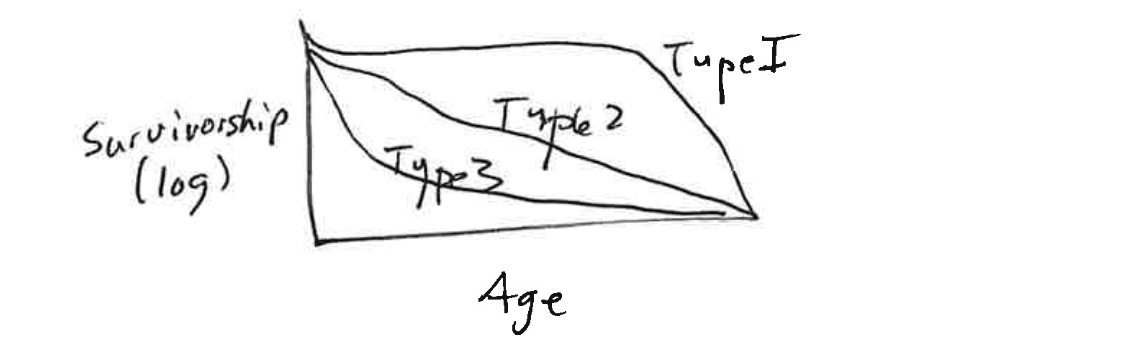
What survivorship curve is typical of mammals?
Type 1
Draw a Natality (Fertility) Curve for mammals
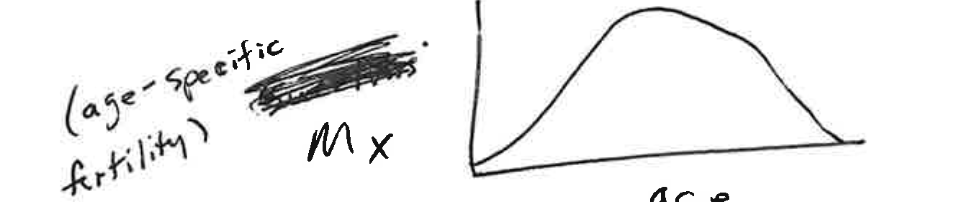
Draw an age pyramid that would be indicative of a population that is increasing in numbers
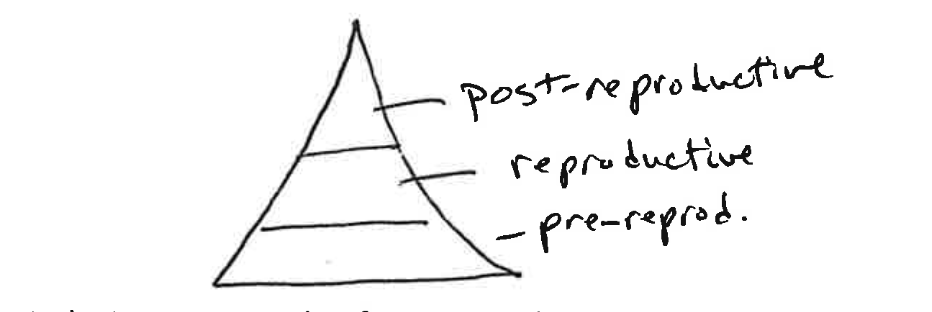
Give an example of a country that has an age pyramid such as the one in question 9
India
In the context of Interspecific competition, what is an “alpha”
Effect of a member of species 2 on species 1
From the graphical models of Interspecific Competition, what are the 4 possible outcomes
Species 1 wins
Species 2 wins
Unstable Equilibrium - one will win, but could be either
Stable co-existance
State “Gause’s Competitive Exclusion Principle”
“Complete competitors cannot co-exist”
List 5 patterns that suggest interspecific competition had gone on in the past, & give 1 example
Niche differences in sympatric close relatives → English titmice
Niche differentiation in guild members → rodents & ants (seed-eaters)
Character displacement → Galapagos Finches
Character release → pigeons in S.E. Asian islands
Abrupt species changes along environmental gradients → N. Guinea Warblers
What pattern