Eye witness Testimony - Leading Questions, Post-event discussion + Anxiety
 Call Kai
 Learn
Learn Practice Test
 Spaced Repetition
 Match
Match Flashcards
 Knowt Play
1/23

There's no tags or description
Looks like no tags are added yet.
Name | Mastery | Learn | Test | Matching | Spaced | Call with Kai |
|---|
No analytics yet
Send a link to your students to track their progress
24 Terms
Eye whitness testimony
Evidence provided in court by a person that witnessed a crime or event, with a view to identify the perpetrator of the crime or details of the event. It lacks accuracy as Ratter (1988) reviewed 205 cases of wrongful conviction and found 52% were due to mistaken eye witness testimony
Post-event discussion
Occurs when an eyewitness discusses what they’ve seen with co-witnesses or other people and this discussion may lead to contamination of the original memory, reducing the accuracy of recall
Why does post-event discussion impact EWT accuracy?
Witnesses often conform their memories with others to win social approval or because they believe others are correct. The actual memory remains unchanged, the individual just experiences memory conformity
Gabbert et al (2003) Research - PED - Procedure
Pts were put in pairs. Both were shown a film of the same crime, but each pts saw it from a different angle and therefore saw different elements of the crime. These pairs were then split between two conditions: pts able to discuss the film with their partner before completing a recall test and pts not able to discuss the film before completing a recall test.
Gabbert et al (2003) - PED - Results
71% of pts in the discussion condition recalled elements of the crime they had not seen in their video (but had picked up in the discussion) - therefore post-event discussion can have a significant impact on EWT accuracy.
Leading Questions
Questions phrased in a way to suggest a certain answer, causing EWT to be less accurate as suggestion in question influences answer. Eg) It was a white van, right?.
Why do Leading Questions impact EWT accuracy?
The response bias explanation suggests the question wording does not impact the memory itself, but it does influence the eyewitness’s decision about their answer.
The substitution explanation suggests that the wording of the question changes the eyewitness’s memories and substitutes elements remembered for elements suggested by the questions.
Loftus + Palmer (1974) - LQ - Procedure
Participants were shown films of road traffic incidents before completing a questionnaire about the films. The questionnaire had one critical question: “How fast were the cars going when…?”. The Participants were split between five groups and each group had a different verb used to describe the interaction between the two cars in the film. The average speed estimates for the cars by each group were then calculated from their answer to the question.
Loftus + Palmer (1974) - LQ - Results
The group with the verb “smashed” has the highest average estimate for the speed of the cars out of all the verbs used (40.8mph). The group with the verb “contacted” had the lowest average estimate for the speed of the cars out of all the verbs used (31.8mph). Therefore, this shows that leading questions have a significant impact on EWT accuracy (as from the same film there was a 11 mph difference in estimates of car speed from the same film due to leading questions)
Response Bias Explanation
This explains the poor accuracy of Eye-Witness testimony by suggesting that the memory itself is not influences, but the decision to give a certain answer is due to the eye-witness wanting to satisfy the researched.
Substitution Explanation
This explains the poor accuracy of eye-witness testimony by suggesting that the memory of the eyewitness changes and is influenced due to either leading questions or post-event discussion.
Leading Questions - Pro - Reliability
One strength of findings about leading questions is that the research proving the adverse affects of them onto eye witness testimony has a high reliability. The procedure used by Loftus and Palmer was extremely controlled and detailed and this means it can be replicated by other researchers and similar findings can be found. Therefore this establishes reliability about the findings that leading questions negatively affect the accuracy of eye-witness testimony.
Leading Questions - Con - Artificial
One weakness of leading questions is that the research proving they negatively effect the accuracy of eye witness testimony is artificial. Loftus and Palmer’s experiment was a laboratory experiment and required participants to watch a film of a car accident, which is very different to experiencing a car accident in real life and therefore pts in the experiment would not have experienced the emotional arousal that usually occurs in situations eye witnesses recount. A psychologist found that when pts watched stressful situations like a bank robbery and were told their responses would inflduence the trial this stress meant that eye witness testimonies were more accurate. Therefore, laboratory research findings have a low external validity as the findings about eye witness testimony from less stressful settings cannot be generalised to real life situations that require eye witness testimony.
Post-Event Discussion - Pro - Memory Conformity Explanation
One strength of findings about post-event discussion is that the memory conformity explanation for why eye witness testimony is less accurate after post-event discussion has evidence. The memory conformity explanation suggests that witnesses conform their memories with those they have post-event discussions with in order to win social approval or because they believe others are correct. Bodner et al. found that effects of post-event discussion can reduced as the pts that were warned about not copying what other said in the post-events discussion has more accurate recall. Therefore, this supports the suggestion that post-events discussion does not effect the memory itself and instead people experience memory conformity.
Post-Event Discussion - Con - Conflicting explanations
One weakness of post-event discussion is that the memory conformity explanation has evidence and other explanations which challenge it. For example, in a piece of research participants were split in pairs. One pts saw a film clip with a mugger with dark brown hair and the other saw a clip with a mugger with light brown hair. The pts then had a post-event discussion and were then asked about the colour of the mugger’s hair. Pts did not report what they or their partner had seen in the video clip and instead reported a blend of the two as many reported that the mugger had ‘medium brown hair. This suggests that the pts memory was changed through the post-event discussion (substitution explanation), rather than it being unchanged like the memory conformity explanation suggests.
Anxiety
There is contradicting research as to if anxiety has a positive or negative effect on the accuracy of Eye-Witness Testimony. Johnson + Scott’s study suggests it has a negative effect. Yuillle and Cutshall’s study and Christianson and Hubinette’s study suggests it has a positive effect. To resolve contradictions within these research findings Deffenbacher proposed the ‘inverted U’/Yerkes-Dodson law
Johnson + Scott (1976) - Summary
Conducted a laboratory experiment. All pts were told they would be part of a laboratory study but whilst in the waiting room pts were subject to one of two conditions: Low anxiety or High anxiety. Pts in the waiting room were asked to identify the man entering the room from a set of photos after being exposed to their condition. In the low-anxiety condition 49% correctly identified the man, whereas in the high anxiety condition 33% correctly identified the man. Therefore, they concluded anxiety has a negative effect on EWT and they also proposed the ‘weapon focus effect’.
Johnson + Scott (1976) - Conditions
Low-anxiety condition: Pts overheard a calm discussion in the next room, a man from that room entered into the waiting room holding a pen and with grease on his hands.
High-anxiety condition: Pts overheard a heated argument in the next room, a man from that room entered into the waiting room holding a knife and with blood on his hands.
Yuille + Cutshall (1986) - Summary
Conducted a natural experiment in which all 13 pts were witnesses of an actual shooting in Vancouver, Canada. All pts were interviewed about the shooting by the researchers 5 months after the event and they were then asked to rank their level of anxiety/stress at the time of the shooting. All pts had very accurate accounts of the shooting when compared to their recollections in the original police interview records, however the highly stressed pts recalled the event with 88% accuracy and the low stressed pts recalled the event with 75% accuracy. Therefore, the researchers concluded that Anxiety does not have a negative effect on EWT in real life contexts and that it can in some cases enhance accuracy of EWT.
Deffenbacher (1983)
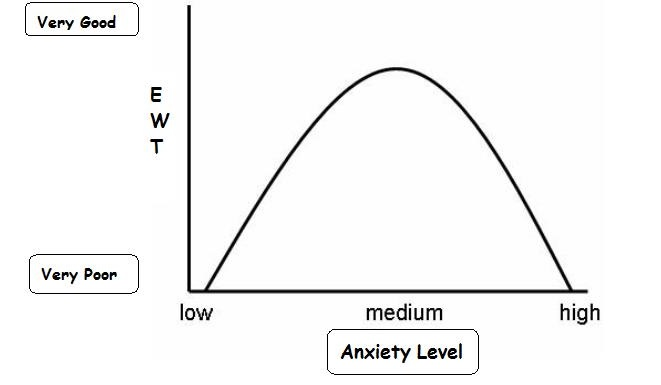
He proposed the ‘inverted U’/Yerked Dodson law in order to resolve the contradictions in research findings to do with anxiety and EWT. The law suggests that performance (of EWT) improves with increases with anxiety up to an optimal point. After this point further increases in level of anxiety causes a decrease in performance. He therefore suggested that studies that found anxiety increased EWT accuracy dealt with stress-levels before or at the optimum level of performance(low/medium stress), and studies that found the opposite occurs in levels of stress past the optimum performance level (high stress).
What does Deffenbacher’s ‘inverted U’ look like?
Anxiety = positive - Pro - Sweden (C+H)
One strength of the concept of anxiety having a positive impact on EWT’s accuracy is that there is further research supporting it. |
For example, Christianson + Hubinette’s study consisted of participants that were eye witnesses of real bank robberies in Sweden. The participants were split into two categories: witnesses who had been directly involved (and therefore experiences more anxiety) and witnesses who had indirectly involved (therefore experiencing lower anxiety). It was found that although recall was strong across all witnesses (above 75% accuracy) the more anxious direct victims were even more accurate than the less anxious witnesses. |
Therefore, these findings suggests that anxiety has a positive impact on the accuracy of EWT. |
Anxiety = Positive - Con - Control (Y+C)
One weakness of the concept that Anxiety has a positive effect on EWT is that Yuille and Cutshall’s research in support of it may lack validity. |
As the researchers interviewed the eye witnesses 5 months after the crime had occurred many uncontrollable events, such as post-event discussion with other eye witnesses, could have impacted the accuracy of the participants' recall. |
Therefore, events in the time between the crime being witnessed and the interview could act as extraneous variables and this means the research may lack internal validity. |
Anxiety = Negative - Pro - Dungeons (V+M)
One strength of the concept that anxiety has a negative impact on the accuracy of EWT is that there is further evidence to support it. |
For example, Valentine and Mesout’s study, in which participants were individuals attending the London Dungeons and were offered money off for taking part, found that participants with lower anxiety levels (measured by a heart rate monitor and answers to a STAI questionnaire) performed better in IDing a scare actor from the dungeon when asked to pick them out of a line-up, doing so with 75% accuracy. Contrastingly, participants with higher anxiety levels only successfully IDed the actor with 17% accuracy and consistently answered questions about details of the actor with errors more than participants with lower levels of anxiety. |
This supports the concept of anxiety having a negative impact on EWT accuracy. |