Chapter 10: Introduction to Metabolism
 Call Kai
 Learn
Learn Practice Test
 Spaced Repetition
 Match
Match Flashcards
 Knowt Play
1/54

There's no tags or description
Looks like no tags are added yet.
Name | Mastery | Learn | Test | Matching | Spaced | Call with Kai |
|---|
No analytics yet
Send a link to your students to track their progress
55 Terms
microbial metabolism and its importance
the total of all chemical reactions in the cell, including both energy conserving reactions and energy requiring reactions
catabolism
fueling reactions
energy conserving reactions
provide ready source or reducing power
generate precursors for biosynthesis
anabolism
synthesis of complex organic molecules from simpler ones
requires energy from fueling reactions
chemoorganotroph
energy from organic molecules
chemolithotroph
energy from inorganic molecules
autotroph
carbon source from CO2
heterotroph
carbon source from organic molecules
organotroph
electron source from organic molecules
lithotroph
electron source from inorganic molecules
thermodynamics
energy is the capacity to do work or to cause particular changes
analyzes energy changes in a collection of matter called a system (cell)
all other matter in the universe is called the surroundings
first law of thermodynamics
energy can be neither created or destroyed
second law of thermodynamics
physical and chemical processes proceed in such a way that the disorder of the universe (entropy) increases to the maximum possible
free energy
changes in energy that can occur in chemical reactions are expressed by the equation ( delta G = delta H - T x delta S)
change in free energy of a chemical reaction is directly related to the equilibrium constant of the reaction
free energy change (delta G)
amount of energy in a system that is available to do work
when delta G is negative
The equilibrium constant is greater than one and the reaction goes to completion
the reaction is said to be endergonic and requires energy (not spontaneous)
exergonic reaction: Z → enzyme → X + Y + ENERGY
when delta G is positive
The equilibrium constant is less than one and little product will be formed at equilibrium
the reaction is said to be endergonic and requires energy (not spontaneous)
endergonic reaction: ENERGY + X + Y → enzyme → Z
ATP
high-energy molecule used to capture, store, and provide chemical energy
hydrolysis of terminal phosphate negative delta G
strongly exergonic reaction that can be coupled with various endergonic reactions to facilitate their completion
high phosphate group transfer
formed from ADP and Pi (inorganic phosphate) by energy trapping processes
oxidation reduction reaction
the release of energy during metabolic processes normally involves oxidation-reduction reactions
involve the transfer of electrons from an electron donor to an electron acceptor
when electrons are transferred from an electron donor to an electron acceptor with a more positive reduction potential → free energy is released that can be used to form ATP
reduction potential (Eo)
the equilibrium constant for an oxidation reduction reaction and is a measure of the tendency of the electron donor to lose electrons
the more negative the reduction potential, the better it is as an electron donor
greater difference between the reduction potential of the donor and the acceptor → more negative delta G
electron transport chain
series of electron carriers each with a different redox potential → ordered from most negative to most positive Eo
important in a variety of electron carriers organized into a chain
electron carriers
located in plasma membranes of chemoorganotrophs in bacteria and archaeal cells and located in internal mitochondrial membranes in eukaryotic cells
NAD+, NADP+, flavoproteins (FAD, FMN), quinones, iron-sulfur centers (ferredoxin), and cytochromes (hemes)
each differ in transporting electrons and impacts how they function in the ETC
enzymes
protein catalysts with great specificity for the reaction
may only be composed of a protein or it may be a holoenzyme
catalyst
substance that increases the rate of a reaction without being permanently altered
holoenzyme
consists of a protein component (apoenzyme) and a nonprotein component (cofactor)
coenzyme
a cofactor that is loosely attached to the apoenzyme
may dissociate from the apoenzyme and carry one or more of the products of the reaction to another enzyme
prosthetic group
cofactor that is firmly attached to the apoenzyme
enzyme: oxidoreductase
oxidation reduction reactions
enzyme: transferase
reactions involving the transfer of chemical groups between molecules
enzyme: hydrolase
hydrolysis of molecules
enzyme: lyase
breaking of C-C, C-O, C-N, and other bonds by a means other than hydrolysis
enzyme: isomerase
reactions involving isomerizations
enzyme: ligase
joining of two molecules using ATP
enzyme reaction mechanism
enzymes increase the rate of a reaction bud do not alter the equilibrium constant (or the standard free energy change) of the reaction
enzymes lower the activation energy
required to bring the reacting molecules together correctly to form the transition state complex
once the translation state has been reached, the reaction can proceed rapidly
enzymes bring substrates together
at the activation site to form an enzyme substrate complex
this can lower activation energy in several ways
local concentrations: increased at the active site of the enzyme
molecules at the active site are oriented properly
environmental effects on enzyme activity
amount of substrate present affects the reaction rate
increase substrate = increase in activity
UNTIL SATURATION → no further increase in reaction rate occurs with increases in substrate concentration, a reaction proceeding at maximal velocity (V max)
michaelis constant (Km)
substrate concentration required for the reaction to reach ½ V max
used to measure the affinity of an enzyme for its substrate
lower Km the more tightly bound the enzyme is to the substrate
enzyme activity is affected by environment
pH and temperature
each enzyme has a specific pH and temperature optima
enzyme inhibition
competitive inhibition
noncompetitive inhibition
competitive inhibition
inhibitor binds at the active site and competes with the substrate
can be overcome by adding excess substrate
noncompetitive inhibition
inhibitor binds at another location and changes the conformation of the active site
inactive or less active
cannot be overcome by the addition of excess substrate
ribozymes
catalytic RNA molecules → act on RNA substrate molecules
posttranslational regulation of enzyme activity
allosteric regulation
covalent modification of enzyme
feedback inhibition
allosteric regulation
an effector or modulator binds reversibly and noncovalently to a regulatory site on the enzyme
regulatory site is distinct from the catalytic site
effect can be positive or negative
covalent modification of enzyme
reversible covalent addition or removal of a chemical group (like phosphate, methyl group, adenylic acid)
effect can be positive or negative
feedback inhibition
every pathway has at least one pacemaker enzyme that catalyzes the slowest reaction in the pathway → often the first reaction in a pathway
the end product of the pathway inhibits the pacemaker enzyme
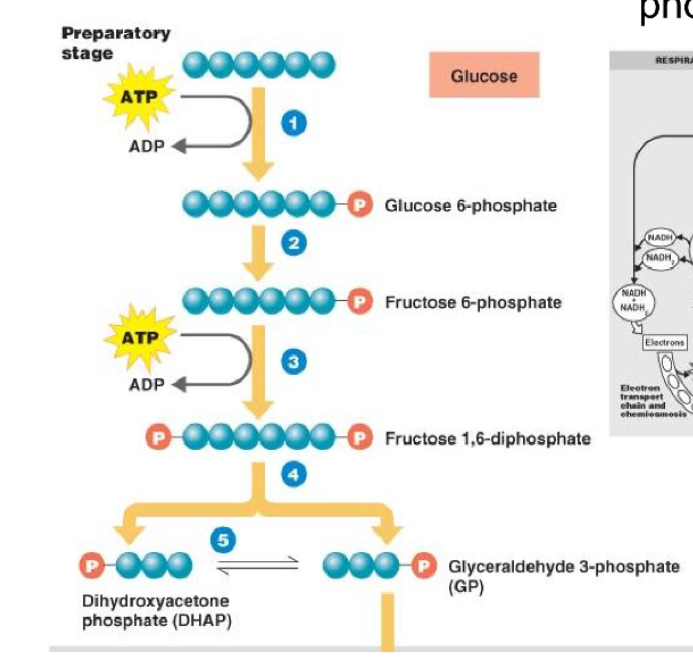
prepatory stage
2 ATP are used
glucose is split to form two molecules of glyceraldehyde 3-phosphate
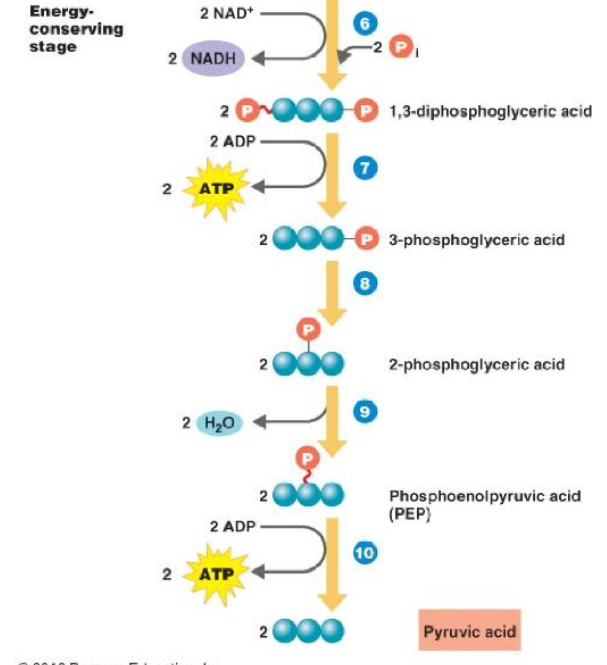
energy conserving stage
two glyceraldehyde-3-phosphate molecules are oxidized to 2 pyruvic acid molecules
4 ATP are produced
2 NADH are produced
glycolysis (embden meyerhof pathway)
the oxidation of glucose to pyruvic acid produces 2 ATP and 2 NADH
preparatory stage
conservation stage
this is one of three glycolytic pathways used to catabolize glucose to pyruvate
aerobic respiration
anaerobic respiration
fermentation
aerobic respiration
electon accepted by NAD+ are transferred to the electron transport chain and accepted by O2
anaerobic respiration
electron accepted by NAD+ are transferred to the membrane and accepted by inorganic molecules (NO3-, SO4-, CO3-)
fermentation
electron accepted by NAD+ are donated to endogenous acceptor (pyruvate)
glycolysis pathway
glucose + 2 ATP + 2 ADP + 2 PO4- + 2 NAD+ → 2 pyruvic acid + 4 ATP + 2 NADH + 2 H+
overall net gain of two molecules of ATP for each molecule of glucose oxidized
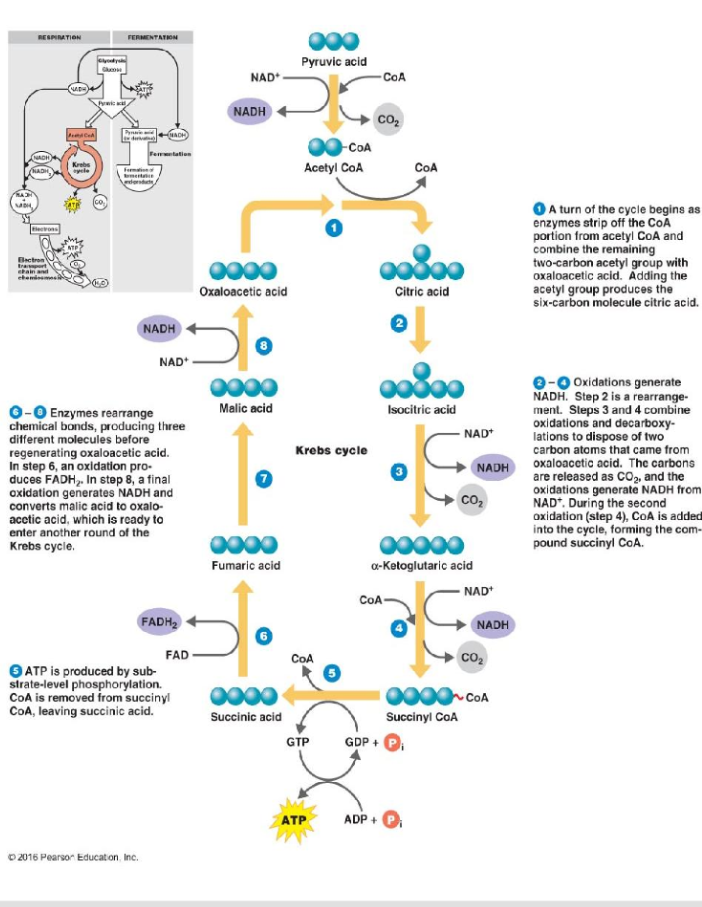
kreb’s cycle
pyruvic acid (from glycolysis) is oxidized decarboxylation (loss of CO2) occurs
resulting in two carbon compound attaches to coenzyme A, forming acetyl CoA and NADH
oxidation of acetyl CoA produced NADH, FADH2, and ATP and liberates CO2 as waste
chemiosmosis
electrons (from NADH) pass down the electron transport chain while protons are pumped across the membrane
establishes proton gradient (proton motive force)
protons in higher concentration on one side of the membrane diffuse through ATP synthase
releases energy to synthesize ATP