Biology H - Final review
 Call Kai
 Learn
Learn Practice Test
 Spaced Repetition
 Match
Match Flashcards
 Knowt Play
1/413

There's no tags or description
Looks like no tags are added yet.
Name | Mastery | Learn | Test | Matching | Spaced | Call with Kai |
|---|
No analytics yet
Send a link to your students to track their progress
414 Terms
- Autotrophs (producers) are…
- This classification consists of:
- organisms that produce their own food.
- Plants, some bacteria, some archaea, and some protists.
- Heterotrophs (consumers) are…
- This classification consists of:
- organisms that consume nutrients from an outside source.
- Animals, some bacteria, some archaea, and some protists.
- Decomposers are…
- This classification consists of:
- organisms that breakdown other dead organisms/waste, releasing vital organic nutrients in the soil for plants (such as Nitrogen and Phosphorus).
- Fungi and some bacteria.
In a food web, the arrows point according to the direction of…
energy transfer.
Explain the Ten Percent principle in Ecology:
- The ten percent rule in ecological food pyramids states that when energy is passed in an ecosystem from one trophic level to the next, only about 10% of the energy is passed on.
- The remaining 90% is lost as heat, used for metabolic processes, or lost as waste.
Because the Ten Percent principle dictates that energy is reduced by 90% at each step, food chains rarely exceed 4 or 5 trophic levels because…
there simply is not enough energy at the top of the pyramid to sustain an additional level of predators.
In one sentence, Ecology is…
the scientific study of the interactions between organisms and their environment.
Biosphere
The part of Earth where there is life.
All ecosystems consist of biotic and abiotic factors, and they affect the distribution of organisms. Briefly explain what each kind of factor is, and exemplify them:
- Biotic Factors: The living components of an environment, such as the various kinds of interactions between producers, consumers, and/or decomposers.
- Abiotic Factors: The non-living components of an environment, such as temperature, precipitation, soil pH levels, elevation, atmospheric pressure, and more.
Explain the differences between a population, a community, and an ecosystem:
These three ecological levels represent a scale of increasing complexity:
- A population is a group of the same species living together.
- A community includes all of the various populations interacting in that same area.
- An ecosystem goes a step further by combining that entire living community with the non-living, physical environment.
Biomes vs. ecosystems:
- An ecosystem is a specific, localized community of living organisms interacting with each other and their non-living environment (like a rotting log or a single coral reef).
- A biome is a massive global region classified by its climate and dominant vegetation, meaning a single biome contains many different ecosystems within it.
Carrying Capacity
The amount of individuals an environment can (naturally) support.
Biotic Potential
The maximum rate at which a population increases under ideal conditions.
The fundamental drivers of population change within a species are…
birth, death, and migration (immigration and emigration).
Relationships between species in a community are referred to as interspecific interactions, and they directly affect a species’ survival and reproduction. List each of the main relationships:
- Competition
- Predation
- Herbivory
- Symbiosis
Parasitism
Mutualism
Commensalism
- Disease
Classify how each kind of interspecific interactions affect their interacting species:
- Interaction is detrimental to both species (–/–):
Competition
- Interaction is beneficial to one species, but detrimental to another(+/–):
Predation
Herbivory
Parasitism
Disease
- Interaction is beneficial to both species (+/+):
Mutualism
- Interaction is beneficial to one species, but does not affect the other(+/0):
Commensalism
Fundamental Niche vs. Realized Niche:
- Fundamental: The initial set of conditions and resources an organism could theoretically use without interference from other species.
- Realized: The restricted, typically smaller space and resources a species actually occupies and uses due to limiting factors like competition, predation, and resource availability.
As biodiversity increases, ecosystem stability…
also increases.
Biodiversity has two main components. Describe each:
- Species richness: The total number of different species in the community.
- Relative abundance (AKA species “evenness”): The proportion each species represents of the total individuals in the community.
… connect all trophic levels.
Decomposers
Summarize the Carbon (CO2) cycle and humanity’s impact on it:
- The Carbon cycle is the continuous natural process by which carbon moves between the atmosphere, oceans, soil, and living organisms through photosynthesis, respiration, and decomposition.
- Humans have made this cycle unbalanced by clearing forests and burning fossil fuels, releasing carbon into the atmosphere much faster than natural systems can absorb it.
Summarize the Nitrogen (N) cycle:
The process by which specialized bacteria convert atmospheric Nitrogen into usable compounds that plants and animals need to build vital molecules like DNA. Through decomposition and denitrification, this Nitrogen is eventually transformed back into gas and released back into the atmosphere in order to naturally complete the loop.
Invasive species
- Foreign organisms that out-compete native ones by aggressively monopolizing vital resources like food, water, and space, often while lacking natural predators to keep their population growth in check.
- These can be introduced accidentally or deliberately, and most are spread due to human activities.
Rachel Carson
- Credited for starting the modern global environmental movement.
- Author of Silent Spring, a book that exposed the dangers of pesticides for both humans and native species, and its name comes from a pesticide’s abilities of silencing birds’ songs and killing both “good” and “bad” insects (pests).
Biomagnification
- The process where the concentration of toxic substances—like mercury or DDT—multiplies and becomes increasingly concentrated as they move up trophic levels in food chains.
- Occurs because a predator must consume large quantities of prey over its lifetime, and these prey store the toxins in its fat reserves. Thus, they eat accumulating amounts of these toxins.
DDT
- A synthetic pesticide. Widely used in the mid-20th century to control agricultural pests and disease-carrying insects (like mosquitoes and lice), it was largely banned globally following the publication of Silent Spring.
There are three types of dispersion that demonstrate how individuals in a population are spatially arranged within a habitat. Name each and briefly describe how their interactions impact their behavior:
- Clumped dispersion → Individuals aggregate in patches; interactions consist of social grouping due to “patchy” resources (commonly seen in more social species).
- Uniform dispersion → Individuals are evenly distributed; interactions involve territoriality due to limited resources (commonly seen in less social species).
- Random dispersion → Individuals are independently positioned in a location; interactions are neutral due to equal amounts of resources.
Exponential population growth vs. Logistic population growth
Exponential:
- Associated with r-selected (opportunistic) species:
Little to no parenting.
Rapid maturation.
- Maximize their reproduction/growth rate by producing many offspring with minimal parental care to quickly populate unstable environments.
- Density-independent population regulation.
- Results in J-shaped curve.
Logistical:
- Associated with k-selected (equilibrial) species:
Intensive parenting.
Slow maturation.
- Fewer, high-quality offspring to live near the environment's carrying capacity; rate of increase declines as carrying capacity is reached.
- Density-dependent population regulation.
- Results in S-shaped curve.
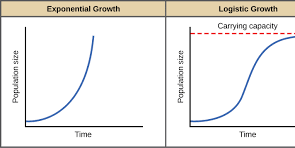
Carrying capacity represents the density-dependent regulative factor (r/k) ..., while biotic potential represents the density-independent regulative factor … (r/k)
- Carrying capacity → k
- Biotic potential → r
Density-dependent population regulation (k-selected; prevent population from indefinite J-shaped curve)
- At high densities, we see a decrease in birth rates and increase in death rates. This is because they act as a breaking system to stabilize populations near their carrying capacity.
- Examples of this kind of regulation include:
Resource competition
Territoriality
Predation (concentrated prey makes its population decline)
Disease and Parasitism (concentrated population makes pathogens spread easier)
Toxic wastes
Intrinsic factors (e.g. crowding causing hormonal changes that delay sexual reproduction in rodents)
Density-independent population regulation
- Birth and death rates remain constant across all population densities.
- Are generally abiotic (non-living) and unpredictable.
- Caused by:
Natural disasters
Extreme weather
Human activities (pollution, pesticide use, habitat destruction, etc)
Briefly explain how Logistic population growth connects to density-dependent population regulation:
- Logistic population growth is the direct visual and mathematical result of density-dependent regulation acting on a population.
- As population density rises, resource scarcity and disease increase death rates and lower birth rates, forcing the growth rate to slow down and stabilize at the environment's carrying capacity.
Briefly explain how Exponential population growth connects to density-independent population regulation:
- Exponential population growth occurs independently of population density because it is driven by density-independent regulation.
- In this scenario, abiotic factors like weather, natural disasters, or sudden habitat destruction eliminate individuals regardless of how crowded the population is, allowing unrestricted, rapid growth whenever conditions are favorable.
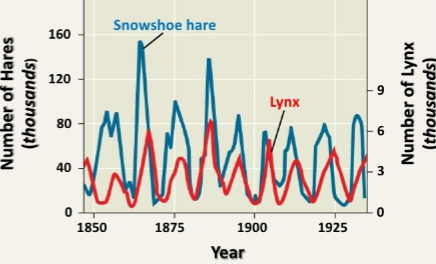
Boom and Bust Model (and example)
- Describes a cyclical dynamic where an animal population undergoes a period of rapid, sometimes exponential growth (the boom), followed by a sudden, drastic population crash (the bust). Thus, according to this model, populations fluctuate in density with regularity.
- Hare and Lynx exemplify this model:
Their populations rise and fall together in a tightly linked, 10-year cycle, driven by food availability and heavy predation.
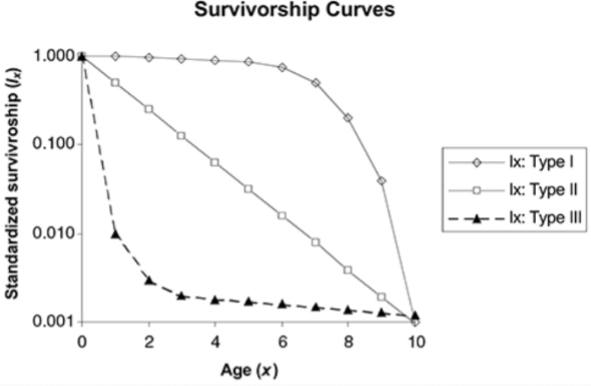
Based on the following graph, which type would represent:
- High death rate for older individuals
- Constant death rate throughout life
- High death rate for young individuals
Type 1 shows dying at older age
Type 2 shows dying at steady, average rate
Type 3 shows dying at younger age
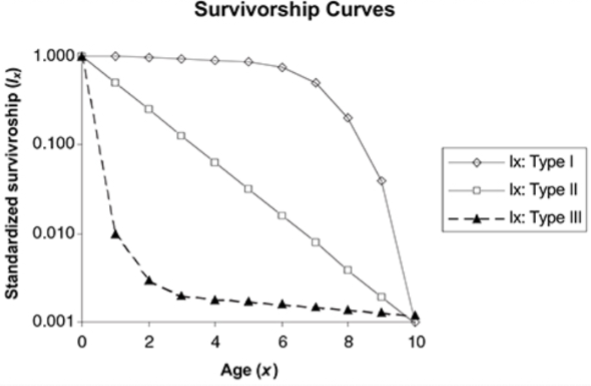
Based on the survivorship curves graph, which species type (1-3) would describe:
- Humans (inhabiting developed countries)
- Sea turtles
- Squirrels
Humans (developed countries) = Type 3
Sea turtles = Type 1
Squirrels = Type 2
Resource partitioning
- The differentiation of similar niches so distinct species can co-exist.
- Sympatric populations tend to do this
A species’ niche is their…
total use of biotic and abiotic resources.
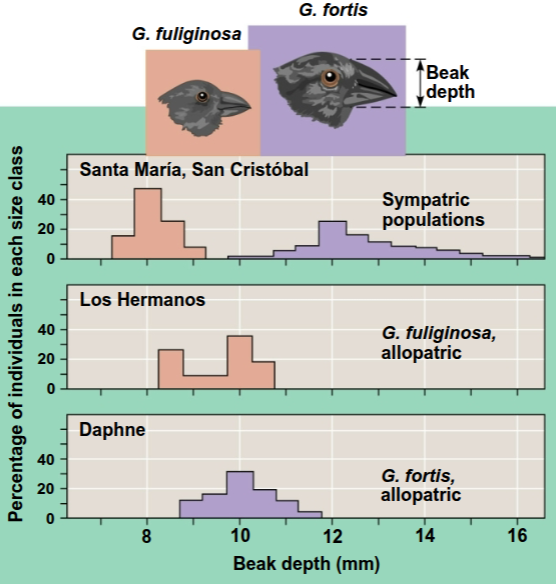
State what is this graph is, and explain what it is illustrating:
- This is a character displacement graph, and it illustrates how closely related species evolve distinct physical differences to minimize competition when living in the same area.
- In sympatric populations—where species share the same geographic range—these traits diverge significantly to allow them to exploit different resources. Conversely, this divergence is absent in allopatric populations, where species live apart and face less pressure to compete for the exact same food or habitats.
Dominant species
Species that are most abundant or have the highest biomass in a community.
Keystone species
- Species that exert strong control on a community by their ecological roles, or niches.
- They are NOT the most dominant, but keep other species “in check,” either from the top-down or the bottom up of a food pyramid (e.g. beavers).
Ecological succession
- Ecological succession is the gradual process by which an ecosystem's biological community is replaced or changed over time as new species come in.
- It typically follows a disturbance (e.g. natural disaster), as such allow pioneer species to establish the foundation for life, eventually leading to a stable and mature climax community as vegetation increases.
Ecological succession has two main kinds of succession, primary and secondary. Briefly explain each:
- Primary Succession: Begins in lifeless areas where no soil exists (e.g., after volcanic eruptions or retreating glaciers), so pioneer species like lichens must first break down bare rock to form soil.
- Secondary succession: Occurs in previously inhabited areas where a disturbance (like a wildfire or hurricane) destroyed the biological community, but the soil remained intact; this process is much faster due to healthy soil already existing.
Climax communities
The final, stable stage of ecological succession in an ecosystem
Primary production
The amount of energy converted to chemical energy by autotrophs during a given time period (e.g. plants photosynthesizing)
State the primary production formula and what each of its variables mean:
GPP - R = NPP
GPP = Total primary production (amount of glucose made)
R = Respiration (amount of glucose used)
NPP = Net primary production (leftover glucose)
Eutrophication
- The excessive enrichment of water by nutrients like Nitrogen and Phosphorus, typically from agricultural runoff or sewage.
- The enrichment triggers explosive algal blooms that block sunlight and deplete dissolved oxygen as they are decomposed, ultimately creating “dead zones” that suffocate aquatic life.
Cite the Hardy-Weinberg formula and label each term:
- p² + 2pq + q² = 1
- p² = frequency of homozygous dominant (AA) individuals
- 2pq = frequency of heterozygous (Aa) individuals
- q² = frequency of homozygous recessive (aa) individuals
Cite the Hardy-Weinberg formula and label each variable:
- p² + 2pq + q² = 1
- p = frequency of dominant alleles in the population
- q = frequency of recessive alleles in the population
Explain the fundamental difference between p and p² (or q vs q²):
p² = frequency of homozygous dominant individuals
p = frequency of dominant allele (homozygous or heterozygous)
q² = frequency of homozygous recessive individuals
q = frequency of recessive allele (homozygous or heterozygous)
List the 5 conditions for Hardy-Weinberg equilibrium:
- No mutations
- Only random mating
- No selection (females pick any male)
- No gene flow (transfer of genes between populations doesn’t occur)
- Large population
When a population is in Hardy-Weinberg equilibrium for a gene, no species within it are evolving because…
allele frequencies (supposedly) stay the same across generations.
There are two distinct types of diversity in evolution. Name and describe them:
- Interspecific diversity: Diversity between different species
- Intraspecific diversity: Diversity within the same species
In one sentence, evolution is best defined as…
the change in gene frequency over time within a population.
The two primary factors for evolution are:
- Change in environment (selecting agent)
- Gene variation (general raw material that is acted upon)
There are gaps in the fossil record mainly as a result of:
- Improper conditions for fossilization
- Soft-bodied (boneless) organisms
The kind of rock where fossils are most commonly found in are…
sedimentary rock.
Name the two most famous transitional fossils and state what evolutionary transitions they illustrate:
- Tiktaalik (transition from aquatic organisms to terrestrial organisms)
- Archaeopteryx (transition from ancient reptilians to avian birds)
Tetrapods are animals with four limbs that live on land. Their four main groupings are:
- Mammals
- Reptiles
- Birds
- Amphibians
Sexually-dimorphic species are those in which…
males and females exhibit distinctly different physical characteristics, behaviors, or sizes beyond their reproductive organs.
- Co-option is an evolutionary process where…
- Feathers in birds are a classical example of co-option because:
- pre-existing traits, genes or body structures are modified to serve a completely new function, essentially “recycling” ancient biological features.
- In early dinosaurs, feathers initially evolved to provide thermal regulation (heat retention) or to act as sexual display during mating. Long after they appeared, these structures were repurposed by avian dinosaurs to create aerodynamic surfaces for gliding or flight.
- Ecological niches are defined as…
- The extinction of dinosaurs exemplifies a redistribution of niches later occupied by surviving species in that:
- the specific roles and environmental conditions that different organisms occupy within an ecosystem.
- After dinosaurs disappeared, many species evolved to take over ecological functions once held by them—such as large herbivores, smaller birds/mammals, and fast‑moving hunters—revealing how life rapidly diversifies when niches become available.
Most extinctions happen gradually. An example of this is:
While the catastrophic asteroid impact caused immediate devastation, the mass extinction itself was a gradual process because the resulting atmospheric debris caused total darkness and altered food chains globally, causing them—and their predators, the dinosaurs—to collapse.
Comparative anatomy consists of two main structures across all species. Name, describe, and exemplify them:
- Homologous structures (Homology): Structures with the same internal composition, but different real-world functions; cat forearms, bat wings, and whale flippers exemplify this category.
- Analogous structures (Analogy): Structures with different internal compositions, but similar real-world functions; insect wings, bat wings, and bird wings exemplify this category.
There are two possible types of evolution within a species. Name and describe each:
- Divergent evolution: Species break apart into different groups from the same ancestor
- Convergent evolution: Entire species undergo a similar genetic change over generations
Vestigial structures (and examples)
Structures reduced in size over time due to no longer being in use.
Examples include:
- The human appendix
- Human wisdom teeth
- Limb bones embedded in snakes/whales
Comparative embryology vs. Comparative biochemistry:
- Comparative embryology is the analytical study of different stages of embryonic development across organisms from different species. It allows for experimenters to visualize relatedness because the further along in development they share similarities, the more closely related they are.
- Comparative biochemistry quantifiably observes the nucleotide sequences of DNA, RNA and/or amino acid sequences of protein to observe genetic relatedness beyond development. It led to a major reconstruction of phylogenics—the study of “family trees”—and resolved many historical misinterpretations that occurred with visual interpretation.
Fully explain Lamarck’s evolutionary theory:
- Lamarck’s theory of evolution proposed that physical change acquired by an organism throughout its lifetime as adaptation to environment can faithfully be passed down to its offspring. It consisted of two main clauses:
Use and disuse - If organisms need a particular structure, they will develop it; if they do not need it, the structure will shrink (and likely become vestigial).
Inheritance of acquired characteristics - Reinstatement of main idea
Explain Weisman’s Experiment and how it ultimately debunked Lamarck’s suggestions:
- In Weisman’s Experiment, scientists cut the tails off of mice and bred them to test Lamarck’s theory of acquired characteristics. Offspring were consistently born with tails, then disproving Lamarck.
Before getting a definite name, Charles Darwin famously referred to “evolution” as…
“descent with modification.”
List direct examples of what Darwin used throughout his career as he sought to explain evolutionary change:
Darwin utilized…
- Fossils (none transitional).
- Biogeography (locking at positions of land masses [e.g. tectonic plates] and historically comparing their rock layers to existing fossils).
- Observing species from land and coast (e.g. his visit to the Galapagos and mainland South America)
- Previous biological and geological evolutionary works.
List all of Darwin’s evolutionary principles
- Overproduction
- Struggle for existence
- Variation (most important)
- Survival of the fittest
- Natural selection
- Evolution of a new species
Overproduction (Darwinian evolutionary principle)
- Stated that more offspring are born than can possibly survive; species number remains more or less constant due to limited natural resources (refer to graph).
- Carrying capacity: Amount of individuals an environment can support
Struggle for Existence (Darwinian evolutionary principle)
- Stated that organisms will compete to survive in regard to Interspecific and intraspecific competition.
- Focuses more on the survival aspect of evolution.
Variation (Darwinian evolutionary principle)
- Stated that differences in individuals occur within the same population; is the key to evolution and therefore a positive attribute (always start with this when describing a species and its population’s gene expression changes).
- Adaptive value: Most variable traits are heritable, and some are more advantageous than others depending on the environment.
Survival of the Fittest (Darwinian evolutionary principle)
- Stated that the organisms who survive and reproduce are the best adapted (most fit) to their environment.
- Differs from the Struggle for Existence principle in that it also involves reproduction.
Natural Selection (Darwinian evolutionary principle)
- Stated that if an environment changes (AKA a selecting agent), the adaptive value of a trait may change; the differential success in reproduction among organisms that vary in their traits.
- Focuses more on the role of environmental change for survival.
-While random genetic mutations provide the raw material for diversity, natural selection acts as a strictly non-random filter and is therefore not random.
Evolution of a New Species (Darwinian evolutionary principle)
- Stated that reproductive differences emerge as each individual interacts with their environment, and over time, natural selection can increase how well-adapted a species is.
- So, if an environment changes over time or if individuals from a particular species move to a new environment, natural selection may result in adaptation to these changes, sometimes giving rise to new species in the process.
Explain some of the problems with Darwin’s theory:
- He didn’t understand the mechanisms of inheritance yet (despite Mendel working on his research at about the same time period).
- He didn’t fully grasp how traits are influenced by the environment (e.g. arctic fox’s distinct fur).
Evolutionary Fitness
- The number of surviving offspring that survive to the next generation (measure of reproductive and thus evolutionary success).
The environment acts upon… and not …
phenotypes; genotypes
Adaptation (and example)
- A genetic variation that is favored by selection as is manifested as a trait that provides advantage to an organism in a particular environment.
- A change in environment affects adaptive value; if the adaptive value is low, eventually the trait will disappear (such as eyes in moles).
Describe Theodosius Dobzhansky’s Modern Synthesis Theory:
- Incorporates Darwin’s ideas with modern ideas of genetics.
- Revealed that mutations were the source of variations (which is then the source of evolution).
- Recognized that reproductive isolation could lead to a new species.
Mechanisms of Variation in Eukaryotes:
- Mutations in genes (main source)
- Sexual reproduction
Crossing over
Independent assortment
Random fertilization (genetic recombination; over 8 million possible in humans)
Directional selection (and example)
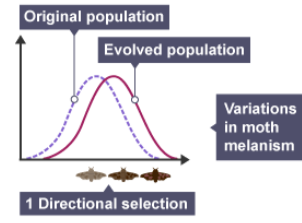
- Selection that shifts the population to one of the extremes in a phenotypic range.
- During the Industrial Revolution, soot-covered trees in England provided camouflage for dark-colored peppered moths while exposing the lighter ones to predators, shifting the population's traits in one extreme direction.
Disruptive selection (and example)
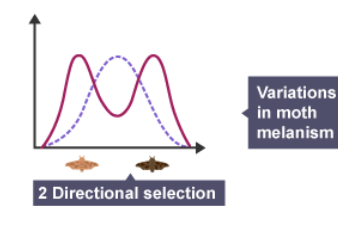
- Selection that favors variants at ends of the distribution of a phenotypic range.
- In a desert environment, both light-colored mice that blend into the sand and dark-colored mice that camouflage against volcanic rock survive better than medium-colored mice, demonstrating disruptive selection where extreme traits are favored over intermediate ones.
Stabilizing selection (and example)
- Selection that removes extreme variants.
- Stabilizing selection is illustrated by human birth weight, where intermediate-weight babies (3 to 4 kilograms) are favored for survival because too-small infants face severe health risks and too-large infants cause dangerous complications during delivery.
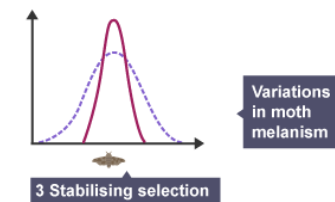
Other Factors of Selection (besides natural selection):
- Heterozygote Advantage - Advantage to heterozygous genotype increases percent of heterozygous individuals (which also halts evolution by not making the otherwise-dangerous trait go away; seen in sickle-cell anemia).
- Sexual Selection - Natural selection for mating success
Intraspecfic sexual selection: Selection within the same sex (e.g. males fighting for females)
Interspecific sexual selection: Individuals of one sex choose their mate from other sex (e.g. females picking males)
- Artificial Selection - Human modification of species by selective breeding (e.g. selective breeding).
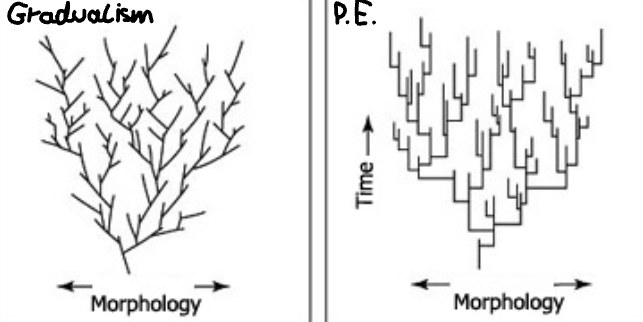
There are two main theories within the study of the rate of evolutionary change. Name them and describe their relationship to evolution:
- Gradualism (supported by Darwin): States that species change gradually over time in a slow, periodic pace.
- Punctuated Equilibrium: States that there are long periods of no change and ones with brief, sudden “bursts” of evolution.
- Truly, evolution is a mix of both, and neither predicts is more right than the other.
Drug resistance increases at a high rate in HIV pathogens because…
they have a high rate of reproduction; utilizing drugs against HIV “selects” for their resistant strains.
Speciation is the process of…
originating a new species through evolution.
If a species cannot mate with their neighbors, they…
aren’t different species.
There are two main kinds of speciation. Name and describe each:
- Allopatric Speciartion: Gene flow is interrupted when a population is separated geographically, as geographic isolation can lead to reproductive isolation (preventing gene flow) and then create a new species.
Different selective pressures lead to strikingly different gene pools and speciation takes place.
- Sympatric Speciation: Speciation takes place in geographically-overlapping populations.
Usually due to non-random mating.
Reproductive Isolation is caused by both pre-zygotic and post-zygotic factors. List and exemplify three for each category:
- Pre-zygotic:
Habitat - Birds eating fruits at the top or bottom of trees.
Temporal - Organisms having nocturnal vs. diurnal lives.
Behavioral - Birds developing different bird songs.
Gametic - Sperm not fertilizing an egg.
Mechanical - Flowers structured to be exclusively pollinated by hummingbirds cannot be pollinated by a bee.
- Post-zygotic:
Reduced hybrid viability - : When female mice and male “deer” mice mate, genetic imprinting is disrupted, causing hybrid embryos to grow abnormally large and die.
Reduce hybrid fertility - Mules (breeding of horses with donkeys) being unable to reproduce.
Hybrid breakdown - Pizzlies/grolars (breeding of brown with white bears) decreasing in viability over time.
Adaptive Radiation
- The concept that one species leads to many (over time).
- Competition leads to exploitation of different ecological niches.
Convergent Evolution
- Two species that aren’t closely related evolve similar adaptations due to living in similar habitats.
- These similar adaptations are said to appear at different times in evolutionary history and may be referred to as analogous structures.
- Genetic Drift is…
- Two effects commonly seen with genetic drift are:
- An unpredictable fluctuation in allele frequencies from one generation to the next, but not due to natural selection.
The Bottleneck Effect: The bottleneck effect causes a drastic, random reduction in population size, typically due to environmental catastrophes or human impact. Consequently, the surviving group has significantly lower genetic diversity, which makes the population less adaptable to future environmental changes (e.g. diseases).
The Founder Effect: The founder effect results in a newly isolated population having significantly less genetic diversity than its parent group because it was established by just a few individuals. Consequently, certain genetic traits or rare disorders can become much more common or even completely lost by pure chance in subsequent generations.
Cladograms (and how they determine relatedness)
- Often called “tree diagrams,” these are graphic representations showing lines of evolutionary history that can be tested according to the presence/absence of traits among different species.
- Relatedness on a cladogram is determined by tracing the branches of different species back to their most recent common ancestor. Organisms that share a more recent common ancestor (represented by nodes) are more closely related than those that only share a less recent common ancestor.
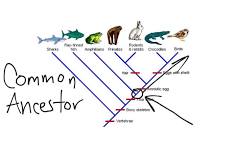
Shared Derived Characters vs. Shared Primitive Characters:
- Shared Derived: An evolutionary “novelty” unique to a particular clade and its recent common ancestor, used by scientists to establish close evolutionary relationship.
- Shared Primitive: Ancestral traits inherited from a more distant common ancestor, meaning it is present across a wider, more inclusive group of organisms. Is unhelpful in determining recent branching patterns due to typically spanning outside of a taxon.
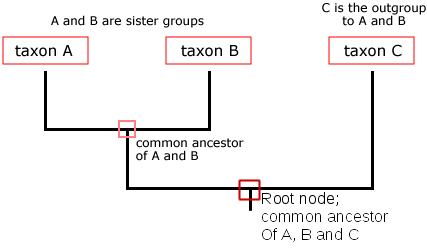
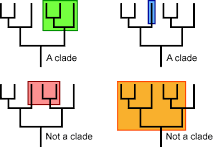
Clades in cladograms are…
groups of organisms that have a single common ancestor whose descendants represent a single, unbroken evolutionary branch on the tree of life.