DNA Part 1: Role and Structure of DNA and RNA!
 Call Kai
 Learn
Learn Practice Test
 Spaced Repetition
 Match
Match Flashcards
 Knowt Play
1/28

There's no tags or description
Looks like no tags are added yet.
Name | Mastery | Learn | Test | Matching | Spaced | Call with Kai |
|---|
No analytics yet
Send a link to your students to track their progress
29 Terms
What are the 3 things that are covalently bonded together in a nucleotide? (Acronym: PNP!!)
Pentose 🧂sugar🧂
Nitrogenous base
Phosphoric acid/Phosphate 🧑🤝🧑group🧑🤝🧑
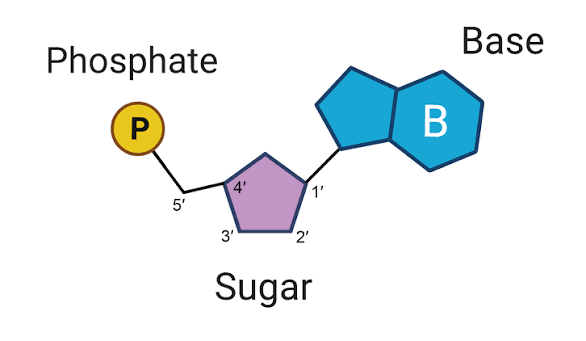
Why is the sugar a pentose one?
The sugar component contains 🕔5-carbon🕔 atoms.
What is the difference in the pentose sugar of DNA and RNA?
Deoxyribose sugar (in DNA, 💪MORE STABLE💪!!): contains a H atom at the carbon-2 position.
Ribose sugar (in RNA): contains an —OH/hydroxyl group at carbon-2 instead.
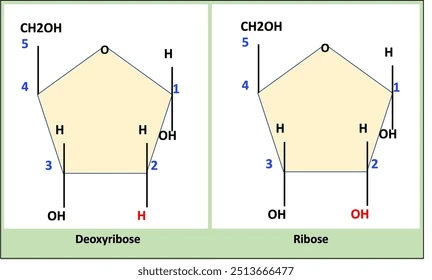
Why is the deoxyribose sugar/DNA more stable than RNA?
This is because RNA contains the ➕additional hydroxyl group➕, which is a polar molecule; polar molecules are ⚗more chemically reactive⚗ as well.
What are the 5 different nitrogenous bases?
They are Adenine (A), Cytosine (C), Guanine (G), Thymine (T), and Uracil (U)
What are the 2 groups of nitrogenous bases called, and what is the difference between the 2 groups?
The 2 groups are called purines and pyrimidines.
Purines contain TWO carbon-nitrogen rings, while pyrimidines only contain ONE carbon-nitrogen ring!
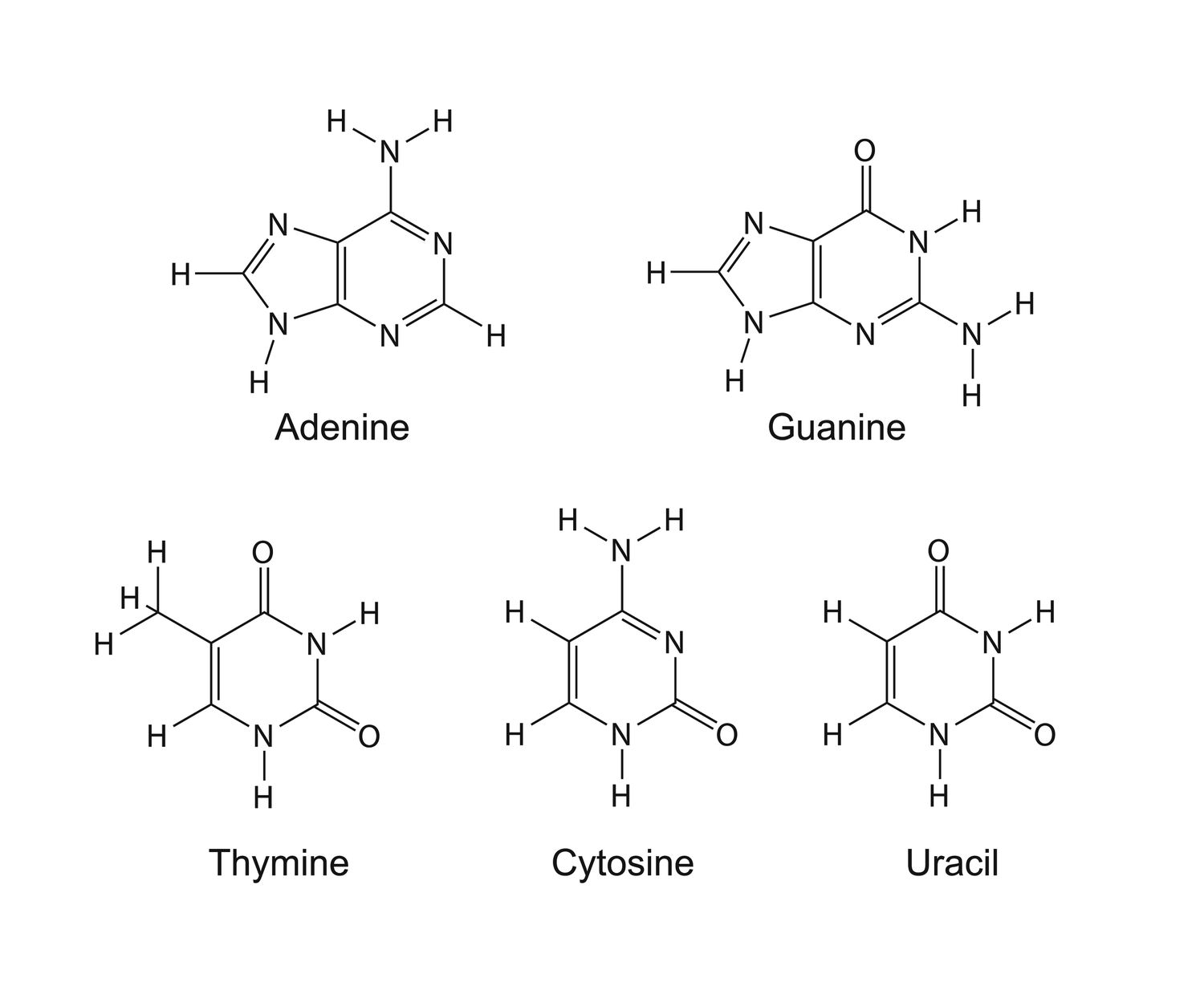
Which nitrogenous bases are considered as purines and pyrimidines?
Purines: Adenine (A) and Guanine (G) (Ag → silver is pure)
Pyrimidines: Cytosine (C), Uracil (U) and Thymine (T)
What gives nucleic acid its acidic character, and makes it negatively charged? What is its formula?
The 🧪phosphoric acid/phosphate group🧪, with the formula H3PO4.
What are nucleotides?
They are nucleosides (nitrogenous base + pentose sugar) ➡covalently linked to one or more phosphate groups⬅. (e.g. Nucleoside monophosphate → 1 phosphate group)
Hence, how many condensation reactions are needed to form a nucleotide? What does each reaction entail?
2 condensation reactions are needed.
1st reaction: The nitrogenous base is joined to carbon-1 of the pentose sugar.
2nd reaction: The phosphoric acid/phosphate group is joined to carbon-5 of the pentose sugar.
Hence, 2 water molecules are removed!!
How are dinucleotides formed, and what bond is formed?
Dinucleotides are formed via the 🌊condensation reaction🌊, between the hydroxyl group at carbon-3 of one nucleotide and the phosphate group at carbon-5 of the other nucleotide.
This forms a ➡phosphodiester bond⬅. There is a 🌊water molecule removed🌊 in the condensation reaction.
Through what reaction are polynucleotides formed from?
Condensation process is 🤯repeated several million times🤯 to form a polynucleotide.
Each condensation reaction, between the hydroxyl group at carbon-3 of one nucleotide, and the phosphate group at carbon-5 of the other nucleotide, 🗑removes 1 water molecule🗑.
What does the backbone of the resulting polynucleotide contain, and what is its charge?
The resulting polynucleotide contains a backbone with an 👫alternating pattern of sugar and phosphate units👫, and it is 😭negatively-charged😭.
Why does each polynucleotide have a 5’ → 3’ direction?
The 5’ end of a polynucleotide chain 🏁ends with a phosphate group🏁, attached to carbon-5 of the sugar residue [residue: sugar already bonded!]
The 3’ end of a polynucleotide chain, however, 🚰ends with a hydroxyl group🚰, attached to carbon-3 of the sugar residue.
Nucleotides are ➕only added onto the 3’ end➕ of the polypeptide chain. Hence, there is a 5’ → 3’ direction.
What type of helix is DNA?
DNA is a 🥈double helix🥈.
How long is a complete turn along the helix, and how many base-pairs does the turn contain? What is the constant width of the double helix?
A complete turn is ⬅3.4nm long➡, and contains 👬10 base-pairs👬!! The constant width of the double helix is 2.0 nm!!
Why is dsDNA (double stranded DNA) very stable, and less likely to be degraded?
This is because the 🚿hydrophilic, negatively-charged sugar phosphate backbone🚿 of DNA is facing outwards. In turn, the 🤮hydrophobic nitrogenous bases🤮 are at right angles, and they ➡face inwards⬅.
Hence, the hydrophobic interactions between the 🥞stacked bases🥞 stabilises the structure; dsDNA thus is very stable and is less likely to be degraded.
What types of grooves can be found along the helix? Where are they located?
The grooves are the 🧑major🧑 and the 👶minor👶 grooves. They are located on opposites of the DNA molecule!
Are the 2 strands anti-parallel or parallel? Hence, which ends of the DNA strands face each other?
They are ❌anti-parallel❌; the 5’ end of one strand of DNA faces the 3’ end of the other strand of DNA.
What is one other characteristic of the 2 DNA strands? (has to do with bases)
The 2 DNA strands are complementary to each other!
Which nitrogenous bases in DNA will base pair with each other?
Adenine and Thymine will base pair together, and Guanine and Cytosine will base pair together! It can be said that 📐pyrimidine bases📐 complementary base pair with the ✨purine bases✨.
What is the ratio of purines (A+G) to pyrimindines (C+T) in a double stranded DNA molecule?
The ratio is 1:1!!!!!
What are the 2 strands held together by? And how many of these bonds are present in the different base pairings?
The 2 strands are held together by ➡hydrogen bonds⬅, with 2 hydrogen bonds between A and T, and 3 hydrogen bonds between G and C.
What is the function of DNA? (Acronym: HACN - Have Apples Come Now)
DNA is the heritable genetic material found in all living things, and it carries the genetic information needed for all cellular activities.
What is the importance of complementary base pairing, in DNA replication? What happens during semi-conservative replication, and what are its impacts?
Double helix structure of DNA 👍enables semi-conservative replication 👍to occur.
During replication, the 💔2 parental strands of the DNA will separate💔.
Both parental strands then act as templates, and a complementary set of nucleotides will then🤗attach by complementary base pairing🤗 via hydrogen bonding.
Hence, 2 daughter molecules of DNA are formed; they each contain one parental strand and one new strand.
The replication is then accurate and genetically identical copies of DNA are produced!
What is the importance of complementary base pairing in the mutation of DNA?
There is a repair mechanism available!
If DNA is mutated, the 😮💨intact DNA strand😮💨 can be used as a template to guide the 🪛repair via complementary base pairing🪛!
This thus ensures that the genetic material 😮💨remains unchanged😮💨.
What is the importance of complementary base pairing in the transcription of DNA?
One polynucleotide strand can serve as a template for the ✨synthesis of a new complementary strand✨!
What is the importance of complementary base pairing in the DNA molecules’ stability? (think about bonds!!)
The complementary base pairs of nitrogenous bases are ➡held on to each other⬅ via 🌊hydrogen bonds🌊.
Furthermore, the adjacent nucleotides within each strand are held together via 💪strong phosphodiester bonds💪, which are not easily broken.
Finally, there are 🤮hydrophobic interactions🤮 between the 🥞STACKED🥞 hydrophobic nitrogenous bases, stabilising the structure of the DNA molecule.
What are the 4 reasons why complemetary base pairing is so important in DNA? (Acronym: SRTS - Sam Rides Tom’s Snake)
To allow Semi-conservative replication to occur
For DNA Repair (from mutations)
Transcription of DNA
Stability of DNA