Intro to Liberalism Social 30-1
 Call Kai
 Learn
Learn Practice Test
 Spaced Repetition
 Match
Match Flashcards
 Knowt Play
1/31

There's no tags or description
Looks like no tags are added yet.
Name | Mastery | Learn | Test | Matching | Spaced | Call with Kai |
|---|
No analytics yet
Send a link to your students to track their progress
32 Terms
Individualism
Individualism is the political and social philosophy that emphasizes the moral worth of the individual, advocating for personal autonomy, self-reliance, and the pursuit of one's own goals over the interests of the collective
Rule of Law
A term associated with individualism - the idea that everyone is equal before the law and that laws should apply uniformly regardless of status
Individuals rights and freedoms
Entitlements and protections given to everyone such as the freedom of expression, religion, association etc.
Private property
Property such as land, intellectual property, and physical items owned by an individual
(Nuance is that exclusive use is not absolute e.g., loud house parties)
Economic freedom
The freedom to buy and sell to whomever in a free market system where government intervention is limited and the economic prosperity is left to the individual
Self interest/competition
The idea that economic freedom is the most beneficial/efficient to the economy when individuals act in their own self-interest which creates market competition
Collectivism:
Prioritizes the common good over the individual and that the rights of the group outweigh the rights of the individual
Economic equality
Largely a collectivist term - Everyone has enough for their needs
Can be obtained through redistribution of wealth or increasing taxes for the rich
Cooperation
Collectivist term - The actions members of a group/collective take to achieve common goals
Public Property
Collectivist term - anything owned by the state/community and is managed to serve the collective
Collective interest
Individual interests that are brought together to form a set of common interests that benefits the whole (basis of unions)
Collective responsibility
The idea that a group should b e held responsible for the actions of a member in that group
- Can be used to oppress a society e.g., North Korea - when someone escapes the family is punished
Adherence to collective norms
Groups impose of a set of standards/expectations to which individuals voluntarily choose to adhere to them to be a part of the group
What does the political spectrum encompass and what are the different perspectives
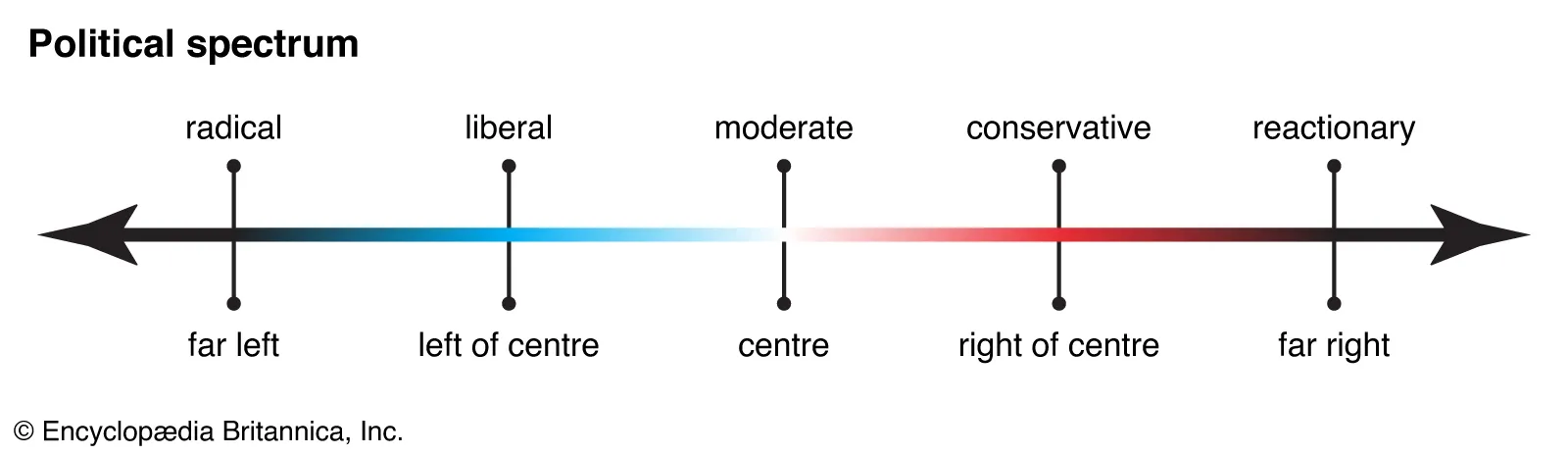
The political spectrum focuses on attitudes toward change
Left - Radical: Revolutionary, believes in extreme change, violence can be used
Centre left: Small changes
Centre Right: In favour of keeping tradition
Reactionary: Idealizes the past, wants to return to the “Good old days,” violence is okay
Authoritarian
Believes that state control is necessary for keeping stability and security
Illiberalism
The state takes more control and removed individual rights under the guise of security
Democracy
Individual freedom is of the ultimate importance
How did the Renaissance contribute to classical liberalism
Emphasized the importance individuals, reasoning, and scientific inquiry above God (humanism) and encouraged individuals to reach their full potential (self-actualization)
The renaissance gave importance to education and gave people the idea that they could learn without a priest
How did the scientific revolution contribute to classical liberalism
Heliocentric model was made which emphasized the idea that the church could be challenged
Prioritized evidence and reasoning
Used the scientific method to discover things
Significance of the reformation
split between catholic and protestant church
People began to question the church
Rise of individualism
People began to come up with their own interpretations of the people
Why was the renaissance, the scientific rev, and the reformation collectively significant
These three eras led toward enlightenment thinking which placed emphasis on the individual and that humans could reason. Moreover, it also supported democratic values and that citizens have the authority.
Classical Liberalism
Advocates for individual rights and responsibilities and that government roles are restricted to ensure security and the rule of law
Individual rights and responsibilities are the priority and that people should act in their self-interests
Humans are reasonable and rational and can make good decisions
Economic freedom
Protect individual rights and limit government power
Social Contract
Humans enter a society and accept to be governed for their safety
Thomas Hobbes
Humans are selfish and naturally in a state of war
Believes that if humans are free, everyone would be in danger
Humans must enter a social contract to ensure security and order and they cannot rebel once entered.
Believes in absolute ruler (leviathan = divine right)
John Locke
Believed humans were naturally intelligent and could make rational decisions
Believed that everyone had the right to Life, liberty, and property
The government's role was to protect these rights, and if the government failed to do so, then humans had the right to rebel
Government should create laws that protect the rights of the people and enforce them for public good
Power is with the people and not God
Montesquieu
Advocated for the separation of powers (Executive, Legislative, and Judicial) that were independent from each other so one could not influence the other
Rousseau
Believed that humans were born good but was corrupted by society, humans are “in chains”
Power should be completely with the people and that humans should make their own laws
General will of the people should be the absolute authority
Against representative democracy
Voltaire
Advocated for freedom of expression, speech, religion, etc
Supported an enlightened monarch
DONT USE TO SUPPORT DEMOCRACY
John Stuart Mill
Believed in individual rights and freedom and championed for individual decision making
Limits could only be placed on people freedoms of those freedoms were being used to infringe on the freedoms of others
No harm principle
Advocated against tyranny of the majority (believed that elected governments represented the views of the majority, and that this could be used to oppress the minority)
Supported women's rights
Mary Wollstonecraft
Argued for the rights of all women
Used arguments from the French Revolution to contend that women need quality education to become useful
Classical Conservatism
A rejection of political liberalism - wants to return to the past
Society should be constructed through a hierarchy
Only educated citizens can vote
Leaders should be humanitarian and responsible for the welfare of others
Society was meant to be stable and this is only possible through law, order, and traditional customs
Edmund Burke
Believed that change should not be made with only the present in mind but should consider the past and the future
Only educated people should be in government to control the irrational passions of the uneducated