Chapter 4 - ENERGY AND MATTER IN ECOSYSTEMS
 Call Kai
 Learn
Learn Practice Test
 Spaced Repetition
 Match
Match Flashcards
 Knowt Play
1/83

There's no tags or description
Looks like no tags are added yet.
Name | Mastery | Learn | Test | Matching | Spaced | Call with Kai |
|---|
No analytics yet
Send a link to your students to track their progress
84 Terms
ENERGY AND MATTER
Energy is essential for a system to do work. Unlike matter, energy cannot be recycled in an ecosystem, but must be supplied continuously. Ecosystems across the world are linked in networks of energy and nutrient (matter) exchange between living things (biotic components) and their nonliving surroundings (abiotic components). Matter consists of atoms and is anything that takes up space and has mass
solar energy.
The Sun provides most of Earth’s energy in a form of electromagnetic radiation that is known as solar energy. Energy in the form of heat energy warms our planet’s surface, and this in turn warms the atmosphere, driving all the processes such as tides, weather systems and ocean currents
biogeochemical cycle
A biogeochemical cycle refers to the pathway of matter through the living components (organisms) and non-living components (such as soils, rocks, water and the atmosphere) of an ecosystem. It involves the chemical interactions in surface reservoirs such as the atmosphere, hydrosphere, lithosphere and biosphere,
producers (autotrophs)
Light energy enters an ecosystem via producers such as plants and algae, which are organisms that have evolved the features to manufacture food in the form of organic matter using the energy in sunlight and simple inorganic substances. Producers begin all food chains, and all other organisms in an ecosystem rely on producers for energy, either directly or indirectly. Producers are also known as autotrophs, meaning ‘self-feeders’ (‘auto’ means self and ‘troph’ refers to feeding). They are able to synthesise organic compounds (e.g. nucleic acids, lipids, proteins and carbohydrates) from inorganic raw materials
How is energy stored
Energy is stored in the chemical bonds in the organic compounds and is released when the chemical bonds are broken.
photosynthesis
The biochemical process that producers use to transform the energy in sunlight into chemical energy is called photosynthesis
chlorophyll
Plant cells have specialised organelles called chloroplasts that contain the pigment chlorophyll, which enables photosynthesis to occur. This pigment is able to absorb most of the wavelengths in sunlight. Photosynthesis in green plants makes greatest use of the red and blue wavelengths of light to produce carbohydrates. The essential inorganic raw ingredients for synthesis of carbohydrate (an organic food) are water and carbon dioxide, and they are usually in plentiful supply.

heterotrophs
living things that cannot synthesise their own organic compounds (food) from inorganic materials. Heterotrophs depend on autotrophs directly or indirectly for their energy needs and their supply of matter. They acquire energy and matter by consuming other organisms, and are therefore also called consumers
Biomass
Biomass is the total mass of biological matter (living or dead) in a given area, at the time of measurement, that can be used as an energy source. Since living biological matter contains water, an inorganic substance that does not contain energy, biomass is normally expressed as the dry weight per unit area, measured, for example, in grams per metre squared (g m –2 ). The percentage of energy entering an ecosystem that is incorporated into biomass is known as productivity. The percentage of energy that is incorporated into biomass by the primary producers in an ecosystem is known as the primary productivity.
photosynthetic efficiency
How well a producer converts light energy into carbohydrates during photosynthesis is referred to as its This depends on the availability of raw materials and sunlight. Temperature influences the rate at which chemical reactions occur, so prevailing environmental temperatures can affect this efficiency as well. Therefore, the production of organic materials from the glucose made in photosynthesis is greater in some seasons compared with others, and also varies according to latitude and altitude
gross primary productivity
GPP is the total amount of chemical energy produced by autotrophs (like plants) through photosynthesis in a given area and time. It represents all the energy fixed by photosynthesis, including the portion used by the plants for their own metabolic processes (respiration)

Ocean ecosystems depend on producers, such as
phytoplankton, which trap huge amounts of light energy. This in turn results in vast amounts of organic material for higher-order consumers. However, light does not penetrate deep water and nutrients are not freely available; therefore, phytoplankton must be highly efficient producers of energy in order to transform the available energy for the ocean ecosystem.
net primary productivity (NPP)
NPP for an ecosystem can be calculated if we know the amount of biomass produced (in grams) over an area (in metres squared) in a given time frame, usually a year. It is important to understand that this is a rate of change of biomass or energy over one year and it must be expressed in the appropriate units, such as:
Net primary productivity is the remaining energy after autotrophs have used some of the energy for respiration. it is the energy available to herbivores and decomposers in an ecosystem

consumer
A consumer is an organism that depends on other organisms for its nutrients and energy requirements. Many consumers are herbivores, animals that feed on plants. Herbivores, including grazing animals, consume large amounts of plant material. They extract energy stored in chemical bonds by a process called cellular respiration. Cellular respiration is a metabolic process. It is the chemical breakdown of organic matter in order to release energy. Cellular respiration can be represented as:

It is important to note that, although only producers perform photosynthesis, both producers and consumers perform cellular respiration.
This is because the cells of producers and consumers need a constant supply of energy in order to carry out their functions
Herbivores have enzymes that can digest
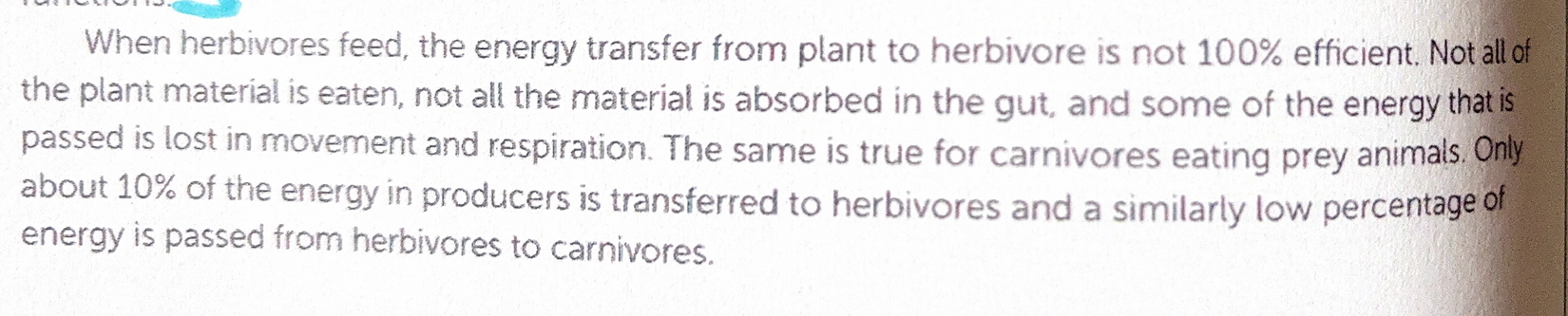
Herbivores have enzymes that can digest cellulose, the major component of the plant cell wall. These enzymes break the chemical bond between individual glucose molecules making up the cellulose, which is the crucial first step in a herbivore’s ability to extract the Sun’s energy from plants. Cellular respiration involves a series of chemical reactions that transform the energy into a usable form. This involves the extraction of the energy stored in the bonds of ATP (adenosine triphosphate). This molecule provides cells with the energy they need to perform their many functions. When herbivores feed, the energy transfer from plant to herbivore is not 100% efficient. Not all of the plant material is eaten, not all the material is absorbed in the gut, and some of the energy that is passed is lost in movement and respiration. The same is true for carnivores eating prey animals. Only about 10% of the energy in producers is transferred to herbivores and a similarly low percentage of energy is passed from herbivores to carnivores.
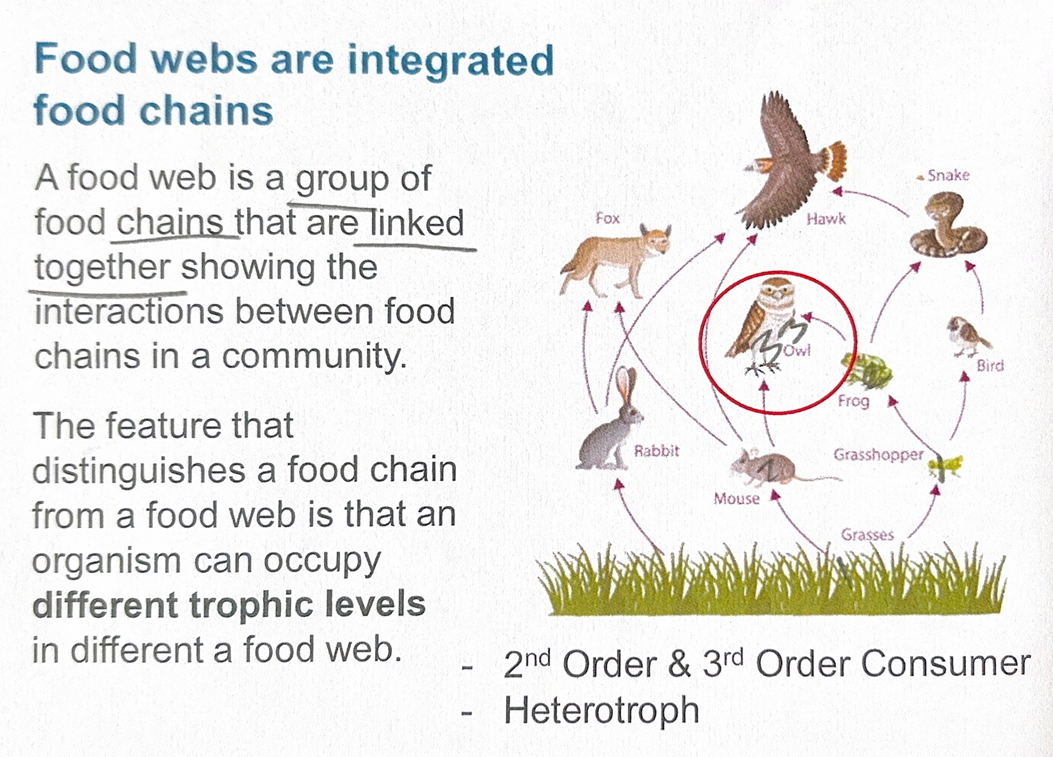
Food chains and food webs are examples of
qualitative, predictive models that allow ecologists to monitor the sustainability of feeding relationships in an ecosystem. Each organism in a food chain obtains its energy from the preceding one. The position an organism occupies in a food chain or web is called its trophic level. The arrows in a food chain or web represent the flow of energy from one trophic level to the next and link species according to who eats whom.
detritus
Some energy is lost from the food chain as chemical energy in organic wastes of dead plant and animal tissues, collectively called detritus. The remaining energy is transferred to the next level.
The top consumers
are not preyed upon but they do die of old age, disease or injury. Energy can then be transferred from the top consumers to scavengers and detritivores.
Scavengers
are animals that feed on the dead remains of other animals.
Detritivores
feed on the detritus and help speed up the process of decay by breaking it down into smaller pieces.
Decomposers
then continue this process by breaking down the complex organic material into simpler inorganic material and returning these nutrients to the soil or water.
P rim a r y c o n s u m e r s (herbivores)
fe e d dir e c tly o n p r o d u c e r s
S e c o n d a r y c o n s u m e r s (carnivores)
F e e d o n p rim a r y c o n s u m e r s
To p c o n s u m e r s (sometimes calle d a p e x p r e d a t o r s)
F e e d o n s e c o n d a r y c o n s u m e r s
O m niv o r e s
F e e d o n b o t h pla n t s a n d a nim als
S c a v e n g e r s
F e e d o n d e a d r e m ain s o f o t h e r o r g a nis m
D e t ritiv o r e s
feed on dead or decaying organic remains and wastes. They are relatively large organisms that help speed up decay by breaking down large pieces of detritus into smaller pieces, increasing the surface area for decomposers to work more efficiently
D e c o m p o s e r s
trophic efficiency
The percentage of the energy at one trophic level that is transferred to the next trophic level is referred to as trophic efficiency.
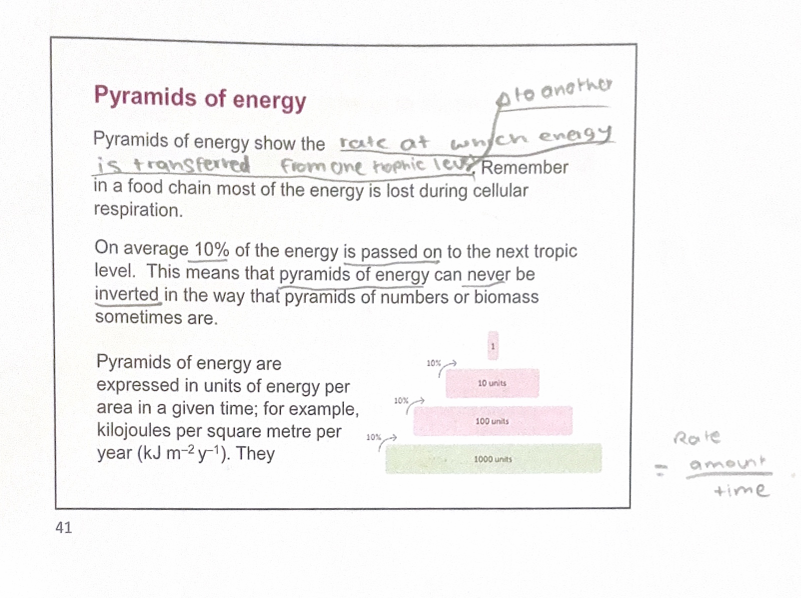
The 10% rule
The 10% rule in ecology states that, on average, only about 10% of the energy at one trophic level is passed on to the next level. The remaining 90% is lost to the surroundings as heat energy and chemical energy in waste
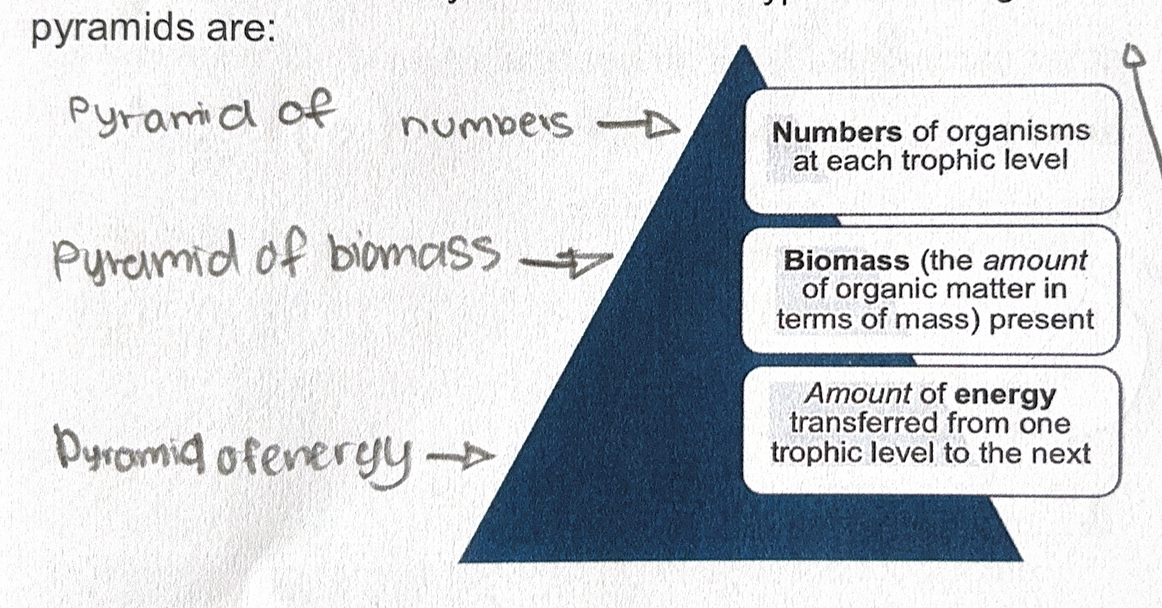
The three types of ecological pyramids provide quantitative relationships between trophic levels of a community in terms of:

Pyramids of numbers
A typical food chain tends to have a drop in the number of organisms at each level. This is represented as a pyramid of numbers. Pyramids of numbers may not always have an apex representing higher trophic levels. For example, a single very large producer, such as a eucalypt tree, may support a large number of primary consumers. Numerous organisms along the food chain depend on the eucalypt, including the larvae of sawflies; cup moths; and wattlebirds, which feed on nectar, pollen, fruits and insects. While the pyramid of numbers is only concerned with the numbers of organisms at each trophic level and their dependence on each other,
Pyramids of biomass
A pyramid of biomass is constructed for a community. the pyramid of biomass records the total mass (amount of dry organic matter) of organisms at each level. Measurements for such a pyramid can be made at one particular time or they can be calculated as rates (productivity) from measurement of dry mass in a given area for the duration of a years

Pyramids of energy
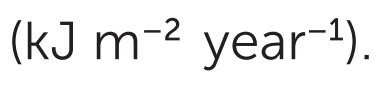
Pyramids of energy are expressed in units of energy per area in a given time; for example, kilojoules per square metre per year (kJ m–2 year–1). They show the rate at which energy is transferred from one trophic level to another. This dynamic view of a community contrasts with the ‘snapshot’ picture provided if energy is only measured at one time. Pyramids of energy allow ecologists to describe the rate of energy transfer in a community. This allows them to make predictions about whether a community can be sustained and what impact any changes to rates of energy transfer will have on the community.
BIOGEOCHEMICAL CYCLING OF MATTER
A biogeochemical cycle is a model describing how chemical elements (e.g. nitrogen, carbon) or molecules (e.g. water) are transformed and stored in both biological and geological components of Earth’s biosphere. These chemicals are recycled through biological food webs and through geological processes, such as weathering, erosion and volcanic activity. Biogeochemical cycles important to living things include the water, carbon, nitrogen, phosphorous and sulfur cycles. The water cycle is especially important, because water provides a habitat for a diverse range of living things and is the medium in which most biological reactions take place. In this course we focus on the carbon and nitrogen cycles.
The carbon cycle
Carbon is constantly moving between different forms throughout the biosphere. It is stored in reservoirs, and it moves between these reservoirs through a variety of processes, including photosynthesis, the burning of fossil fuels and the release of breath from the lungs (respiration). The carbon cycle is the biogeochemical cycle by which carbon is exchanged between the biosphere, geosphere, hydrosphere and atmosphere of Earth.
Carbon is in all organic matter,
ncluding carbohydrates, lipids, proteins and nucleic acids, which are the chemical building blocks of cells and the source of their energy.
Decomposers break down
Decomposers break down complex organic matter into simple inorganic molecules (nutrients). In this way, the organic matter is recycled so that it may re-enter food chains via producers. Fungi and bacteria are common decomposers.
consumption
The process of a consumer feeding on a producer or another consumer is called consumption
Nitrogen cycle
Nitrogen is an essential element, along with other elements (e.g. carbon, hydrogen and oxygen), for living things to make protein and nucleic acids. These molecules are essential for the structure and function of all living things, including controlling cell activities and the growth of new cells. The nitrogen cycle includes many processes which together balance the amount of nitrogen in the atmosphere. In addition, a small amount of gaseous nitrogen is removed from the –atmosphere by lightning
Nitrogen fixation
Nitrogen fixation also removes nitrogen from the atmosphere due to the metabolic activities of specialised bacteria. The use of nitrogen is balanced by the return of nitrogen to the atmosphere by abiotic processes, including volcanic activity, and by the bacterial conversion of nitrites to nitrogen gas.
Nitrogen fixers
Air is 80% gaseous nitrogen (N2 ), but plants are unable to absorb this form of nitrogen directly from the atmosphere. Gaseous nitrogen is converted to nitrates and nitrites by nitrogen fixation carried out by certain prokaryotes. Some specialised bacteria (e.g. Azotobacter and Rhizobium) invade the fine root hairs of plants such as legumes and native wattles, causing the formation of nodules. This symbiotic relationship provides the bacteria with the carbon they need, and in turn the bacteria deliver additional nitrogen to the plants. Other nitrogen fixers live freely in the soil. These prokaryotes are able to absorb the nitrogen gas from the air spaces in the soil and build it up into amino acids, the building blocks of proteins.
Nitrifiers convert decaying material into nitrites and nitrates
Nitrifying bacteria convert the ammonia released in urine and from the decay of faeces, dead plants and animals to nitrites (NO2 ). This takes place in a series of chemical steps during which energy is – released as heat. The bacteria use this energy for building up their own organic compounds. Other bacteria convert the nitrites to nitrates that, only then, can be absorbed by plants.
Denitrifiers convert nitrites into atmospheric nitrogen
Plants growing in waterlogged soils have a particular problem to overcome: there is a shortage of available oxygen. However, denitrifying bacteria convert nitrates in the soil into gaseous nitrogen, and this process releases the oxygen required for their metabolic processes. The combined action of nitrifiers and denitrifiers results in the recycling of nitrogen between plants and the atmosphere.
How does nitrogen reach the ocean?
In the oceans, some available nitrogen (such as nitrate and ammonium compounds) is brought in by rain and run-off and the activities of nitrogen-fixing organisms. This nitrogenous material circulates through the ocean’s plants and animals. Some of the available nitrogen, however, sinks below the upper 100 m of the surface, beneath which photosynthetic organisms are absent. It may then descend all the way through to the sediments at the bottom of the ocean. Here the nitrogen compounds are unavailable to most organisms unless eventually returned to the atmosphere by volcanic emissions and other processes. This sinking of nitrates and other nutrients makes the ocean a relatively poor environment in terms of available nutrients.
The fundamental niche
The fundamental niche (potential niche) is the ideal niche a species would occupy if there were no competitors, predators or parasites.
The realised niche
The realised niche (actual niche) is narrower. It results from an organism’s inability to exploit the resources of its habitat because of restrictions caused by other organisms. Such restrictions mean that a species may not be distributed evenly throughout its potential geographic range.
competitive exclusion principle
The competitive exclusion principle postulates that no two species can occupy the same niche in the same environment for an extended period of time
keystone species
A keystone species is not necessarily abundant in number in a food web, yet it can exert a large effect on population numbers of other species in the community. Keystone species may have different niches, but they each have a disproportionate effect on how their ecosystem functions.
energy can be transferred
energy can move from one organism to another
for example from producer to consumer by consumption of food. The energy type stays the saem
energy can be transformed
From one type of energy to another
for example light energy can be transformed into chemical (glucose) energy and stored in producers
Energy from sun is transformed into
chemical energy in biomass
Energy transformation
changes from different forms
Energy transfer
movement of energy without changing its form
Cycling of matter
Nitrogen and Carbon
Sun ——>
chemical energy
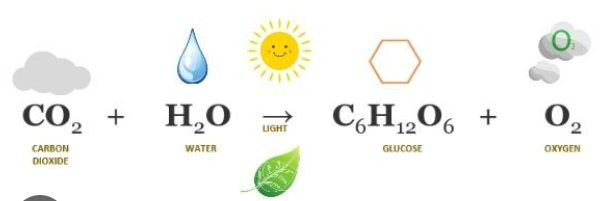
Photosynthesis equation
For substance to be organic it must have
contain carbon and hydrogen
Decomposers
also release nitrogen in the soil
why predators or foreign animals more successful than native animals
Light energy
Enters an ecosystem via autotrophic producers who transform light energy into chemical food energy during photosynthesis.
Chemical Energy
Energy stores in chemical bonds in the carbohydrate food is transferred to consumers upon consumption
Heterotrophs depend on autotrophs
members of a community that consume food because they can not perform the process of photosynthesis are called heterotrophs.
Photosynthesis equaton
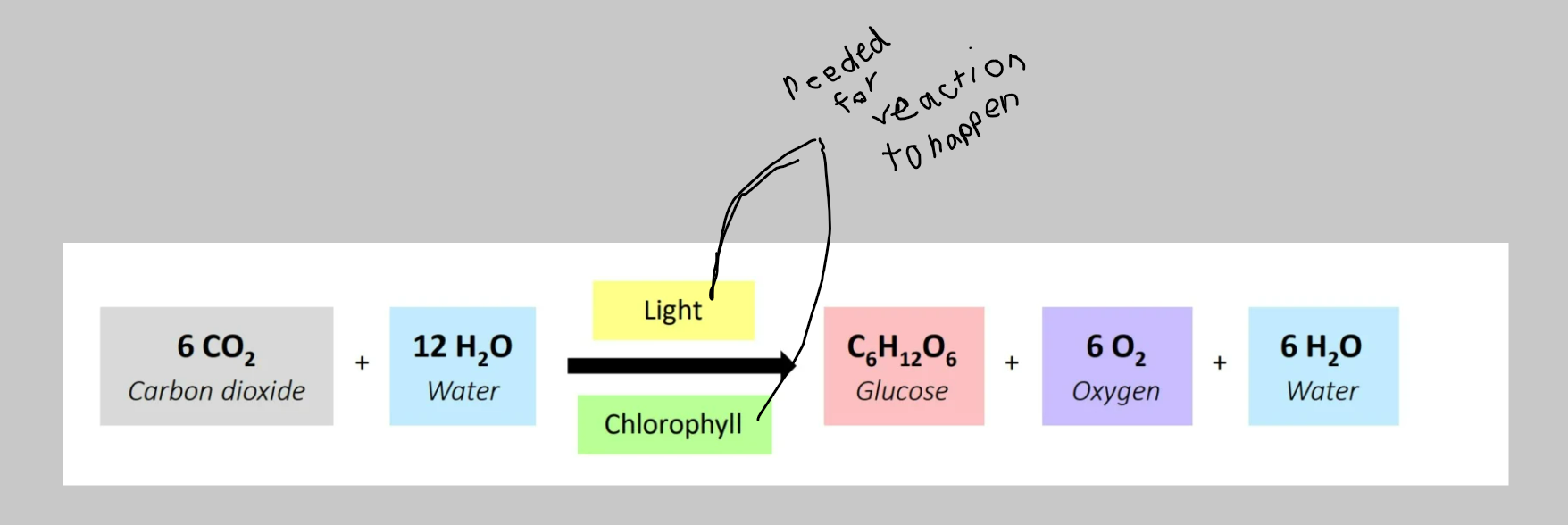
High Biomass
high biomass often reflects a productive ecosystem whee energy is efficently captured. hight water and high nutrients
Primary productivity
refers to the rate at which pants (photosynthetic organisms) produce organic compounds (such as glucose) using sunlight, water and carbon dioxide. It measures the energy entering an ecosystem through the process of photosynthesis
Consumer
a consumer is an organism that depends on other organisms for its nutrients and energy requirements
Trophic transfer
energy is transferred up the trophic levels when consumers feed on organisms lower in the chain
Energy loss
at each trophic level only about 10% of the energy is transferred to the next level whilst the rest is lost or used for metabolic processes.
both consumers and producers perform photosynthesis??
both producers and consumers perform cellular respiration. This is because the cells of prodcuers and consumers need a constant supply of energy in order to carry out their functions
Herbivores and their enzymes
Herbivores have enzymes that can digest cellulose, the major component of the plant cell wall. These enzymes break the chemical bond between individual glucose molecules making up the cellulose. Which is the crucial first step in herbivores ability to extract the sun’s energy from plants.
Food chains + Food webs
Ecological pyramids

The three types of ecological pyramids
Pyramids of numbers
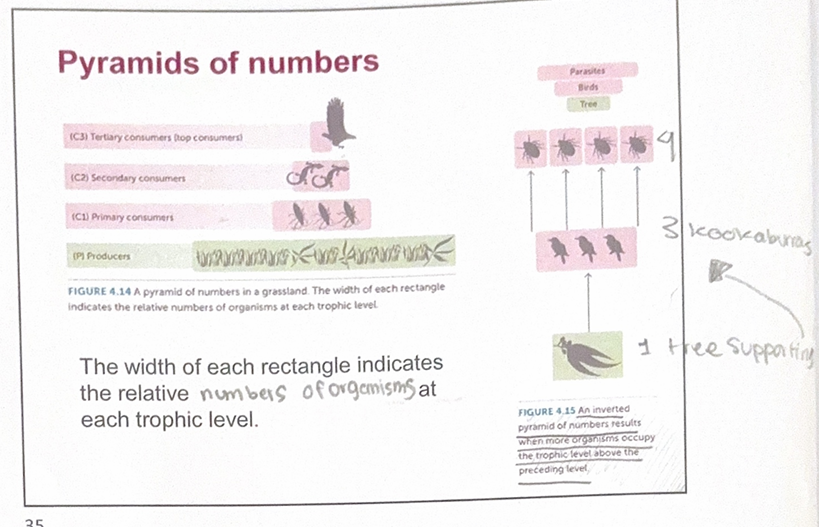
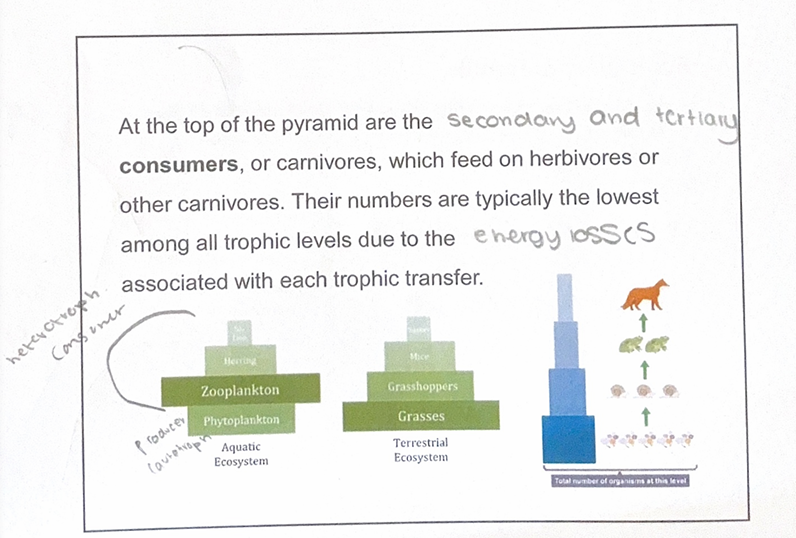
Top of the pyramid
Define Mass
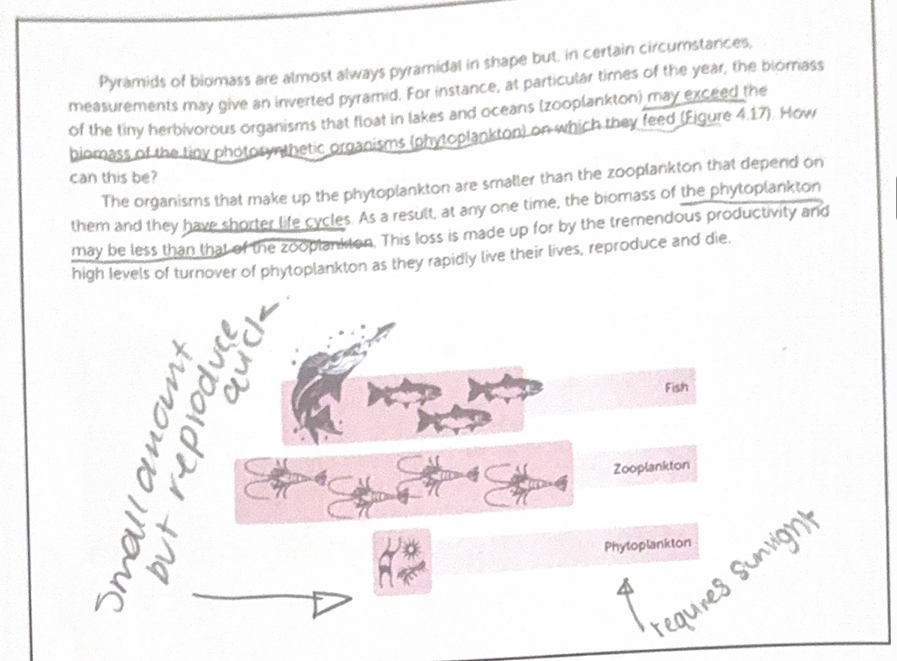
Inverted pyramids
An inverted pyramid of biomass is a graphical representation where the biomass of organisms at higher trophic levels exceeds that of organisms at lower trophic levels.
inverted pyramids of biomass can occur in ecosystems with
high productivity
efficent energy transfer of herbivores
and long lived predators that accumulate biomass over time
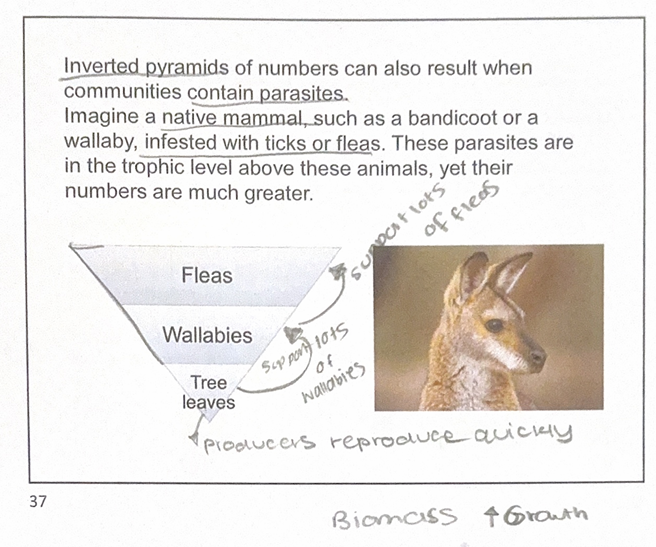
Pyramid of biomass
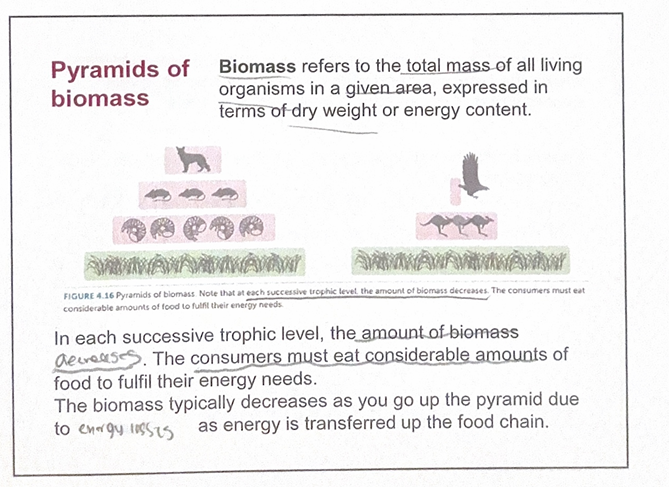
Pyramid of biomass and Inverted pyramids
Pyramid of energy
A pyramid of energy shows the rate of energy transfer through successive trophic levels
the organisms at the top of the food chain receive only a small amount of the total energy stored by producers
This ultimately limits the number of possible trophic levels
Identify the points in the carbon and nitrogen cycle where interconnections occur
Plants are eaten by other consumers in the ecosystem, thus passing nitrogen through the food web
Nitrogen fixing bacteria provide nitrogen to plants through nitrogen fixation, while plants supply organic carbon to the nitrogen-fixing bacteria through photosynthesis