Chapter 1: Microbial life origin and discovery
 Call Kai
 Learn
Learn Practice Test
 Spaced Repetition
 Match
Match Flashcards
 Knowt Play
1/47

There's no tags or description
Looks like no tags are added yet.
Name | Mastery | Learn | Test | Matching | Spaced | Call with Kai |
|---|
No analytics yet
Send a link to your students to track their progress
48 Terms
What is a microbe and some characteristics of it?
A microbe is a microscopic organism such that are typically unicellular but can be multicellular.
contains genome used to reproduce its own kind
cannot regulate internal temp
What is the size range of a microbe?
0.2mm to 5mm
What do microbes include?
prokaryotes: bacteria, archaea
eukaryotes: algae, fungi, protists
viruses: noncellular particles
What are the 3 domans of life?
bacteria, archaea, and eukaryotes
What is a genome
the total genetic information contained in an organisms chromosomal dna
Who developed the first method of dna sequencing?
Fred Sanger sequenced haemophilus influenzae
What is a metagenome?
DNA of all microbes in a community or environment
What are 3 examples of microbes affecting human history in positive and negative ways?
yeasts and bacteria gave use fermented food and alcohol but spoils meat and wine
Lithotrophs aided metal mining but deteriorate ancient stone monuments
microbes of all times have caused disease and famine
What are four microbial diseases that have devestated human populations?
Yersinia pestic: the plague
Mycobacterium tuberculosis: tuberculosis
HIV: aids
SARS-CoV-2: Covid-19
Who was florence nightingale and what did she do?
founder of professional nursing and medical statistics
recognized significance of disease in warfare
Devised the polar area chart
What did robert Hooke do?
built the first compound microscope and coined the term “cell”
What did Antonie van Leeuwenkoek do?
built the single lens magnified and was the first to observe single cell organisms
established microbiology as a discipline
What was the theory of spontaneous generation?
A theory that living creatures such as flies could arise spontaneously without parents
how was spontaneous generation disproved?
Louis Pasteur did an experiment with a swan-neck flask which proved that the boiled broth did not grow microbes until exposed to the trapped microbes in the water of the neck
What was the overall contribution of Lous Pasteur?
discovered biochemical basis of microbial growth
founder of medical microbiology and immunology
What did Robert Koch contribute?
founder of scientific method of microbiology
provided proof of germ theory of disease: many diseases are caused by a specific pathogen (not all:diabetes)
Who developed the petri dish?
Julius Petri made the double sided petri dish
Who developed agar?
kochs colleagues Angelina and Walther Hesse
made from red seaweed a polymer of sugar galactose
What are Kochs postulates?
an ordered set of criteria to establish a causative link between an infectious agent and a disease
suspected microbe always present in diseased host and absent in healthy
Suspected microbe is isolated and grown in pure culture outside host without other microbes present
Introduce pure microbe into healthy hosts and individuals become sick with same disease as original host
same microbe now re-isolated from sick individuals
What did Koch test his postulates on?
Anthrax from bacillus anthracis
Who made the first vaccine and how?
Dr Edward Jenner
cowpox infection protects patients from smallpox
How did louis pasteur make vaccines better?
developed vaccines with attenuated strains of microbes that could pass through immune system without harming it
Who disovered the first antibiotic?
alexander Fleming
penicillin
What is penicillin?
an antibiotic created by penicillium notatum
Why was antibiotics a revolutionary discovery at the time?
saved lives of allied troups during WW2
who discovered viruses?
Dmitri Ivanovsky
How were viruses discovered?
Ivanovsky studied tobacco mosaic disease and realized it could pass through a .1 filter (much smaller than bacteria)
What did Beijerinck do?
proposed that the causative agent of tobacco mosaic disease was not a bacteria
he termed to coin virus!
What did Wendell Stanley do?
Purified and crystallized the causative agent of tobacco mosaic virus
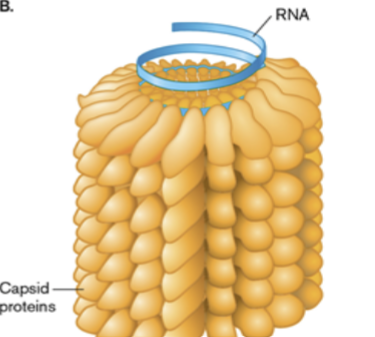
Tobacco mosaic virus
the proteins capsids surround the RNA chromosome
Why are microbes important to earth?
they cycle many nutrients necessary for life
ex) ALL N2 and most O2 on earth
Who was sergei winogradsky and what did he do?
a microbiologist that was among the first to study microbes in natural habitats
built the winogradsky column to study it! it was a model of a wetland ecosystem
discovered lithotrophs
Developed enrichement cultures
How did the Winogradsky column work?
most oxygen at top and none at the bottom. slowly decreased down the pipe
thus aerobes would grow at the top and anaerobes would grow towards the bottom
What are lithotrophs?
organisms that feed solely on inorganic material
What are enrichement cultures?
the use of selective growth media that support certain classes of microbial metabolism while excluding others
what are endosymionts?
microbes that live inside a larger host organism
What is an example of endosymbiosis in plants?
the bacteria Rhizobium induce the roots of legumes to form nodules and they go into them and facilitate bacterial N2 fixation
What is an example of endosymbiosis in animals and insects?
require bacteroides to break down cellulose in their digestive system
What is an example of endosymbiosis in humans?
human instestines containt Escheria coli and bacteroides that grow as a biofilm and contribute positively to human health
what is a biofilm?
organized multispecies community adhering to surface (colonic epithelial cells)
What were the 5 kingdoms Robert Whittaker generated?
bacteria
protists
fungi
plants
animals
How did Carl Woese change the 5 kingdom system?
he discovered prokaryotes that lived in hot springs and produced methane
did a 16S rRNA and revealed these as a distinct form of life
they were archaea!
What is the origin of mitochondria?
ancient proteobacteria
What is the origin of chloroplasts?
anciet cyanobacteria
What did Rosalind Franklin do?
discovered DNA is a double helix by an xray diffraction pattern
What did Watson and Crick do?
discovered complementary bases and antiparallel structure of DNA
What did Thomas Cech do?
discovered catalytic rna
What is catalytic RNA?
Catalytic RNA, or ribozymes, are RNA molecules that have the ability to catalyze chemical reactions, similar to protein enzymes.