bio mod 1 year 11
 Call Kai
 Learn
Learn Practice Test
 Spaced Repetition
 Match
Match Flashcards
 Knowt Play
1/72

There's no tags or description
Looks like no tags are added yet.
Name | Mastery | Learn | Test | Matching | Spaced | Call with Kai |
|---|
No analytics yet
Send a link to your students to track their progress
73 Terms
cell theory
all living things are made of cells
cells are the smallest unit of life
all living things come from pre-existing cells
cell membrane
semi permeable barrier that surrounds all cells
separates cell’s contents from surroundings and controls what enters and leaves the cell
protoplasm
consists of nucleus and cytoplasm
90% of cytoplasm is water that chemicals can be dissolved in
responsible for making cellular products and respiration
nucleus
large oval structure that stores information needed to control cell activities
located in cytoplasm - essential for it to be able to communicate with surrounding organelles
nucleolus: manufactures ribosomes
endoplasmic reticulum
network of flattened, interconnected membranes
provides transport path between nucleus and cells environment
immense folding of sheets of membrane increases SA which allows for more efficiency for protein folding and transport
what does the rough ER do?
protein synthesis and folding
what does the smooth ER do?
lipid and steroid production
ribosomes
attached to rough ER
made of RNA
site of protein synthesis
small size increases surface area which increases efficiency
golgi bodies (post office)
flat membrane stacks that process, package and sort cell products
vesicles help transport and provide a membrane around cell products to package them
lysosomes
formed by golgi bodies
contains digestive enzymes responsible for splitting complex chemical compounds into simpler ones
simpler molecules are used as building blocks for new compounds and organelles
mitochondria
double membrane organelle that performs cellular respiration
membrane is folded into cristae which increases the surface area for attachment of enzymes
which produce energy for the cell during cellular respiration
vacuoles (plant)
large, permanent fluid filled sacs with single membrane for storing water and nutrients
water filled vacuole exerts pressure on cell wall which provides support and structure to plant cell
chloroplasts (plant)
double membrane, conducts photosynthesis
grana stacked on top of each other
increases surface area and capture more light for photosynthesis
inner thylakoid membrane surrounding granum CONTAINS CHLOROPHYLL
keeps reactants and products separate
maintains optimal concentration for best rate of reaction and efficiency
cell wall (plant)
rigid outer layer surrounding cell membrane
non-selective, permeable to most molecules
made of cellulose and provides strength and support for plant cell
can withstand pressure
phospholipid bilayer
made of 2 layers of phospholipids
hydrophobic tails facing inwards and hydrophilic heads facing outwards
transport proteins (type of integral protein)
proteins that penetrate membrane
assist particles (e.g nutrients, ions) to cross membrane
selectively permeable
floating + fixed proteins (type of integral protein)
proteins scattered in the lipid bilayer, used for cell signaling and anchorage for the cytoskeleton
integral proteins
proteins embedded within bilayer
span partially or completely across membrane
for transport, receptors, structure/support
receptor proteins (type of integral protein)
penetrates membrane
has binding sites on outer surface
substances attach to receptor sites and start chemical reactions in cell
eg neurotransmitters and hormones
glycoproteins and glycolipids (uniform)
proteins and lipids which have carbohydrates attached for cell recognition
important for immune system to recognise its own/foreign cells
diffusion
net movement of molecules from a region of high concentration to a region of low concentration along a concentration gradient until equilibrium is reached
no energy input required
the rate of diffusion…
depends on concentration gradient
if there is a greater difference in concentration
concentration gradient will be steeper and diffusion will occur faster
facilitated diffusion
when carrier/channel proteins assist large or charged molecules in diffusing into the cell
osmosis
net movement of solvent molecules from region of high solvent concentration to region of low solvent concentration through a semi-permeable membrane
isotonic
fluids inside and outside a cell are of equal solute concentration, no net water movement
hypertonic
a solution of higher solute concentration (lower water concentration) surrounds a cell
net movement of water molecules will be out of the cell
hypotonic
a solution of lower solution concentration (higher water concentration) surrounds a cell, net movement of water molecules will be into the cell
tonicity
refers to a solution’s solute concentration relative to that of another solution on the opposite side of the cell membrane
active transport
movement of molecules from region of low concentration to region of high concentration through a semi permeable membrane
requires energy input as it move against concentration gradient
process does not stop when equilibrium is reached
passive transport
movement of molecules from region of high concentration to region of low concentration across a semi-permeable membrane
along a concentration gradient, no energy required
process stops when equilibrium is reached
endocytosis
moves large molecules that cannot cross the cell membrane
requires energy
cell membrane changes its shape and engulfs the particle so that it enters the cell
e.g white blood cells engulfing bacteria
phagocytosis
process whereby solid particles are engulfed by the cell membrane
exocytosis
when substances inside the cell are moved elsewhere in the organism
during exo., a membrane bound vesicle move to the cell membrane, fuses with it and releases its contents outside the cell
e.g insulin secretion by pancreas cells
carbohydrates
1 molecule = monosaccharide (monomer) (e.g glucose)
molecule structure of H, C, and O
2 linked monosaccharide = disaccharide (e.g sucrose)
polysaccharide = many monosaccharides linked together in a repetitive chain
proteins (biomolecules)
molecule made of N, O, H and C atoms
1 molecule = amino acid (monomer)
2 linked amino acids = peptide
polypeptide = many amino acid monomers linked together in a repetitive chain
lipids (biomolecules)
molecules made of H, C and O
1 molecule = fatty acid (monomer)
3 fatty acid chains attach to 1 glycerol to make a lipid
nucleic acid (biomolecules)
aka DNA (but DO NOT write DNA as it could also be RNA)
made of N, O, H, P, C
1 molecule = nucleotide monomer
DNA / RNA = nucleotides linked together in a long repeating chain (polymer)
photosynthesis
process where plants use light energy,
trapped by chlorophyll,
to break down water and carbon dioxide molecules to build them up into
oxygen, glucose and water molecules
photosynthesis (light dependent stage)
occurs in grana
involves absorption of light energy by chlorophyll
energy is used to split H2O into
H ions (saved for next stage)
O (released into atmosphere)
ATP formed at this stage
photosynthesis (light INdependent stage)
occurs in stroma
involves combining CO2 w/ H ions made in first step
forms glucose
ATP is needed for this reaction
light microscope
up to 2000x mag, but mag is limited because of lenses
resolution is limited because of wavelength of light
light source passes thru condenser lens
then it passes thru a thin specimen to illuminate specimen
used to observe samples of living tissues and cells
electron microscope
SEM scans surface, TEM looks into a thin slice of specimen
bombards a specimen with a beam of electrons, causing secondary electrons to be emitted from surface layers of specimen
electrons have a much smaller wavelength than light → better resolution
- used for viewing organelles
prokaryotic cell
unicellular
has cell wall
no membrane-bound organelles
no nucleus
0.1-5 um
e.g bacteria (e.coli) or archaea
eukaryotic cell
uni/multicellular
some have cell wall
has nucleus
has membrane-bound organelles
10-100 um
e.g animals
endosymbiosis
theory to explain how eukaryotes evolved
proposes that organelles found in euk. were once prok. living in a larger host cell
chloroplasts + mitochondria - were once prokaryotes engulfed by another prok. to form an early eukaryote
both organelles have their own DNA
difference between mag and res
mag: increase in size of image
res: smallest distance between 2 objects where each can be observed as separate
bacteria cell structure
pili - facilitates adhesion to host cells
flagellum - propels them to move/swim
plasmid - contains DNA
how does the shape of the cristae (in mitochondria) relate to its function?
immense folding of cristae increase SA, increases no. of sites available for chemical reactions, thus increasing efficiency
how does the shape of the inner membrane (in mitochondria) relate to its function?
seperates inner matrix from rest of organelles
increases efficiency of mitochondria by maintaining optimal concentration of reactants for best rate of reaction
how are wastes/cellular products removed in cells?
simple diffusion - O2, CO2, urea
proteins get broken down by lysosomes
osmosis - water
fat soluble substances - attached to small charged molecules to make them water soluble
so they can be removed when water diffuses out
exocytosis - secretion of hormones and enzymes
alcohol fermentation - anaerobic cellular respiration
breakdown of glucose in the absence of oxygen to form ethanol and CO2
2 ATP molecules produced as a result
glucose → ethanol + carbon dioxide + ATP
lactic acid fermentation - anaerobic cellular respiration
1 glucose molecule broken down in absence of oxygen
produces 2 molecules of lactic acid + 2 ATP
occurs during strenuous exercise when body cannot deliver enough O2 to muscles to produce energy required
once exercise is over → lactic acid converted to pyruvate to be used during aerobic respiration
glucose → lactic acid + ATP
aerobic cellular respiration - word equation
glucose + oxygen → carbon dioxide + water + ATP
what happens in glycolysis?
occurs in cytosol
breaks down glucose into 2 pyruvate molecules
accompanied by release of energy - 2 ATP molecules
what happens after glycolysis (in aerobic respiration)?
2 pyruvate molecules enter mitochondria to undergo series of chemical reactions
each reaction catalysed by a specific enzyme
energy from these reactions is released in 34 ATP
makes a total of 36 ATP from breakdown of every glucose molecule
enzymes
biological catalysts, usually made of protein (or RNA) that speed up rate of a specific chemical reactions within a cell or an organism’s body fluids
enzymes are:
substrate specific
operate under optimum conditions of temperature, pH and substrate conc.
control metabolic reactions in cells
control rate of reaction in each step of all chemical reactions taking place in cells
lower activation energy required for chem. reactions
properties of enzymes:
unchanged by process → only substrate changes
reusable → enzymes only need to be made/present in small quantities
specific
enzyme reactions are reversible
composition of enzymes: protein/RNA
polypeptide chain folding itself over forming a 3D structure
3D shape determines specificity of enzyme
3D shape unravels completely when enzyme is denatured (pH or extreme temp.)
composition of enzymes: active site
part of enzyme that binds to substrate
co-enzymes or co-factors (non-proteins) may be required to complete active site
e.g vitamin B2 (co-factor)
induced fit model
enzyme changes shape on contact w/ substrate
substrate is released - enzyme returns to original shape
enzyme pracs: pH (range of IV, DV, CVs)
range of IV: pH 4, 5.5, 7, 9, 11
DV: enzyme activity (measured by height of bubbles, representing oxygen production)
CVs:
same temp of solution
same substrate conc.
same size of potato
same volume of H2O2
same time potato was left to react before measuring DV
enzyme pracs: pH (graph)
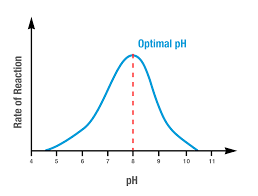
enzyme pracs: pH (explanation)
if solution is too acidic/basic:
enzyme shape changes → denatures
substrate can no longer bind to active site
on either side of optimal, enzyme can still work but not as efficiently/effectively
enzyme pracs: substrate concentration (range of IV, DV, CVs)
range of IV: 0%, 10%, 20%… 100%
DV: enzyme activity (measured by height of bubbles, representing oxygen production)
CVs
same pH of solution
same temp. of solution
size of potato (i.e volume of catalase)
same volume of detergent
same time potato was left to react w/ DV
enzyme pracs: substrate concentration (graph)
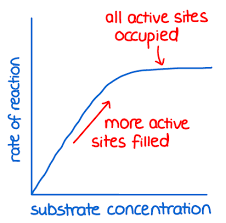
enzyme pracs: substrate concentration (explanation)
as substrate concentration (H2O2) increases, enzymes have more molecules of substrate to bind to (i.e collisions increase), so activity increases
once saturation point is reached (i.e all active sites are full), enzymes cannot bind to any more substrate molecules so enzyme activity plateaus
if more enzymes were added, enzyme activity would begin to increase again
enzyme pracs: temperature (range of IV, DV, CVs)
range of IV: 2°C, 20°C, 37, 60, 80
DV: enzyme activity (measured by height of bubbles, representing oxygen production)
CVs:
same pH of solution
same volume of H2O2
size of potato (i.e volume of catalase)
same volume of detergent
same time potato was left to react w/ DV
enzyme pracs: temperature (graph)
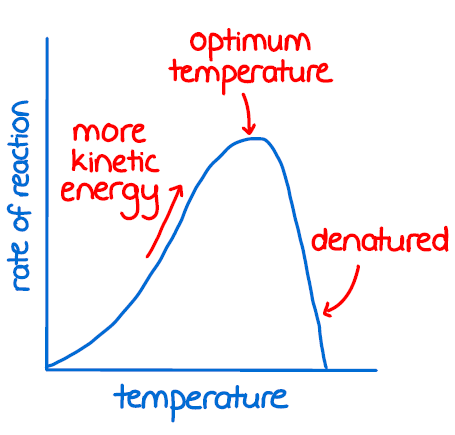
enzyme pracs: temperature (explanation)
at low temps, enzyme and substrate molecules do not have as much KE
fewer collisions → less enzyme activity
as temp increases (up to optimal temp)
rate of collision increases → enzyme activity increases
beyond optimal temp.
enzyme begins to change shape and bind to substrate less efficiently
if temp is too hot, enzyme becomes denatured and won’t work anymore
catalase H2O2 equation
2H2O2 → 2H2O + O2
catalase
enzyme pracs: substrate concentration (POTATO DISC)
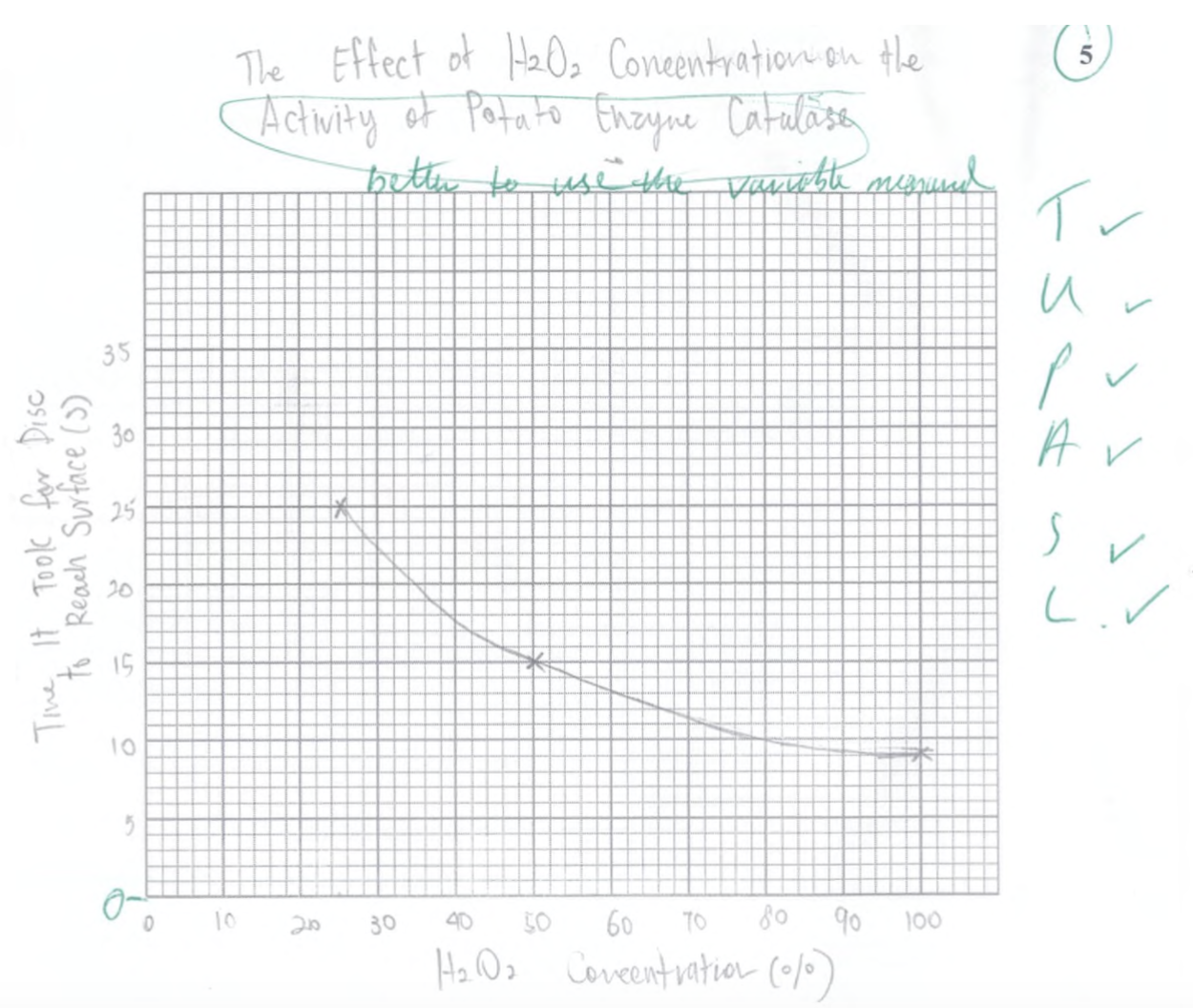
explain the trend
as concentration of H2O2 increases, time taken taken for the discs to rise decreased at a decreasing rate
this is because as H2O2 concentration increases, collisions between H2O2 and catalase increase, increasing the rate of reaction
leads to bubbles of oxygen being produced faster and thus discs floating more quickly
enzyme pracs: substrate concentration (POTATO DISC)
how was validity ensured?
experimental control - 0% H2O2 concentration
used to check whether presence of H2O2 causes discs to rise
control variables: pH, temperature, amount of enzyme
important to keep constant so they don’t cause enzyme activity to change in addition to substrate concentration
pH - only diluting w/ distilled water
temperature - keeping reactants at room temp
amount of catalase - using same size discs to absorb same amount of potato extract on each one