Math vectors
 Call Kai
 Learn
Learn Practice Test
 Spaced Repetition
 Match
Match Flashcards
 Knowt Play
1/28

There's no tags or description
Looks like no tags are added yet.
Name | Mastery | Learn | Test | Matching | Spaced | Call with Kai |
|---|
No analytics yet
Send a link to your students to track their progress
29 Terms
Intersection between two planes (2 steps)
Finding a line.
Do scalar/vector product of normal of both planes to get the direction vector of the line
Pick/Find a point that is on both of the planes and use that as position vector
Intersection between two lines (3 Steps)
Make sure the lines use different parameters
Equate the generic points (x’s, y’s, and z’s) of both lines.
Solve using two of the equations and confirm with the third unused one
Intersection between line and plane (3 Steps)
Take generic point of line, meaning x,y,z including parameter
Plug the generic point x,y,z of line into equation of plane and solve for parameter
Plug parameter into equation of line to get the point that is on the line and plane.
How to determine if two lines are parallel (2 ways)
If dot product is 1, or if direction vectors are multiples or each other.
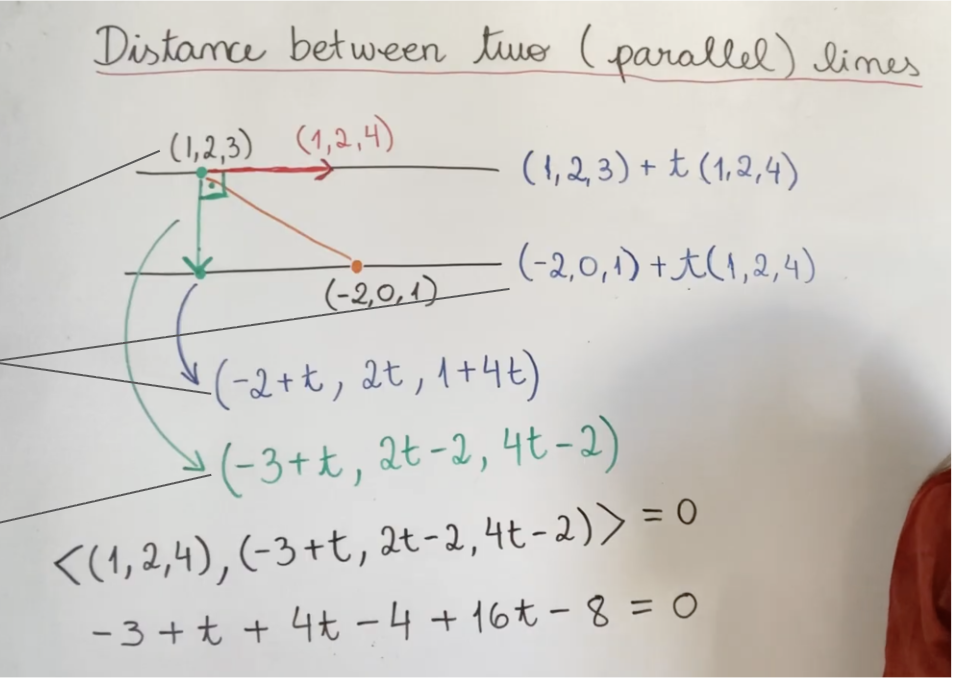
Distance between (two parallel lines). (6 Steps & Similar to line and point)
Pick a point on line A
Use given equation to name a general point on line B
Find vector directly perpendicular AND between both lines by subtracting the points.
Do cross product is = 0. Rearrange and solve for the parameter.
EITHER:
Plug parameter into line b to find where in line b that point lies.
Then use distance between two points formula.
OR
Plug parameter into vector directly perpendicular and between both lines and calculate magnitude
Distance between point and plane (4 Steps)
Use normal vector of plane to create direction vector
Use point to create position vector and complete the line equation
Plug generic point x,y,z of the line equation into the plane equation and solve for parameter
Plug parameter value into the derived line to get the vector then do magnitude of that.
Distance between two lines (5 Steps)
Do not use the same parameter for the two lines
Do cross/vector product of the two direction vectors to get direction vector perpendicular to both lines
Use generic point of both planes and use create a new parameter which you multiply with direction vector to reach from one plane to the other.
Do system of linear equations to solve for the new parameter
Plug that parameter into equation and find magnitude to get distance
Distance between a point and line. Similar to two parallel lines (5 Steps)
Use given equation to name a general point on line B
Find vector directly perpendicular to line and point by subtracting general point of line from the given point.
Do cross product is = 0. Rearrange and solve for the parameter.
Plug parameter into line to find where in line b that point lies.
Then use distance between two points formula.
Distance between two parallel planes (5 Steps)
Get normal of the plane and use as direction vector
Get point on: the other plane Use as position vector
Plug the generic point x,y,z of line into equation of plane of unknown point and solve for parameter
Plug parameter into equation of line to get the point that is on the line and plane.
Use distance between two points formula.
Angle between two lines
Do dot product of direction vectors
Angle between two planes
Simply dot product of normal of planes
Angle a plane and a line
Dot product of normal of plane and line
Then do pi/2 - that angle to get the ACTUAL ANGLE
If a line and a plane have no points in common it means???
They must be parallel to each other and dot product of line and normal of plane is 0
Two lines are skew if??
When solving for the parameters you don’t get solutions
To get equation of a plane
You just need two lines parallel to that plane that are not parallel to each other and take cross product to determine normal. This is how you convert from vector equation to cartesian equation
Then get/find/use a position on plane as position.
What about other cases of horizontal asymptote?
If denominator heavy leading x power then horizontal asymptote is 0
If equal level then use the ratio.
When is there a slant asymptote?
If degree of numerator is exactly one higher than degree of denominator. You must divide top and bottom equations until a remainder, then the linear answer you get is the equation of the line.
What does a repeated root look like?
Essentially if it does not cross the axis, it is a repeated root.
This is mathematically checked/calculated based on the derivative. If the derivative at that point is =0, then the order of derivative determines the number of repeated roots. Eg. if you have a root of an equation at a point, then take the derivative of that equation, plug that same root into the derivative and it is 0, then it is a repeated root at least once, take second derivative and plug the same root and it is 0, then repeated root at least twice and so forth.
What is ambiguous case, when applicable, and what do you do?
When you have two lengths and an angle which is not between those two lengths. Find angle by using regular methods, then do 180-that angle, logically to get the second possible solution.
Taking cross product what does your thumb represent and the other fingers in terms of direction?
First vector in the cross product multiplication is index
Second vector is the middle finger
Thumb is the resultant cross product
Intersection of 3 planes?
Solve system of 3 linear equations based on the equations of the three planes
Where is mode of probability density function?
It is at the peak of the function as this represents the highest probability, which is therefore most common which is what mode is.
Where is median of probability density function?
Think of the curve like a pile of sand.
The Median (Halfway): This is the point that divides the weight of the sand in half. It divides the probablity in half, and is at half the area under the curve
Requirement for a piecewise function to be differentiable at a point?
Both functions need to be equal at that point, and the derivatives must be equal at that point as well.
Integrating method key step + shortcut?
Recognizing that we are looking at the result of a product rule.
SHortcut is after multiplying by integrating factor, take whatever is being multiplied by derivative and multiply by y. (essentially multiply the integrating factor by y) then put d/dx
Y on x vs x on y?
Y on x regression etc is the normal axis
x on y is flipped.
normal dsitribution general range values?
68% 1 standard deviation
95 % 2 standard deviation
99.7% 3 standard deviations
What is Z-score?
It calculates how many stds a given x value is from the mean