bio 1220 practical
 Call Kai
 Learn
Learn Practice Test
 Spaced Repetition
 Match
Match Flashcards
 Knowt Play
1/74

Earn XP
Description and Tags
Flashcards covering key concepts of plant diversity, evolution, and classification.
Name | Mastery | Learn | Test | Matching | Spaced | Call with Kai |
|---|
No analytics yet
Send a link to your students to track their progress
75 Terms
Evolution of Plants
The process by which plants develop new traits and adapt to survive and outcompete others in their environment.
Angiosperms
A group of flowering plants that produce seeds, flowers, and fruits, rapidly diversifying and outnumbering all other plant groups combined.
Gymnosperms
Non-flowering seed plants, such as conifers, which reproduce with seeds and pollen grains dispersed by wind.
Seedless Vascular Plants
Plants like ferns that possess vascular tissue but reproduce via spores, requiring water for gamete dispersal.
Nonvascular Plants
Plants such as mosses that lack vascular tissues and rely on water to transport gametes.
Alternation of Generations
A reproductive cycle in plants involving two multicellular stages: gametophyte (haploid) and sporophyte (diploid).
Gametophyte
The haploid multicellular stage in the alternation of generations that produces gametes.
Sporophyte
The diploid multicellular stage in the alternation of generations that produces spores.
Lycophyta
A division of seedless vascular plants, including club mosses, characterized by vascular tissues and a dominant sporophyte generation.
Pteridophyta
A division of vascular plants that includes ferns, characterized by a dominant sporophyte generation and sporangia on leaves.
Sphenophyta
A division of vascular plants, commonly known as horsetails, with a dominant sporophyte and strobili at the stem tips.
Cycadophyta
A group of gymnosperms known as cycads, recognized for their large strobili and once prominent presence.
Ginkgophyta
The only gymnosperm that cycles leaves with the seasons, producing fleshy seeds.
Coniferophyta
The division of gymnosperms that includes conifers, characterized by strobili and the largest, longest-lived plants.
Anthophyta
The division of flowering plants, also known as angiosperms, which develop seeds within an ovary that becomes fruit.
fungi
main eukaryotic decomposers on the planet
parasitic
obtain nutrients from living organisms
saprophytic
obtain nutrients from dead organisms, mostly fungi
fungal structure
biomass containing filaments called mycelia
individual mycelia filaments
hyphae
fungal feeding
utilizing external digestion and secrete enzymes that break down organic material and then gets absorbed into the hyphae
yeast budding
asexual reproduction by developing a chain of buds
fungal groups
chytridiomycota
mucoromycetes aka zygomycota
basidiomycota
ascomycota
mucoromycota
soil dwelling saprophytes. sexually reproduce by forming diploid zygospores in the zygosporangium which will undergo meiosis to produce zygomycete spores. examples are bread and fruit molds
basidomycota
mainly saprophytic species, sexually reproduce by the formation of specialized cub-shaped cells called basidium which will make basidiospores. examples would be mushrooms, puffballs, etc
ascomycota
largest fungal group. have a ascocarp which contain the ascus which produce ascospores. examples are molds, truffles, yeast
lichen
mutualistic symbiotic relationship between cyanobacteria or green algae and a fungus
mycorrhizal relationships
fungi that covers plant roots in which the plant will gain increase surface area to uptake more water and nutrients while the fungus receives carbs and sugars from the plant
what are animals?
multicellular eukaryotes
heterotrophs
ingests their own food
type of body symmetry
asymmetry, radial symmetry, bilateral symmetry
ectoderm
covering the outside part of the organisms, give rise to skin and nervous system
mesoderm
becomes muscles, connective tissues, skeleton, kidneys, circulatory and reproductive organs
endoderm
cell will form the lining of the gut and major organs derived from it
Acoelomate
no coelom, only digestive cavity
pseudocoelomate
“sort of” body cavity and also digestive cavity
eucoelomate
true body cavity and digestive cavity
gametes
sperm and eggs produced within the gonads of the animals through meiosis
gonads
testes and ovaries
fertilization
egg (n) and sperm (n) unite to produce a diploid zygote (2n)
internal fertilization
egg and sperm meet inside the body of one of the parents and develop
external fertilization
eggs and sperm are dispersed into medium in hopes that they meet and fuse
Porifera (sponges)
no distinct body plan, lack tissues (also lacking tissue layers, organs, and organ systems, and are sessile filter feeders on ocean floor
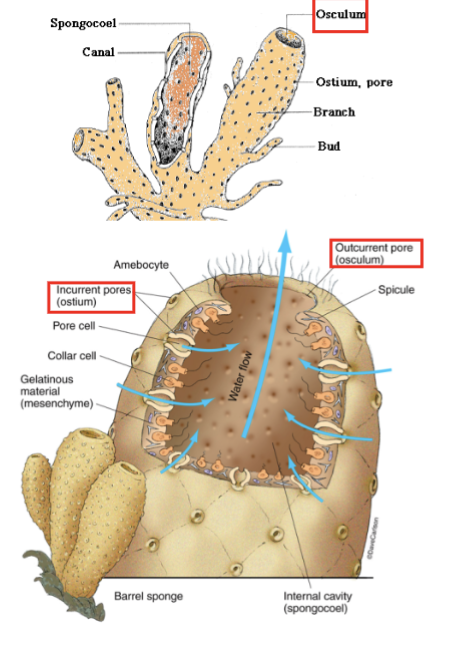
Porifera anatomy
water enters the sponge through the pores called ostium
water exits through large opening at top called osculum
collar cells aka choanocytes create a current which draws water through the ostium and out of osculum
spicules are structural supports that deters predators
cnidaria
common name coral, jellyfish, sea anemones
have radial symmetry, diploblastic (ecto + endoderm)
have tentacles with cnidocytes (stinging cells)
cnidarian body plan
either sessile (immobile) polyp or motile medusa
polyp adhere to substrates
medusa moves freely
protostomes
undergo protostome embryonic development
have bilateral symmetry (symmetrical to one body axis
cephalization
triploblastic
function through organ systems
cephalization
an accumulation of a nervous system (brain and eyes) at head of the animal
Platyhelminthe
aka flatworms
live as either free-living or parasitic flukes/tapeworms
acoelomate
incomplete digestive system
Annelida
aka segmented worms
live as either earthworms, leeches, or marine polychaetae worms
complete, one-way digestive tract
mollusca
aka molluscs
have complete digestive tract
eucoelomate
muscular foot
soft mantle
4 main groups; chitons, gastropods, bivalves, cephalopods
gastropods
snails and slugs
bivalves
oysters and clams
cephalopods
squid and octupuses
in a earthworm, what is a crop?
a part of digestive system that stores the food
in a earthworm, what is a gizzard
second part of digestive system that breaks down the nutrients stored in the crop
incomplete metamorphosis
juvenile stage resembles adults, differing only in size and sexual maturity
Complete metamorphosis
organisms undergo dramatic transformation in form and ecology as they move from juvenile to adult stages ex) caterpillar to butterflies
Nematoda
aka nematodes or roundworms
free living, found in soil or aquatic habitats
pseudocoelom and complete digestive tract
not segmented
arthropoda
aka arthropods
insects, chelicerates myriapods, crustaceans
growth by ecdysis
characterized by having segments called tagmata with a pair of appendages
chelicerata
horseshoe crabs, sides, ticks, mites, scorpions
have 2 tagma (cephalothorax and abdomen)
6 pairs of appendages ( 1 pair of fanged chelicerae, 1 pair of pedipalps, and 4 pairs of walking legs)
myriapoda
aka milipedes and centipides
2 tagma (head and trunk)
paired appendages per trunk segment
centipedes
carnivorous and often poisonous, have 1 pair of walking legs per segment
centipedes
detritivores (feed on dead organic matter) and have 2 walking legs per segment
crustacea
aka lobsters, crayfish, shrimp, crabs, barnacles, etc
have 2 tagma (cephalothorax and abdomen)
have 2 pairs of antennae
insecta
aka beetles, grasshoppers, bees, cockroaches, etc.
3 tagma (head, thorax, and abdomen)
3 pairs of walking legs
usually 2 pairs of wings
like protostomes animals, deuterostome animals are also
eucoelomate
triploblastic
bilaterally symmetrical
embryonic development
the zygote grows through cellular division, and the cleavage of the zygote exponentially increases. a solid morula forms and will hollow out to become a blastula
gastrulation
cells migrate to form the three tissue layers; ectoderm, mesoderm, and endoderm
neurulation
development of the nervous system by a neural tube that will eventually become the brain and spinal cord