Paper 2
 Call Kai
 Learn
Learn Practice Test
 Spaced Repetition
 Match
Match Flashcards
 Knowt Play
1/65

There's no tags or description
Looks like no tags are added yet.
Name | Mastery | Learn | Test | Matching | Spaced | Call with Kai |
|---|
No analytics yet
Send a link to your students to track their progress
66 Terms
State the most appropriate instrument for measuring the peak value of an oscillating voltage
Cathode Ray Oscilloscope
Define the torque of a couple
product of force and perpendicular distance between forces
State the type of emission that is not affected by electric and magnetic fields
Gamma
State the type of emission that has a range of energies, rather than discrete values
Beta
State Kirchoff’s second law
Sum of electromotive force = sum of potential differences around a closed loop
(To do with conservation of energy)
Explain what is meant by frequency for a wave on the surface of water
number of wavefronts passing a point per unit time
State what is meant by an alpha particle
A helium nucleus
State the conditions for the formation of stationary waves
two waves of same speed travelling in opposite directions overlap
waves are the same type and have same frequency and wavelength
State Newton’s first law of motion
A body continues at rest or constant velocity unless acted upon by a resultant force
State what is meant by the mass of a body
the quantity that resists changes in motion
OR the quantity of matter in a body
For a progressive wave, state what is meant by the wavelength
the distance between two adjacent wavefronts
Define displacement
Distance from a fixed point in a specified direction
Describe one cause of a random error and systematic error in measurements of a constant current taken using an analogue ammeter
Random:
wrongly interpolating between scale divisions
reading scale from different angles
Systematic:
zero error
wrongly calibrated scale
Describe the energy conversion that occurs when a particle is falling through the air at constant speed
GPE to thermal energy
State the principle of superposition
Two waves meet at a point/overlap.
Resultant displacement is vector sum of individual displacements.
Why does beta decay have a range of energies?
three body decay
energy from decay is shared randomly between an electron, daughter nucleus, and anti-neutrino
What are the SI base units
Mass (kg)
Length (m)
Time (s)
Current (A)
Temperature (K)
Describe the concept of weight
The effect of a gravitational field on a mass
Principle of conservation of momentum
linear momentum always conserved with no external forces
State the effects in an elastic collision on the total kinetic energy and relative speed of approach vs separation
KE is conserved
relative speed of approach = relative speed of separation
How do you find relative speed of approach/separation?
u(1) - u(2) = v(2) - v(1)
What defines an inelastic collision
Momentum always conserved
Some change in KE may take place. (Could be lost to surroundings via deformation, heat)
What is a couple
a pair of forces that acts to produce rotation only
Define pressure
Force perpendicular to a surface per unit area
What is the origin of upthrust acting on an object in a fluid?
it is due to a difference in hydrostatic pressure
pressure increases with depth
pressure acting upwards greater than pressure acting downwards on object
so force is exerted upwards on object
What is the equation for upthrust force
(Archimedes principle - upthrust is equal to weight of fluid it displaces)
F = density x volume x g
What is the equation for hydrostatic pressure
change in pressure = density (of fluid) x g x depth in fluid
Define load
The tensile force that causes the extension
What is the compression
Original length - reduced length
What is Hooke’s law
The extension of an object is proportional to the applied load, given temperature stays constant and the limit of proportionality is not exceeded.
What is the limit of proportionality
The point up to which the force is directly proportional to extension
What is the spring constant of an object
The force per unit extension
What two numbers are conserved in nuclear processes
nucleon number
charge (lepton number)
What particles are released in Beta minus radiation
Electron, (electron) anti-neutrino, and daughter nucleus
What particles are released in beta plus radiation
positron, neutrino
Why are electron anti/neutrinos produced in beta decay
to conserve lepton numbers, and energy-momentum
Electron anti-neutrino has a lepton number of -1
an electron neutrino has a lepton number of +1
What is the lepton number of an electron
+1
What are the six flavours of quarks
Up, down, strange, charm, top, bottom
What is the relationship between: hadrons, mesons, baryons, and leptons
Hadrons: particles that have quarks
Mesons: two quarks (1, 1 anti)
Baryons: three quarks
Leptons: do not feel the strong force
Define the electromotive force
energy transferred per unit charge in driving charge around a complete circuit
Transverse vs longitudinal waves
transverse can be polarised
transverse: direction of energy propagation perpendicular to direction of oscillations
Define wavelength
Minimum distance between particles which are vibrating in phase
or distance between adjacent wavefronts
What is a property of all waves
can be reflected and refracted
can produce interference patterns
What is the Doppler effect
the frequency change due to the relative motion between a wave source and an observer
Why do electromagnetic waves differ to other types of transverse waves
don’t need a medium to travel through
If a wave slows down, what changes and what remains constant
frequency remains constant
wavelength decreases
What is the electromagnetic spectrum in order of longest wavelength to shortest
Radio
Micro
Infrared
Visible
Ultraviolet
X-rays
Gamma rays
Give approximate wavelength range for radio
10e4 - 10e-1
Give approximate wavelength range for microwaves
10e-1 to 10e-3
Give approximate wavelength range for infrared
10e-6 to 10e-2
Give approximate wavelength range for visible
7 × 10e-7 to 4 × 10e-7
Give approximate wavelength range for ultraviolet
10e-7 to 10e-9
Give approximate wavelength range for X-rays
10e-9 to 10e-12
Give approximate wavelength range for gamma rays
10e-10 to 10e-16
Define a polarised wave
A transverse wave in which vibrations occur in only one of the directions perpendicular to the propagation of energy
What is the condition for a wave to be plane polarised
vibrations in just one plane
in the direction the wave energy is travelling
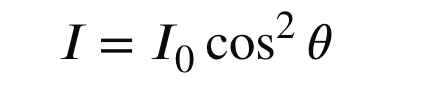
What is Malus’ law
Where Inought is the plane polarised intensity (or I is the intensity that passes through the analyser).
The angle between polarisation direction and analyser axis.
What conditions must be the case to produce an observable interference pattern/
same frequency
constant phase difference
Described as coherent sources.
What is a stationary wave
two waves travelling with same speed in opposite direction along the same line overlap, hence interfere. Same frequency, same amplitude, same wavelength.
What is the fundamental frequency/first harmonic
lowest frequency at which stationary wave forms (1 antinode, 2 nodes).
How do you find the frequency of the second harmonic from the frequency of the first harmonic
2 x f
What is a node, what is an antinode
Nodes: zero amplitude, max destructive interference (no vibration of wave)
Antinodes: max amplitude, max constructive interference
What happens with white light incident on a diffraction grating
dsinx = nlambda
Each wavelength is diffracted a different amount
A continuous spectrum is repeated (there may be some overlapping of different orders)
Define potential difference across a component. What is the associated equation.
Energy transferred per unit charge. V = W/Q.
Why does the resistance of a filament lamp increase as current increases?
current is flow of electrons
as electrons move, they collide with vibrating metal ions
the more the ions vibrate, the greater is the chance of collision
the higher the temp, the greater the amplitude of vibration
As current increases, the temperature increases.
What is Ohm’s law
current directly proportional to potential difference across component with constant temp.