Understanding Ultrasound Physics chapter 6 - Interaction of Sound and Media
 Call Kai
 Learn
Learn Practice Test
 Spaced Repetition
 Match
Match Flashcards
 Knowt Play
1/162

There's no tags or description
Looks like no tags are added yet.
Name | Mastery | Learn | Test | Matching | Spaced | Call with Kai |
|---|
No analytics yet
Send a link to your students to track their progress
163 Terms
What is the attenuation coefficient in soft tissue?
0.5 dB/cm/ MHz
Decibel Notation
A standard measurement tool used to report RELATIVE changes in attenuation or amplification
- LOGARITHMIC
-comparison
-a ratio
Logarithm
Mathematical construct for rating numbers:
-The LOG represents the # of 10's that are multiplied to create the original number
- To determine the log of powers of ten, simply count the ZEROES
Decibels are a Ratio, what is needed to solve a dB problem?
RATIO =
(Actual level / Starting level)
This means that TWO intensities are required
1. the STARTING level
2. ACTUAL level at the time of measurement
Amplified by +6 dB
The intensity has increased 4X = QUADRUPLED
Amplified by +9 dB
The intensity has increased 8X
Amplified by +20 dB
The intensity has increased 100X
- +30 dB = 1000X
- +40 dB = 10000X
etc
Attenuated by - 6dB
The intensity has decreased by a fourth (-1/4)
Attenuated by -9dB
The intensity has decreased by an eighth (-1/8)
Attenuated by -20dB
The intensity has decreased by -1/100
-30 dB = -1/1000
-40 dB = - 1/10000
etc
Attenuation is determined by TWO factors:
1. PATH LENGTH
[distance]
2. FREQUENCY
[penetration]
Relationship between FREQUENCY and PENETRATION
INVERSELY RELATED
- High frequency means LESS penetration (the sound beam can NOT travel as far into the body)
- Low frequency means MORE penetration
Attenuation is reported as:
a RELATIVE CHANGE, not absolute
3 Processes that contribute to attenuation
1. Reflection
2. Scattering
3. Absorption
Reflection
- As a sound strikes a boundary a portion of the wave's energy is redirected/or REFLECTED back to the SOUND SOURCE
- Reflection is likely to occur when the dimension of the boundary is LARGE
2 Types of Reflection
1. Specular Reflection
2. Diffuse Reflection
Specular Reflection
When the boundary is LARGE and SMOOTH (i.e. diaphragm):
The sound is reflected in ONE direction in and ORGANIZED manner.
- Must be at 90 DEGREE ANGLE
Diffuse Reflection (Backscatter)
This type of reflection occurs when the sound beam strikes an IRREGULAR boundary and radiates in MORE THAN ONE direction.
- Does not have to be 90 degree angle
- Backscatter has lower strength than specular reflection
Scattering
RANDOM redirection of sound in MANY DIRECTIONS
- Sound scatters when the tissue interface SMALL
- It is DISORGANIZED
What causes the most scattering?
AIR - Lung tissue will cause scattering because the alveoli are filled with air.
Rayleigh Scattering
Type of scattering that occurs when structure's DIMENSIONS are MUCH SMALLER than the beams wavelength
Relationship between RAYLEIGH SCATTERING and FREQUENCY
DIRECTLY RELATED:
The higher the frequency the higher the Rayleigh Scattering
Rayleigh scattering is PROPORTIONAL to FREQUENCY to the 4th POWER
How does Rayleigh Scattering redirect the sound wave?
EQUALLY in ALL DIRECTIONS
- It is ORGANIZED
What is an important tissue property that influences the amount of REFLECTION
acoustic IMPEDANCE
Impedance
Acoustic resistance to sound traveling in a medium
- Impedance DEPENDS upon the DIFFERENCE between the IMPEDANCES of the 2 media at the boundary
- If the impedances EQUAL each other, there is NO REFLECTION
How is IMPEDANCE calculated
Z = density (kg/cm3) X propagation speed (c)
UNITS: rayls
Incidence
refers to the ANGLE at which a wave strikes a boundary which will then determine the behavior of that pulse
PORNN
1. P - Perpendicular
2. O - Orthogonal
3. R - Right
4. N - Normal
5. N - Ninety
All these words mean NORMAL incidence at 90 DEGREES
Incident Intensity
The sound wave's intensity immediately BEFORE it strikes a boundary
Reflected Intensity
The intensity of the portion of the incident sound beam that AFTER striking the boundary, RETURN BACK in the direction from which it came
Transmitted Intensity
The intensity of the portion of the incident sound beam that AFTER striking the boundary, CONTINUED FORWARD in the direction it was traveling
Since there is conservation of energy at the boundary:
Incident (starting) Intensity =
Reflected Intensity + Transmitted Intensity
What UNITS is Intensity measured in?
The unit for all intensities is W/CM2
Intensity Reflection Coefficient (IRC)
Is the PERCENTAGE (%) of the intensity that BOUNCES BACK when the sound beam strikes the boundary between 2 media
What is the IRC between SOFT TISSUE and AIR?
The percent reflected back is 90-99%
What is the IRC between SOFT TISSUE and BONE?
The percent reflected back is 50%
What is the IRC between SOFT TISSUE and SOFT TISSUE?
The percent reflected back is 1%
Intensity Transmission Coefficient (ITC)
The percentage (%) of the intensity that passes in the FORWARD DIRECTION when the sound beam strikes the interface between 2 media
Since there is conservation of energy at the boundary:
Intensity REFLECTION coeffecient (IRC) (%)
+
Intensity TRANSMISSION coeffecient (ITC) (%)
=
100%
Reflection with Normal Incidence
When a sound beam strikes a tissue boundary at a 90 DEGREE ANGLE (normal incidence), reflection occurs ONLY if the media on the other side of the boundary have DIFFERENT IMPEDANCES
What would cause NO REFLECTION to occur?
If Z1 = Z2
If the impedances are IDENTICAL, no reflection will occur
TRANSMISSION = !00% because nothing is reflected back
Reflection with OBLIQUE incidence
Reflection MAY OR MAY NOT occur:
However, 2 principles ALWAYS apply
1. Conservation of energy
2. REFLECTION ANGLE = INCIDENT ANGLE
REFLECTION ANGLE = INCIDENT ANGLE
When reflection occurs with oblique incidence, the sound beam is NOT redirected back to the transducer, but rather in a DIFFERENT DIRECTION.
The direction it goes in will be EQUAL and OPPOSITE to the incident angle:
ANGLE OF INCIDENCE = ANGLE OF REFLECTION
Transmission with Oblique Incidence
similarly MAY or MAY NOT OCCUR:
If it does occur, the beam could travel in a straight line (angle of transmission)
or
the sound beam could bend/change direction (angle of refraction)
Refraction
TRANSMISSION WITH A BEND:
A change in direction of wave propagation when traveling from one medium to another
Refraction occurs only if 2 conditions are met:
1. OBLIQUE incidence (angle) - not 90 degrees
2. DIFFERENT PROPAGATION SPEEDS between the 2 media.
- If these 2 conditions are met, the sound beam WILL NOT travel in a straight line, it will BEND
Snell's Law
Snell defined the physics of refraction (LAW OF REFRACTION)
- has to do with the relationship between the incident angle and TRANSMISSION ANGLE
Half-value layer thickness units...?
Cm
Attenuation coefficient units...?
dB/cm
T/F: attenuation and prop speed are unrelated
True
T/F: if 2 media have the same prop. speed but different densities, the one with higher density will have higher impedance
True
Impedance (rayls) = density mass/volume x c
When ultrasound encounters a boundary with perpendicular incidence, the _______ must be different to produce a reflection
Impedance
What is half value layer thickness?
Distance that sound must travel in a tissue to decrease by half [ attenuate 3dB]
3 synonyms for half value layer thickness
Penetration depth, depth of penetration, half boundary layer
What is total attenuation?
Attenuation coefficient multiplied by distance traveled through the tissues
Determined by path length and frequency
Impedance is determined by...?
Medium
Half boundary layer is determined by...?
Medium and frequency
Acoustic impedance is a property of the _____, and determined by its_____ & _____
Medium, density, stiffness
A sound beam has > from its initial intensity by a factor of 100, how is this described in dB?
20dB
A wave's intensity is 2mW/cm^2,
There is a 9dB change,
What is the final intensity?
16mW/cm^2
Def of Attenuation Coefficient
# of dBs of attenuation that occurs when sound travels one cm
dB/cm
Total attenuation formula
TotalAttenu = AttenuCo [dB/cm] x distance [cm]
In air, frequencies above____ attenuate entirely
1 MHz
No noticeable attenuation occurs with frequencies less than_____ is observed in water
10 MHz
Typical values for 1/2 value layer thickness
0.25 - 1.0 cm
Tissue impedance is______, not_____
Calculated, measured
Typical values for impedance
1.25 - 1.75 Mrayls
Synonym for impedance
Characteristic impedance,
Acoustic impedance
As path length increases, the half boundary layer will...
Remain the same
As path length increases, the attenuation coefficient in soft tissue will...?
Remain the same
Impedance is important in______ at boundaries
Reflections
Intensity reflection coefficient (IRC) formula
(With regard to impedances)
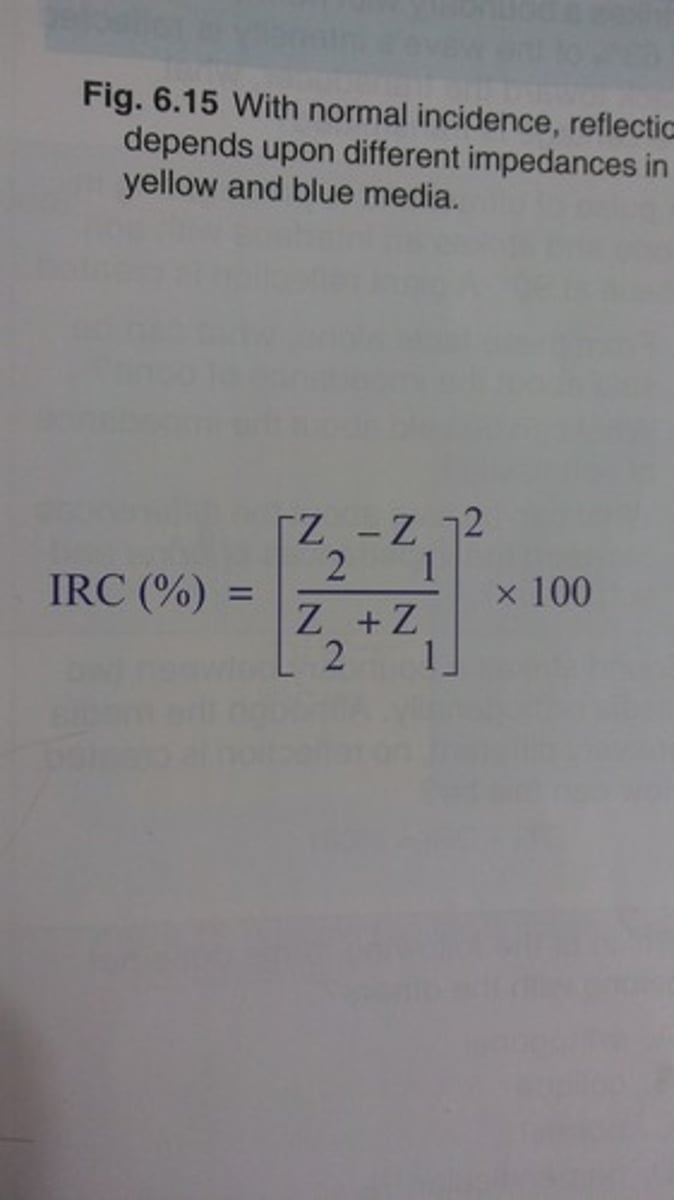
Orthogonal means...?
Normal incidence
Transmission with Normal Incidence (ITC) coefficient formula
ITC (%) = transmitted intensity/incident intensity x 100
A sound pulse travels in Med1 and strikes a boundary with Med2 at 30*,
The AoT is 10*
In which medium is the impedance higher?
Cannot be determined with info provided.
Refraction is affected by SPEED OF SOUND in the media
attenuate
to reduce in force or degree; to weaken
amplified
increased strength
decibel notation
a relative measurement, a comparison, a ratio, logarithmic
Every 3 dB change means that the intensity will?
double
Every 10 dB change means that the intensity will?
increase ten times
A reduction in the intensity of a sound beam to one-half of its original value is _____ dB.
-3 db
A reduction in the intensity of a sound beam to one-quarter of its original value is _____ dB.
-6 db
-10 dB means that the intensity is reduced to _____ of its original value.
one-tenth
dB is a mathematical representation with a
logarithmic and relative scale
true or false
we need one intensity to calculate decibels.
false
a wave's intensity is 2mw/cm^2. there is a change of +9 db. what is the final intensity?
c. 16 mw/cm^2
If the final intensity of a sound beam is more than the initial intensity, then the gain in dB is ____. (+ or -)
positive.
If the initial intensity of a sound beam is less than the final intensity, then the gain in dB is _____
positive.
Distance and attenuation are ______ related.
directly
Frequency and attenuation are ______ related.
directly
More attenuation
longer distances, higher frequencies
Less attenuation
shorter distances, lower frequencies
three processes contribute to attenuation
1. Reflection
2. Scattering
3. Absorption
two forms of reflection
specular and diffuse are created in soft tissue, depending on the nature of the interface that a sound wave strikes
specular reflection
a reflection produced by a smooth surface in which parallel light rays are reflected in parallel
diffuse reflection or backscatter
Reflection that occurs when parallel rays of light hit a rough surface and all reflect at different angles
Rayleigh scattering
Special form of scattering that occurs when the structure's dimensions are much smaller than the beam's wavelength
what is the significance of attenuation in diagnostic sonography?
the goal in diagnostic imaging is to use the highest frequency that still provides images to the depth of the structures of clinical interest.
Absorption
the process or action by which one thing absorbs or is absorbed by another.
Absorption and frequency are ____ related.
directly