Chapter 3: Atomic & Ionic Arrangements
 Call Kai
 Learn
Learn Practice Test
 Spaced Repetition
 Match
Match Flashcards
 Knowt Play
1/79

There's no tags or description
Looks like no tags are added yet.
Name | Mastery | Learn | Test | Matching | Spaced | Call with Kai |
|---|
No analytics yet
Send a link to your students to track their progress
80 Terms
Solids
Large numbers of atoms or molecules held together in an amorphous or crystalline arrangement by metallic, covalent, ionic bonds or Van der Waal’s bonds
What order do monoatomic gases have? Give an example
No order
ex. Argon gas
What order do amorphous materials have? Give an example
Short-range order
ex. amorphous Si, Glasses, Plastics
What order do liquid crystals have? Give an example.
Short and long-range order in small values
ex. LCD polymers
What order do crystalline materials have? Give an example for single crystal and polycrystalline.
Short and long-range order
single crystal: Si, GaAs
polycrystalline: metals, alloys, and most ceramics
Single crystal
crystalline material consisting of only one large crystal
Polycrystalline
composed of many small crystals with varying orientations
Crystallography
study of the arrangements of atoms in solids
Lattice
collection of point that divide space into smaller equally sized segments
Basis
group of atoms associated with a lattice point
actual atom or group of atoms attached to every lattice point
Unit cell
subdivision of the lattice that still retains the overall characteristics of the entire lattice
repeat the unit cell in all directions to build entire crystal
Lattice points
points that make up the lattice
surroundings of each point in lattice are identical
Define 1D, 2D and 3D lattices
1D: only 1 type of lattice (points separated by equal distance)
2D: more than one type of lattice
3D: 14 unique lattices (Bravais lattice)
What are the 4 out 14 types of Bravais lattices you need to know?
Simple cubic (SC)
Face-centered cubic (FCC)
Body-centered cubic (BCC)
Hexagonal
What are the axes and angles between axes in cubic lattices?
a=b=c
all angles are 90 degrees
What are the axes and angles between axes in hexagonal lattices?
a=b≠c
two angles are 90 and the other is 120
Provide an example of FCC lattice
Copper and nickel
Provide an example of hexagonal lattice
Graphite
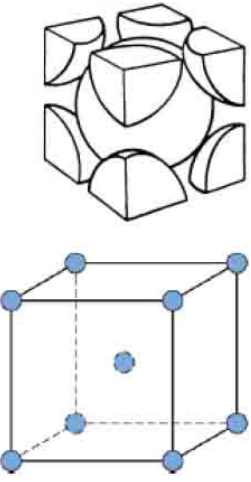
How many atoms are in a BCC unit cell?
2
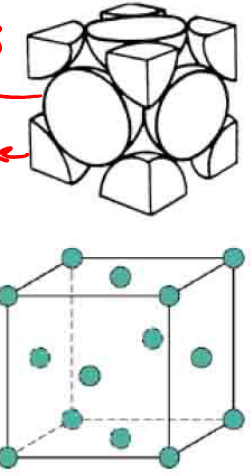
How many atoms are in an FCC unit cell?
4
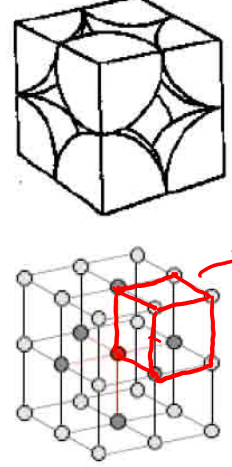
How many atoms are in a simple cubic unit cell?
1
Coordination number
number of nearest neighbours that an atom has
What is the coordination number of an SC unit cell?
6 atoms touch each other
What is the coordination number of an FCC until cell?
12 atoms
What is the coordination number of a BCC unit cell?
8 atoms touch each atom
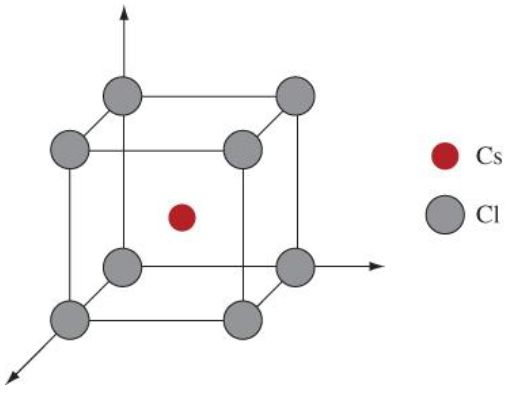
Identify the lattice and basis and define the unit cell of CsCl, an ionic and crystalline compound.
BCC lattice
Basis of 2 ions
Definition of unit cell:
a=b=c
all angles are 90 degrees
Cl- ion at (0,0,0) & Cs+ ion at (1/2,1/2,1/2)
Atomic Packing Factor (APF)
= fraction of space occupied by atoms
= (number of atoms/cell)(volume of each atom)/volume of until cell
*used to calculate relationships between lattice parameter and radius of atom
Close-packed directions
directions in unit cell along which atoms are in continuous contact
What is the relationship between the atomic radius and the lattice parameter in an SC unit cell?
a =2r OR r=a/2
What is the relationship between the atomic radius and the lattice parameter in an FCC unit cell?
a=2r√2 OR a=4r/√2
What is the relationship between the atomic radius and the lattice parameter in a BCC unit cell?
a=4r/√3
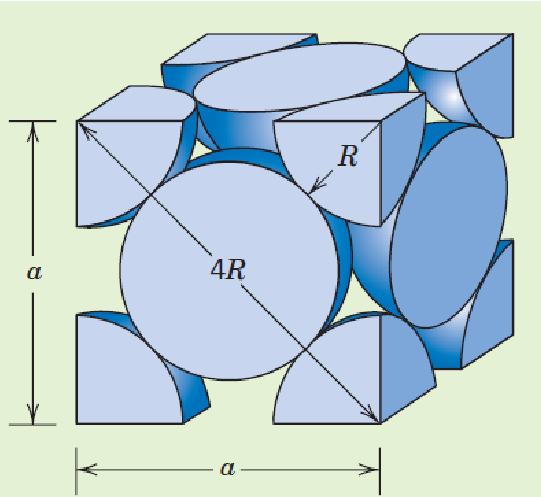
Calculate the volume of an RCC until cell in terms of the atomic radius R
vcell = 16√2R3
What is the APF for SC?
π/6 = 52%
What is the APF for FCC?
π/3√2 = 74%
What is the APF for BCC?
√3π/8 = 68%
Equation for calculating the theoretical density of a material from the properties of the crystal structure
ρ = nA/VcNA
n = # of atoms associated with each unit cell
A = atomic weight (g/mol)
Vc = volume of the unit cell
NA = Avogadro’s number (6.022 × 10²³ atoms/mol)
Copper has an atomic radius of 0.128 nm, an FCC crystal structure, and an atomic weight of 63.5
g/mol. Compute its theoretical density and compare the answer with its measured density
8.89 g/cm3
What can accompany a transformation of material? What does that mean for ceramics?
Volume can change
for ceramics, can cause the material to fracture
What happens when the crystal structure of a metal changes?
Changes in crystal structure cause changes in the metal’s properties (like hardness, strength, and ductility).
Why does heat treatment work for steels and other alloys?
Because heating and cooling cause controlled changes in crystal structure, which change the material’s properties
Allotropy
The characteristic of an element being able to exist in more than one crystal structure depending on temperature and pressure
Polymorphism
compounds (more than one element) exhibiting more than one type of crystal structure
Which elements have a Simple Cubic (SC) crystal structure?
Polonium (Po), α‑Manganese (α‑Mn)
Which elements have a Body‑Centred Cubic (BCC) crystal structure?
Ferrite (Fe), Titanium (Ti), Tungsten (W), Molybdenum (Mo), Niobium (Nb), Tantalum (Ta), Potassium (K), Sodium (Na), Vanadium (V), Zirconium (Zr), Chromium (Cr)
Which elements have a Face‑Centred Cubic (FCC) crystal structure?
Austenite (Fe), Copper (Cu), Gold (Au), Platinum (Pt), Silver (Ag), Lead (Pb), Nickel (Ni)
Which elements have a Hexagonal Close‑Packed (HCP) crystal structure?
Titanium (Ti), Magnesium (Mg), Zinc (Zn), Beryllium (Be), Cobalt (Co), Zirconium (Zr), Cadmium (Cd)
In what direction is deformation easier?
In the direction where atoms are packed most closely
True or False: Magnetic properties are different in different crystallographic directions
True
How do you find Miller indices for directions?
Determine coordinates of 2 points that lie in the direction
Subtract the coordinated of the tail point from the head to obtain the number of lattice parameters traveled in the direction of each axis of the coordinate system
Clear fraction and/or reduce the results to the lowest integers
Enclose the numbers in square brackets []. *No commas
Negatives are represented by bar above number
Where does deformation usually occur?
on the planes where the atoms are most tightly packed
True or False: semiconductors are grown and cut along specific crystallographic planes
True
How do you find the Miller indices of planes?
Identify the points at which the plane intercepts the x, y and z coordinates in terms of the number of lattice parameters (If the plane passes through the origin, the origin of the coordinate system must be moved)
Take reciprocals of the intercepts
Clear the fractions but DO NOT reduce to lowest integers
Enclose results in () *No commas
Negatives should be written with a bar over the number
True or False: Planes and their negatives are not identical (ex. (020) ≠ (0-20))
False, planes are their negatives ARE identical
True or False: In cubic systems, a direction that has the same indices as a plane is perpendicular to that plane
True, for example, (0-10) and [0-10] are perpendicular.
A result of symmetry in the cubic system is:
a family of directions
True or False: A family of directions is represented by square brackets
True
True or False: A family of planes is represented by square brackets.
False, a family of planes is represented by curly brackets
Linear atomic density (LD)
describes how much of a line is covered by atoms (considering only atoms whose centers are on the line)
expressed as [atoms/m]
What is the equation for LD?
LD = equivalent length of atoms centered on the direction vector/length of direction vector
Planar atomic density (PD)
the fraction of the area of the plane is covered by atoms whose centers lie in the plane
expressed as [atoms/m2]
What is the equation for PD?
PD = area of atoms centered on a plane/area of plane
Why is it important to know LD and PD?
Slip (mechanism by which metals plastically deform) occurs:
Along directions with greatest linear density " ("closed-packed directions”)
On planes with highest planar density (“closed-packed planes”)
Close-packed direction
the direction where atoms are lined up most tightly and touch along a row
(ex. in FCC, close-packed directions are <110>)
Close-packed plane
the plane with the highest atomic packing density
(ex. in FCC, close-packed planes are {111})
True or False: Close-packed means every atom touches every surrounding atom
False, it means atoms touch their nearest neighbours
What is the coordination number for HCP?
12
True or False: A direction and its (-) are identical
False
True or False: A direction and its multiples are identical
True
True or False: certain groups of directions are equivalent
True
When do close-packed planes occur?
When ideal packing density is achieved (does not happen in the SC or BCC systems)
When is SC in close-packed direction and plane?
Direction: <100>
Plane: None
When is BCC in close-packed direction and plane?
Direction: <111>
Plane: None
When is FCC in close-packed direction and plane?
Direction: <110>
Plane: {111}
When is HCP in close-packed direction and plane?
Directions: <100>, <110>, <1120>
Planes: (0001), (0002) → Basal Plane
Interplanar spacing (dhkl)
distance between two adjacent parallel planes of atoms with the same Miller indices
Important for x-rays to identify materials and crystals
How to calculate interplanar spacing (dhkl)
dkhl = a0 / √(h2 + k2 + l2)
Interstitial sites
the spaces between the atoms/ions of a crystal
(ex. SC until cell has 1 interstitial site)
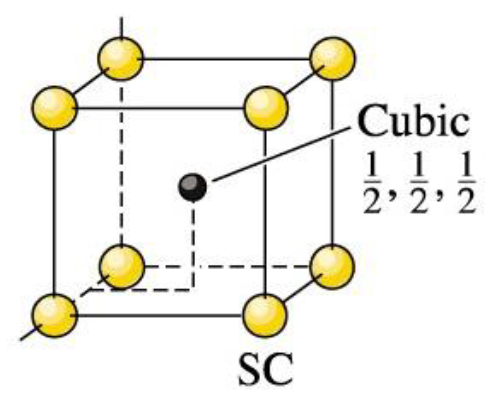
How do you determine the coordination number of an interstitial atom/ion?
It is equal to the number of atoms/ions it touches
How many tetrahedron and octahedron interstitial sites does a BCC unit cell have?
24 tetrahedron & 18 octahedron
How many tetrahedron and octahedron interstitial sites does a FCC unit cell have?
8 tetrahedron & 13 octahedron