MAME - Chapter 10 Quiz
 Call Kai
 Learn
Learn Practice Test
 Spaced Repetition
 Match
Match Flashcards
 Knowt Play
1/26

There's no tags or description
Looks like no tags are added yet.
Name | Mastery | Learn | Test | Matching | Spaced | Call with Kai | Chat |
|---|
No analytics yet
Send a link to your students to track their progress
27 Terms
A famous Nobel laureate mentioned in this chapter said that viruses were bad news wrapped up in protein. The bad news refers to a type of molecule.
Generally, referring to all types of viruses, what is this bad news?
Nucleic acid
In marine systems, direct counts (e.g. epifluorescence microscopy or flow cytometry) routinely show that the actual number of virus-like particles (VLPs) is ~10× to 100× higher than the number of plaque-forming units (PFU) counted on host lawns. What is the best explanation for why plaque assays systematically underestimate viral abundance in ocean water samples?
The “Great Plate Count Anomaly” shows that only a minority of the bacteria present seawater are culturable, so only the viruses of the culturable host fraction are able to produce plaques on plates.
In many oceanic regions, viral abundance is extremely high, based on flow cytometry and direct epifluorescence count methods. Viral particle abundances are quite high (see Fig 1.8), often 10⁶ to 10⁸ virus-sized particles per mL, but we know that a large fraction of marine bacteriophages are temperate and frequently integrate into host genomes instead of immediately lysing their hosts. Given this, what is the best explanation as to why protozoan grazers can sometimes dominate total bacterial mortality even though viruses are far more numerous?
Because many phages integrate into host genomes as a prophage instead of lysing immediately, a lower fraction of phage encounters result in cell death per unit time. In contrast, grazers directly convert most prey encounters into consumption and mortality.
Sir Peter Medawar said “A virus is a piece of bad news wrapped up in protein.” When he said “bad news,” for whom is this “news” BAD?
The entire host if the host is a multicellular organism & the host cell if the host is a unicellular organism.
The viral capsid is ______ .
The protein shell of a virus, encapsulating its nucleic acid.
Viruses that infect bacteria are called “________,” “_______” for short.
bacteriophages; phages
How do we characterize viruses (put them into taxonomic groups)?
Determine nature of the genome (what type of nucleic acid), and if it is single-stranded RNA or single-stranded DNA, determine the strand (plus or minus) that is in the capsid
Reverse transcriptase is _________ .
An enzyme encoded by the genome of a single-stranded (e.g. ssRNA) virus or a partially-dsDNA virus that reverse transcribes the viral nucleic acid strand to convert the message into double-stranded DNA.
What genes are included in a virus genome?
Only the genes necessary to make viral capsid proteins, viral tail proteins, viral baseplate proteins, host-membrane-recognition proteins, and other basic core genes are necessary for the regulation of expression of groups of viral genes.
Lysis is ______ .
Rupture of a cell when a virus triggers the release of its replicates into the environment.
Lysogeny is ______ .
Viral genomic material either integrated into the host genome or forming a self-replicating plasmid.
A temperate virus ________ .
Has two different “life” phases; either lytic or lysogenic phase
The _____________ is sometimes used to enumerate particular types of aquatic viruses, but usually this method underestimates the actual number of viruses in the environment, due to “cultivability” of hosts used in the assay.
Plaque assay
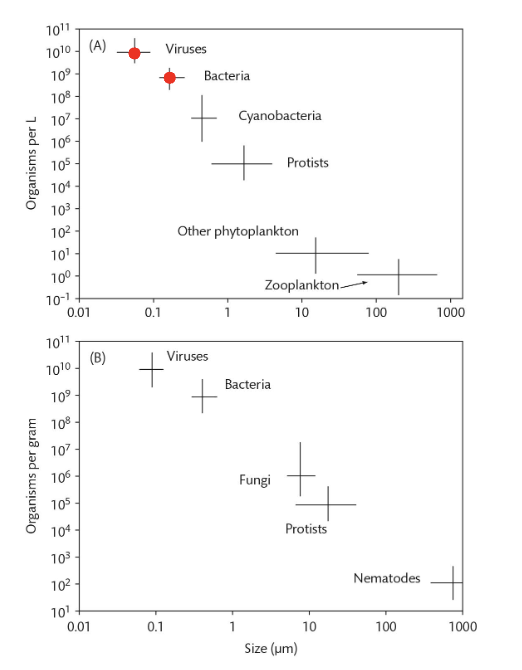
Virus to Bacteria Ratio (VBR) for this graph (mean, the center of the point for each):
10^10 / 10^9 = 10
VBR’s for most of the sediment samples in this graph are ______ the VBR’s for ocean samples in this graph.
less than
Besides the “culturability” issue of the viral hosts that could be used in the plaque assay, there is another reason plaque assays underestimate the actual number of viruses. What is this reason?
Many types of bacteriophages are temperate.
Bacterial death in the ocean can occur by one of 2 top-down factors (viral lysis or predation). Which one causes MORE bacterial death in the oceans & estuaries?
On average, overall, viral lysis accounts for ~50% and the other half is due to grazing, but the relative amounts vary greatly between environments and vary temporally within environments.
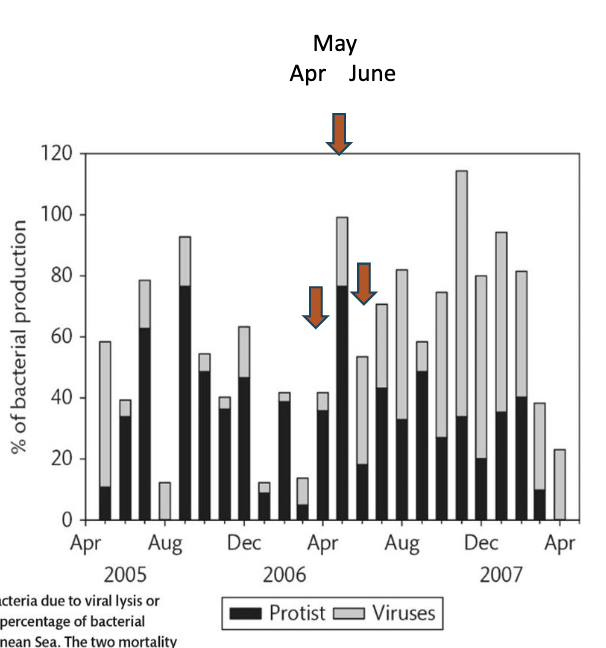
The graph below shows mortality of bacteria due to viral lysis or protist grazing, expressed as a percent of bacterial production lost due to bacteria death. Of the months listed below (April, May, or June 2006), in which month did viral lysis have a larger impact than did protist grazing?
June 2006
The lytic phase is ________.
The process of viral replication eventually resulting in lysis of the host cell.
A prophage is
The viral genome integrated into the bacterium genome or independently replicating like a plasmid within the host.
viral receptors
Essential host molecules that specifically bind the virus particle...Host-specificity depends on host cell receptors.
Given that Reverse Transcriptase (RT) has a much higher error rate than DNA polymerases, which type of virus will have the highest mutation rates?
RNA
____ among prokaryotes of different lineages can be mediated by transduction, a process caused by temperate viruses.
Horizontal gene transfer
What is the viral shunts?
The production of dissolved organic material by viral lysis and its subsequent use by microbes.
When the VBR exceeds 1, is grazer-mortality likely to be LESS or GREATER than viral lysis-related death? Assume that even if many bacteriophages are temperate, eventually, a stress-induced induction of lysis will occur.
It is complicated; a choice for VBR answer
An increase in abundances of cyanophages would first have a direct effect on ____ in the open ocean
Primary production
Sometimes oceanic viral abundance is extremely high, based direct count methods, often 10⁶ to 10⁸ virus-sized particles per mL, but we know that a large fraction of marine bacteriophages are temperate and frequently integrate into host genomes instead of immediately lysing their hosts. Given this, what is the best explanation as to why protozoan grazers can sometimes dominate total bacterial mortality even though viruses are far more numerous?
Because many phages integrate into host genomes as a prophage instead of lysing immediately, a lower fraction of phage encounters result in cell death per unit time. In contrast, grazers directly convert most prey encounters into consumption and mortality.