Radiation Interactions
 Call Kai
 Learn
Learn Practice Test
 Spaced Repetition
 Match
Match Flashcards
 Knowt Play
1/35

There's no tags or description
Looks like no tags are added yet.
Name | Mastery | Learn | Test | Matching | Spaced | Call with Kai |
|---|
No analytics yet
Send a link to your students to track their progress
36 Terms
Ionizaiton
removing bound electrons
excitation
exciting bound electrons
nuclear
interactions involving a nuclear change
Photon Interactions with matter
Rayleigh Scattering, photoelectric effect, compton scattering, pair production, photonuclear interactions
Rayleigh Scattering (Coherent Scattering)
little concern in radiation therapy
For low-energy photons
Electric field of photon causes an electron to oscillate which is scattered in another direction with no change in energy
coherent scattering interaction probability
Z/ E²
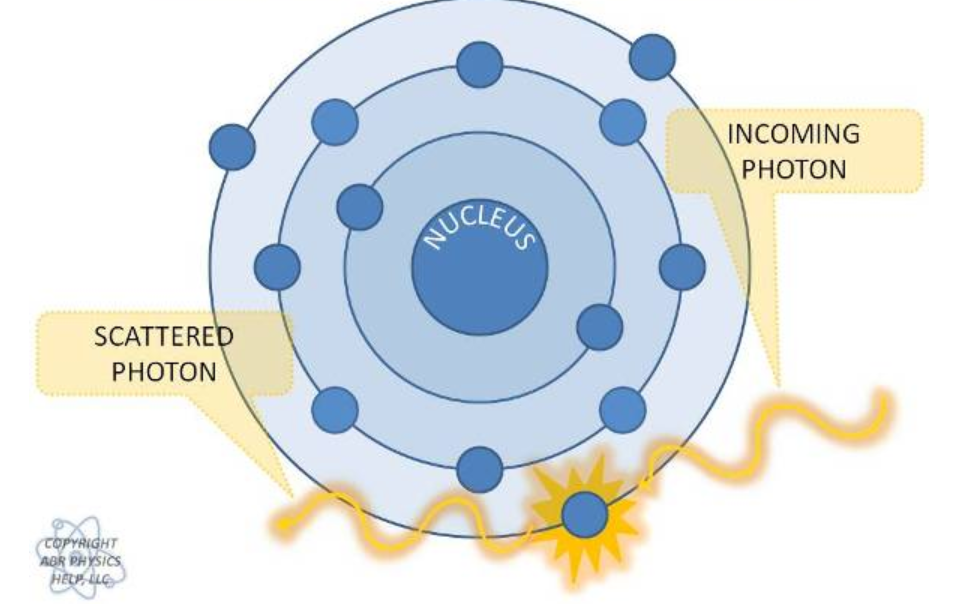
Coherent Scattering
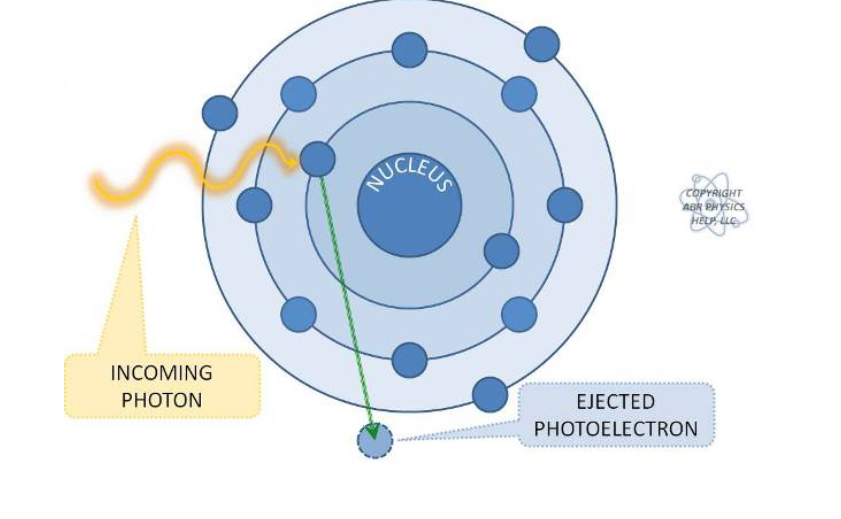
Photoelectric effect
photoelectric effect
a photon interacts with electron on inner shell where it is asborded and electron is ejected
either an a characteristic xray or auger electro emittedc
characteristic xray
photon emitted when electron drops from higher to lower energy state
binding energy equals difference between energy levels
Auger electron
characteristic xray interacts another bound electron and is absorbed, ejecting electron
Photoelectric Effect probability
Z³ / E³
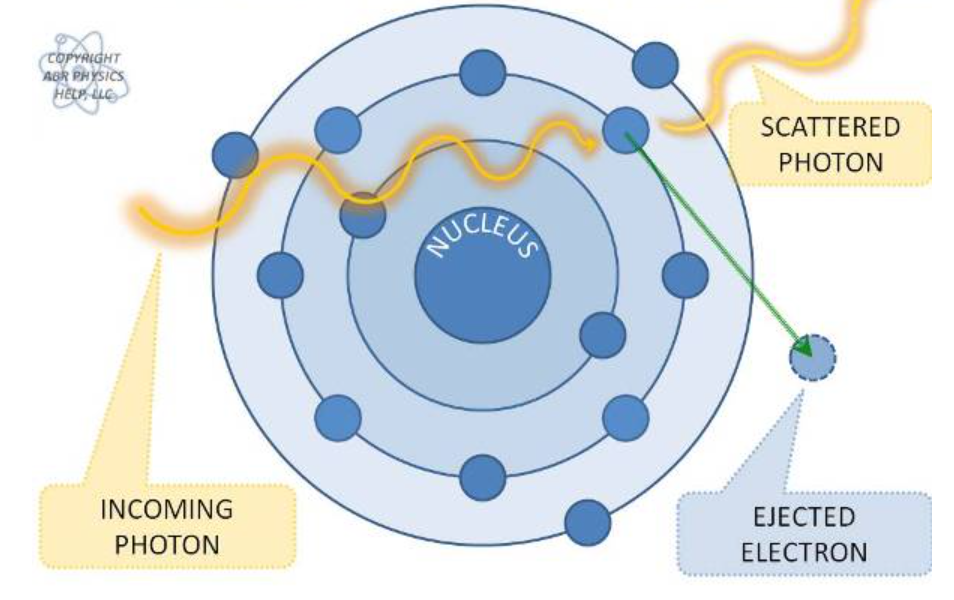
Compton Scattering
Compton Scattering
occurs when a photon interacts with an outer shell electron and is scattered thru some angle ejecting electron with energy related to scattering angle
Compton Scattered Photon energy formula
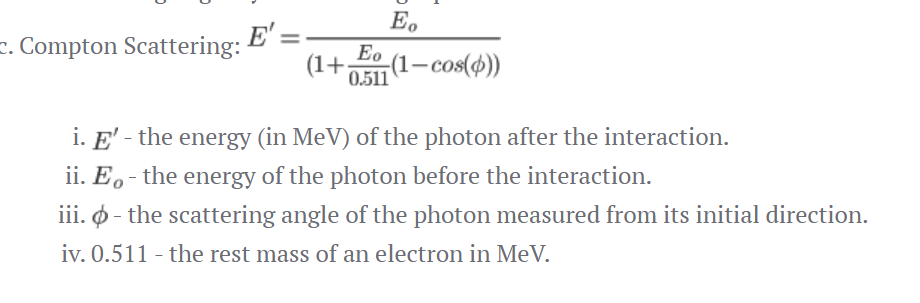
Photons scattered at 90
side scatter
independent of energy with a max of 0.511 MeV
Photons scattered at 180
backscattered
independent of energy with a max of 0.255 MeV
Photons scattered between 90 and 180
Max energy between two max energies
Compton Scattering Probability
1/E for everything but hydrogen
As Energy increases, probability of compton decreases
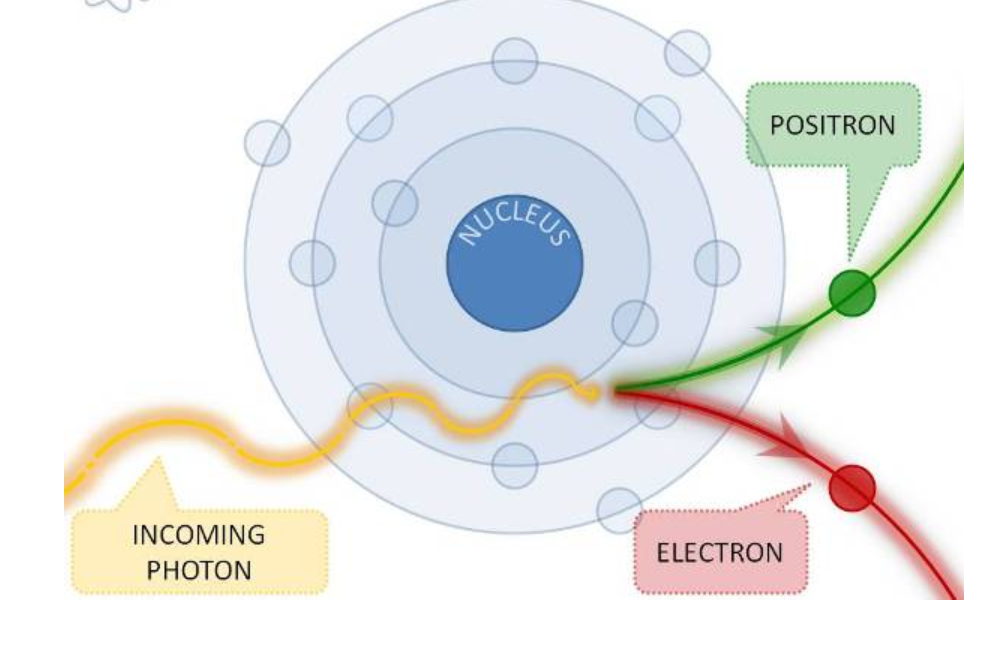
Pair Production
Pair Production
occurs when a photon near a nucleus of an atom and an electron and positron pair are created
Min thershold is 1.022 MeV
Pair Production probability
Z ln(E)
More probable than Compton interactions about 25 MeV in tissue
slowly increases with increasing energy
Photonuclear interactions
high energy photons (above 8 MeV) interact with nucles and ejects neutrons (photodisintegrations)
more common around 10 MeV
why neutron shielding is important for linacs
Charged particle interactions
for a given medium is proportional to C² / v²
C = particle charge
v = particle speed
Bragg peak
occurs at end of charged particle’s path
as particle slows down, its rate of energy deposition increases rapidly
CSDA
continuous slowing down approximation (CSDA)
shortcut for approx range of charge particles
average energy loss per unit path length in a given medium
Proton Interactions
usually interact by ionizing atom by knocking off electrons
if too high energy, they reach nucleus and create a new atom (ex. F-18 in cyclotron)
relatively straight path due to large size, bragg peak
Beta interactions
scatter off bound electrons and eject them similar to compton interactions in photons
produces characteristic xrays
Bragg peak but cant observe it due to electrons scattering electrons that have random paths
Range Straggling
range of ranges bein exhibted for electrons due to energy straggling
energy straggling
each particle presents with different interactions, which varies energy of particles at a given depth
Beta particles
Bremsstrahlung radiation
electrons are decelerated in the electric field of nucleus so that change direction and radiate a photon
photons are emitted with a huge spectrum p to max energy of incident electrons (average = 1/3 Emax)
very inefficient (1%)
alpha interactions
can ionize electrons or interact with nucleus causing spontaneous or delayed radioactive decay
outer layer of skin is enough to stop them (but harmful to ingest)
Neutron Interactions
two categories:
Recoil reactions and nuclear activations
Recoil reactions
where a neutron hits a nucleus
Nuclear Activations
since neutrons carry no charge, they can easily reach a nucleus as electrons do not screen them with any repulsive forces due to charge
can be absorbed into nucleus and results in spontaneous decay
Photon interaction in Tissue
photoelectric effect - dominant from 10-30 keV
compton scattering - dominant from 30 keV to 25 MeV
pair production - above 25 MeV