Bio final exam study
 Call Kai
 Learn
Learn Practice Test
 Spaced Repetition
 Match
Match Flashcards
 Knowt Play
1/57

There's no tags or description
Looks like no tags are added yet.
Name | Mastery | Learn | Test | Matching | Spaced | Call with Kai |
|---|
No analytics yet
Send a link to your students to track their progress
58 Terms
Members of a population of organisms (like a population of pigeons, or people) have inheritable variations. That is, they are different from each other and those differences are given to their children. Where do these differences come from? Would you describe the creation of these differences as "random" or "ordered, determined.
These differences comes from mutation, and changes in DNA that changes the protein. These are random
pt) One gene is the instruction to make one:
1) Nucleic Acid
3) Organism
2) Organ
4) Protein
4) Protein
The genes are 'written' on the:
1) Cytoskeleton
3) Rebuttal
2) DNA
4) Cell Membrane
DNA
The simplest form of matter one can make with normal chemical means is called a:
1) Compound
3) Element
2) Reagent
4) Plasma
Element
Most atoms tend to gain or lose electrons so their outer electron shell is either completely full or completely empty. When this happens, a pair of atoms can either become ions and form ionic bonds, or a pair of atoms can form covalent bonds. What determines whether a pair of atoms will form ionic bonds of covalent bonds?
what determines covalent bond is electronegativity of the
element. if two elements with same on higher
electronegativity bond it will share electrons.
ionic bonds are formed when two elements have different charges. One will have higher electronegativity and electrons will permanently go to one atom
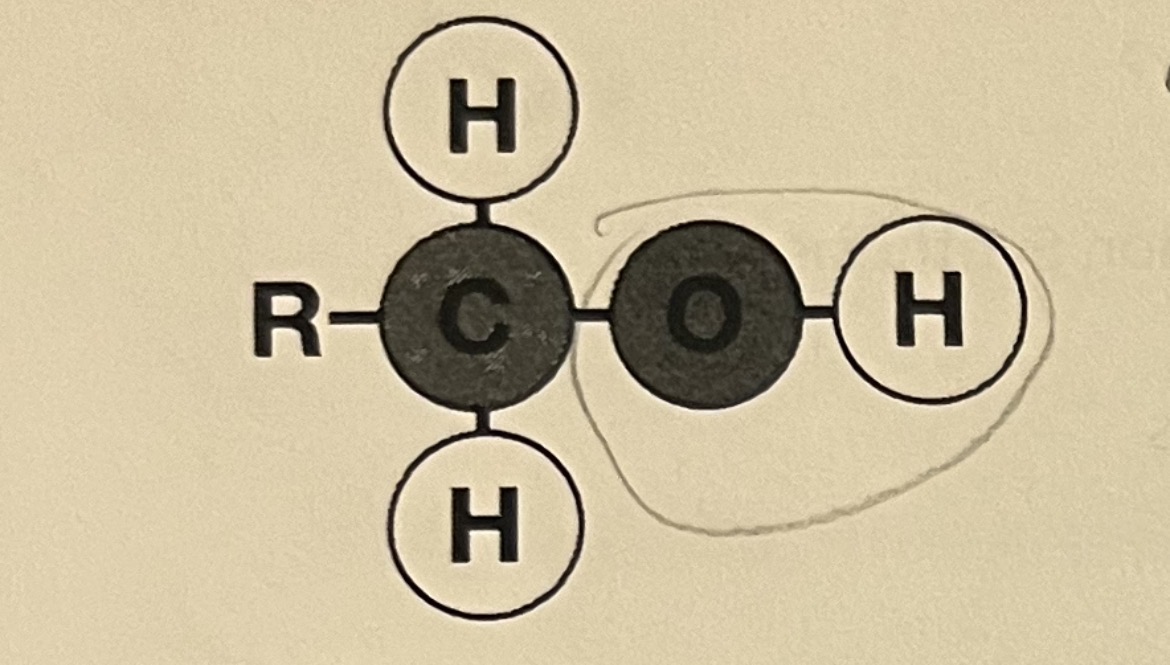
Name the following functional group. Is this polar or non-polar? Is it hydrophilic or hydrophobic?
Functional group is hydroxyl, it’s polar and hydrophilic
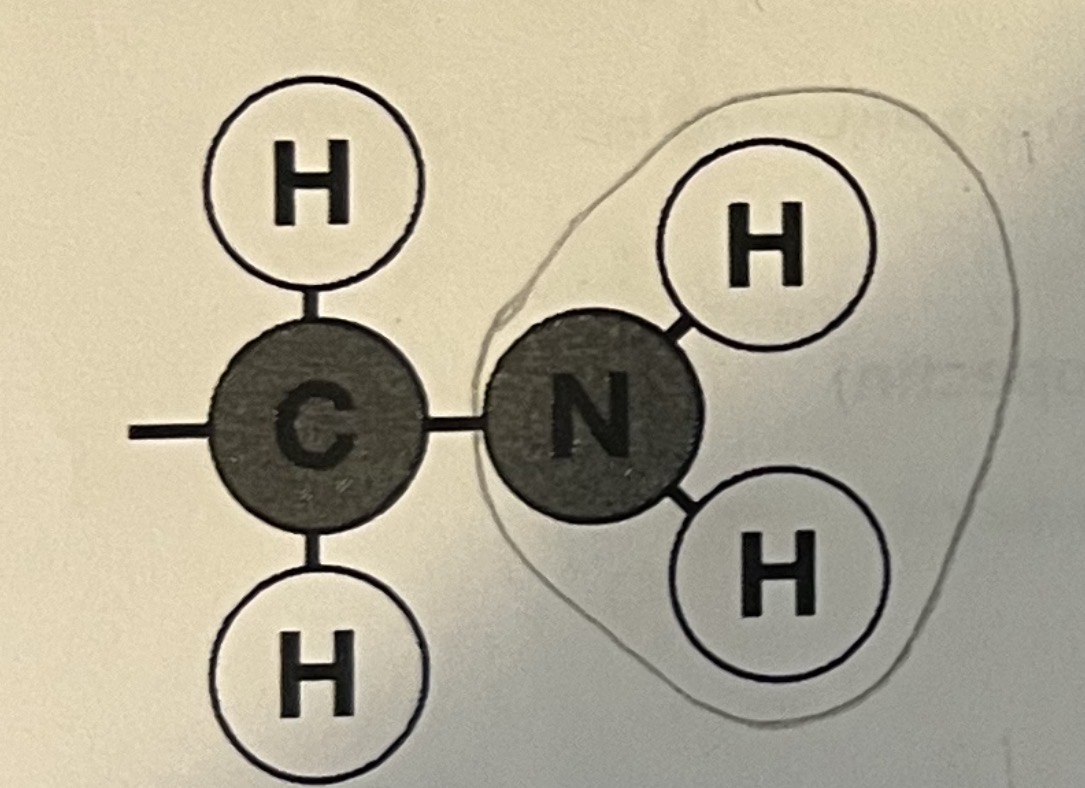
Name the following functional group. Is acidic or basic? Will it raise or lower the relative number of H+ ions in the solution. Will it raise or lower the pH?
This is Amine group, it’s basic and lower the number of H+
Give a simplified diagram of a fat (triglyceride). Label the main components. Give the most important biological function of fat
Glycerol base+ 3 fatty acids
Most important biological function is to store energy.
What mechanism links the components of a fat together?
1) Transcendental Linkage
2) Dehydration Synthesis
3) Protein Kinase
4) Hydrolysis
Dehydration synthesis
Chemically, how are Cellulose and Starch (Amylose and Amylopectin) similar?
They are both similar because they are
polymers of glucose
pts) Chemically, how are Cellulose and Starch (Amylose and Amylopectin) different?
They are different in terms of their bonds. In starch glucose units connect by ą-linkage and in cellulose glucose connect by b-linkage.
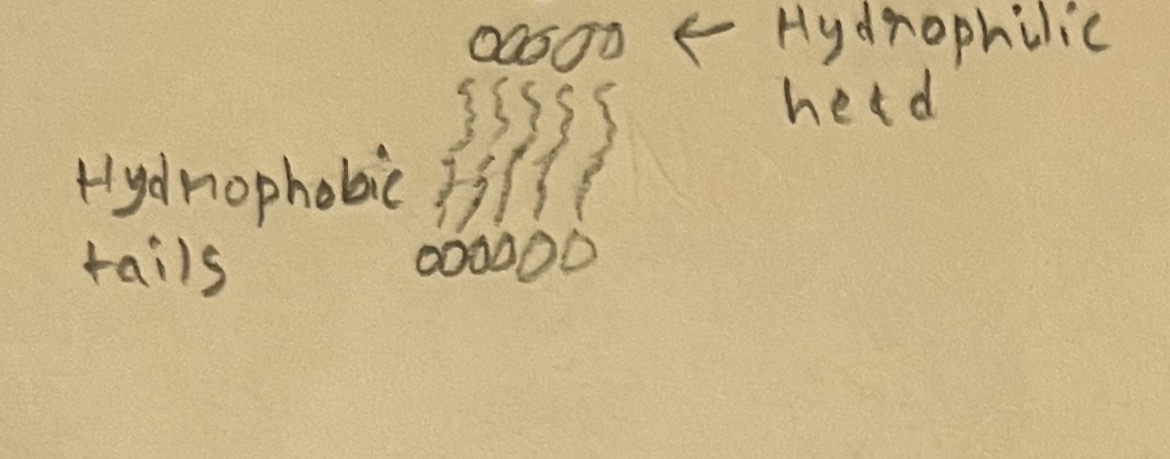
Diagram the Phospholipid Bilayer and describe how it stays together.
when phospholipid bilayer is put in aques Environment (cells) the hydrophobic tails like to stick together and have hydrophobic interactions. The hydrophilic head likes to interact with water
Can Glucose pass though the Phospholipid Bilayer? Why or why not?
No it can’t because glucose is polar
The following structure produces proteins.
1) Nucleus
3) Plasma Membrane
2) Golgi apparatus
4) Ribosome
Ribosomes
When looking at a cell, one cannot generally differentiate individual chromosomes. The chromosomes are spread out into this mass called:
1) Amylose
2) Chromatin
3) Ribosome
4) Cellulose
Chromatin
The following is the site of aerobic respiration:
1) Endoplasmic Reticulum
3) Nucleus
2) Mitocondria
4) Flagellum
Mitochondria
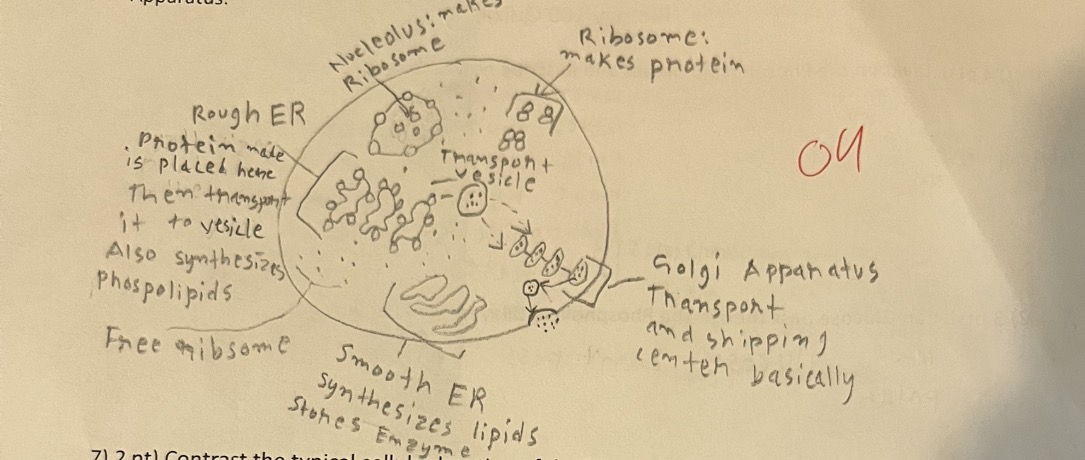
A pancreatic cell is producing and then modifying the protein hormone insulin for export out of the cell. Diagram or describe how the cell does this, specifically giving the functions of the: Ribosome, Rough Endoplasmic Reticulum, Transport Vesicle, and the Golgi Apparatus.
PRACTICE DRAWING THIS
Contrast the typical cellular Tocation of the Microtubules and the Actin Microfilaments.
Where in the cell are they found?
Microtubules spread out from centrosome and extend through out the cell. Actin microfilament typically found in layer underneath cell membrane
The main protein of the extra-cellular matrix is:
1) Actin
3)Collagen
2) Keratin
4) Pepsin
Collage
When plants strengthen their cell walls to make wood, they add large amounts of:
1) Collagen
3) Lighn
2) Amylopectin
4) Myosin
Lignin
A cell uses the GLUT4 transporter protein to allow Glucose to travel across the cell membrane from an area of high glucose concentration (the blood outside the cell after a meal to an area of low glucose concentration (inside the cell). What is this form of transport called?
1)Simple Diffusion
2) Facilitated Diffusion
3) Active Transport
4) Osmosis
Facilitated
Oxygen crosses the cell membrane, moving from an area of high concentration (the blood outside the cell to an area of low concentration (inside the cell). What is this form of transport called?
1)Simple Diffusion
3) Active Transport
2) Facilitated Diffusion
4) Osmosis
Simple diffusion
Cells in your kidneys move salt from an area of low concentration (inside the cell) to an area of higher concentration (the blood outside the cell). They use a membrane bound protein to do this. What is the form of transport called?
1) Simple Diffusion
3) Active Transport
2) Facilitated Diffusion
4) Osmosis
Active transport
The overall solute concentration is also higher outside of the cell. Does this make the outside of the cell hypertonic or hypotonic?
Will water enter or leave the cell? What is the movement of this water called?
Hypertonic when solute concentration high outside
Water will leave the cell (osmosis)
Your cell's make glycogen by connecting glucose together with covalent bonds. Is this reaction endergonic or exogenic?
Endergonic
The protein Na+/K+ ATPase uses energy to perform actives transport. It gets its energy by coupling its activity to the hydrolysis of ATP. Describe how the energy "gets" from the hydrolysis of ATP to the protein.
Protein hydrolyzes ATP and the phosphate group covalent bonds to protein, when the covalent bond is broken, the protein performs active transport
Contrast the activity of competitive enzyme inhibitors and allosteric (non-competitive) enzyme inhibitors. How do they deactivate the enzymes?
Competitive inhibitors block active site
Allosteric inhibitors bind to different site, changing enzymes shape
The the formula for Aerobic Respiration. That is, what goes into the cell or what leaves the cell.
“Food + O2 —> Co2 + H20
In: food and oxygen
Out: carbon dioxide, energy (ATP), H20
1 pt) The following phase of Aerobic Respiration does NOT occur in the Mitochondria:
1) Glycolysis
2) Pyruvate Oxidation
3) Citric Acid Cycle
4) Oxidative Phosphorylation
Glycolysis
Give the inputs and outputs of the Energy Recovery phase of Glycolysis. Of the inputs tell me which are oxidized, and which are reduced.
In: 2 G3P + 2 NAD + ADP+ Pi
Output: 2 pyruvate + 2 ATP + 2 NADH
During the citric acid cycle, Acetyl-CoA reacts with Oxaloacetate to form:
1) Ribulose
3) Pyruvate
2) Citrate
4) Carbon Dioxide
Citrate
Use this cell membrane to diagram the oxidative phosphorylation phase of aerobic respiration. Be sure in include how the electrons enter, how they leave, and how ATP is produced.
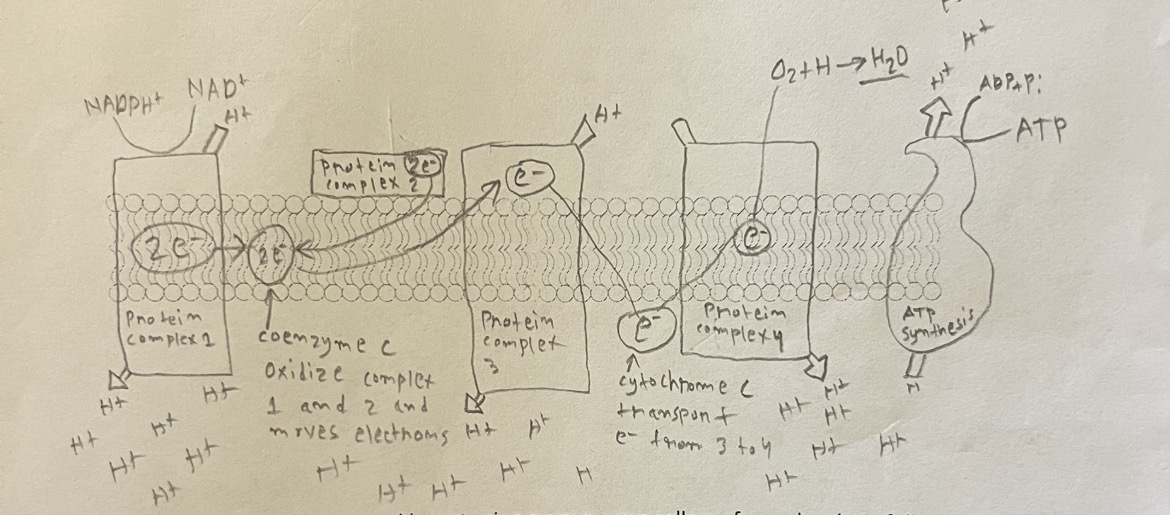
To produce energy quickly, not using oxygen, your cells perform glycolysis followed by lactic acid fermentation. In this fermentation, pyruvate is reduced to Lactate. What is oxidized in the fermentation? Why does the cell need ta perform this oxidation?
In this NADH is oxidized to NAD. Usually NADH is oxidized in electron transport chain but when there is low oxygen that can’t occur. So cells perform fermentation to keep glycolysis running
During B-oxidation, fatty acids are oxidized into:
1) Ammonia
3) Acetyl-CoA
2) Pyruvate
4) Fructose
Acetyl-CoA
Give the equation for photosynthesis. That is, what enters the chloroplast and what leaves the chloroplast?
Co2 + H20 —> O2 + food
When excited, how does the chlorophyl at the photosystem's reaction center release it's energy?
1) It fluoresces.
2) Its Oxidated
3) By Resonance Energy Transfer
4) Using Microwave radiation
Oxidated
The following phase of Photosynthesis produces Oxygen (O2).
1) Photosystem i
3) Glycolysis
2) Photosystem II
4) Calvin Cycle
Photosystem II
During the Calvin Cycle, NADPH reduces the following intermediary.
1) Glycerate 3-p
3) Succinate
2) Oxaloacetate
4) Pyruvate
Glycerate 3-P
How many chromosomes does a human somatic (non gamete) cell have when the cell is in G1 of the cell cycle?
46
How many chromosomes does a human somatic (non gamete) cell have when the cell is in G2 of the cell cycle?
46
How many chromatids does a human somatic (non gamete) cell have when the cell is in G2 of the cell cycle?
92
How many chromosomes does a human gamete have?
23
pt) The only part of the cell cycle where one can see individual chromosomes is:
1) G1
3) G2
2) S
4) Mitosis
Mitosis
The following type of protein, when active, will keep the cell in he Go phase of the cell cycle:
1) Tumor Supressor
3) Kinase
2) Cytokine
4) Growth Factors
Tumor supressor
You are looking at a cell under the microscope. The cell is in metaphase. How could you tell if the cell is in metaphase of mitosis, instead of metaphase of meiosis I?
In metaphase of mitosis individuals chromosomes are lined up in the center of cell
In meiosis I the homologous chromosomes pair are lined up in the center of cell
Describe the main disadvantage, discussed in class, of using sex to reproduce (as opposed to asexual reproduction/cloning)
Using the sex, the amount of DNA passed down goes down by half every generation. By cloning ALL of the DNA is passed down every generation.
The following is a feature of a simple trait
1) Large environmental Effect
2) large variation in expression
3) Governed by one gene
4) Not inherited
Governed by one gene
Give example Character and traits and genes
Guppies can have 1 character. EXP: The color
But they can have multiple traits of the character: Grey, Red, Gold
The gene in this case will only be one. The guppy color gene
Diagram a generic nucleotide. Label the components. Label the 3' and 5' sides.
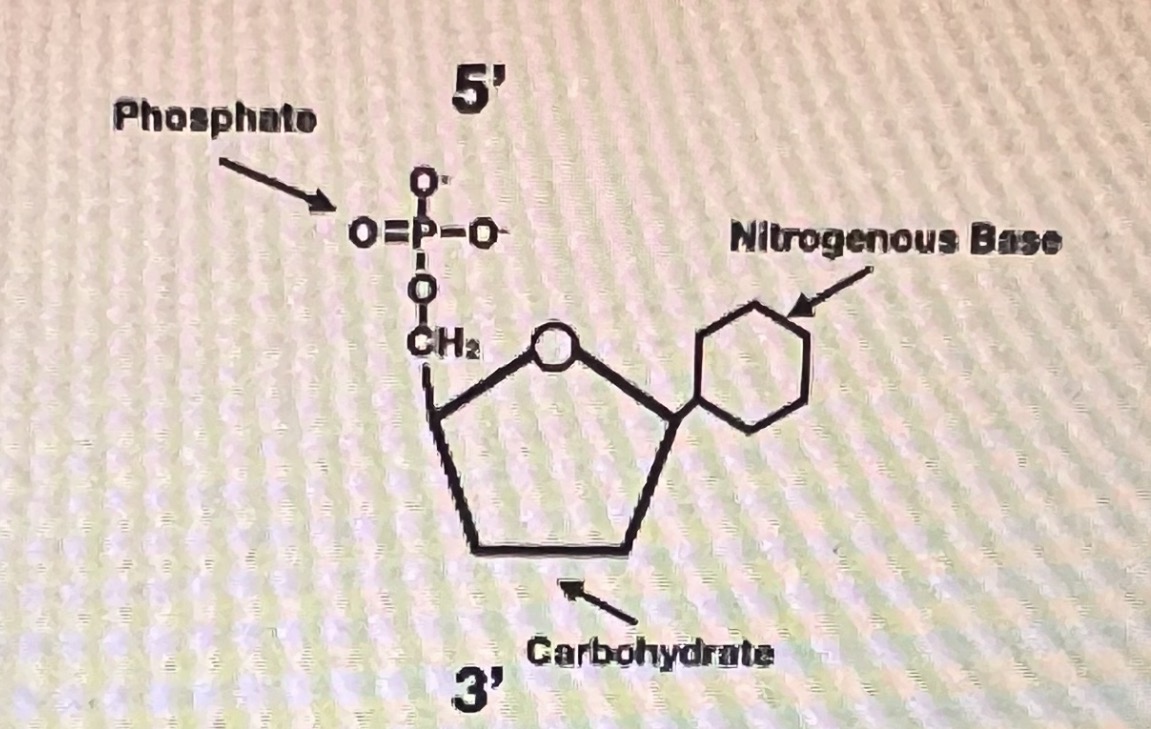
A chemist has drawn a nucleic acid on the whiteboard. Please describe three ways you would tell if this nucleic acid is DNA or RNA.
1: DNA is usually double starved and RNA is usually single stranded
2: DNA has letter T and RNA has letter U
3: The carbohydrate of DNA is deoxyribose and carbohydrates of RNA is ribose
The lac operon is an example of an inducible operon. It allows production of lactose metabolizing enzymes when lactose is present, and blocks production when lactose is absent.
Describe how the presence or absence of lactose changes production of these enzyme.
When lactose is absent the lac repressor sits on operator blocking RNA polymerase
When lactose is present lactose binds to lac repressor moving it off the operator so RNA can begin transcription of mRNA

DNA in this form is highly compacted, largely unavailable to the transcription apparatus.
1) Globin
3) Plasmid
2) Euchromatin
4) Heterochromatin
Heterochromatin
Describe the effect of a generic transcription factor. How, when activated, to they promote the transcription of specific genes.
There many transcription factors. They bind to the specific promoter sequence when activated. Allowing the RNA polymerase to start transcription of those gene
In the first step of PCR, the temperature raises to 95C. Describe what this step does.
Denatures protein separating the double stranded DNA to single stranded DNA
the second stage of CR the cooler temperature allows the primes to anneal to the template DNA. Describe how this stage gives PCR it extreme specificity.
The primers are complementary to only the both regions of intrest. During this stage they anneal to only those places so DNA polymerase can only produce DNA in that are
In the third step of PCR, the temperature warms up to 73C. Describe what this step does.
DNA is being made here because it’s the ideal temperature for thermus aquatic polymerase
pts) The DNA polymerase used in PCR is called Taq Polymerase. Describe the unique property of Taq Polymerase that allows it to be used in PCR.
Taq polymerase is a bacteria evolved in extremely high temperatures so it can survive the and function during high temperatures of PCR