Ecosystem Processes
 Call Kai
 Learn
Learn Practice Test
 Spaced Repetition
 Match
Match Flashcards
 Knowt Play
1/28

There's no tags or description
Looks like no tags are added yet.
Name | Mastery | Learn | Test | Matching | Spaced | Call with Kai |
|---|
No analytics yet
Send a link to your students to track their progress
29 Terms
What are producers?
Organisms that produce their own food through photosynthesis
Write the word and balanced chemical equation for photosynthesis? Where does it occur
Carbon dioxide + water —- Glucose +oxygen
6Co2 + 6h20 —- c6h12o6+ 6o2
Mainly in leaves but some in stems
How do plants get water for photosynthesis?
water moves in though the root hair cell by osmosis
Water is trasported in the xylem vessles
Water evaporates from the stomato
What are the 4 adaptations of a leaf and how does it help with photosynthesis?
Green- has lots of chlorophyll to absorb sunlight
Broad- A large surface area to absorb sunlight
Thin- shorter diffusion pathways
Veins- xylem for water and minerals, phloem for the transportation of glucose
How does the top layer of the leaf differ from the top?
The top layer is waxy to prevent water loss. It is green as it contains lots of chlorophyll to absorb sunlight. No stomata to reduce water loss
The bottom layer is less waxy as there is less chance of water loss at the bottom. it does not contain as much chlorophyll. and has stomata for gas exchange
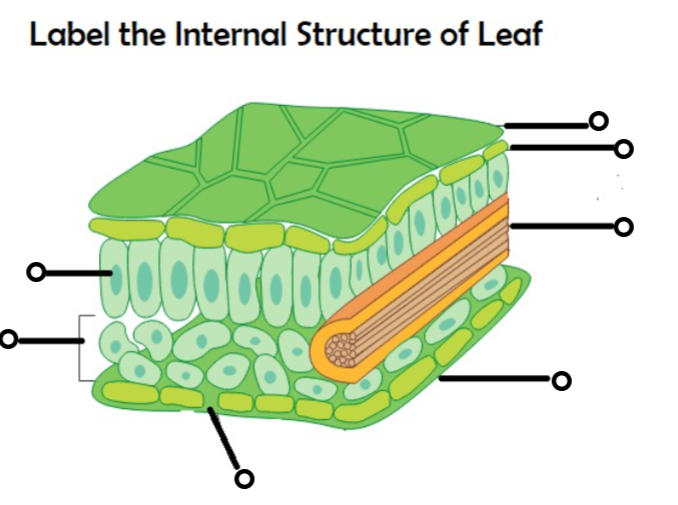
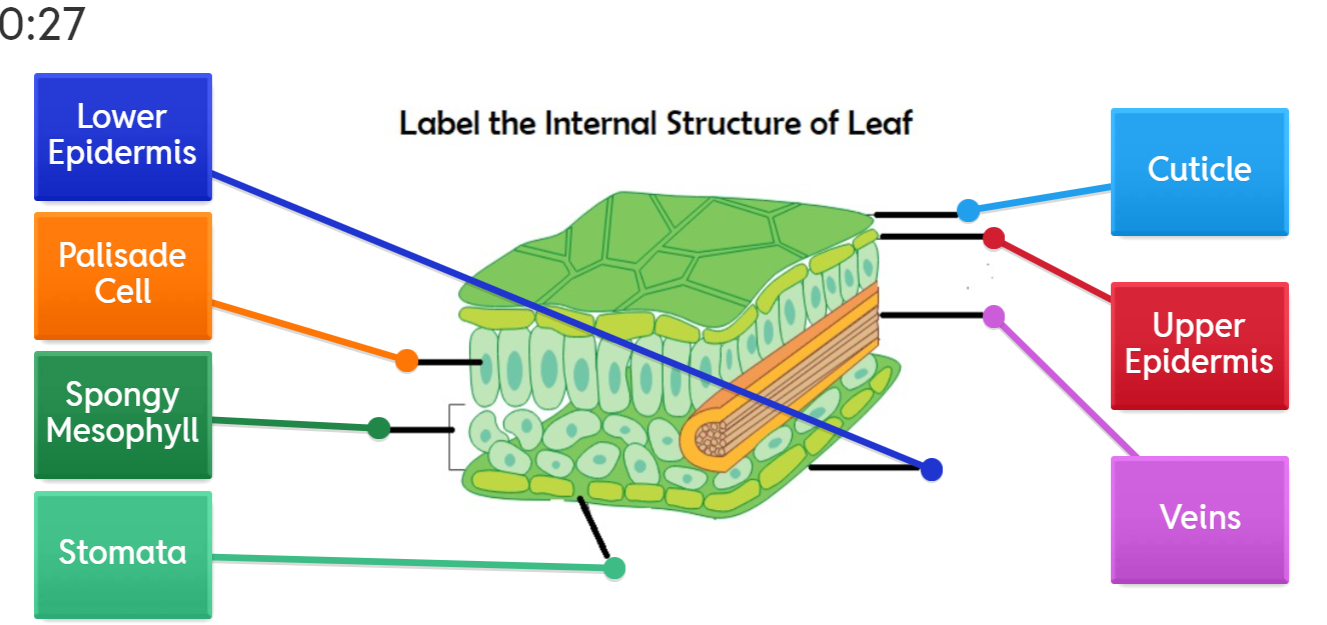
label the structure of a leaf and the uses
Waxy cuticle- Prevents water loss
upper eperdermis- protects the main part of the leaf
palisade layer- main sight of photophynthesis
spongy mesophyll layer
Stomata- gasses diffuse in and out carbon dioxide enters and oxygen leaves
What are stomata? How do they work? Why are they not found at the top of a leaf?
Tiny whole on the underside of the leaf
opened by guard cells, carbon dioxide comes in and oxygen and water diffuse out, open in the day close at night- photosensitive
It would increase exposure to wind = water loss
What minerals does a plant need to grow and if they don’t have them what deficiencies can occur?
Nitrates- needed to make proteins- poor growth and older leaves will become yellow
Phosphates- Healthy roots- Poor growth, younger leaves will look purple
potassium-Healthy leaves and flowers- - yellow leaves and dead patches
Magnesium- needed to make chlorophyll- leaves will be yellow
How do farmers replace missing minerals
Fertilisers e.g. NPK and manure
What is Chemosynthesis?
Reaction carried out by chemosynthetic bacteria using energy transferred from chemical reactions to produce glucose
Where are chemosynthetic bacteria found and how do they carry out photosynthesis
Sulphur bacteria- found near or in volcanic vents:
When a volcano erupts hydrogen sulphide pours out of the vents
bacteria convert hydrogen sulphide to glucose
Nitrogen bacteria is found in the soil and roots of some plants:
In the soil nitrogen is used to form ammonia which is converted into nitrates
bacteria use this to make glucose
What is the difference between chemosynthesis and photosynthesis
| Photosynthesis | Chemosynthesis |
Energy | Yes | Yes |
Energy source | sunlight | Chemical reactions |
Water required | Yes | No |
CO2 | Yes | Often |
Glucose made | Yes | Yes |
What is the world and chemical equation of aerobic respiration
Glucose + oxygen —- carbon dioxide + water
6C6H12O6 + 6O2 —- 6CO2 + 6H20
Where does aerobic respiration occur?
In the microchondria, muscles that require a lot of energy will more mitochondria in them
What is anaerobic respiration? And where does it occur?
When there is not enough oxygen for aerobic respiration, the body starts respiring anaerobically which and lactic acid is build up is muscles which causes cramps. It occurs in the cytoplasm
What is the oxygen dept?
When your body breathes heavily to take in oxygen to break down the build up of lactic acid
What is the word equation for anerobic repiration?
lactic acid + glucose — carbon dioxide +water
What is fermentation?
When some organisms anaerobically respire to produce co2 and ethanol instead of lactic acid
Why is fermentation usefull?
Making bread- co2 is trapped inside making bread rise, ferment carbon dioxide and ethanol evaporates
Make beer and wine- beer is used in the fermentation of Bali, in wine the fermentation of sugar
What is a food chain?
Diagram that shows what an organisms wats and energy transfers between organisms
How is energy lost as you go up a food chain?
As energy is transferred along the food chain, some energy is lost through respiration excretion and heat
What is a food web?
A diagram that shoes organisms that eat more than one type of food
What is interdependence?
The way which living organisms depend on each other to survive and grow and reproduce
What is population?
Number of organisms present in a species that live in the same area
What impact does change in the producers and consumers have on food webs?
Prodcuers- Affects all the organisms as the producers are the main source of energy
Consumenrs- increase or decrease
Explain how are insecticides and other chemicals passed on in a food chain?
Farmers use insectaries to protect their crops from insects and an animal may eat that plant of the chemical may be washed away in the rivers
Fish and other small organisms absorb these chemicals and store them in their bodies as they are eaten chemicals are passed on the food chain
The concentration of the chemicals inside the organisms increase along the food chain as each predator will eat more than 1 prey .This causes the top predator to become ill or die. This is known as bioaccumulation
What is an ecosystem?
the interaction between plants, animals and their habitat in a particular locations
What is co-existence?
Plants and animals living in the habitat at the same time
What is a niche?
A particular place or role and organism has in an ecosystem