Ch4: Infancy - Physical Development
 Call Kai
 Learn
Learn Practice Test
 Spaced Repetition
 Match
Match Flashcards
 Knowt Play
1/58

There's no tags or description
Looks like no tags are added yet.
Name | Mastery | Learn | Test | Matching | Spaced | Call with Kai |
|---|
No analytics yet
Send a link to your students to track their progress
59 Terms
changes in sleep patterns
adult sleep patterns
about 7-9 hours a night
generally sleep through the night
newborn sleep patterns
need more sleep (between 10-21 hours a day; 18 hours on average)
sleep cycle more erratic (3.5 hours at a time in first few months)
can start sleeping through night at 3 months/regularly at 6 months
shared sleeping
answer depends on culture
common practice in some cultures (China and Guatemala)
in others, newborn more commonly sleeps alone in another room in a crib
sometimes crib kept in same room as parents for first few months
shared sleep in the US
controversial
general trend is against, especially with infants under 6 months
earlier bedtimes, shorter time to sleep, fewer interruptions when sleeping in separate room
may be related to risk of SIDS (sudden infant death syndrome)
nutrition
individual differences in infants (as well as adults)
body composition
growth rate
activity levels
changes in eating pattern in first year
move from suck-and-swallow reflex to chew-and-swallow
milk/formula > semisolids > more complex foods
improved motor skills help us move toward self-feeding
milk/formula is primary source of energy in first 4 to 6 months of life
breast vs. bottle feeding
common question among parents in the US
debate about which is better for baby still persists
general consensus is breast feeding is better for baby
81% of US mothers at birth
52% at 6 months
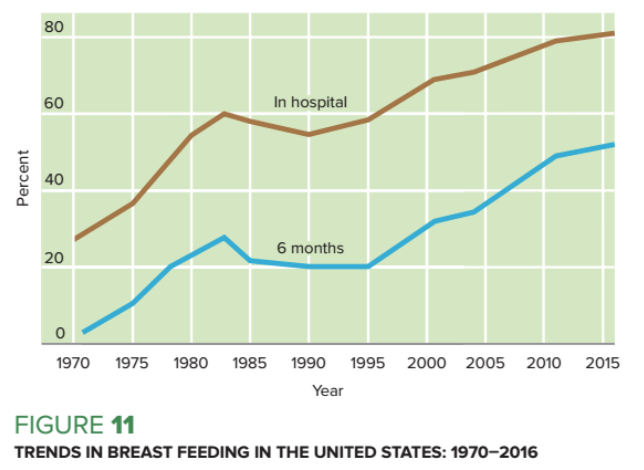
breast vs. bottle feeding recommendation
exclusive breast feeding for first 6 months
continued breast feeding while introducing new foods for year 1
can continue longer if desired by baby and mother
when not to breast feed:
mother infected with HIV or some other infectious disease that might be transmitted through her milk
taking any drug that may not be safe for child
breast vs. bottle feeding benefits
less likely to become overweight/ obese in childhood and beyond
less likely to become diabetic in childhood
lower rates in SIDS
lower rate of infections
minor qualification:
most of the above research is based on correlational data
may not be the one causes the other
wealthier, higher educated, health-conscious mothers are more likely to breast feed
reflexes
built in automatic reactions to stimuli
rooting reflex: stroking cheek or side of infant, infant turns its head in that direction in an attemtp to suck
sucking reflex: automatically suck an object placed in their mouth
grasping reflex: grasping tightly when something touches infant’s palms
these lessen after first - 4 months of life, as more voluntary control over body
gross motor skills
involve using larger muscles in the torso, arms, and legs to complete whole-body movements
sitting up on their own
standing up (leaning on an object)
standing on their won
crawling
walking
influences on our development of gross motor skills
developing voluntary control over muscles
perception of goals in our environment, motivation to develop
interactions with caregivers that promote development
not all skills may occur, or occur in precise order
fine motor skills
coordination of small muscles in movements, usually involves coordinating movements of the hand, fingers, and eyes to perform tasks
grasping a toy (“pincer grip” with fingers)
holding a spoon
buttoning a shirt
turning pages
cutting w/ scissors
attachment
the close emotional bond between people
trust vs mistrust
parents ability to provide comfort and care for infant helps to establish this basic sense of trust
This forms basic foundation for lifelong expectations that the world will be a good and pleasant place to be
Bowlby and attachment theory
First year is a sensitive period for the development of attachment between child and parent
Both parent and child are biologically predisposed to form an attachment
E.g., Baby’s social behavior (smiling, cooing, following parents around)
Attachment promotes survival by keeping caregiver nearby
proposes that infants develop an “internal working model of attachment”
A mental model for understanding the caregiver, their relationship, and their self as deserving to be cared for
This mental model later goes on to influence relationships with other people (expectations for how we should relate to others)
ainsworth’s strange situation task
Strange Situation is a task developed to assess infant attachment
Child, parent, and stranger enter room together
Child left alone with stranger
How does child respond when parent returns?
Baby’s response classified based on security in attachment
Securely attached babies
insecurely attached babies (avoidant / resistant / disorganized)
secure attachment
seeks out parent for comfort upon return
Is able to be soothed by caregiver after reunited
“Check ins” with parent to make sure still there
insecure avoidant attachment
Avoids caregiver / does not seek out for comfort
Not as visibly distressed when caregiver leaves the room
Does not try to re-establish contact when they return
May avoid eye contact / turn their back on caregiver
insecure resistant attachment
Cling to caregiver upon reunification, but also resist at the same time
Kicking, pushing away
Inability to be comforted
insecure disorganized attachment
Baby appears dazed, confused, fearful
Wandering, undirected movements, unorganized patterns of interactions with caregivers
May show extreme fearfulness around caregive
caregiver secure attachment
Caregiver is generally responsive and sensitive to needs of child
“Good enough” parenting (does not have to be perfect)
Comforting, physical contact, which releases oxytocin hormone (promotes normal attachment between caregiver/infant)
outcomes of secure attachment
Positive emotional health
Higher self-esteem
Higher self-confidence
Greater social competence in interactions with others (peers, teachers, etc.)
Less externalizing problems (fights, getting in trouble) than insecurely attached children
criticisms of attachment theory
is attachment at infancy truly a critical/sensitive period?
may not adequately consider biological influences or personality factors
may not adequately address consider cultural contexts
emotions
positive or negative
pleasant or unpleasant
primary emotions and secondary emotions
temperament
primary emotions
joy
sadness
fear
disgust
surprise
anger
appear in first 6 months of human development
emotions and social interactions
play a large part in our social interactions
Largely limited to smiling, crying, and laughing, but rapidly expands
Even these “simple” behaviors can be complex and vary greatly
Tired cry / angry cry / pain cry
bidirectional relationships and emotions
Baby’s smile and parental engagement
Reinforcement and shaping via operant conditioning
Synchronicity between parent and child
Adapting our emotional responses based off of the “other”
Social referencing and reading emotional cues of others
emotion regulation
Learning emotion regulation is an important developmental milestone
Gradually develop ability to reduce intensity / duration of emotional reactions
Even infants have some basic self-regulation abilities (e.g., sucking thumb)
Largely depend on caregivers for emotion regulation early on
Various influences on emotional development of infant
influenced by parents, biology, and environment
influences on emotional regulation
parents and emotion regulation
Parent’s response to baby’s distress
Helps to soothe the child before better able to do it themselves
Over time, baby learns how to regulate through these interactions
Shaping of their physiological responses
Debate: Can you be too responsive in first year of life?
biological processes:
regions of the brain associated w emotional processing
environmental processes:
how have life experiences shaped emotional development?
temperament
individual differences in behavioral styles, emotions, and characteristics ways of responding
Even from infancy, children have individual differences in temperament
E.g., easy-going / aloof / fussy
Several different methods of classifying temperament
common dimensions to consider:
Behavioral inhibition
Effortful control / self-regulation
Negative affectivity (how easily distressed)
Extraversion
we learn through the use of schemes (schemas)
Schemes are mental structures we use for organizing the world around us and interpreting information
Schemes become more complex as we mature, helping us better understand the world
E.g., scheme for sucking and grasping as infant (and not much else)
E.g., scheme for what to do on a job interview as an adult
two concepts to explain how we use and adapt our schemes:
Assimilation: Occurs when children use our existing schemes to understand new information or experiences
Accommodation – Adjust their existing schemes to better take into account new information and experiences
Examples: Moo cow vs. Doggy, Cars vs. Truck
disequilibrium
cognitive conflict when we are confronted with information that contradicts our schemes
Inconsistency between our understanding of the world and new, conflicting information
Internal desire for equilibrium creates motivation for change
We are constantly taking in information, comparing it to our existing schemes, making adjustments, developing new schemes, refining old ones, all to better understand the world around us
We actively construct our understanding of the world
sensorimotor stage
birth to 2 years
object permanence: the understanding that objects continue to exist when they cannot be seen, heard, or touched
Construct their understanding of the world through coordinating sensory experiences with our physical actions
In beginning, actions guided mostly by reflexes
Focus on exploring our own bodily sensations / control of body
Over time, slowly become more goal oriented and using our growing motor skills to explore the environment
attention
the focusing of mental resrouces on select information
sustained attention
the ability to keep your attention focused on something
improves over infancy
about 5-10 seconds at a time by age 3 months
determinants of attention
important stimuli (mom or dad)
novelty (new stimuli)
habituation and dishabituation
habituation is lessened interest after repeated exposure to a stimulus
dishabituation is renewed interested after a change in stimulus
joint attention
when two or more individuals focus on the same object or event
pointing and looking; paying attention to same TV show
three defining characteristics
requires ability to track another person’s behavior
one person directs the attention of another
reciprocal interaction
aspects of joint attention
milestone for social behavior
early on caregiver points or uses words to get attention of infant
Later (end of first year) infants follow gaze of others
By 1 year, direct adults’ attention to objects of child’s interest
problems with joint attention and later difficulties
attachment
language
social skills
infantile or childhood amnesia
phenomenon where most adults cannot remember anything from first 3 years of life
Memories tend to fade away significantly around 9 years of age
brain development and memories
Long-term memories more fragile in first two years
As brain development continues, more robust long-term memories
language
form of written, spoken, or signed communication based on a system of symbols
Many languages share some basic characteristics
Consists of words used by a community and the rules for varying and combining them
organization of languages:
Phonology / phonemes
Morphology / morphemes
Syntax
Semantics
Pragmatics
phonemes
most basic units of sound in a language
morphemes
bare minimum units of meaning in a language
not just full, complete words
includes modifiers of words
syntax
involves the way words are combined to form phrases and sentences
semantics
meanings of words and sentences
pragmatics
the appropriate use of language in different contexts
receptive vocabulary
words child can understad
spoken vocabulary
words child can use
recognizing sounds of language (first year)
Can detect subtle differences between sounds (e.g., “pa” and “ba”) at birth
Throughout first 6 months, improving at differentiating words / sounds in caregiver’s language
Gradually lose ability to distinguish for other languages (for sounds not important in own language)
Recognize some sounds are more likely to occur in some situations than others (e.g., “Mom”)
Separate stream of speech into words
Notice patterns that help distinguish between words
E.g., nt at end of words, br at beginning of words
basic vocalizations (0-6 months)
Practicing making sounds / attract attention
Crying (distress)
Cooing (pleasure)
Babbling (social interactions)
gestures (7-15 months)
Pointing / waving goodbye / nodding
Important milestone for social communication
Early absence may be indicator of autism spectrum
Form of joint attention
first words (10-14 months)
Typically nouns are learned first
Typically are words most important or familiar to them (e.g., dada, milk, ball)
Single word used to communicate larger idea (“I want a cookie”)
vocabulary spurt (-18 months)
Child starts rapidly learning several new words, expanding vocab
~50 words by 18 months
~200 words by 2 years
two-word utterances (18-24 months)
Use two words to convey information
Location / identification / possession…
“See mama”
“My candy!”
“Want milk”
Broca’s area
area of brain associated with production of speech
Wernicke’s area
area of brain involved in language comprehension
Noam Chomsky and the Language Acquisition Device (LAD)
Argued children are “hard-wired” to readily learn aspects of language via this LAD (e.g., syntax, phonology, morphology)
Children are biologically prepared to learn language
Theoretical construct, not a physical part of the brain
May account for remarkably similar language milestones across cultures / languages
child-directed speech/”parentese”
Higher-than-normal pitch, slower, exaggerated intonation, simpler words and sentences
“Mmm! Does that taste good? You want more?”
Much of this is automatic and not even aware we are doing it
Captures attention of child, makes it easier for infant to follow and understand
other common adult strategies
labeling objects
expanding information
rephrasing