(8) Adolescents transition
 Call Kai
 Learn
Learn Practice Test
 Spaced Repetition
 Match
Match Flashcards
 Knowt Play
1/35

There's no tags or description
Looks like no tags are added yet.
Name | Mastery | Learn | Test | Matching | Spaced | Call with Kai |
|---|
No analytics yet
Send a link to your students to track their progress
36 Terms
What is a teenager?
A person aged between 13 and 19 years.
What is adolescence?
A transitional stage where a young person moves from childhood to adulthood.
What is meant by biological adolescence?
The physical and biological changes linked to puberty, including body and brain development.
Why do humans have a prolonged adolescence compared to other species?
Humans mature slowly and experience several years of dependency in childhood before gradually becoming independent.
When does biological adolescence typically begin?
Around ages 9–11, marked by puberty onset and development of secondary sexual characteristics.
What triggers puberty biologically?
Activation of the neuroendocrine hypothalamic–pituitary–gonadal (HPG) axis.
Does biological development end at age 20?
No, brain development and processes like tooth growth (e.g. wisdom teeth) continue into the 20s.
What is social adolescence?
The transition into adult social roles such as employment, relationships, and parenting based on societal norms.
Why is adolescence an important period to study?
It involves major changes in social context, physical development, and brain function.
How does the social context change during adolescence?
Includes new educational settings, decision-making about the future, romantic relationships, and increased independence (e.g. driving).
What did Steinberg (2000) find about family relationships in adolescence?
Contrary to “storm and stress,” about 75% of teenagers report happy relationships with parents.
the original storm and stress looked ta at risk groups
What is authoritative parenting and its effect?
A parenting style encouraging autonomy while maintaining boundaries; linked to better adolescent development.
How does parental influence change in adolescence?
Parents become less influential over time as peers and independence increase.
Why are peers important during adolescence?
They help build social networks, promote independence, and provide opportunities for new experiences.
What did Sebastian et al. (2010) show about social exclusion?
Adolescents show decreased mood when excluded, and younger adolescents show increased anxiety.
experimenter manipulated online game of how many times a ball was passed to you
When is peer influence strongest?
Early to mid-adolescence, with resistance improving after age 14 (Steinberg & Monahan, 2008).
girls more resistant than boys
What did Knoll et al. (2017) find about peer influence?
Teenagers are more likely to adjust their risk ratings to match other teenagers, typically lowering them.
590 participants aged 8-59 rated risks for hypothetical settings
What is the hormonal cascade of development
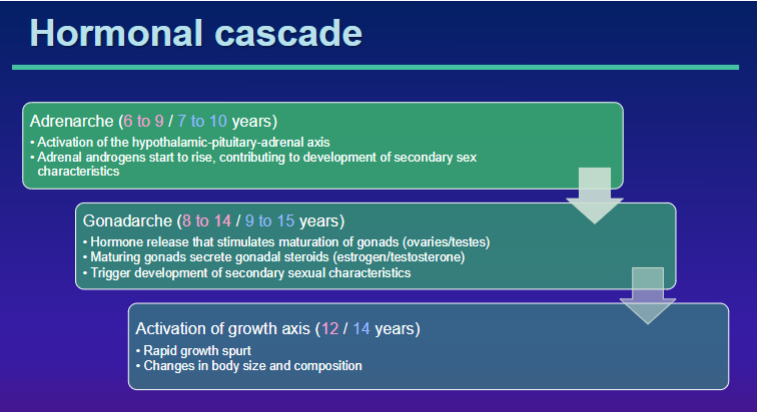
What is the Tanner stage?
A subjective measure of pubertal development based on outward physical characteristics.
How does emotional reactivity change in adolescence?
Adolescents experience more intense emotions compared to adults.
What is the link between adolescence and mood disorders?
Pubertal stage predicts onset of depression better than chronological age.
What did McRae et al. (2012) find about emotion regulation?
Older individuals regulate negative emotions better due to greater vlPFC activity and cognitive control.
looked at fmri data
What are the two phases of hormonal effects on brain development?
Organisational effects (before/after birth) and activational effects (during puberty).
What happens in organisational hormonal effects?
Testosterone masculinizes the brain; absence leads to a female neural phenotype.
What happens in activational hormonal effects?
Hormones activate neural circuits for reproductive behaviour and increase neural plasticity.
How does white matter change in adolescence?
It increases due to myelination, improving communication between neurons.
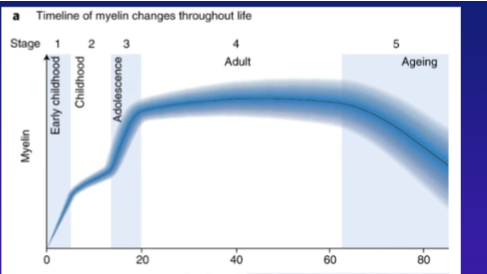
How does grey matter change in adolescence?
It decreases due to synaptic pruning, making neural processing more efficient.
Which brain regions undergo significant changes in adolescence?
The prefrontal cortex and subcortical limbic system.
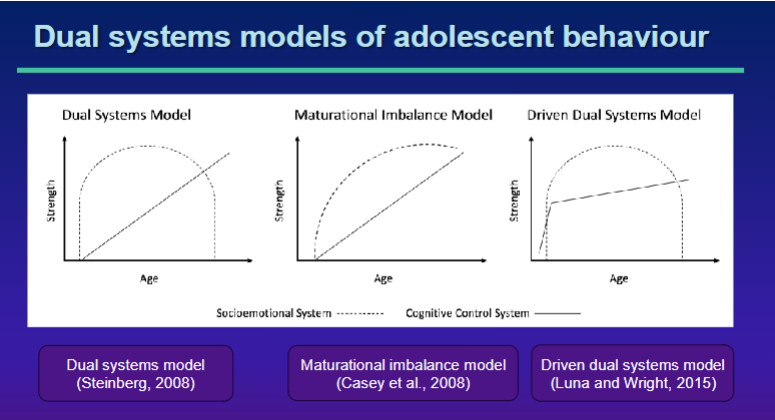
what are the three dual systmes model of adolescent behaviour
dual systems model - Steinberg 2008
Maturational imbalance model (Casey et al. 2008)
Driven dual systems (Luna and Wright, 2015)
Risk taking behaviour is highest when cognitive control is underdeveloped by socioemotional system is at its highest
What is executive function?
A set of processes (e.g. inhibition, task switching, working memory) that enable goal-directed and adaptive behaviour.
How does executive function develop in adolescence?
It becomes more specialised and improves with increasing white matter and prefrontal cortex development
What is the brain’s reward system?
A network involving limbic regions (amygdala, hippocampus, striatum) that processes reward, motivation, and learning.
How does the reward system change in adolescence?
It becomes more sensitive, with greater dopamine release and stronger responses to rewards.
What is the dual systems model?
A theory suggesting imbalance between a highly sensitive reward system and underdeveloped cognitive control leads to risk-taking.
Why is risk-taking highest in adolescence?
Cognitive control is still developing while socioemotional/reward systems are highly active.
What did Cauffman et al. (2010) show using the Iowa Gambling Task?
Adolescents show higher reward sensitivity (desire to picl good decks) than children and adults, while risk avoidance improves (desire to avoid bad ones) linearly with age.
it is not just being impulsive it is looking for reward