Neuro of Stress Exam 2
 Call Kai
 Learn
Learn Practice Test
 Spaced Repetition
 Match
Match Flashcards
 Knowt Play
1/75

There's no tags or description
Looks like no tags are added yet.
Name | Mastery | Learn | Test | Matching | Spaced | Call with Kai |
|---|
No analytics yet
Send a link to your students to track their progress
76 Terms
Chronic Stressor
Stressor applied over time
Mild stressor
Anything not frightening/painful
Chronic + mild most useful/common
Variable Stress (CVS/CMS/CUS)
Do something different every time, no difference in acronyms
Unpredictable, more stressful so more behavioral changes (ex: altered light/dark cycles, food deprivation at irregular times)
Rodents exposed chronically to constant unpredictable microstressors --> behavioral changes (anhedonia, weight loss, less motivation, less sleep, less locomotor activity, etc)
Repeated stress
Pick stress, repeat it, induce HPA axis
Forced swim, tail suspension, restraint
Social defeat stress
potent form of chronic psychological stress resulting from losing social confrontations or experiencing subordinate status
Mouse exposed to bully for 10 minutes, fight, bully wins
Then co-housed for 24 hours, divider between them but can still sense each other
Bully mouse replaced daily for 10 duration of stress protocol
Social defeat 2
Mouse placed into box. Box has interaction zone (wire cage on one end), either place social target (other mouse) there or nothing in cage
Undefeated control mice spent most of their time interacting socially when presented with an unfamiliar target mouse.
Defeated mice displayed intense aversive responses and spent less time in close proximity to the target mouse
This difference was observed exclusively in the presence of a social target and was not apparent in response to an inanimate novel object [the empty wire cage
Traumatic stress
Exposure to large foot shock, predator odor, can cause PTSD
Acute stress
One time, anxiety/fear learning
Physical stressor
Produce stress response through induction of discomfort, loss of control, homeostatic challenge
Restrained, tail suspension, swimming
Cage stressors (tip it, heat, cool)
Behavioral changes following stress protocols
Depression like behavior
Learned helplessness from forced swim, tail suspension
Anhedonia when sucrose preference test, reduction in preference in sucrose when depressed
Self care (grooming) reduced?
Anxiety Like behavior:
Induce conflict in animal
Elevated plus maze (spend less times in open area when anxious)
Open field test (avoid open center, stick to edges)
Light dark box test (avoid brightly lit, prefer dark space)
Novelty suppressed feeding
Behavior: This test creates a conflict between the hunger-driven desire to eat and the fear of a new, bright environment.
Observations: Anxious mice take a much longer time (high latency) to begin eating food placed in the center of the arena compared to calm mice, prioritizing safety over food intake
Social behavior:
social withdrawal (social interaction/avoidance test)
Not limited to social defeat stress paradigms
HPA activation necessary and sufficient for effects of chronic stress
A necessary condition is a requirement that must be present for an event to occur, but it does not guarantee the outcome.
A sufficient condition is a factor that guarantees the outcome, but is not the only way to achieve it.
Behavioral effects of chronic stress are blocked by any of following (all of these are necessary for chronic stress, don;t see behavioral effects):
Adrenalectomy (take out adrenal cortex)
Corticosterone synthesis inhibitor (MET, metyrapone)
Glucocorticoid receptor antagonist (mifepristone, MFP)
Behavioral effects akin to chronic stress produced by chronic administrtaion of corticosterone in drinking water
Decreased sucrose preference, increased time/latency to feed because anxious,
Yang et al. (Timeline of stress testing, Behavioral effects of acute and chronic stress)
Panel A — Experimental Timeline
This panel lays out the overall study design. Two stress paradigms were run in parallel:
Acute Social Defeat Stress (ASDS): On Day -1, mice underwent 1 hour of social defeat (alternating 5 min physical contact + 10 min sensory stress, repeated 4×). One cohort (ASDS-1h) was tested immediately after; a second cohort (ASDS-24h) recovered for 23 hours before testing. Both cohorts underwent the Social Interaction Test (SIT) and Open Field Test (OFT).
Chronic Social Defeat Stress (CSDS): Starting Day 1, mice underwent the same daily cycle for 10 consecutive days, each time with a novel aggressor ICR mouse. After a 24-hour recovery (Day 11), mice were tested on Days 12–13 with SIT and OFT.
Panel B — Acute Stress SIT Results
The SIT measures social avoidance by comparing time spent near a social target vs. an empty enclosure (SIT ratio > 1 = social approach; < 1 = avoidance).
Key findings:
ASDS-1h mice showed a significantly reduced SIT ratio compared to controls (p < 0.01), indicating increased social avoidance immediately after stress. Time in the social zone was also significantly reduced (p < 0.01).
ASDS-24h mice showed no significant difference from controls in either measure, meaning the social avoidance fully resolved after 23 hours of recovery.
This demonstrates that acute stress causes transient social avoidance that is reversible.
Panel D — Chronic Stress SIT Results
Using the same SIT measures, but now comparing control vs. CSDS mice after 10 days of defeat + 24h recovery:
Key findings:
CSDS mice showed a significantly reduced SIT ratio compared to controls (p < 0.05), indicating persistent social avoidance even after 24 hours of rest.
Time spent in the social zone was also significantly reduced (p < 0.01).
The path tracings visually reinforce this — CSDS mice (red traces) show much less exploration near the target enclosure compared to controls (black traces).
This demonstrates that chronic stress causes lasting behavioral changes that do not resolve with a brief recovery period, consistent with a depression-like phenotype.
Why is chronic stress necessary to model mood disorders (as opposed to acute stress)?
After just 24 hrs, acutely stressed animals return back to baseline (eg same time in center zone of OF as controls)
- Only chronically stressed animals demonstrate a persisting behavioral phenotype
variable stress enhances HPA response, messes up HPA axis
Both repeated restraint and variable stress sensitize HPA response to novel stressors
variable stress has a stronger and more general sensitizing effect than a repeated stress
Increases ACTH and CORT more than Acute and repeated)
Restraint experience reduces HPA response to future restraint
Habituation - reduction in physiological response by repeated exposure to a homotypic stressor
Predictive validity
Ability to produce a state useful in predicting features of human disorders
In this case referred to anti-depressant response
Predictive mouse model validity demonstrates that treatments effective in humans produce similar therapeutic results in mice
Give anti-anxiety meds to mouse, spend more time in elevated mazes
The forced swim test (FST) or tail suspension test (TST) in rodents accurately predicts the clinical efficacy of antidepressants, where chronic (not acute) administration of drugs like fluoxetine reduces immobility, mirroring human response timelines.
Face Validity
Similarity between symptoms caused by the model and those seen in target human condition
the degree to which a mouse model reproduces the specific symptoms, behaviors, or pathology seen in human diseases. It ensures the model "looks like" the human condition
Mice treated with neurotoxins (like MPTP) or engineered to express 𝛼-synuclein demonstrate progressive motor deficits, including tremor, rigidity, and gait abnormalities similar to human Parkinson's disease.
Construct Validity
Similarity in psychological and neurobiological constructs (makes model with using)
Psychological: Anhedonia and perturbations in reward processing
Neurobiological: Alterations in morphology, synapses, cell signaling
Construct validity in mouse models is achieved when the biological cause of a human disease—such as a specific genetic mutation or mechanism—is replicated in the mouse, ensuring the model represents the underlying disease mechanism. Examples include knockout models, transgenic humanized genes, or induced neuroanatomical lesions
All 3 in one scenario: MPTP Mouse Model of Parkinson’s Disease
Face Validity (Appearance/Symptoms): The MPTP-treated mouse exhibits reduced movement, tremors, and balance deficits, resembling the physical motor symptoms (parkinsonism) found in human Parkinson's patients.
Construct Validity (Mechanism/Cause): The MPTP toxin selectively destroys dopamine-producing neurons in the substantia nigra, mimicking the exact biological mechanism and pathophysiology responsible for the disease in humans.
Predictive Validity (Drug Response): The motor symptoms in the MPTP mouse are reversed by administering L-DOPA (the standard human Parkinson's drug), allowing researchers to predict if new drugs will work in humans based on their success in the mouse
Systems affected by stress
Hippocampus
Atrophy in hippocampus leads to dysfunction in feedback loops
Amygdala becomes overactive, drives HPA activation
Dopamine
Fundamental for reward processing and motivation
Impaired following chronic stress
PFC
Cortical synchrony essential for proper behavioral control
Desycrhonization caused by stress
Serotonin
In pop culture, the transmitter most strongly associated with depression
Surprisingly, scientific literature has harder time making sense of it
ANT PIT Pathway
1. Neurons in hypothalamus make a hormone
2. Axons carry hormones to the median eminence (base of hypothalamus)
3. Hormones travel through portal veins to the anterior pituitary
4. Hypothalamic hormone acts on endocrine cells here that release their own tropic hormones into blood
5. Tropic hormones released into capillaries --> systemic circulation
6. Hormone travels through blood --> tissues, triggering biological response
1. Parvicellular neurons in PVN within hypothalamus synthesize CRH (corticotropin releasing hormone)
2. CRH travels down axons to median eminence
3. CRH travels through portal veins to anterior pituitary
4. CRH acts on corticotroph cells in anterior pituitary that release ACTH (adrenocorticotropic hormone)
5. ACTH released into capillaries --> bloodstream
6. ACHT acts on adrenal cortex, which releases cortisol --> increased blood glucose, helps body respond to stressor
POST PIT Pathway
1. Neurons in hypothalamus make a hormone
2. Axons travel down pituitary stalk, carrying the hormone to the posterior pituitary
3. Hormones are stored in the axon terminals within the posterior pituitary
4. Neurons fire and release hormones into capillaries (part of the systemic bloodstream)
5. Hormone travels through blood --> tissues, triggering biological response
1. Magnocellular neurons in PVN + SON within hypothalamus synthesize oxytocin
2. Oxytocin travels down the axons of these neurons, running through pituitary stalk to posterior pituitary
3. Oxytocin is stored axon terminals
4. Neurons fire and release oxytocin into capillaries within posterior pituitary --> systemic circulation
5. Travels to target cells (mammary gland myoepithelial cells) --> biological response (milk let-down)
Hippocampal feedback dysfunction by chronic stress
Hippocampus constrains HPA Axis activity through negative feedback
Chronic GC exposure is neurotoxic, HC neurons atrophy
HC volume decreases (seen in both animal CVS and human depression)
Weakened HC feedback permits over activation of amygdala and HPA axis
Amygdala synapses and circuits get stronger
Animals develop anxious behavioral phenotype
How does chronic stress affect decision making
Decreased sensitivity to outcome value --> less goal-directed behavior, more habitual
- Caused by structural changes in circuits underlying behavioral strategies: atrophy of mPFC + associative striatum, hypertrophy of sensorimotor striatum
- Problematic because optimization of decision-making is adaptive
Pros and cons to using rodent models
Pros
Can do more invasive things than in humans
Treatment development opportunities
Test drug side effects
Cons
Ethical concrns
Does it translate to humans
Inducing stress in rodent models
Physical stressors
Chronic unpredictable mild stress
Social isolation
Social defeat (bully mouse)
Social defeat induces social avoidance and other anxiety like behavior
Put bully mouse in with test mouse
See test mouse readouts after interaction with bully, see variable responses
Graph
Same stressor viewed different in individuals, some more susceptible, others resilient
X axis is social interaction with other mice after bully interaction
Susceptible mice less interactive than control, resilient same as conrol
FIgure
Susceptible mice spend less time near interaction zone (heat map) after social defeat when another mouse/target in there than when empty/ no target
Control has same heat map near interaction zone, assumed undefeated
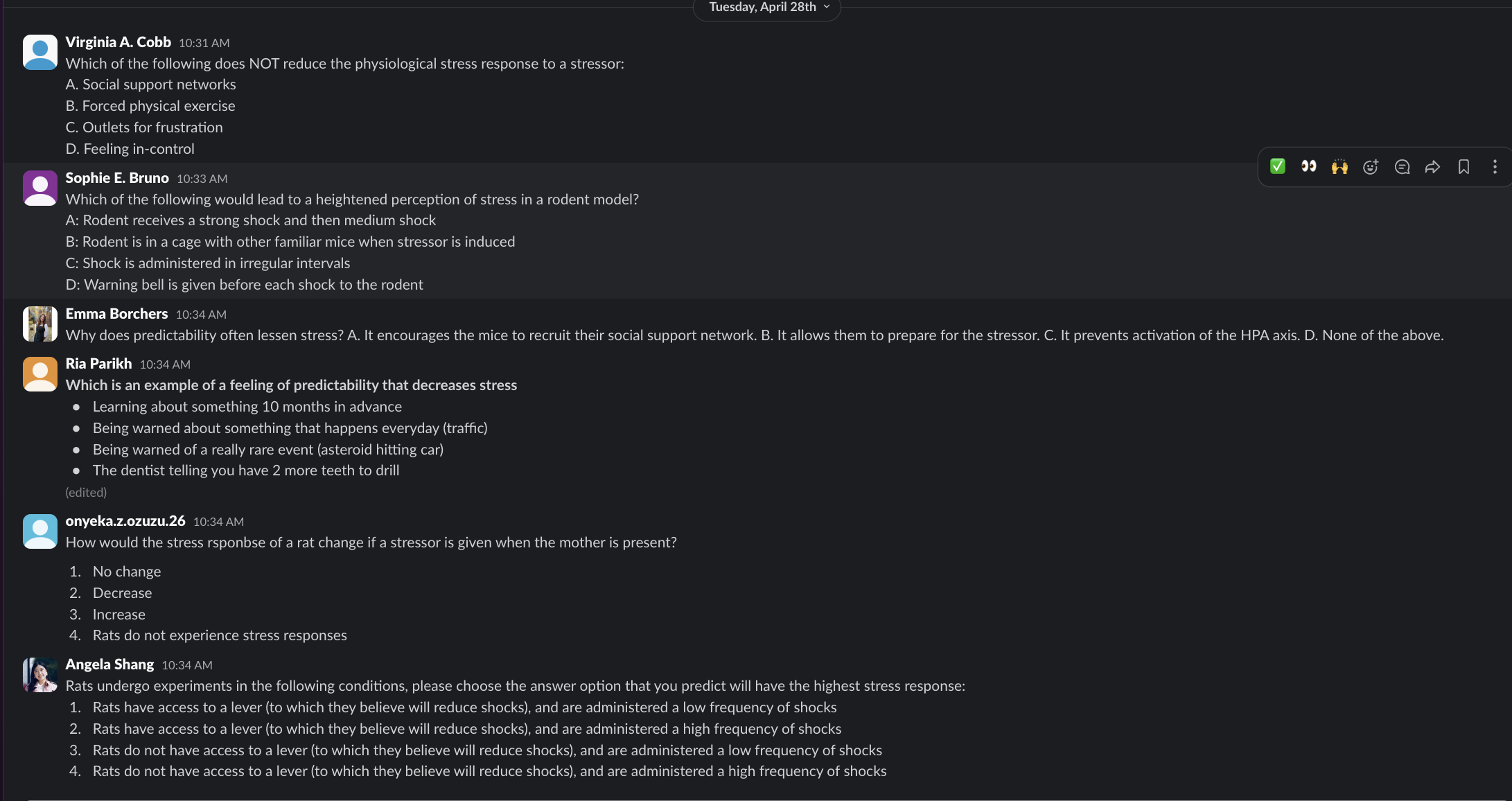
4 building blocks of psychological stressors
Control, outlets, social support, predictability
Perception of things worsening, stressors perceived more stressfully
- Outlets for frustration: stress-induced displacement of aggression, eg block of wood to gnaw on post-shock
- Predictability: mild unpredictable stressor WORSE than more harmful but predictable stressor (bc habituation), eg warning bell before each shock
- Control: even illusion of control lowers stress, eg disconnected lever
- Perception of things worsening/improving
- Social support
Stimulation is the right amounts of loss of control and predictability
Caveats
Warnings less effective for very rare and very frequent stressors
Info just before or very long before stressor not helpful
Measuring anxiety like behavior
Don’t know if exactly measuring anxiety
Use conflict based assays
Conflict-based assays in mice (also known as approach-avoidance tasks) are behavioral paradigms used to study anxiety, pain, and reward by forcing animals to balance competing motivations, such as exploring a new environment versus avoiding danger.
Measure perceived danger (open arms vs closed, center (predation) vs edges
Graph
Divide mice into Control and CORT mice
Give CORT in drinking water, track their direction in a center vs edges task
When given CORT, stayed in edges more, more anxious, scared of predation
Normal cort, went everywhere in box
Only works with chronic cort
Control had higher percentage in center, and entries into center
Conditioned Fear Pavlovian
Day 1 — Habituation: The animal is placed in the chamber with no stimuli to acclimate to the environment. Baseline freezing is essentially zero.
Day 2 — Conditioning: A conditioned stimulus (CS; a tone) is paired with an unconditioned stimulus (US; a brief foot shock lasting 0.5–1.0 sec). The CS precedes the US by 20–30 seconds. This CS-US pairing is repeated across trials, and freezing increases progressively as the animal learns to associate the tone with the shock.
Day 3 — Testing: The CS (tone) is presented alone in a new context scented with peppermint (to isolate cue-based fear from contextual fear). Two groups are compared:
Paired (black line): animals that received CS+US together show high and sustained freezing to the tone alone, demonstrating successful fear acquisition.
Unpaired (red line): animals that received CS and US separately (not associated) show low freezing, confirming that the learned fear response depends on the CS-US association, not mere exposure.
Key Takeaway
This paradigm tests associative fear learning — the animal learns to fear a neutral cue (tone) because it was paired with an aversive event (shock), and the peppermint context on Day 3 isolates this cue-specific memory from generalized contextual fear.
Why is psychological stress successful (Sapolsky)
2 identical stressors with same extent of allostatic load can be perceived and appraised differently
Psychological variables modulate stress response
Outlets for frustration
Predictability
Control
Perception of things worsening
Social support
Individual difference in perception and response to stress influences different susceptibility to stress related disorders
Graph
Same stressor viewed different in individuals, some more susceptible, others resilient
X axis is social interaction with other mice after bully interaction
Susceptible mice less interactive than control, resilient same as conrol
FIgure
Susceptible mice spend less time near interaction zone (heat map) after social defeat when another mouse/target in there than when empty/ no target
Control has same heat map near interaction zone, assumed undefeated
Stress related psychiatric disorders
Maladaptive behavioral and physiological responses to stressors
Chronic stress associated with increased likelihood of developing anxiety disorders, major depressive disorder, other psych disorders
People diagnosed with depression and anxiety disorder experience negative experiences (including stressors) more intensely
Anxiety and stress related disorders
Excessive fear or worry that interferes with functioning or causes significant distress (DSM-5)
Change edition to edition, culture to culture
Criteria for general coping vs actual disorder
Generalized Anxiety Disorder, panic disorder, phobias, social anxiety disorder, agoraphobia, separation anxiety disorder
Persistent, excessive anxiety about everyday actions
World prevalence: Anxiety>Depression>Alcohol use>drug use> bipolar disorder>schizophrenia>eating disorders
Prevalence of anxiety disorders vs GDP per capita
The core finding: wealthier countries tend to report higher rates of anxiety disorders, which is counterintuitive but reflects several important factors.
likely reflects reporting and diagnosis bias rather than a true protective effect of poverty. Wealthier countries have more developed mental health infrastructure, greater public awareness, and reduced stigma — all of which increase diagnosis and reporting rates. Lower-income countries likely underdiagnose anxiety disorders significantly.
Lifetime prevalence of anxiety disorders in US adults is 25-32%
Obsessive-compulsive and related disorders
Conditons including intrusive thoughts, repetitive behaviors including obsessions (persistent, recurring, unwanted thoughts, and urges) and compulsions (repetitive behaviors or mental acts)
OCD and obsessive compulsiverelated/spectrum disorders (hair pulling, skin picking, body dysmorphic disorders, misophonia)
Trauma and stressor-related disorders
Conditions directly precipitated by exposure to a stressful or traumatic event
PTSD, acute stress disorder, adjustment disorder and attachment disorders
Depressive disorders
Persistent, severe sadness, low mood, or loss of interest in activities lasting at least 2 weeks which affects daily functioning and causes symptoms like fatigue, sleep changes, worthlessness
Major Depressive Disorder, Persistent Depressive Disorder, Disruptive mood dysregulation disorder, prementstrual dysphoric disorder
Chronic stress is one of most potent factors that contribute to onset of depressive episode
MDD
Have to meet at least 5 criteria in 2 week period, at least 1 being depressed mood or Loss of interest/pleasure
Resources: UWill, SWC wellness checkins, National Alliance on Mental Illness, Dartmouth Counseling Center, Substance Abuse and mental health services administration, 988 suicide hotline, MHU peer support
HPA axis
Negative feedback gets dysregulated in anxiety and stress related disorders
Amygdala excites HPA Axis (positive feedback), HC and PFC inhibit HPA Axis (negative feedback, decrease in volume during chronic stress)
Amygdala:
Greater activity leads to worse Fear, anxiety, aggression
Hyperresponsive under chronic stress
Direct correlation to severity (the more severe the symptoms, the more active the amygdala)
Hippocampus
Declarative and spatial memory
Negative feedback
Reduced volume after stress
Normally helps terminate the stress response through GR-mediated negative feedback
As it shrinks, it loses this inhibitory capacity, meaning the HPA axis stays activated for longer
PFC
Hyporesponive under chronic stress
Inverse correlation to symptom severity
Responsible for fear extinction and executive function
Amygdala response to emotional images in generalized social anxiety disorder
gSAD patients have more activation to negative (emotional and fearful) images than control in both right and left amygdala
Prefrontal cortex
vmPFC reactivity to angry faces is less in the generalized social phobia group than the healthy control group at pre-treatment
After viewing fearful face, gSP have less PFC activity, used SSRI as treatment, found that it reversed hypoactivity, back to above normal MRI activity
Insula
Insula, like amygdala, is important in subjective emotional experiences (consequence or cause)
Increased activity = increase negative affect
Bilateral insula hyperactivity in response to negative images in participants with generalized social anxiety disorder (gSAD)
Cingulate Cortex
Corticolimbic system: Amygdala, mPFC, HC, insula, CC
Neural circuits in anxiety/stress related disorders: HPA, PFC, Amygdala/Limbic Circuits, HC
Amygdala = Insula, PFC = CC
Severe MDD, not treated with anything else, profound effects of reversing depressive system if they stuck something in it?
ACC is opposite, more like mPFC, inhibits negative emotions
Decreased CC response in GAD group (also depression and comorbidity) compared to healthy control
Fearful faces, see amygdala activity in depression
Panel A — Ventral Cingulate
Healthy Controls:
Strong positive response (~+0.35)
Means healthy brains engage the cingulate during emotional conflict — using it to regulate and resolve competing emotional signals
Generalized Anxiety Only:
Mildly negative response (~-0.15)
Cingulate regulation is reduced but not severely impaired
Depression Only:
Strongly negative response (~-0.55)
Severe failure of cingulate engagement — greatest impairment of all groups
Suggests depression specifically disrupts this regulatory region
Comorbid Group:
Moderately negative (~-0.20)
Falls between anxiety-only and depression-only
Panel B — Amygdala
Healthy Controls:
Strongly negative response (~-0.80)
Means healthy amygdalae are suppressed during emotional conflict — the cingulate is successfully dampening amygdala reactivity
Generalized Anxiety Only:
Mildly positive (~+0.15)
Amygdala is no longer suppressed — shows hyperreactivity to conflicting emotional signals
Depression Only:
Strongly positive (~+0.40)
Greatest amygdala hyperreactivity of all groups — amygdala is highly active when it should be suppressed
Comorbid Group:
Moderately positive (~+0.15)
Similar to anxiety-only
The Critical Relationship Between Panels A & B
These two panels reveal a seesaw relationship between the cingulate and amygdala:
In healthy controls: cingulate is UP → amygdala is DOWN (effective top-down regulation)
In clinical groups: cingulate goes DOWN → amygdala goes UP (failed regulation)
This is a direct demonstration of the cingulate-amygdala regulatory circuit breaking down in psychiatric disorders.
Benzodiazepines
Anxiolytics, decrease anxiety symptoms , sedatiion
Controversial (issue with dependence, misuse)
Bind to GABA-A receptor to decrease anxiety
GABA binds this receptor, allows influx of Cl- into cell, quiets cell
Benzodiazepines are Allostatic modulator
Binds to different binding site on same GABA-A receptor, changes function of receptor
Increases amount of Cl- influx into cell, increases GABA potency, more inhibition
Decrease limbic region activity
Requires gamma subunit
SSRIs
Selective serotonin reuptake inhibitors (SNRI is NorE)
Most common antidepressant, most effective first line therapy for depressive and anxiety disorders,
By end of trying 3 SSRIs, 60% ppl are better
longer to work but less side effects than benzes
Block serotonin reuptake into cell (blocks SERT Transporter), leaves Ser in cleft
Get more Ser in synapse, binds receptors on post synaptic cell
SSRI have fewer side effects
Increase in serotonin happens immediately, but no behavioral effects/ change in symptoms until weeks later
Could be neurogenesis in HC
Treatments for Anxiety disorders: SNRI>Benzos>CBT + drug> SSRI> TCAs
Pharmacotherapies more effective for anxiety disorders
SSRI = SNRI
SSRI better for long term use, Benzos more effective but not form long term
CBT + Drug better than CBT or drug alone
Placebo strong, as effective as psycotherapy
All active treatments substantially outperform waiting list
Medications show larger effect sizes than psychological treatments alone, but CBT + drug combination is competitive with medications alone
Griffiths Psychedelics Study
Psilocybin for those with terminal cancer diagnoses
Low dose (placebo) and high dose (recreational dose)
Looked at bunch of indices with quality of life, anxiety, depression
Results showed that high dose reduced anxiety/depression and increased quality of life
Psilocybin for MDD treatment
Serotonin agonist
Pre-treatment preparation sessions
20-30 clinical trials recruiting
Psilocybin (oral treatment) 15-30 mg
7-8 h sessions with supportive supervision of 2 study staff members
recumbent on couch with eye masks (trained sitters, less bad trips)
Niacin placebo, waiting list, equivalent time of psychological support
Study:
Showed that single dose psilocybin therapy lowered MADRS, BDI (depression scales) levels (hard to be blind)
Rapid antidepressant effects of psilocybin persist for at least 12 months, compared to SSRIs that take daily
Psilocybin compared to SSRIs is same effectiveness at decreasing depressive symptomology (not more than, even though expected to be), increases mental well being more than SSRI; can block 2a receptors to not get hallucinations
MDMA-AT for treatment of PTSD
Messy drug, many functions
Acts on SERT
Instead of block SERT reuptake, reverses function, spews Ser out of presynaptic terminals
Greater effect on increased Ser in synapse
Can lead to serotonin syndrome (a potentially life-threatening drug reaction caused by excessive serotonin accumulation in the body)
Agonist for Ser receptors, can bind to receptors directly
Dopamine/NorE effects agonist
Block MAOA (which breaks down SER)
Vesicular storage of SER is impeded, free Ser in synapse
Arguments for and against MDMA to treat PTSD
For
Efficacy in decreasing PTSD, especially in treatment resistant population
One treatment vs daily pills
Against
No blinded controls, large population excluded (psych disorder or family history), unrepresentative patient sample, cost of treatment, unknown long term effects
Small sample size
Also therapy assisted, can’t say effect just from MDMA
Cardiac effects
Highly controlled, not in real world
70% effect in placebo, why do you need MDMA
MDMA vs placebo
MDMA-AT significantly attenuated PTSD symptomology versus pla-
cebo with therapy, as measured by a reduction in CAPS-5 total severity
score from baseline to 18 week
In the MDMA-AT group, 45 of 52 (86.5%) participants were responders with
a clinically meaningful improvement at 18 weeks after baseline, defined
as a ≥10-point reduction in CAPS-5 total severity score, versus 29 of 42
(69.0%) in the placebo with therapy group (Fig. 3). By study end, 37 of 52
(71.2%) participants in the MDMA-AT group no longer met DSM-5 criteria
for PTSD versus 20 of 42 (47.6%) participants in the placebo with therapy
group. Furthermore, 24 of 52 (46.2%) participants in the MDMA-AT group
and nine of 42 (21.4%) participants in the placebo with therapy group
met remission criteria (Fig. 3).
The treatment gap widens over time. Both groups showed improvement session by session, but the MDMA-AT group pulled progressively further ahead. This suggests MDMA-AT isn't just a one-time boost — its benefit compounds across the treatment course.
Remission was roughly twice as common with MDMA-AT. By the end of session 3, 46.2% of MDMA-AT participants met remission criteria (CAPS-5 ≤11, no longer meeting PTSD criteria) versus only 21.4% in the placebo group. This is a clinically meaningful difference — nearly half the treated group achieving full remission from a condition that averaged 16 years in duration.
Loss of PTSD diagnosis followed a similar pattern. 71.2% of MDMA-AT participants no longer met diagnostic criteria for PTSD by study end, compared to 47.6% in the placebo group. Even the placebo-with-therapy result is notable — suggesting the manualized therapy itself has standalone value.
Non-responders shrank dramatically in the MDMA-AT group. Starting around 50% after session 1, non-responders in the MDMA-AT arm fell to just 13.5% by session 3, versus 31% in the placebo arm. This means very few people treated with MDMA-AT failed to benefit at all.
The placebo effect here is unusually large, which the authors acknowledge — the therapy protocol alone drove meaningful improvement. This complicates interpretation but also highlights that MDMA's benefit is above and beyond an already active control.
Overall criticism of clinical trials
No psychoactive placebo (or sub threshold dose)
Exclusion criteria usually includes pts with bipolar disorder, BPD, family history of psych disorder etc
Costly, limited access
Specific setting/context
Expectancy effects
Susceptibility and Resilience
Susceptibility- tendency to experience exaggerated response to stress
Resilience - less stressfully experience stress
Factors
Genetics (same burden gives more allostatic load)
Environmental Factors (Adverse Childhood Experience, can change biology)
behavioral/modificable factors that can boost resilience (SSRI, meditation)
Goal of social defeat paradigm
Determine central and peripheral signatures of stress resilience and stress susceptibility in mice exposed to chronic social defeat paradigm
1 wk single. housing
Take plasma CORT on Day 0
Day 1-10, chronic social defeat stress
Day 11, Plasma CORT analysis, social interaction testing
Day 12 sacrifice
Chronic social defeat stress induces social avoidance and other anxiety like behavior
Gururajan paper
Increased cortisol in susceptible mice compared to control, resilient mice
Indicates HPA-axis dysregulation in susceptible animals
Not innate/predictive because same baseline as resilient mice
more about appraisal/perception
Decrease in Body weight for resilient mice, trend towards decrease in BW in susceptible mice compared to control
Likely reflects differences in feeding, metabolism, or energy use during stress
- Best understood as a downstream consequence of how the animal copes with stress, not a pre-existing cause
Increased adrenal weight in susceptible
Adrenal hypertrophy reflects chronic stress hormone activation --> consequence of susceptibility
Decreased thymus weight in resilient mice
Increased CORT as readout of stress susceptibility
Decreased Body weight as readout for stress exposure
Speculate that susceptible mice have dysregulated HPA Axis so can be cause
But also readout of social stress, might be consuquence
Social stress causes higher CORT, but don’t know what comes first
Downstream physiological consequences of differential stress processing/regulation across repeated stress exposure
Predicting resilience in mice (contrast to Gururajan)
Suggests cortisol is adaptive by sensitizing negative feedback and calibrating HPA early on (stress inocculation)
- 2nd hit model: phenotypic changes aren't observed until 2nd stressful experience (accumulation of stress)
Increased cortisol alone is not predictive of increased stress response/susceptibility!
- More complex process involving timepoints, repeated exposure, appraisal, control, etc.
Full Interpretation: Predicting Resilience in Mice
Experimental Design
At P32 (adolescence): Mice undergo the 10-day CSDS paradigm — 5 minutes of physical interaction with an aggressor followed by 24 hours of sensory stress through a partition. Crucially, corticosterone is measured at this timepointduring the stress exposure.
At P62 (young adulthood, 30 days later): Mice are tested in a social interaction test measuring two behaviors:
Interaction — time spent approaching a social target
Aversion — active avoidance of the target zone
An avoidance ratio is calculated and used to classify mice into three groups: Control, Resilient, and Susceptible.
Behavioral Results (Avoidance Ratio Scatter Plot)
Control and Resilient mice cluster near zero, indicating normal social approach behavior
Susceptible mice show significantly higher avoidance ratios (p < 0.001), meaning they actively avoid social contact in adulthood — a depression-like phenotype
This confirms the CSDS model successfully produces distinct behavioral phenotypes
Corticosterone Results (Line Graph: P23 → P32 → P62)
P23 (pre-stress baseline): All groups start at similar CORT levels, confirming comparable baselines before any intervention. Resistant mice are marginally higher (~115 ng/ml) but groups are broadly equivalent.
P32 (during adolescent stress): This is where groups diverge critically:
Resistant mice show a large CORT spike (~175 ng/ml)
Susceptible and Control mice remain flat (~100–110 ng/ml)
P62 (adulthood): All three groups decline to similarly low levels (~70–95 ng/ml), converging again with no lasting group differences in basal CORT.
Core Finding & Interpretation
The key finding is that corticosterone reactivity at P32 predicts resilience, not susceptibility. Mice that mounted a strong HPA axis response during adolescent stress went on to be behaviorally resilient in adulthood, while mice with a blunted CORT response during stress became susceptible to social avoidance.
This suggests:
A robust acute corticosterone response to stress may be adaptive and protective, helping the organism process and recover from the stressor
A blunted or insufficient HPA response during stress may reflect an inability to mount an adequate coping mechanism, predisposing animals to long-term behavioral vulnerability
HPA axis reactivity in adolescence could serve as an early biomarker of future stress resilience or susceptibility, measurable weeks before behavioral outcomes are apparent
Gilbertson paper
Monozygotic twins, one went to Vietnam, one didn’t
Separated groups of twins by if Vietnam twin developed PTSD or not
twins with one Combat exposed PTSD twin both had smaller hippocampal volumes than twins with one combat exposed twin without PTSD
Suggests pre-existing small HC volume leads to PTSD development in Vietnam soldier, as both combat exposed and non exposed had smaller hippocampal volumes
If combat exposed twin with PTSD had smaller HC volume than unexposed twin, then would be neurotoxicity effect (combat causes PTSD, causing lower HC volume due to stress degradation)
If both effects, twin set without PTSD would have largest HC volumes, PTSD group twin without combat would be medium, and PTSD group combat twin would be smallest
Gilbertson second study
Smaller HC, more severe PTSD, more likely to be treatment resistant
Smaller HC in unremitting
1. Chronic PTSD could be neurotoxic, shrink HC
2. Smaller HC to begin with, less likely to be treated
- No PTSD = largest hippo, PTSD relenting medium hippo, PTSD unrelenting = smallest hippo
- Role of consequential factors (eg susceptibility to treatment) vs. causal factors (eg innate neurotoxicity) unknown
- Maybe stress of unrelenting PTSD decreases hippocampus size over time?
Prenatal Stress
Adult rats whose mothers were stressed while pregnant had elevated corticosterone concentrations in response to restraint
Increased stress response, impaired negative feedback
Mediated by cort response in dam/ mother
If take out adrenal gland before stress mom, no effects in offspring
Neonatal/ Early Life stress
Graph:
Stress responses reduced in rats that received more maternal attention as pups
20 minute restraint stress
Lower ACTH, Cortisol in rats that had received large amount of maternal licking as pups, than in rats that had received smaller amount of maternal licking as pups
Stress inoculation
Take pups away from mom, then give back
15 mins or less of stress, no effect, can even be protective
More protective if mom welcomes pup back with lots of licking/love
Teaches pup that stress is Ok, lowers stress response
Comfort after stress is important for later life stress
Monozygotic twins not identical
Genotype: genetic makeup of organism
Phenotype: traits of organism
Phenotype interaction of genes and environment
Human genetic predispositions influenced by environment
Polymorphism which influences transcriptional efficiency of SERT
s and l (short and long alleles)
Polygenic = 100s of genes contribute to genetic susceptibility
ss short allele, makes less SERT, expect more SERT, but more susceptible to depression
Genetic polymorphism is the presence of two or more variant forms (alleles) of a specific DNA sequence among individuals or populations, with the least common variant occurring at a frequency of at least 1%. These common, inherited variations account for many inter-individual differences, including blood types, disease susceptibility, and drug responses
Polygenic traits are controlled by multiple genes working together to produce a single characteristic (e.g., height, skin color). Polymorphic genes refer to the existence of multiple, common variants (alleles) of a single gene within a population (e.g., blood types)
- s allele --> reduced transcriptional efficiency --> lower SERT expression
- Increases sensitivity to environmental stressors
- Gene x environment interaction: stressful life events + s allele --> higher risk of anxiety/depression (increased amygdala activation to emotional stimuli)
- Influenced by environment --> affects how strongly the s allele's effects show up
Genetic predisposiiton to depression
All studies a bit weak
A
Stress influencies likelihood of depression based on alleles
Graph shows s/s>s/L>L/L when it comes to number of depression symptoms based on number of stressful life events
B)
2 graphs showing major depressive episodes for s and L genotypes based on number of stressful life events
L genotype pretty level
S genotype left skewed (higher values on right), more major depressive episodes per # of stressful life events
C)
Functional difference in amygdala activation
Higher right and left amygdala MRI activation in S/L and SS genotypes than LL genotype
Epigenetics
Modifications to the genome that affect the expression of genes
Mechanism to adapt to environment you live in
Environment affects genes to alter phenotype
Long term adaptations
Long lasting changes in biology, can dictate later stress response
Experience changes epigenome
3 year old twins have similar chromosomes, not too many experiences
50 year old twins have different chromosomes, experience of life changes chromosomes
Protein Synthesis
1. Transcription (In the Nucleus)
Initiation: RNA polymerase binds to a specific DNA gene and unwinds the double helix.
mRNA Synthesis: RNA polymerase reads the DNA template and builds a complementary messenger RNA (mRNA) strand using RNA nucleotides.
Termination: The mRNA molecule detaches when a stop signal is reached on the DNA.
YouTube·Professor Dave Explains +3
2. mRNA Processing (In the Nucleus)
The pre-mRNA undergoes modifications, including splicing (removing non-coding regions called introns) and adding a 5' cap and a poly-A tail to form mature mRNA.
YouTube·yourgenome +1
3. Translation (In the Cytoplasm)
Initiation: mRNA binds to a ribosome, which identifies a start codon (AUG).
Elongation: Transfer RNA (tRNA) molecules carry specific amino acids to the ribosome, matching their anticodons to the mRNA codons. The ribosome links these amino acids together via peptide bonds, forming a growing chain.
Termination: When a stop codon is reached, the ribosome releases the completed polypeptide chain.
YouTube·Teacher's Pet +3
4. Protein Folding
The polypeptide chain folds into a specific three-dimensional shape, becoming a functional protein.
YouTube·yourgenome +1
Histone modifications
Changes to the histone proteins that change the way DNA is packaged, making it harder or easier to unwind and read
Histone acetylation
Acetyl group added to histone tail
Relaxes chromatin
More access for transcription factors
More gene expression
Acetyl and Methyl usually long lasting
DNA methylation
DNA methylated at CpG (CG or GC in same strand) site in DNA sequence
Majority of CpG sites (75%) in genome are methylated
CpG islands generally in promoter regions/ near transcription start sites
Methylation at CpG site in promoter regions turns off gene expression
usually somewhere between totally unmethylated and methylated
Maternal behavior influences later life response to stress
Graph) Compare Low LG-ABN (bad mom) vs High LG- ABN (good mom) vs Glucocorticoidreceptor immunoreactivity for Control and TSA (TSA essentially forces the GR gene promoter open, allowing it to be transcribed regardless of what epigenetic marks were laid down during early life by maternal care, Promotes Histone acetylation,rescues GR expression in Low-LG offspring to match High-LG levels, demonstrating that the difference in GR expression caused by poor maternal care is epigenetically regulated) treatment
For TSA (GCR no matter what), Low and High LG ABN had similar counts of GCRs
For control, low LG ABN led to lower density of GCRs in Hippocampus, less negative feedback
2nd graph
Pups of good mom have lower cort response to same stressor compared to that of bad mom in non TSA group
Glucocorticoid receptor expression modified by maternal behavior
Low maternal licking and grooming (in first week of life)
Methyl groups added, gene expression of stress hormone receptor reduced
Decreased hormone receptor expression in brain
High stress hormone levels, high anxiety, low licking/grooming
High maternal licking/grooming
No methyl groups, high expression of stress hormone receptor gene
“Licking methyl groups off, increased GCR, increased negative feedback, decreased cort
Hormone receptor expression in the brain increased
low stress hormone levels, low anxiety, high licking and grooming
Cross fostering
Gold standard to determine epigenetic or genetic causes for phenotype
Evidence for epigenetic mechanisms when phenotype changes depending on early environmental conditions (prenatal and/or postnatal), despite identical genetics
2 types of mice: B6 (normal) and Balb (anxious)
Take B6 embryos (genetic) , implant into Balb or B6 mothers to carry to term (prenatal environment)
Then take children when born, either reared by B6 or Balb mouse (postnatal environment)
Results:
Results shown as time, lower time = anxious, higher time = less anxious
Open field test
Need to have both pre and post natal Balb env. to get anxious phenotype (lower time spent in center of open field)
Elevated plus maze
Need at least prenatal Balb to get anxious phenotype, if have both pre and post natal Balb, get very anxious
Prenatal B6 is protective
Speed of solving maze
Need to have both pre and post Balb to have slower maze solving speed, if any B6, normal fast speed
Tendency to use warning signal to inhibit startled response
All bars same size, means only attributed to genetics of B6 embryos, pre and post natal have no effect
*Be able to graph BB, GG, BG, GB, also effects if only genetic
Paternal effects
Fathers are males that grew up, had children
Sperm hyper-susceptible to environmental programming
- Early-life paternal stress --> increased stress for offspring
- Only social paternal stress increases depression-like traits in offspring
Effect of paternal stress (stress on father) on adult offspring dependent on when in development father is stressed, also type of stress (psychosocial/social defeat or asocial/restrainment stress)
If father stressed young, social
Decreased anxiety phenotype, increased depressive phenotype
If father stressed young, asocially
Decrease in anxiety phenotype, no depressive phenotype
If father stressed old, social
Increase in both anxiety and depression phenotype
If father stressed old, asocially
Normal phenotype
Maybe some early life stress is good
IVF
Reasons for why paternal stress might alter offspring phenotype
. Sperm programs embryo
2. Lack of maternal investment (since mother knows she's carrying the offspring of a dud dad, doesn’t invest into offspring)
- Controlled for by IVF!!!
repeated paternal stress experiment with IVF and got results
If results were same as original experiment
Behavioral effect caused by epigenetic changes in sperm, transfer and program embryo
If diminished behavioral effects on offspring
Transmission of stress caused by non epigenetic
Requires maternal mediation, non genomic behavioral changes
Also maternal investment, knows stressed Dad not good for survival of fittest
a) Results are the same with IVF
Maternal investment as a confound is ruled out (no male-female interaction)
But maternal mediation could still be operating
The sperm are carrying a signal, and the mother may be responding to something different about the embryo/pup
You cannot distinguish true epigenetic transmission from maternal mediation with IVF alone
Cross-fostering would be the next required step
b) Results are diminished with IVF
This is trickier — diminished doesn't mean zero
The confound interpretation: some of the original effect was due to maternal responses to the stressed male during mating, now removed by IVF
The mediation interpretation: less likely to explain diminished results, because if sperm carry a real signal, IVF shouldn't weaken it
So diminished results point more toward confound than mediation
Male Transgenerational vs Intergenerational inheritance
F0, F1, and F2, all males
F0 has sperm, placed in poor paternal environment , stressed
F0 passes sperm onto F1, F1 is made into organism by F0 sperm
F1 still has biological material from F0, so only intergenerational inheritance
F1 has own sperm separate from F0 (body and everything else if developed from sperm in F0), passes onto F2, F2 made into organism by F1 sperm
F2 has no bio material from F0, so won’t feel effects of stress from F0 mouse, is transgenerational inheritance from F0
Female Transgenerational vs Intergenerational inheritance
F0, F1, F2, and F3 all females
Pregnant F0 has fetus with eggs, placed in poor maternal environment, stressed
Fetus has all eggs ever going to need, from F0
Fetus turns into F1 adult female mouse
Biological developed from F0 material, intergenerational inheritance
F1 gets pregnant
F2 Fetus is made from eggs that were originally in F0
F2 grows into adult female mouse
Biologically developed from F1 eggs, which were made in F0, intergenerational inheritance
F2 gets pregnant
F3 fetus made from eggs that were originally in F1
F3 grows into adult female mouse
No bio material from F0, transgenerational inheritance between F0 and F3
Distinguishing between intergenerational and transgenerational inheritance is crucial because it differentiates between direct environmental exposure and true, inherited epigenetic memory that persists without continued exposure
Intergenerational vs. transgenerational inheritance
- Intergenerational: effects seen in directly exposed generations --> could reflect epigenetic inheritance OR direct biological exposure (eg mother drinks alcohol)
- Transgenerational: effects persist in generations NOT directly exposed to the original factor --> evidence for epigenetic inheritance
HPA Activation to acute stressor
Measure ACTH and CORT in early adolescent and adult rats during restraint stress
Adolescent rats have longer recovery to bring ACTH and CORT levels down to lower level, slower response
Adult rats are better at recovering levels lower quicker
Habituation to stressors
Blunted response in adolescent rats
Adult single restraint stress CORT is higher than Adult repeated restraint stress, shows that repeated stressor causes habituation, decreases stress response
Adolescent single restraint stress CORT lower than Adolescent repeated restraint stress, shows that adolescents don’t habituate to stressor, stress response increases with repeated stress
CRH activation
Increased CRH activation in adolescents after single stress and after repeated stress, lack habituation (Via cFOS as proxy for CRH activation)
Adults have decreased cFos after repeated stress, habituate
Increased CRH activation, could lead to less habituation to stressors, less negative feedback
Measuring stress responsiivity in human adolescents
Readouts of autonomic activation = HR, BP, GSC
Salivary cortisol
fMRI, DTI
Adolescents have higher BP before during and after both performance stress and peer rejection stress
Persisting emotional response for adolescents
Light predicts shock early on, learn to associate light with shock
Then stop shocking after light, measure how long does it take for association between shock and light to disappear “extinction”
Adolescents show low levels of extinction, less than children and adults
Increased amygdala activity in adolescents (in response to fearful face)
Participanst shown faces, told to press button if only saw fearful face
MRI showed increased amygdala activation in response to fearful activity in adolescents
Prolonged exposure to stress hormones explains why adolescence is a major vulnerability window for the onset of psychiatric/metabolic disorders
Top down regulation
preforntal regions (PFC) inhibit limbic regions (amygdala) via top down cortex control
When see fearful stimulus, amygdala activated, but PFC dampens activation, says not big deal
Limbic regions develop faster than prefrontal regions, biggest gap between both is during adolescent
When amygdala activates, nothing to top down inhibit during adolescence, leads to overactive amygdala
REVIEW EXAM 2